FELs and digging

   / FELs and digging #21  
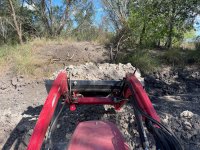
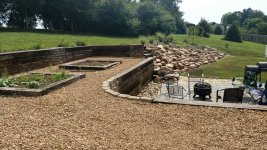
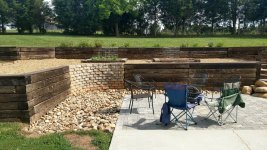
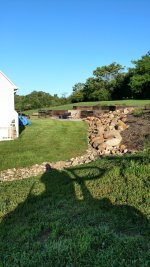
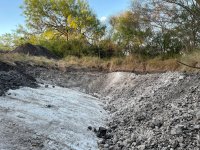
Depends on the tractor and the soil. The manufactures data on the FEL will list digging depth, usually 5 to 10 inches which is how far below grade you can dig at any time, then you drive the tractor into the hole. It is important to push not ram and the weight of your tractor makes a big difference. the attached photos are all in undisturbed packed clay and in the 1st photo the pile in the background is 9 feet high for reference and if you look closely you can see the top of my tractor. Plan a ramp into the excavation so you can get in and out and plan on backing out of the hole a lot. lower the bucket with it level or just a little down angle start pushing and gradually bring the bucket angle up as the tractor stalls, weight in the tires or on the back help a lot, all of this is without a tooth bar, and for this on my tractor i do not need one but it would add extra protection against bending the lower lip of my bucket. the main thing is that this is not a excavator, push do not use momentum and you should be fine (well follow all the other safety rules). in the end it is a lot slower than any dedicated digging equipment but you can get it done.
 

Attachments
  • 1.jpg
    1.jpg
    5.1 MB · Views: 255
  • 2.jpg
    2.jpg
    5.3 MB · Views: 239
Last edited:
   / FELs and digging #22  
Put a disc on the rear, or subsoiler, rip the ground a little and dig it up. I put clay in chicken houses. That's the way I do it.
 
   / FELs and digging #23  
A toothbar essentially puts the same force (the partial weight of your FEL and tractor, and any pushing force) onto a smaller area, fewer points. So more rock, dirt and sod busting PSI, but you can keep the same force on the loader arms and cylinders…or try to.
A spade bucket does the same thing.
that is true for the length of the teeth, but after the 3 to 5 inches you have the original bucket lip and the tooth bar so your force is more spread out making it harder to get a full bucket, but i will agree for the first few inches the tooth bar helps and it also helps to get a grip on some things like rocks and roots.
 
   / FELs and digging #24  
I recently dug out a bank to make a shooting range with my MX5800:
IMG_000369.JPG


I used the LA1065 FEL bucket for most of the digging. I did need the hoe to break up some shale when I got down below 4'.

I took it slow and didn't over stress the FEL but it worked out fine.

As others have said, it really depends on the type of soil you're working in.
 
   / FELs and digging #25  
A toothbar essentially puts the same force (the partial weight of your FEL and tractor, and any pushing force) onto a smaller area, fewer points. So more rock, dirt and sod busting PSI, but you can keep the same force on the loader arms and cylinders…or try to.
A spade bucket does the same thing.
that is true for the length of the teeth, but after the 3 to 5 inches you have the original bucket lip and the tooth bar so your force is more spread out making it harder to get a full bucket, but i will agree for the first few inches the tooth bar helps and it also
 
   / FELs and digging #27  
Front end loader is designed to load, which suggests that the load is already loose. A back hoe is a hoe, which is a digging implement. If you can "load" loose earth away from where you don't want it to be, that's loading, go for it.

It is wise to approach digging with a front end loader with caution, as expectations should be low for that.

As for teeth on the bucket, that's not really the best indicator of the intended use regards digging. I have both toothed and cutting edge only buckets for my excavator, depending upon what I intend to dig. I don't have a toothed bucket for my front end loader, I'm not aware that one is available for it.
 
   / FELs and digging #28  
Honestly they are not made to dig. scootr
yes to this, esp w/smaller compacts...
and then there is this from the manufacturer, if you are not suppose to dig with it why do the advertise a digging depth?
now can it dig in the type of soil that you have? that is a different question, But i would have a serious issue if the manufacturer refused a warranty clam because i was digging with my FEL.
 

Attachments

  • Pages from series-2600 (9).pdf
    1,017.7 KB · Views: 210
   / FELs and digging #29  
all good points. tooth bar does help to "shave" rather than excavate.
 
   / FELs and digging #30  
I have toothbars on 3 tractors and they help greatly in loosening the soil so you can get a full bucket, I have a huge ditch that gets cut every yr from my lake overflow , luckily their is a large embankment that i can dig dirt out of to fillit in , This is clay soil but most of the yr it is easy to scoop full buckets to fill the ditch,
 
   / FELs and digging #31  
Tell this guy he can't dig.....

Not sure what exactly he is trying to accomplish, but this is how you 'dig' with a FEL. Little bits / inches at a time.
 
   / FELs and digging #32  
I have twice dug horse graves with my 2WD JD870. Smooth 5 foot bucket. Just takes time. It has been a while but I recall more than an hour, less than two. I did buy a toothbar but have not had to dig a grave since I got the toothbar.
a good tool for a morbid task
 
   / FELs and digging #33  
Make sure you dig with the whole bucket, or at least just the center. Don't dig off-center. Don't ram the bucket into the dig. If the stuff isn't loose, shave it with the bucket at bit at a time.

They can dig, but if you break it, good luck with a warranty claim!
 
   / FELs and digging #34  
I have a clamp on spade that slides on to forks or clamps on to bucket. I have used it on my forks and works well. There are other brands that make them as well. Mine was from Bucket Solutions which appears to be out of business.

Quick Spade.png
 
   / FELs and digging #35  
I've dug plenty with my little tractor, tooth bar transformed it, but reality is they aren't designed for "real" digging. Without argument they can if you take little careful bites, and have plenty of time as plenty of posters have outlined.
Loaders are meant to drive into piles of material, not virgin ground. A bulldozer is the answer for that. Or, for a tractor with a box blade with teeth. That will dig and move dirt likely quicker then a loader and you don't have to be constantly paying close attention to make sure you're not hurting anything. Then the piles you create with the box blade you can quickly pick up with the loader to dump into a trailer if it is to be relocated.

E.
 
   / FELs and digging #36  
IMG_20170503_162849.jpg
In the middle of digging a grave for a dead cow. Seems to be a theme here. Need to maintain a good slope to drive out with dirt and use the box teeth to score the next layer since this is hard clay. And I think having a top-and-tilt helps because I can keep the hole level.
 
   / FELs and digging #37  
I kind of think "front end loader" means an implement on the front end for picking up and moving loads, from a pile. I fear my little CUT bucket (with a straight edge) isn't meant for cutting into the earth, and if I try to do that, I should go easy, because I'm pushing it out of its intended comfort zone.

But I also think a "backhoe loader" that has teeth on the backhoe bucket and ALSO the front end loader bucket is indeed meant for cutting into the earth. So, it's heavier as well as having teeth.

These seem contradictory. So, how do you tell if a bucket on the front is intended for actual digging? Is it the teeth? Is it the fact that there's also a backhoe on the other end? Putting a tooth bar on my bucket could be taking a bit of a chance with it, right?

Enlighten me please? Thanks!

I kind of think "front end loader" means an implement on the front end for picking up and moving loads, from a pile. I fear my little CUT bucket (with a straight edge) isn't meant for cutting into the earth, and if I try to do that, I should go easy, because I'm pushing it out of its intended comfort zone.

But I also think a "backhoe loader" that has teeth on the backhoe bucket and ALSO the front end loader bucket is indeed meant for cutting into the earth. So, it's heavier as well as having teeth.

These seem contradictory. So, how do you tell if a bucket on the front is intended for actual digging? Is it the teeth? Is it the fact that there's also a backhoe on the other end? Putting a tooth bar on my bucket could be taking a bit of a chance with it, right?

Enlighten me please? Thanks!
I dug out my neighbor's hillside for a landscape project with my [AFFILIATE=1, nofollow=true, newwindow=true, title="Kubota"]Kubota[/AFFILIATE] 3940. I used a six foot bucket with tooth bar. It was hard packed clay. I dug using a scalloping motion with the tilt function. It was very time consuming. I also used a box blade to smooth out the different levels.
 

Attachments

  • IMG_20170620_165228881_HDR.jpg
    IMG_20170620_165228881_HDR.jpg
    4 MB · Views: 278
  • IMG_20170620_165136672_HDR.jpg
    IMG_20170620_165136672_HDR.jpg
    3.3 MB · Views: 166
  • IMG_20170501_184858283_HDR.jpg
    IMG_20170501_184858283_HDR.jpg
    3.2 MB · Views: 166
   / FELs and digging #38  
The issue with a light gage material bucket, versus a heavy gage excavation bucket is the light gage bucket has a single bottom sheet and digging with it (even with a tooth bar installed) can cause a smile in the bottom sheet that is hard to remove. Most dealers sell a new unit with a light gage bucket. I have both.
 
   / FELs and digging #39  
The issue with a light gage material bucket, versus a heavy gage excavation bucket is the light gage bucket has a single bottom sheet and digging with it (even with a tooth bar installed) can cause a smile in the bottom sheet that is hard to remove. Most dealers sell a new unit with a light gage bucket. I have both.
That might be true. My digging picture was with the heavy-duty bucket with the optional 3/4" bolt-on cutting edge. No teeth, but I am not bending that thing.
 
   / FELs and digging #40  
I kind of think "front end loader" means an implement on the front end for picking up and moving loads, from a pile. I fear my little CUT bucket (with a straight edge) isn't meant for cutting into the earth, and if I try to do that, I should go easy, because I'm pushing it out of its intended comfort zone.

But I also think a "backhoe loader" that has teeth on the backhoe bucket and ALSO the front end loader bucket is indeed meant for cutting into the earth. So, it's heavier as well as having teeth.

These seem contradictory. So, how do you tell if a bucket on the front is intended for actual digging? Is it the teeth? Is it the fact that there's also a backhoe on the other end? Putting a tooth bar on my bucket could be taking a bit of a chance with it, right?

Enlighten me please? Thanks!
A solution I have found is a "stump bucket" or "poor man's backhoe" I have 35hp MF the smooth bucket (60") is of little use for digging. I can use the stump bucket to dig a trench and use the standard bucket for moving. This also applies to stockpiled dirt and gravel. The stump bucket cuts 12" wide and widens to 36". I have also found the stump bucket better for moving small boulder rocks. In the past, I have owned more significant equipment, which equaled constant repairs due to the age of the equipment. This is for my use. If I did work for the public, I would invest in a piece of appropriate-sized equipment.
 

Tractor & Equipment Auctions

Enmark Z Spray (A53316)
Enmark Z Spray...
TANK MANIFOLD (A55745)
2007 Western Star 4900 (A56438)
2007 Western Star...
UNUSED FUTURE 40" HYD TILTING BUCKET (A52706)
UNUSED FUTURE 40"...
2021 JOHN DEERE 6145R TRACTOR (A59823)
2021 JOHN DEERE...
HUSQVARNA RIDING MOWER 46IN DECK (A56859)
HUSQVARNA RIDING...
 
Top