Fencing Question

   / Fencing Question #1  

jtn

Silver Member
Joined
Apr 1, 2002
Messages
204
Location
Illinois
Tractor
New Holland TC45D
I am building a fence around part of my property. It will be three strand barb wire on cedar posts. My property has very few natural trees so I would like to keep as many as possible. Unfortunately one of these trees is right on the corner of my property where I need to locate a post. It is large and nice looking so I would not like to cut it down. Putting the post right next to it would be fine but I could never dig through the roots by hand or with a PHD.

I have considered the following options:

1. Nail the wire to the tree (simple, easy, and cheap)
2. Pounding in a pointed stake or steel post next to the tree (might prove difficult or impossible)
3. Cutting the corner and fencing around the tree (not aesthetically pleasing)

Any advice or other suggestions would be welcome.

JT
 
   / Fencing Question #2  
I think I would try option #2. Driving a steel fence post in on either side of the tree. As close to the tree as possible yet allowing for future tree growth. If you can get them driven in through whatever root base there might be, you could at least form the corner of the fence line, either just in front of or just in back of the tree.. tree being either inside or outside of the fence. Then go back to ceder posts.
You didn't say what kind of a tree it is, (root base) but I think you would stand a better then average chance of getting a couple of metal fence posts in
It might not be the prettiest, but sometimes necessity takes priority. You can always do something creative to blend the metal fence posts in. I think it would look better then having to cut the corner off.
 
   / Fencing Question #3  
jtn, Depending on what type of tree it is and what the other property owners I would nail to it everytime. They make fencing very easy. Fantastic to stretch too and from. Drawbacks, don't completely wrap around it or chance of dying increases. Don't nail wire to hickories due to some kind of chem. reaction that eats up the wire. If it is a line tree and it dies, your fault nature's fault nobodies fault, it will be blamed on the wire. I would probably nail to it, no more damage than digging into the roots. But it would depend on the tree type.
 
   / Fencing Question #4  
Also, wondering what kind of tree you have at the corner?

Depending, I would incorporate the tree into the fence and not place a post next to it, as the tree will grow in diameter and push against the post (of course, that will take a few years depending on the species of tree). I wouldn't wrap anything around the tree for the same reason - that the girth of the tree will increase.

SO what I would do, is drill three holes through the tree(either straight through at 45 degrees to cut the corner or two holes that meet in the middle. Then run the wire through the holes. These holes may grow shut at the bark over time, but they will not change relative position up or down, nor with respect to the center of the tree. This should not hurt the tree.

Usually trees on property lines, and especially at corners of properties, are also the property of the neighbors. What do they say?
Good luck with your fence.
 
   / Fencing Question #5  
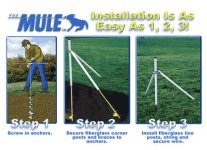
They make what they call a mule anchor. It goes in the at an angle and holds your corner post in. That's what I'd use for that area.
 
   / Fencing Question #6  
Put a post beside the tree and strap it around the tree. use turnbuckles or some other type of device that will let you make the strap bigger in the future. Nail the fence to the post
 
   / Fencing Question #7  
Morning,

<font color=blue>I am building a fence around part of my property. It will be three strand barb wire on cedar posts.</font color=blue>

If I was your fence contractor talking over the job with you or if we were neighbors and asked my opinion I'd probably offer this suggestion.

I'd stop the fence eight to ten feet from the tree on each side. Then I'd build a gate looking panel that would be attached to the post and tethered at the tree.

Here's the logic involved. One, if you bring the wire up to the tree and don't wrap around the tree you only have staples or nails supporting your fence against the pull. That isn't worth a flip. Two, if you wrap the tree you have just signed it's death warrant. Trees don't like being choked for very long. They'll get mad and die just to express their disgust with your lack of consideration.

The frame can be wood or steel or even aluminum and it doesn't need to swing. I'd tether it to the tree with a loose knot, preferably rope, not wire or cable. Eight to ten feet out you have a fifty to fifty chance of not hitting a major root and your odds aren't that good closer in towards the tree.

Make sure you're using hot dip galvanized staples when attaching the wire to the cedar posts. The chemicals in the cedar love iron for some reason. The will eat it quickly. They take a little longer on galvanealed or electroplated but not much.

If you go to a box store you will pay dearly for hot dipped galvanized anything. So the best source is where the professionals buy because they buy hot dip galvanized products for just a tad more than the lesser quality stuff.

I wouldn't blink about attaching three strands of barb wire to a tree as a line post. I can show you one tree, Hackberry, in Dallas that twenty five to thirty years ago had a chainlink fence put up next to it. I removed that fence, well not all of it. The top rail is cut off on each side of the tree because it's dead in the middle of it, same with the fabric. That's a ton of steel and galvanizing and no visible damage to the health of the tree.

I'm sure you have a system all figured out on working with the barbwire. The stuff is nasty. It's sorta like an ex mother in law. About the time you think you're safe it strikes from your blind side and cuts you to pieces.

I use good leather gloves. I will use a piece of pipe across a wheel barrow as an axle for unrolling it when I'm doing short sections. For longer sections I use a piece of steel rod or pipe stuck in a stake pocket on the truck with a plow disc sitting below the roll of wire. This allows it to spin free while driving down the line.

I will usually do the top line first. That way the other lines aren't as likely to get entangled with the first ones. I have learned to be very careful when cinching it down after wrapping a post on a corner or end. I will usually hand wrap the first couple of coils and then use the serrated edges of the pliers to wrap a couple of more. I don't use the serrated edges of the pliers for the final tightening on those hand wrapped coils. And I do my doggonedest not to knick the horizontal wire. A knick can hurt you two ways. First it might weaken the wire to the point where it breaks and then decides to get even with anything close for having been stretched. It opens the door for quick rusting and then it breaks later. Usually when it's too cold or wet but has to be done anyway.
 
   / Fencing Question #8  
For ease, I would go for #1 and make the tree the corner post. Except rather than nails, I would use screw in eye bolts. A lot more secure and sturdy than nails. And you don't have to wrap the wire around the tree.
For more effort, I would set 2 pipe posts each side of and near the tree. Then I would weld pipe cross bracing between the 2 posts and then weld some pipe "wings" that would reach almost to the tree to close the gap. That would also provide a very study end to your fence. Of course, now we are talking about a lot more work. /w3tcompact/icons/smile.gif
 
   / Fencing Question #9  
<font color=blue>Cutting the corner and fencing around the tree (not aesthetically pleasing)</font color=blue>

Why not? If the tree is nice looking and right in the corner, I'd fence around it and and make the corner look nice with a few shrubs and some bark mulch. It will look better than barbed wire nailed to a tree, in my opinion /w3tcompact/icons/smile.gif
 
   / Fencing Question #10  
My fencing contractor uses trees all the time. Generally he nails a piece of pressure treated wood to the tree and attaches the wire to the wood. This protects the wire from chemical reaction with the tree. Apparently, depending on the species of the tree, this can be a real problem.
 
   / Fencing Question #11  
Most trees don't do well with a strap around them, as the growing layer (cambium) under the bark will distort from the pressure, and cause that area to possibly die and possibly kill the tree. But whether it does or does not, depends on a lot of different variables. I wouldn't recommend it on a tree that is important.
 
   / Fencing Question #12  

Attachments

  • 33-229430-MuleBrace.jpg
    33-229430-MuleBrace.jpg
    36.1 KB · Views: 140
   / Fencing Question #13  
Nail the fence to tree. The tree will grow around the fence, it's a common practice around here. Never seen no damage to trees caused by nailing a fence to a tree. Wraping the fence around the tree I can see how problems may happen with the tree and fence.

Brace. On the corners with a / | \ look, and it don't hurt to do this after long straight runs to add strenght to the fence.

If you suspect you'll be climbing over the fence for any reason build a ladder type section (which doubles as the brace).
And/or
Consider adding a gate or gap in the fence so you and/or neighbors can have access if needed for whatever reason (such as hauling firewood, fence posts or chasing cattle thru).
A gap is a section of fence where the poles are not in the ground and can be pulled back to open. A handy thing.

I've helped to build a lot of fences over the years and it ain't fun at all. It's hard to repair too.

Why only 3 strand? Most in these part are 4. If it's too high at the bottom cattle will crawl under the fence, just as deer. If it 's spaced too far between strands a cattle will step (or try) thru the fence. I've seen horses and deer hurdle 4 strand fence too.
 
   / Fencing Question #14  
For a young fella, wroughtn_harv makes a lot a sense, except he didn't make it emphatic enough about how important it is to the long life of a fence in not nicking the wire (sorry, Mr. harv!). In today's throw it away society, I wonder who cares?

I was looking at some other posts and was thinking about what's getting lost today - how would someone like to start a thread where folks could archive odds n' ends?

The bucket of sand with used engine oil in it for garden tools, shovels, etc.
Not painting a wooden ladder ( are there any left), but using varnish. Also on shovel and ax handles.
Soaking the ax head in linseed oil.
If you have a real hammer, soak that too. Won't work on the air driven type.
 
   / Fencing Question
  • Thread Starter
#15  
Thank you all for the reams of good advice! Luckily I have time to digest it all while the ground unthaws.

To answer some questions, I am not sure what kind of tree it is; I do not recognize it from growing up in New England. Must be one of those Midwest types. It is about 10" in diameter. The corner it is on is between me, my neighbor and the road, thus wanting a solution that looks good. It would not bother my neighbor one way or the other if I went a couple of inches on his property. Lastly, the reason I suggested nailing the fence to the tree is the provious fence was nailed to the tree. The guy I bought my house from fenced in the front piece of property for his goats. by the time I bought it the goats were long gone and the fence was looking rough and the posts were rotting.

I am currently considering using a drive stake near the tree with supports or making a gate as Harv suggested. When I get something up I will take pictures to post.

Thanks,
JT
 
   / Fencing Question #16  
When I was 9 or 10, I put a tin can on a tree with a nail.

I was reamed up & down, inside & out by both mom & dad! Man, a person _never_ puts metal into a tree! That lesson was well learned.

We make fire wood from our trees, and at one time had a lot of trees cut into lumber. Metal is a bad, bad, bad thing on a tree! Can actually kill people. Costs thousands to a lumber cutter.

So, I just shutter at the thought of putting nails, screws, or holes with wire in your tree.

In addition, to me personally, it would look really ugly to have the fence attached to the tree. Any other suggestion here would look much better to me. (I guess the folks made quite an impression on this 10 year old!)

I like the (real or fake) gate idea someone had. If looks are important, you could box that corner out, make a square around the tree with 3 corner posts - always looks good if you keep it square, I do understand about just cutting across the corner not being so good. You can do some flower bed or shrubs in the corner to make quite a centerpiece out of it.

Your tree, so don't let my ranting & ravig bother you. :)

(But, don't nail to it - please..... ;)

On a side note, have you checked local laws on setbacks, especially from the road? Neighbor had to pull his fence & redo it 15 feet back from the easement line. And this is about as rural as it gets. Just a thought.

--->Paul
 

Tractor & Equipment Auctions

Kubota L4701 (A53317)
2019 PJ  40FT GOOSENECK TRAILER (A58214)
2019 PJ 40FT...
2021 Deere 333G (A53317)
2021 Deere 333G...
2023 CATERPILLAR D6 LGP HIGH TRACK CRAWLER DOZER (A60429)
2023 CATERPILLAR...
500 Gallon Fuel Tank with Pump (A55853)
500 Gallon Fuel...
2006 KOMATSU PC228USLC-3 EXCAVATOR (A60429)
2006 KOMATSU...
 
Top