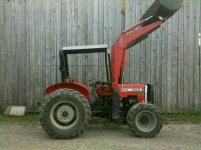
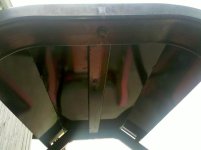
(FOPS)FALLING OBJECT PROTECTIVE STRUCTURES

   / (FOPS)FALLING OBJECT PROTECTIVE STRUCTURES #41  
My fundamental problem with this logic is that it is not overcoming an inherent problem or safety issue with the machine. It is yet another step to remove personal responsibility. I would bet the farm that the number of incidents like this that could be traced back to an equipment problem would be too small to measure.

We can't keep accommodating people using poor judgment by putting more safety devices in place. All it does is irritate the majority of operators.

Everyone can make a choice. If someone is concerned about this problem, they can choose to put a FOPS on the tractor. Just like people concerned about debris when operating a rotary cutter can put a screen in place to mitigate this.

Pauchik, a couple of questions for you:

1) Where are you from? That might give us some insight into your point of view.
2) Can you provide meaningful statistics on the frequency of this accident? # of incidents per hours operated across all FEL equipped tractors? It would also be helpful to have the same number for other accidents for comparison.
3) Please explain how this will save money. Adding say $500 to the cost of each tractor sold with a FEL for a FOPS. How does that compare to the costs of the injuries per tractor sold with a FEL?

Ultimately, this is a math problem. I doubt that it would prove to be a wise move from a strictly financial point of view once you do the math. I doubt the figures are even out there, or at least available to us to do the math.
 
   / (FOPS)FALLING OBJECT PROTECTIVE STRUCTURES #42  
You are very perceptive MarkV. I was moving a bale to feed my animals and was approaching a gate into the field on a recently paved gravel roadway. The tractor in the incident had been purchased several months before and replaced a tractor/FEL with a cab and a self load leveler that had two separate hydraulic FEL control levers. The tractor/FEL in the incident (MF 243/1032) replaced the old tractor. This newer tractor had a fixed fork quick detach pallet fork attachment, no self load leveler and a joystick hydraulic control lever.

For twenty years prior to the incident I had moved bales with a spear (attached to bucket of the old tractor) or with the bale strapped to the bucket and I have never had an accident on the farm. Specifically, as I approached the gate, I raised the bucket about a foot and a half to clear some ruts I saw in the field before I entered and then attempted to level the forks (no self leveling device) using the joystick control. Instead of leveling the forks, the lift arms quickly raised without a concious intention or notice on my part. the lift-arms hit the top limit and “catapulted” the bale out of the restraint. The bale landed on my head and neck pinning me to the seat and steering wheel between the exhaust pipe and the ROPS. I was paralysed from nipples down but was just able to pull the shift out of gear and get to my cell.

There was no warning on the pallet fork regarding its use with round bales. There was a warning in the owners instruction book supplied to me several months after I bought the tractor and put away for reference. As I mentioned, I have farmed for over twenty in central NY although this is not my day job, and was a Massey, Hesston, Yanmar farm equipment dealer/service center for about three years in the mid 80’s. Because of my day job, I am extremely careful on the farm and I am very handy as an operator of all kinds of farm and construction equipment and other equipment. There was no warning regarding the operation of the joystick – that it could be easily shifted from bucket lift to bucket level and that the difference between the two positions was difficult to distinguish the two positions because the joystick lever distance between the two movements is very small. There was no tactile or other indication regarding the position of the joystick and any position reference would have to be visual.

My opinion is that had this relatively new tractor/FEL been equipped with two lever control or a joystick that was safe to use, a mechanical or hydraulic self leveler or a FOPS, this incident would not have resulted in injury. There was no warning on the forklift attachment or the joystick valve pack and I had followed standard safety measures of fixing the load to the forks with a strap. Massey did not then and does not now offer a bale grapple, two lever hydraulic control, a self leveler or a FOPS for this tractor. I have now modified my old bale spear for use with this bucket, however based on the position of the spear I use now and the one offered as a quick detach attachment by the manufacturer, the bale could have still come off when the lift-arms forcefully hit the lift-arm raise stop and would have fallen about where it did. Aware of the hazard with fork-lift, I am not using it for round bales until my FOPS is installed. This is my only safety option with this tractor since none of the other options are available from Massey.

WVPolekat, I agree with you that judgement is an important factor and all possible incidents cannot be protected against. What I have been trying to stress is that risks or hazards that are not obvious or easily knowable and are not a matter of judgment should also be protected against if they are known, are preventable at a reasonable cost (all true for this accident type and equipment). Any of the methods I mentioned would protect against the incidents that cannot be anticipated by a reasonable operator.

I am researching the general statistics, but on a cursory review of newspaper reported incidents and medical trauma journals, it is a very common accident which is increasing with the increasing use of round bales and when it occurs, it is routinely devastating. I would like to know from you which statistics would be meaningful because it is not likely that we can know how many roll-off incident injuries were prevented by FOPS because, more likely than not, they would not be reported, absent an injury and FOPS are not available from many manufacturers and therefore are not installed.

Personally, I am extremely lucky since I have partially recovered. In terms of cost, the cost of just one half of one of the five days I was hospitalized is significantly more than the cost of the FOPS I am having manufactured and installed (about $550). Add all the xrays and tests and the surgery I will be undergoing soon and you can guess and I am the lucky victim. According to the NYS ROPS rebate program the average cost of a ROPS is $850. I don’t believe a FOPS would be much different. The manufacturer of a self leveler (Zetor) says because they are safer and requested, they have been able to reduce production costs so that they are about equivalent to non-leveling loaders.
 
   / (FOPS)FALLING OBJECT PROTECTIVE STRUCTURES #43  
I would not want a 2 lever control on my tractor. It would make loader use much slower. My loader does not move fast when I have my tractor at slow idle or even at a higher idle.

Does your new tractor have a seat belt interlock that requires you to be wearing your seatbelt when the tractor is in gear? Most deaths that occur in modern tractors with ROPS are probably because someone was not wearing a seatbelt and the ROPS did not do much good with an ejected operator. Most maimings of rollovers where the operator was strapped in occur because the owner did not buy a cab to keep his arms and hands inside of a "safe zone." Just speculation. Somewhere along the line people have to be aware of risks.
 
   / (FOPS)FALLING OBJECT PROTECTIVE STRUCTURES #44  
While I am sorry for your accident, I think you are trying to deny or transfer your responsibility in it. Hear me out, I am honestly not just trying to bust your chops on this.

What I read in your recount of your accident was an operator who was unfamiliar/inexperienced with the equipment he was operating (joystick loader control) was using the wrong implement (pallet forks) in an unsafe manner (round bale strapped to forks) and made an error (raised loader higher than intended, faster than intended) which caused the bale (which was being unsafely transported) to come loose (improperly secured) and come over the loader on to the operator.

Let's look at objectively at the factors that led to this accident and how they could have been mitigated (yes, I do root cause analysis for a living):

1) Operator training. Considering the number of possible uses for an item such as a tractor, it would be up to the owner to insure that he or other operators are properly trained in the machine they are operating, including any attachments/controls as well as how to operate it safely in the situations relevant to the intended jobs. Doing unsafe things many times without an accident is not the same as training, it is luck.

2) Using the correct implement. Pallet forks are just that. Forks for pallets. A round bale is a) Not the same shape b) Does not have the same features as a pallet to secure it to the forks. c) Without any means to secure it to the forks. The fact that MF does not make a bale grapple for the FEL is irrelevant. They don't make a tree trimmer attachment either, but that doesn't mean that users should figure out how hang a chain saw on the loader. Buy the right implement to do the job at hand, even if from another vendor. Bale spears and grapples are common. If you are going to be handling these, they should be considered necessary for safe and efficient operation.

3) Properly secure loads. If the bale had be properly secured, it would not come loose in any reasonable situation. Obviously, it was not or could not be.

4) A FOPS. Yes, it would have helped mitigate the injuries. But, considering the number of other things that led up to the accident, it would be a last ditch fail safe. As I said before, mostly to protect against operator error and negligence. In this case, I would say that perhaps the owner/operator should have invested in one if they were going to use the FEL/forks outside of their designed purpose and therefore subjecting themselves to higher than normal risk rather than expecting the tractor mfg to allow for this.

Yes, we all do things with implements they are not intended to do. But, we should also understand that doing this comes with some responsibility for the outcome and any resulting accidents. Saying that all tractors should be equipped to protect us from our own lapses in judgment just is not reasonable.

I am truly sorry to hear of your unfortunate accident and I wish you the best in a speedy recovery.
 
   / (FOPS)FALLING OBJECT PROTECTIVE STRUCTURES #45  
Re: (FOPS) / Tiltmeters

Dan, I have a fiberglass canopy that is designed to keep the rain and sun off only. It has a big sticker that says something to the effect "Will not protect from falling objects". I can tell you that I've had several limbs hit the top of it pretty hard and it's held up BUT I KNOW IT ISN'T DESIGNED FOR THIS, guess I takes mys chances. If I was doing a lot of work in the woods I would get a FOPS without question. As I've said, my sun canopy has saved my butt once or twice, but I know it's designed for it.

Bill Cook

Bill,
Why not fab up a metal (aluminum/steel) plate to fit over/under your existing canopy? Would likely get close and might even exceed a factory FOPS. If you used expanded steel mesh up under your existing cap it would be relatively light and give you lots of attachment points for hanging other stuff.

$.02
Dennnis
 
   / (FOPS)FALLING OBJECT PROTECTIVE STRUCTURES #46  
Would anyone be interested in joining a group recommending the installation of FOPS with a front end loader installation?
 
   / (FOPS)FALLING OBJECT PROTECTIVE STRUCTURES #47  
Because of the front and back posts, the FOPS also helps when the tractor is parked at an extreme (and not recommended) angle... :eek: Between the FOPS, loader mounts, wheels, loader bucket, and backhoe stabilizers my B21 made a 7 point landing, nothing broken but my pride.
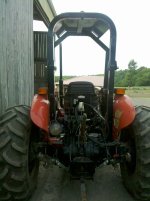
Sure makes sense to me to have a FOPS on anything with a FEL.

Pete

Pete,
I presume you were also wearing the seat belt. Eh? If not injuries FOPS could easily be worse than without a FOPS.

I usually do wear mine when in any off road situation. Got to be careful or Darwin will come looking for ones carcass to add to his collection.

Dennis
Working on B.S. from TBNU ;' >
 
   / (FOPS)FALLING OBJECT PROTECTIVE STRUCTURES #48  
in the 70s i worked at J.I. Case experimental shop ,in wichita ks. i built a few fops,rops.. how ever i fear my info may be old and out of date. i will say one thing. if you roll a tractor and bend the rops it would be best to toss the rops , and get a new one.
 
   / (FOPS)FALLING OBJECT PROTECTIVE STRUCTURES #49  
I have a Perry canopy on my Ford 4610 and it is FOPS certified. It's aluminum with noise supprssing material on the underside and the structure to attach it to the factory ROPS on my tractor.

All that FOPS certification means is that if a 50 pound object is dropped from X feet above the canopy it will not hurt the operator. It won't help you with falling trees or large round bales. Google Perry Canopy for more info.

Jerry,
I looked at The Perry Company: Tractor Accessories and what they show has no forward support posts. Half of the protection offered by a FOPS would be the forward posts blocking a rolling log or whatever load might come back at the operator from the front. Which model do you use?

I entered FOPS in the search box and got no result. Same when I entered "prices". The Perry's seem to shy about the cost of their products. What did your model cost?

Thanks,
Dennis
 
   / (FOPS)FALLING OBJECT PROTECTIVE STRUCTURES #50  
Would anyone be interested in joining a group recommending the installation of FOPS with a front end loader installation?

You mean, like a political action committee? What, more zactly, do you have in mind?

Got to say, that I held off buying a used tractor until I found one with a ROPS, but have not seriously considered the intelligence of a FOPS if using the tractor in any situation where it might save your face or head etc, which is a lot of what I do with mine.

Luckily a FOPS appears to be an add on to a ROPS, or can be, so I can look forward to improving my lot in life, or at least my tractor's.

Any dealer worth his salt as a salesman should be able to righteously convince a customer getting a new tractor to spend a few more hunner for the protection a FOPS will provide. A more shady and dryer work station would be a plus.

Dennis
 
   / (FOPS)FALLING OBJECT PROTECTIVE STRUCTURES #51  
I believe that a political action committe or similar beast is in order consider the devastating effects that roll off or fall off accidents result in. there are state organizations (NY & PA) that give rebates for ROPS installation but I can't convince them (YET) to include FOPS.

I mentioned that most ROPS (if available from manufacturer) can be had for less than $1000 and my quotes for manufacturing one was about $800. With my own materials and work, I could build one equivalent to OEM ROPS for $300 or less. This would be two vertical posts attached (detachable) from the verticals of the FEL with a center piece on top extending back to the ROPS. It would be nice to add a fiberglass canopy which would protect from dirt, gravel or stone injuries. I would be building mine now except for my injury and the need for surgery.
 
   / (FOPS)FALLING OBJECT PROTECTIVE STRUCTURES #52  
I've had my FOPS installed now for quite some time since my last post. My expense was about $500. The cost to manufacturers would obviously be less with production savings. It can be removed with the FEL after removing one bolt.

FEL back view.jpg
FOPS FEL up.jpg
FOPS attach ROPS.jpg

My point is that this inexpensive protection would be effective against the final common pathway of accidents from objects falling from virtually any FEL attachment and includs improperly attached quick detatch implements falling from the lift arms.

I cannot conceive of an argument against this simple option and its installation upon the purchase of FELs. I bleive its installation should receive the same attention as regards the present requirments regarding ROPS/seatbelts on tractors. Is there actually an argument against this out there? If so, does it apply to ROPS too?
 
   / (FOPS)FALLING OBJECT PROTECTIVE STRUCTURES #53  
I cannot conceive of an argument against this simple option and its installation upon the purchase of FELs.Is there actually an argument against this out there? If so, does it apply to ROPS too?

Likewise I cannot conceive an argument for it. We cannot protect every single person from every single conceivable risk or danger.

You obviously could purchase and have installed the protection that you wanted and or needed so likewise anybody else that wants this can have it as well. There is no need to get more "regulation" involved.

Your loader tractor as pictured would be worthless and unusable in my application.
 
   / (FOPS)FALLING OBJECT PROTECTIVE STRUCTURES #54  
What is your application Duffster?
 
   / (FOPS)FALLING OBJECT PROTECTIVE STRUCTURES #56  
I mentioned that most ROPS (if available from manufacturer) can be had for less than $1000 and my quotes for manufacturing one was about $800. With my own materials and work, I could build one equivalent to OEM ROPS for $300 or less...

Let me start by saying that I have nothing against a FOPS or a ROPS ... however ... let me ask - The FOPS or ROPS that you built for less then you could buy one for -

Did it pass all the engineering and safety standards when you had it tested? Does it meet the legal requirements to not only get the proper certification from the Government, but to alleviate any legal repercussions in a lawsuit in case someone did get hurt?

These may seem like odd questions, since most of us do not have the time or the money for such testing and documentation. Bit, before any manufacturer can build or offer such devices, they MUST. All this testing and certification costs money. That is one of the reasons they cost more when we buy "ready-made". It also takes quite a bit of time ... time most manufacturers don't want to spend ... so they WOULD argue against them being required.

My point is that this inexpensive protection would be effective against the final common pathway of accidents from objects falling from virtually any FEL attachment ...

Two additional thoughts here:

1) A cab, enclosed and having Heat/AC would be just as effective ... why not require that?

2) I am sure that someone would find some way to get hurt even with the FOPS, so it is not the "final common pathway"


... just some additional food for thought ...​
 
   / (FOPS)FALLING OBJECT PROTECTIVE STRUCTURES #57  
Qpala, I' sure someone could get hurt with FOPS in place but my point is that FOPS with a solid shield virtually eliminates falling object injuries (stones or other objects in a bucket, feed cement or other 80 # bags from a pallet fork, round hay bales from any attachment, the improperly fixed attachment from the lift arms) - this IS the final common pathway of all objects falling from a FEL regardless of the attachment.

If you can eliminate even some of those injuries at little expense, doesn't it make sense? The only way to avoid all tractor related accidents is to not use one. The manufacturers must provide FOPS, at least as an option, and FOPS should recieve the same priority for FEL as ROPS do for tractors. Can you prevent rollover injuries using ROPS, NO. But, you can substantially reduce the incidence and severity of the injuries. That is why they are now standard on utility tractors. The same should apply to FOPS.
 
   / (FOPS)FALLING OBJECT PROTECTIVE STRUCTURES #58  
A distinction should be made between a two and four post ROPS-- there don't seem to be very many open station 4 post ROPS tractors around my area. Also cabs may be qualified different ways, I am not familiar with whether most cabs would qualify as four post ROPS or not (or as FOPS for that matter).

I have an open station tractor, FOPS with a two post ROPS. A log rolling off the loader won't be stopped by anything significant before reaching the operator (but I have an MSL loader specifically due to the danger of the non-MSL loaders in this regard. Been there done that in a skid steer. MSL loaders that I have used don't curl quite as much and generally cost more, which may dissuade people from the safety features.).

The FOPS I have is mainly for driving in the woods-- while worming between trees and watching all the edges of the tractor and mud covered hilly ground, it is easy to miss the widow maker hanging up above. They make a pretty good bang hitting the FOPS.
 
   / (FOPS)FALLING OBJECT PROTECTIVE STRUCTURES #59  
Interesting read.

I have to agree with this:
You obviously could purchase and have installed the protection that you wanted and or needed so likewise anybody else that wants this can have it as well. There is no need to get more "regulation" involved.

4-post FOPS like the setup on Kubota's commercial tractors (L35) would be a nice option for many of us. I've yet to find one readily available, so I'll be making one myself.

Since I use my NH TC35D for my business and it's used many times for work it was never intended for, it would be nice to incorporate a design that adds a bit of structural support to the top of the FEL pin attachment area as well. Hopefully this winter I'll have it all figured out and have time to fab one up to fit my needs.
 
   / (FOPS)FALLING OBJECT PROTECTIVE STRUCTURES #60  
I am not talking about regulation, I object being told what to do as much as most people. What I am talking about for a start, is for manufacturers to make a FOPS available as an option or at least set up their machines so that a FOPS can be attached without modification.

It is ironic that virtually every commercial manufacturer (of backhoes for instance) with open platforms have a four post FOPS incorporated into the ROPS system which is standard. It seems to me that the utility or compact tractor user is probably less experienced than the commercial operator and did not get the safety instruction or supervision that the commercial operator had, yet it is the commercial unit that has the protection of ROPS/FOPS.

NY and Vermont have a rebate program to encourage the installation of ROPS on older tractors because of its proven safety factor and they are considering the same program for FOPS for the same reasons.

In terms of engineering and production expense, I have been amazed by the cabs available for compact tractors and their associated unnecessary bells and whistles. These are "ROPS certified" but not "FOPS certified". It just doesn't make sense when a rock or log could fall out of the bucket under certain circumstances and crush that beautiful cab (and operator).
 

Tractor & Equipment Auctions

500 BBL FRAC TANK (A58214)
500 BBL FRAC TANK...
2019 CATERPILLAR D6T LGP HI TRACK CRAWLER DOZER (A60429)
2019 CATERPILLAR...
2024 KAUFMAN LOPRO WEDGE 3 CAR TRAILER (A59905)
2024 KAUFMAN LOPRO...
16ft. Canoe w/ 12ft. Trailer (A59231)
16ft. Canoe w/...
2025 BOBCAT ZT7000 MOWER (A59905)
2025 BOBCAT ZT7000...
2012 BRUMLEY MANUFACTURING DATA VAN TRAILER (A55745)
2012 BRUMLEY...
 
Top