Foundation questions

/ Foundation questions #1  

skidoo

Gold Member
Joined
May 24, 2007
Messages
323
Location
Montana - Growing Zone 5
Tractor
JD 2520, JD X749, JD110TLB
I have a daylight basement where the back of the house is concrete up to the second level and the front of the house has maybe 4 feet where there is probably at least 2-3 feet of dirt.

I am re-doing the deck for the second level and I would like more space under the deck. There will be a new full height retaining wall at the back and along half the side. I want the new space underneath to be clean, so I'll put concrete there too for the floor. Always hated the dirt under the deck! So this leads me to the questions below.

Is it practical to excavate the 2-3 feet at front and all of it in the back (to essentially the bottom of the basement), add new concrete floor and retaining walls? Since the back retaining wall will be poured to the existing foundation, there may not be a good seal. If it can be done like this and work well in a cold climate, what is the proper method?

Should I just leave the floor level at the 2-3ft and be satisfied with a 6ft high wall height under the deck? Non-110TLB Tractors can still be parked there...
 
/ Foundation questions #2  
When you excavate, make sure you maintain the minimum frost depth of the footings.

Footings are usually lowered at the location of an excavated basement for this reason.

Otherwise, your foundation may heave due to frost.

Good Luck

Yooper Dave
 
/ Foundation questions #3  
To make a good connection to the existing foundation drill holes at least 4 inches into the foundation and epoxy short sections of rebar into them. Tie that rebar into rebar in the new slab.
 
/ Foundation questions
  • Thread Starter
#4  
Thanks for the replies.

But, what I am asking is related to the floor level under the new space. Can I make that floor level the same as the level inside the daylight basement and allow for an 8ft high space, or do I keep it filled at about 2 to 2.5 ft against the existing foundation and allow only about 5.5 to 6 ft of wall height. I plan to pour concrete for that floor too with a new retaining wall on the back and side.
 
/ Foundation questions #5  
The footers for the enclosed space need to be a certain depth below the exterior finished grade. That depth is the frost line depth in your area and is usually specified by the building dept.

So if the new slab is open to the weather then the current wall's footers will need to be frost depth below the slab. If the new slab is fully enclosed then it's footers will need to be below the frost depth.
 
/ Foundation questions
  • Thread Starter
#6  
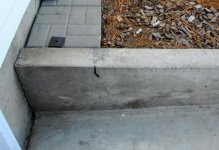
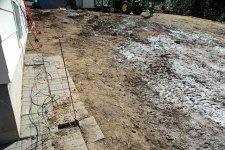
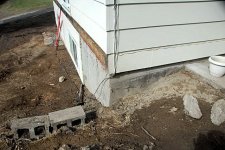
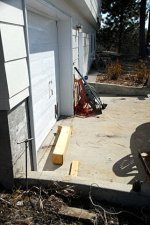
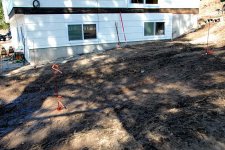
The first picture is what was there. Since, the deck has been torn down. Couldn't believe how poorly it was constructed. The nails came out and it warped. The posts were set on concrete rounds only 6 to 8" deep.

Anyway, the next picture shows the level of the floor vs fill in the front of the house. This wall is about 15" high and goes level to the other end of the house. So, as you can see in the picture, the fill slopes higher towards the back of the house and under the deck there is less and less height. I plan to extend that back wall by 15 feet and add a full retaining wall along the first half of the deck from the back, and a lower height wall for the rest. I want to fill under the deck with concrete. So, I have been thinking it would be nice to have it full height for all the space to the back retaining wall. I wasn't planning to enclose it in front, but may decide to later.

So, after measuring the existing floor height vs front fill, I guess I am looking at a 15" difference. Keep the fill at 15" and live with a 6.5ft hight to the ceiling beams, or dig down 15 more inches for the full 8ft height? If I did this, then it could become a second small garage. Not that I need it for a full garage because I am planning on a 40 x 80 building about 250 feet from the house. But, for convenience items such as the garden tractors and other hand power equipment.

I am in an unzoned rural area and don't require permits. Regardless, I want it done the best possible way. Is it too risky to go down the additional 15"? I don't yet know how much lower the existing footers are deep. Our minimum lows typically do not go below -20F for not longer than a week or so.
 

Attachments

  • HEL_9008asmall.jpg
    HEL_9008asmall.jpg
    85.5 KB · Views: 205
  • HT0_3476asmall.jpg
    HT0_3476asmall.jpg
    64.1 KB · Views: 208
  • HT0_3474small.jpg
    HT0_3474small.jpg
    136.1 KB · Views: 183
  • HT0_3475small.jpg
    HT0_3475small.jpg
    93.7 KB · Views: 205
/ Foundation questions #7  
Well,what the previous posts are saying still remains a potential problem assuming you proceed with your plan. Picture this scenario; When the house was initially designed and built, the masons probably poured a continuous footing at one level based on the premise that the front of the house would receive at least two feet of backfill. They should and most likely did pour the footing level at a certain distance below grade for protection from frost and to meet code.

Now here you come maybe 30 years later with this plan to excavate that two feet of fill away from the front and install a stilted deck and you are wanting 8' of headroom with a concrete base none the less. Being it is going to be concrete you will probably scrape what little snow gets under a deck (slim to none) over the Winter. So you have not only taken one thermal blanket consisting of 24" of backfill but will also keep or not receive any insulation quality due to the lack of any snow.

What we are trying to say is that it looks like you are creating a vulnerability for your house due to frost penetration in your cold climate. Make sure if that footing should be exposed with this plan that you are aware of this potential problem before you commit to such a project.


Frost levels for footings in areas where Winter lows can gt down to -20* F are probably at the very least 42"from top of grade to bottom of footing. You might be able to use a layer of Styrofoam placed on top of existing house footing and left in place beneath any potential flatwork to reduce frost depth codes. Another consideration to think about after looking at your current elevations now. If you lower that grade will you be creating a situation where water has to run back toward your new concrete floor. You sure don't need that to ruin your day. Good luck and I hope this helps.

rimshot
 
Last edited:
/ Foundation questions
  • Thread Starter
#8  
Thanks for the input!

It sounds like I should not go deeper than it is in front. It is lower on the other side of the house for a 1 car garage and there is concrete at that level out in front with another 15" retaining wall from the edge of the house. If I was able to do that on this side, obviously, I would need another short retaining wall there too. I am not talking about reducing the level at the front of the house, but only along the side and create a similar pad to the existing garage on the other side of the house.

We are re-building the deck into an enclosed sun/screen-room with a lot of glass. The space underneath is bonus, but I would like as much available as practical.

How likely is it that the back of the house footers are higher than in the front? Could I have the same issue if I level out the space under the sun-room to that same 15" level, maybe sloping back just slightly.

If that is risky, how about at the back 4 feet, I create another wall 3 ft higher so that there would be a shelf at the back wall. That would still give me a lot of space underneath and still have the back footer well covered. Is this a good idea or anyone have any better idea?
 

Attachments

  • HT0_3478small.jpg
    HT0_3478small.jpg
    67.9 KB · Views: 174
  • HT0_3480small.jpg
    HT0_3480small.jpg
    108.4 KB · Views: 175
/ Foundation questions #9  
<<How likely is it that the back of the house footers are higher than in the front?>> (skidoo)
===================


Good point. For the sake of argument let's assume the footing was built according to code and that frost code was 42'' backfill grade to bottom of footing. That would tell us that the bottom of the footing was at least 42'' below the point at which the backfill grade intersects the front wall.

If all our assumptions prove correct (which only seems to happen in Indiana Jones movies) the footing very likely stepped deeper as it ran down the front wall. if this were so, perhaps you would end up with a diminished need for backfill height or a the very least could provide a 2" thick layer of a good sheet foam such as Dow (blue, r-11 ?)foam because removal of that berm has created less protection than needed however you would still likely be deviating from code.

I don't advocate for your shelf suggestion unless you insulate and make it at least 4' or more in width out from building. I still would be concerned with creating a negative grade out from the building which would invite surface drainage towards the structure.

rimshot
 
/ Foundation questions #10  
Sounds to me like you need to excavate however deep you want (15" I think you said) and then dig a new deeper footing adjacent to the existing footing and tie them together, Then you have effectively deepened the original footing and you will be fine.
 
/ Foundation questions #11  
Another possibility is to completely enclose the space under the deck, i.e. make it part of the basement.

If you did this, the new footer directly under the outboard side of the deck would need to be below the frost line, but the existing footer under the existing edge of the basement would now be under heated space and would not be subject to freezing.


It seems to me that enclosed basement space is more valuable than space under the overhang of a deck anyway...
 
/ Foundation questions
  • Thread Starter
#12  
Another possibility is to completely enclose the space under the deck, i.e. make it part of the basement.

If you did this, the new footer directly under the outboard side of the deck would need to be below the frost line, but the existing footer under the existing edge of the basement would now be under heated space and would not be subject to freezing.


It seems to me that enclosed basement space is more valuable than space under the overhang of a deck anyway...

That is sort of along the lines I was thinking, essentially expanding the basement area too. But, I wasn't planning on heating it. My existing garage on the other end is not heated. On a few occasions, the cat's water bowl has frozen in the garage...

I am planning to excavate down to the existing footer and pour new ones at that level for the retaining walls on the back and side. So, it is just a matter of deciding at what level the floor will be. If enclosing the front will make a significant difference even if not heated, then maybe I should consider that more. Access to that entrance will be first under 10 ft of uncovered deck out front. And, there would be no other access from the house, unless I was able to cut a doorway in the existing concrete side. I don't think I would like to do that! But, maybe there are ways to do it safely and that would be fine.

I intend to ensure that there is positive drainage away from the house everywhere. A second project is to regrade the back to ensure that proper drainage. As you can see in one of the pictures, bad drainage lead to erosion at the corner underneath the sidewalks and the sidewalks have dropped toward the house. Its been like that for at least 20 years. Never did like it like that, but always put it off for a later time. Well, that time is now coming up!
 
/ Foundation questions #13  
<<Another possibility is to completely enclose the space under the deck, i.e. make it part of the basement.>>(curlydave)

===========

The only problem I can see with that,Dave is coming up with a roof line. Look at that picture showing the front elevation of his house, he currently has a sliding door at the second floor level and I think he is going to want to keep his deck space to be able to keep egress at that level. Perhaps he should consider two levels then or end up stuck with a darn flat roof and it still looks to me like any garage door entrance at that level would have to pitch down to floor level. I don't know if you were planning on keeping a tractor down there or not but if you are eight foot garage door heights are nice considering ROPS requirements and that might be hard to come up with RO height for a header given this plan.

If however you could make this work,it could eliminate any previous concerns about that existing footing level. My vote for skidoo now is to hire an architect and work this out. The roof line has become a problem now. Just hate throwing cold water on this and there has to be a way.

rimshot
 
/ Foundation questions
  • Thread Starter
#14  
I am putting a new metal roof on the house as well. The roof line over the Sun Room will be an extension at the Gable end. So, the space underneath will certainly be covered. The roof line is straight and simple.
 
/ Foundation questions
  • Thread Starter
#15  
Perhaps another picture would help the visualization. This is how it was. The Deck was removed and the Tree next to it was removed. I will essentially be re-doing it to a similar layout, but lengthening the space to 15 ft from 10 ft, and the space above will be enclosed with lots of glass. The end will be about at the right edge of where that tree was. The deck space out front will remain open but extended to 10 ft in the front. I have been thinking if I could make the space underneath very similar to the garage space on the left. It has the 8 ft height...

I have presently been parking my 2520 under that space with the ROPS down. But, I could only go back half way due to the slope. But, that was enough to cover the tractor.
 

Attachments

  • HEL_9863small.jpg
    HEL_9863small.jpg
    68.5 KB · Views: 156
/ Foundation questions
  • Thread Starter
#16  
The weather has been cold, snowy, rainy, etc... So, I tried out this Sketchup program and drew what I think I would like it to end up like.

It was muddy out this afternoon and the wife says "get to digging" or else... She can't wait any longer. So, I dug down to the footers at each corner to see how far down they were.

So far, it looks like these footers may only go down to the basement floor level !?!?! Well, the house has been here for 35 years and I haven't seemed to have a problem. I know it has been down to -40F here in 1989. One potential positive is that the dirt that came out was very dry and power like, almost like an absorbent power... Is it possible that if the dirt remains dry enough that the footers don't need to go very deep?

The dirt under the topsoil elsewhere does seem to be dry and powdery just like this. My neighbor had his own open gravel pit probably 1/3 mile away, and the well has to go down 200 feet...

My concrete and framing contractors think this is doable. What do you think? Any other considerations I may have missed?
 

Attachments

  • House.pdf
    98.8 KB · Views: 232
/ Foundation questions #17  
If the dirt is dry then it can't heave in the cold.
 
/ Foundation questions #18  
My neighbor had his own open gravel pit probably 1/3 mile away, and the well has to go down 200 feet...

My well is 700 feet, and I get lots of mud on the surface in the winter. Fortunately, the frost line is less than 12" where I live, so I don't need deep footers.
 
/ Foundation questions
  • Thread Starter
#19  
Thanks Scott... That is what I would have thought. It sure would be nice to have others confirm that opinion. But, this thread has generated little response. Oh Well...

Anyway, my contractors seem to think it will be fine and they like the 3D sketch I drew. Finally, after the wife was able to see the sketch, she could visualize it and agrees. Before that, she just could not visualize by looking at painted lines and stakes.

So, we decided to go forward with this. Unfortunately, or fortunately (depending on how one looks at it), this is an evolving plan. For example, we have decided to have the full space underground, but that was not the primary purpose of this project. So, I am still debating on how to best use the space. I could use it as a second garage to collect stuff, dedicate it for some parking of small tractors, or a car, or a separate work shop from the other garage, i.e. one for metal work and the other for wood work, or I am thinking it would be great to function as a root cellar. I think I will start a separate thread on that idea.

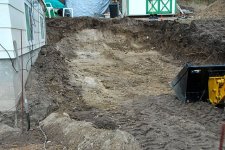
Here is the progress so far. My concrete contractor wants the trench for the concrete forms about four feet deeper than the existing floor in the back, side and front. He says he wants it that deep not necessarily for frost, but for strength due to the amount of dirt being held back.
 

Attachments

  • HT0_3490small.jpg
    HT0_3490small.jpg
    109 KB · Views: 130
/ Foundation questions #20  
skidoo- after seeing the cad drawing, I agree with your contractor. You definetly need to have deep footings for the back/front and side walls to hold back the dirt. If you don't, you can get some cracking in the walls without the deadmans posts installed. SO getting a deep footing will help with stablity just like a regular basement to hold back the dirt without deadmans posts. deadman post is meant only for wood or rock walls, not concrete walls like the ones you are proposing. Good luck and keep us posted of the progress. I think it will come out nicely as the cad drawing you have.
 
 
Top