Loader Front end Loader Lift Question

   / Front end Loader Lift Question #1  

drajj5

Gold Member
Joined
Jan 19, 2014
Messages
297
Location
North GA
Tractor
Mahindra 28, Bolens G14 repower
I did some searching on this site regarding FEL lifting, and did something that you are not supposed to do.


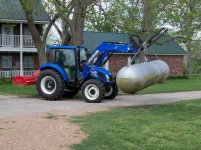
I recently purchased the property next to mine and needed to move the Propane Tank from that home to mine. Today was the day of the move.... Tractor that I own is a Mahindra Max 28 to make the move. Not too far maybe 1/2 mile between where it was and where it needs to go. I realize that this is probably not the right tool for the job but must suffice as it is the only piece of equipment I own- lame excuse I know; there is redneck blood in me!

I Lifted the tank with a chain wrapped around the bucket attached to the welded hooks on either end of the tank. I moved it maybe 5 foot and could not control the swaying of the tank and any bump in the sloped gravel road gave me the heeby jeebies. So I had to rethink it; took 2 large ratchet straps and used the bucket to cradle the tank and secured it firmly to the bucket. The bucket on the tractor is small compared to the size of the tank - another clue that what I was doing was stupid.

Now to the meat of the post, The loader was able to pick it and transport it to my home using the strap technique. Curling the load proved to be more than the loader could handle; the loader arms would lift it fine ( the loader controls were super sensitive with that much weight). The bucket roll cylinders did hold but were unresponsive to curling the tank.

So the question- I always thought the bucket curl would be the, "strongest" part of the loader. I know that the loader arms do more work but thought; curl force would exceed the loader arms as its only job is- working the bucket roll. I am pleased it did the job... But learned that the cylinders that work the bucket are not a stout as I thought.

I always assumed that (breakout force) was bucket curl, which is typically marketed with a (higher capacity than the loader) Am I mistaken?
 
   / Front end Loader Lift Question #2  
On most SCUT FEL buckets the curl cylinder geometry gives at max "curl" at one point in the curl. This point may be with bucket almost level or slightly dumped. The lift cylinders usually have a more uniform lift capacity through there whole range of motion.

Either way good job on the "redneck" move :)
 
   / Front end Loader Lift Question #3  
They usually are stronger, but the leverage was too far out. It sure isn't good for your front axle to do that.
 
   / Front end Loader Lift Question #4  
I have done the same thing with some big logs that were in my yard, only I couldn't lift much just curl and almost skim the ground. Good job. Ed
 
   / Front end Loader Lift Question #5  
On most SCUT FEL buckets the curl cylinder geometry gives at max "curl" at one point in the curl. This point may be with bucket almost level or slightly dumped. The lift cylinders usually have a more uniform lift capacity through there whole range of motion.

Either way good job on the "redneck" move :)
Agreed, take a look at the geometry of where the curl cylinders were and you might notice they were not at the optimum position.
 
   / Front end Loader Lift Question #6  
Leverage. At the bucket edge and flat on The ground, curl will be stronger.

Curl is strongest in about the middle of its range, gets progressively weaker nearing the ends of its travel.

Loader lift is strongest at ground level and gets weaker the higher you go.

Given the leverage ratios, the further out in front of the bucket you go, the curl looses force at a much faster rate than the lift. The curl starts off strongest near the bucket, then there is some point where they are equal, then beyond that point loader lift is stronger. The tank must have been beyond that point.
 
   / Front end Loader Lift Question #7  
I would have lifted off the back side of the bucket and even removed the bucket if quick attach. If you had the bucket fully curled when you hooked up (to the back side) dumping the bucket would have more power than curling.
Curling the bucket, bucket cylinders, you have the piston area MINUS the rod area, less area for the hydraulic oil to put force against. Lift cylinders will have full piston area to work against.
 
   / Front end Loader Lift Question #8  
I recently purchased the property next to mine and needed to move the Propane Tank from that home to mine. Today was the day of the move.... Not too far maybe 1/2 mile

Now to the meat of the post, The loader was able to pick it and transport it to my home using the strap technique. Curling the load proved to be more than the loader could handle; the loader arms would lift it fine ( the loader controls were super sensitive with that much weight). The bucket roll cylinders did hold but were unresponsive to curling . . .

Drajj5,

It sounds like you were far too heavy a load to move a distance that far. But more importantly . . A tank with liquid in it that is explosive.

We all do things later we recognize are stupid. And I don't want to sound like a too stern father or preacher . . but your post seems more concerned about the weight than it does about how incredibly hazardous such a move is for explosion. Had a policeman seen you moving this . . you would have been stopped IMMEDIATELY.

I'm not talking about tip-over . . . I'm talking about simply cracking or bending the tank valve and gas leaking out as you're moving it. Propane is heavy so the gas hangs low . . . So you're driving along and the gas is at or near ground level. Your radiator pulls it into the engine area . . . and you get a "movie special effects" explosion fireball and then the tank goes up like a giant grenade after that first explosion.

And the only times a propane tank is "empty" is when:

A. Its new
B. Its sand filled
C. Its been left with the valve open a week or more steady.

"redneck stupid" is hauling too heavy a load for too long a distance. "really redneck stupid" is hauling too heavy a load with movable shifting contents (like liquid).

But combining "really redneck stupid" and the words like nitro or propane . . I don't have a descriptive phrase for that.

I'm writing this not to lecture . . but to emphasize you are fortunate to not have killed yourself and others within 100 yards of you while doing this imo.

Curl is not the issue . . life and death is. Serious.
 
   / Front end Loader Lift Question #9  
Curling the load proved to be more than the loader could handle; the loader arms would lift it fine ( the loader controls were super sensitive with that much weight). The bucket roll cylinders did hold but were unresponsive to curling the tank.

It amazes me that people will take a $20K asset and push it to it's absolute breaking point in order to avoid a hundred dollar moving fee.
 
   / Front end Loader Lift Question #10  
I see the safety police showed up...

Risks are identified, cautions taken, and people survive dangerous tasks every day. Probly more likely to get hurt driving to work than moving the tank.

Polite advice, great. Response seems slightly harsh...
 
   / Front end Loader Lift Question
  • Thread Starter
#11  
Leverage. At the bucket edge and flat on The ground, curl will be stronger.

Curl is strongest in about the middle of its range, gets progressively weaker nearing the ends of its travel.

Loader lift is strongest at ground level and gets weaker the higher you go.

Given the leverage ratios, the further out in front of the bucket you go, the curl looses force at a much faster rate than the lift. The curl starts off strongest near the bucket, then there is some point where they are equal, then beyond that point loader lift is stronger. The tank must have been beyond that point.


The Bucket attached to my loader has radius sides - this radius matched perfectly to the radius of the tank. I agree that the tank was way to large for the bucket.

Bucket level and driven up to the tank - Sides of bucket did not meet the side of the tank. Tried to curl bucket to (roll the tank back) unsuccessful.

What I ultimately did; Dropped bucket to the ground and rolled the bucket without a load to displace the dirt underneath the tank - fit like, "O.J.s glove" well... close enough. Then ratchet strapped the heck out of it, all this knowing not to touch the lever for the curl.

//////////////////

I knew I would catch some flack about this but, "He who hasn't done something stupid may cast the first stone" Police? Safety was a concern, however I took precautions I.E. (went super slow). and made sure the lid was secure that covered the tank valves. I am not sure how much liquid was in there but I agree there was "some" there. I survived the experience but recommend to others - don't try this at home.

I was shocked none the less that it would not curl the tank but lift it only.

Zebrafive
I did lift off of the back of the bucket initially but the tank 'swayed' and my bucket was high off the ground which scared the heck out of me on uneven and un-level ground. this made me rethink the whole operation.
 
   / Front end Loader Lift Question
  • Thread Starter
#12  
It amazes me that people will take a $20K asset and push it to it's absolute breaking point in order to avoid a hundred dollar moving fee.

Thinking back on it now.... I should have spent the 100bucks instead of "hold my beer and watch this" technique.
 
   / Front end Loader Lift Question #13  
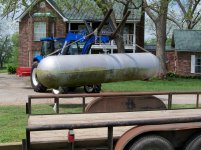
I had to move this 1,000 gallon tank this last year with my tractor as buildings and fences had been built around it over the years and there was no other way to get it over to and on the propane companies flat bed trailer. Decided to use the forks instead of the bucket and all went well though I did have to go up a small incline at a slight angle. Kept the tank close to the ground and had no problems and I went really slow.....
image.jpg
image.jpg
 
   / Front end Loader Lift Question #14  
It is so easy to do something dumb and even a really dumb thing and be blessed and thankful it went fine. Glad it did for you with the move.

My question just asking here: will the welded on hooks lift a loaded tank? I know on fuel tanks they are not rated to lift loaded fuel tank (or ones I have seen) and wondered if same with propane tank.
 
   / Front end Loader Lift Question #16  
It is so easy to do something dumb and even a really dumb thing and be blessed and thankful it went fine. Glad it did for you with the move.

My question just asking here: will the welded on hooks lift a loaded tank? I know on fuel tanks they are not rated to lift loaded fuel tank (or ones I have seen) and wondered if same with propane tank.

Welded on hooks on 125 gallon, 250 gallon, and 500 gallon propane tanks (usually referred as "pickles" ) are designed to lift empty tanks . . . not filled tanks. In fact 5 lb, 20 lb, 30 lb, 40 lb 60 lb and 100 lb verticals are the only ones in WI allowed to be transported in a filled condition for propane. Even the 100 gallon verticals must be filled "on pad".

The tiny 5 lb vertical tank that looks like a dwarf version of a 20 lb. grill tank . . is explosive enough to blow a tractor bucket off a scut tractor. If you recall these little miniature grill tanks are what terrorists had in backpacks in Paris and yes that is the smallest size other than 1 lb campstove units. Propane is so dangerous because it goes down . . Not up . . Like natural gas or gasoline does. As a result propane delivery trucks never have tanks in front of the engine.

Propane companies are happy to relocate and move tanks . . They pump the propane out . . Transfer the tank and pump the propane back in plus fill to full. While they do that process it also filters out part of the condensation in the tank as well. They keep charges to do this low because its another way to encourage the user to use lp which is the way to make money.

My original post was less worried about the operator . . who makes his own choices . . . its about kids and adults and their lives, limbs, or personal property that come within a 100+ yard blast zone who have no choices.

Remember . . in Paris the blast zone for a 5 lb tank was 25 yard radius. The smallest "pickle" tank is 125 gallons . . thats 200 times the 5 lb tank.
 
Last edited:
   / Front end Loader Lift Question #17  
drajj5: how large was your tank?

If I had to move a tank any distance at all, I'd have done it just as you describe. Chained solid to the bucket.

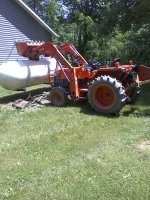
I had to move my 500 gallon tank just a few feet closer to the house so the copper line would reach. The standard 20' length of copper I bought was just a tad too short. The tank still had about 15% in it to. My best guess is 1400-1500# I wouldn't

The hooks are for empty only. With only 15% in the tank I wasnt worried. But wouldnt have dine it with any more in the tank.

propane.JPG
 
   / Front end Loader Lift Question #18  
Mother nature did not give humans very good talents for judging risks. We all see drivers taking insane chances in traffic, good old boys trying things that have poor odds of success, etc. When someone's life is at stake, doing something that has only a 99% chance of succeeding is really not good odds. If airline pilots flew their planes to that level, there would be a dozen or so plane crashes every day. As for moving propane tanks with a tractor, if enough people try it, eventually someone will have a really bad day.
 
   / Front end Loader Lift Question #19  
I have 6" teeth on my bucket and if I had to do the same move I would put wood across the teeth and then up both sides of the bucket and go in from the bottom and strap the tank to the bucket and move. Steel won't spark against wood.
 
   / Front end Loader Lift Question #20  
I would have let the propane company move it if possible.

However if I were in the position of HAVE TO move it with a tractor, I would have done it just like the OP did by placing the tank into the FEL bucket and strapping it down tightly. If I were going to sling it like LD1 and my tractor had lift issues, I might have removed the bucket, passed chains around each end in sling fashion (where the tank legs attach) and then attached the chains to the lift arms and slowly raised it to transport height. Then using ratchet straps, strap each end to the tractor (grill guard would work for this) and tighten the straps so the tank doesn't sway back and forth. Slow travel as required to keep everything in position.

Note: keep all chains well away from the propane valves and make sure the valves are properly closed.
 

Tractor & Equipment Auctions

Wacker Neuson AR14H (A60462)
Wacker Neuson...
2016 INTERNATIONAL PROSTAR (A59904)
2016 INTERNATIONAL...
500 BBL FRAC TANK (A58214)
500 BBL FRAC TANK...
2012 International WorkStar 7300 AWD Altec DC47TR Insulated Digger Derrick Truck (A60460)
2012 International...
2009 MULTIQUIP 25KW GENERATOR (A55745)
2009 MULTIQUIP...
20FT X 30FT STEEL CARPORT (A58214)
20FT X 30FT STEEL...
 
Top