Loader Front end Loader Lift Question

   / Front end Loader Lift Question #21  
Propane tanks get moved all the time by people like us. Propane company isnt gonna move a customer owned tank, and there are alot of them out there. Not to mentioned all the ones that get re-purposed for boilers, storage tanks, air tanks, pumpkin-chunkers, etc
 
   / Front end Loader Lift Question #22  
As someone mentioned, the curl function has a lot of power at the bucket edge. You had the center of the load out too far.

I would have moved it like you did. My odds of dying from a tree falling on me while cutting wood in the timber are far, far, far greater than blowing myself up while moving a propane tank.

As for the image of a catastrophic explosion,,,,,, have you ever saw a propane tank on fire??? I've saw 2 burn completely. No explosion. Just a slight rush when the popoff started letting out fumes. Then just a blow torch until it expended all flammables. No explosion.
 
   / Front end Loader Lift Question #23  
The Bucket attached to my loader has radius sides - this radius matched perfectly to the radius of the tank. I agree that the tank was way to large for the bucket. Bucket level and driven up to the tank - Sides of bucket did not meet the side of the tank. Tried to curl bucket to (roll the tank back) unsuccessful. What I ultimately did; Dropped bucket to the ground and rolled the bucket without a load to displace the dirt underneath the tank - fit like, "O.J.s glove" well... close enough. Then ratchet strapped the heck out of it, all this knowing not to touch the lever for the curl. ////////////////// I knew I would catch some flack about this but, "He who hasn't done something stupid may cast the first stone" Police? Safety was a concern, however I took precautions I.E. (went super slow). and made sure the lid was secure that covered the tank valves. I am not sure how much liquid was in there but I agree there was "some" there. I survived the experience but recommend to others - don't try this at home. I was shocked none the less that it would not curl the tank but lift it only. Zebrafive I did lift off of the back of the bucket initially but the tank 'swayed' and my bucket was high off the ground which scared the heck out of me on uneven and un-level ground. this made me rethink the whole operation.
I have moved several propane tanks with my tractor and a 1000 gallon with a case backhoe. All were as empty as they could be. I pick them up and set them on a trailer usually if there is distance involved for sure. What amazes me about the safety police is they always assume something is. I wouldn't have thought that you would have tried to move a full tank, you didn't say that anywhere in your post. So why assume people? Good job on the move. Many of us on here, including myself, do things on our own. We wouldn't own a tractor if we didn't. I buy my stuff to use. Regardless on how much it cost. And before someone says anything, I am not condoning any unsafe acts. I use my judgement and take full responsibility for anything I do. That's what it's all about. I will say this, most of the people you call out to pay to do something don't have enough sense to get out of the rain. LUTT
 
   / Front end Loader Lift Question #24  
I was wanting to switch propane suppliers. New company wanted to come install, but old tank was still in the backyard. It had <5% in it. I put the pallet forks on, ratchet strapped it to the forks and moved out front by the road. I couldn't roll it back, but I could pick it up. Went slow, and nothing happened. New LP company came and installed new tank. The old tank sat in my front yard for 6 weeks before it was removed. That ticked me off....
 
   / Front end Loader Lift Question #25  
I have to move my propane tanks regularly, one 300 gallon/lb pickle barrel and several 100 gallon/lb tanks.
Usual move is to load in skiff, 20 mile trip to cannery, unload/fill/reload at cannery, back home then unload full. I appreciated the addition of the pickle barrel as it makes the refill an annual thing instead of more frequently.

This is the first time I have heard the ears on the pickle barrel are only for lifting empty barrels and not sure how I could accomplish the refill without being able to lift full tanks? Guess I could make rope bridles for lifting??
 
   / Front end Loader Lift Question #26  
I have moved several propane tanks with my tractor and a 1000 gallon with a case backhoe. All were as empty as they could be. I pick them up and set them on a trailer usually if there is distance involved for sure. What amazes me about the safety police is they always assume something is. I wouldn't have thought that you would have tried to move a full tank, you didn't say that anywhere in your post. So why assume people? Good job on the move. Many of us on here, including myself, do things on our own. We wouldn't own a tractor if we didn't. I buy my stuff to use. Regardless on how much it cost. And before someone says anything, I am not condoning any unsafe acts. I use my judgement and take full responsibility for anything I do. That's what it's all about. I will say this, most of the people you call out to pay to do something don't have enough sense to get out of the rain. LUTT

Greetings Lutt,

Lets assume you're considering me "the safety police". There is no part of my pists on this thread that "assumes" fullness or emptiness level if the tank.

What I know is the op stated the tank was so.heavy he could lift it a few inches high but couldn't even curl it. And because it was a max 28 . . That means it was a very heavy load for the tractor. Again by fact . . . . that means either a very large tank with a little in it or a medium or smaller tank with definite gas quantities in it. There's no "assuming" involved.

Secondly the op stated he had to stop and redo because the tractor was rocking around quite a bit . . Again no assumption s needed . . . very heavy load only a few inches off the ground and unstable tractor needing to transport 1/2 mile on a gravel road.

And terrorists use small propane tanks to cause explosions . . so we don't have to asdume anything about propane tank explisive potential either . . The Paris athletic field attempts showed us the potentional right on tv of what a tiny 5 lb tank can do . . . its not complicated to understand what just 25 or 50 gallons could do.
 
   / Front end Loader Lift Question #27  
I have to move my propane tanks regularly, one 300 gallon/lb pickle barrel and several 100 gallon/lb tanks. Usual move is to load in skiff, 20 mile trip to cannery, unload/fill/reload at cannery, back home then unload full. I appreciated the addition of the pickle barrel as it makes the refill an annual thing instead of more frequently. This is the first time I have heard the ears on the pickle barrel are only for lifting empty barrels and not sure how I could accomplish the refill without being able to lift full tanks? Guess I could make rope bridles for lifting??
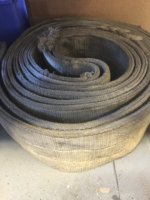
Maybe you could use a lifting strap like this? Just something shorter. I was thinking the same thing you were when I read that. If the fellar or gal welding up the tank was proficient enough to pass the inspections on the tank. Assuming for fun that they used a 7018 rod , that's a rating of 70,000 pounds per square inch. Depending on steel, I know there are other variables . So those straps have several inches of weld. Pretty sure they would hold. But no manufacture in there right mind would promote that. LOL LUTT
 

Attachments

  • image-2881918251.jpg
    image-2881918251.jpg
    342.9 KB · Views: 169
   / Front end Loader Lift Question #28  
I have to move my propane tanks regularly, one 300 gallon/lb pickle barrel and several 100 gallon/lb tanks.
Usual move is to load in skiff, 20 mile trip to cannery, unload/fill/reload at cannery, back home then unload full. I appreciated the addition of the pickle barrel as it makes the refill an annual thing instead of more frequently.

This is the first time I have heard the ears on the pickle barrel are only for lifting empty barrels and not sure how I could accomplish the refill without being able to lift full tanks? Guess I could make rope bridles for lifting??

A bit confused tungular. You label each tank as gallon/lb. A 100 lb tank holds about 80 to 85 pounds of propane but a 100 gallon tank holds about 850 pounds of propane.
 
   / Front end Loader Lift Question #29  
Greetings Lutt, Lets assume you're considering me "the safety police". There is no part of my pists on this thread that "assumes" fullness or emptiness level if the tank. What I know is the op stated the tank was so.heavy he could lift it a few inches high but couldn't even curl it. And because it was a max 28 . . That means it was a very heavy load for the tractor. Again by fact . . . . that means either a very large tank with a little in it or a medium or smaller tank with definite gas quantities in it. There's no "assuming" involved. Secondly the op stated he had to stop and redo because the tractor was rocking around quite a bit . . Again no assumption s needed . . . very heavy load only a few inches off the ground and unstable tractor needing to transport 1/2 mile on a gravel road. And terrorists use small propane tanks to cause explosions . . so we don't have to asdume anything about propane tank explisive potential either . . The Paris athletic field attempts showed us the potentional right on tv of what a tiny 5 lb tank can do . . . its not complicated to understand what just 25 or 50 gallons could do.
Greetings, I also said I don't condone any unsafe acts also. That I use my on judgement and sense and take full responsibility for such actions. I'm pretty sure that we all know what propane is capable, as a 15 year volunteer fireman, a chief engineer for a very large company, I deal with safety on a day to day basis and so called safety experts. But I also know how much sense some people really have. That's my experience. I don't want to see any one getting hurt, but we could debate this all day about how much was in the tank and we will never know. Far as tractor lift, a few inches off the ground that tank is not gonna fall off the loader and explode. The op knows he done something unsafe. He realized it and like someone pointed out. No sense in being harsh to him. Have a nice day. LUTT
 
   / Front end Loader Lift Question #30  
That's ok, I have spent my whole life confused?

Here everyone calls the tanks gallon instead of lb so I used both, just to stir up the mud;)
 
   / Front end Loader Lift Question #31  
Greetings, I also said I don't condone any unsafe acts also. That I use my on judgement and sense and take full responsibility for such actions. I'm pretty sure that we all know what propane is capable, as a 15 year volunteer fireman, a chief engineer for a very large company, I deal with safety on a day to day basis and so called safety experts. But I also know how much sense some people really have. That's my experience. I don't want to see any one getting hurt, but we could debate this all day about how much was in the tank and we will never know. Far as tractor lift, a few inches off the ground that tank is not gonna fall off the loader and explode. The op knows he done something unsafe. He realized it and like someone pointed out. No sense in being harsh to him. Have a nice day. LUTT

Lutt,

Because you work with firefighting I have a couple questions about propane tank issues you might be able to answer.

LP Tanks are dangerous for both explosion and also for fire ball issues.

1. If the valve cracks or leaks you can create first a fireball of leaked gas at groudlevel and then it follows back and creates like a giant bunsen burner at the valve. I assume that is fought with foam or some freezing element ???

2. I assume smothering the flame could allow flame to get in the tank to create explosion instead or if there was a puncture in a lower area of the rank or the valve ended up facing anyway but up??

How do the firemen know if they can get close enough to spray /foam without triggering explosion issues? Does pouring cold water on the tank to drop temperature reduce or increase potential flame in the tank ?
 
   / Front end Loader Lift Question #32  
I am no fireman, but saw a show on tv, one of them about real life documentaries and such.

The fireman did spray water go try to lower the temp of a tank of combustible liquid.

The explosion they were trying to prevent was called a bleve. Pronounced blevy.

Stood for boiling liquid expanding vapor explosion.

I think that is indeed the main threat of explosion. But don't know that it would happen if a line caught fire and followed back to the tank, especially if the valve were on top. I think it applys more to, say a gas tank. Where a leak underneath catches fire and heats the contents of the tank as it burns.

Did also see a few mythbuster episodes. One about trying to blow up a gas tank, the other bout trying to explode a propane tank with a bullet. Both nwere bear impossible
 
   / Front end Loader Lift Question #33  
Its been several years ago, but a nearby fire department lost 2 or 3 guys to a LP tank explosion. They were spraying the tank down, more or less from behind a fire truck at the time. The tank near a building that was on fire. The tank was venting and on fire and then exploded. The tank flew a long distance and hit the truck they were behind killing them. Not a common thing since they are designed to bleed off the extra pressure through the valve on the top.
 
   / Front end Loader Lift Question #34  
The risk is the fire heating vapor space in the tank up (causing steel to weaken and the propane to boil and expand faster than the relief valve can release the pressure) until the pressure from the propane is higher than the tank can hold and the tank blows up (causing ALL the propane left in the tank to be released at once and causing a BLEV)

Here is a video showing how it happens:

Aaron Z
 
   / Front end Loader Lift Question #35  
A video showing a training practice for a burning propane truck:

Aaron Z
 
   / Front end Loader Lift Question
  • Thread Starter
#36  
drajj5: how large was your tank?

If I had to move a tank any distance at all, I'd have done it just as you describe. Chained solid to the bucket.

I had to move my 500 gallon tank just a few feet closer to the house so the copper line would reach. The standard 20' length of copper I bought was just a tad too short. The tank still had about 15% in it to. My best guess is 1400-1500# I wouldn't

The hooks are for empty only. With only 15% in the tank I wasnt worried. But wouldnt have dine it with any more in the tank.

View attachment 449757


The tank size was a 250 gallon "I think" - hard to tell the difference. I do know it is smaller than the one at my house #1. I just set it off down by the barn, maybe I will move up; to gas heat in the barn,,,one day.
 
   / Front end Loader Lift Question
  • Thread Starter
#37  
I have 6" teeth on my bucket and if I had to do the same move I would put wood across the teeth and then up both sides of the bucket and go in from the bottom and strap the tank to the bucket and move. Steel won't spark against wood.

I too have the tooth bar installed, wood was not needed as those ratchet straps were so tight that the tank would have ripped the bucket from the loader before it moved/wiggled while attached to bucket.
 
   / Front end Loader Lift Question #38  
i'm not going to comment on how anything was done or if it was dangerous.

i'll just say that i have shot at 20lb propane tanks with high powered rifles and all they did was go psssssst and shoot propane out the hole until they were empty..
 
   / Front end Loader Lift Question #39  
Firemen typically won't try to stop the tank venting if it is already (typically the vent "vents" if the pressure is exceeded in the tank that it's designed for and that happens typically from excessive heat applied to the tank.) Instead they attempt to cool the tank to the point that it stops venting. If it stops venting then there's also no more gas coming out of it, mitigating that issue. If you try to cap the vent all you're doing is stopping the tank from being able to release the pressure that's building up inside the tank. Guess what happens if you stop that from happening...
Now if the vent can't keep up with the pressure that's building up inside the tank or if the tank structure itself weakens to the point it can't take the pressure in the tank then the tank ruptures - at that point the gas is released in an uncontrolled fashion. (unlike from the vent) At that point the tank will BLEVE as was explained above. And at that point if said tank ONLY travels a 100' everyone is lucky. Chances parts will travel much much further. IF a 100 gallon tank bleve's the ERG (Emergency response guide) recommends a minimum safe distance of over a quarter mile, a 500 gallon tank that becomes a half mile, 2000 gallon - now you're getting close to a mile before you're possibly safe... You get the idea.
Incidentally For those curious the problem compounds if the tank is being heated by a fire causing it to vent - a full tank because of all the propane in it helps keep the tank structure from heating up to the point that the steel weakens to the point it fails but while it continues to vent guess what - that full tank gets emptier and emptier and then there isn't as much propane keeping things cool (plus the propane also heats up of course.) And then the steel heats up and fails. Boom!

Anyway, that's my basic knowledge on the stuff. So, ya, don't light a fire under a tank, don't knock the vent or any other fitting off the tank, and don't dent it if you feel you must transport a tank. :) That's my 2 cents on the whole transporting issue. ;) Btw - if you have a proper sized counterweight hangin' off the rear of the tractor then you in my simple mind aren't overloaded the tractor. It was designed to lift what the loader can lift. Of course if you're at the max speed with said heavy load instead of inching along then you're increasing the risk of braking something but then you weren't very bright in the first place. (Doesn't sound like that was the case here happily.)

My 2 Canadian cents - So that's not worth much today!
E.
 
   / Front end Loader Lift Question #40  
I know this event is in the past, but maybe someone else will read it later, so I'll add one comment.

Rather than using the FEL, strapping the tank to a carryall on the 3pt probably would have been safer, and easier on the machine. You can get a pretty big tank strapped to a carryall if you have the ability to secure it really well. Add some boards to the carryall, and it won't even scratch the tank. Depending on the exact situation, it might take a couple of boards to make a ramp, and either someone to push the tank, a come-a-long, or something similar to get the tank on the carryall, but it shouldn't be that difficult....worst case, dig down six inches so the top of the carryall is even with the bottom of the tank, then pull it on with straps/chains and binders.
 

Tractor & Equipment Auctions

SAMSUNG REFRIGERATOR/FREEZER (A60432)
SAMSUNG...
2020 DRAGON ESP 150BBL ALUMINUM (A58214)
2020 DRAGON ESP...
UNUSED RAYTREE RMLS18T-18 TON HYD LOG SPLITTER (A60432)
UNUSED RAYTREE...
2003 Freightiner FLD120 (A61306)
2003 Freightiner...
2023 VOLVO ECR25 ELECTRIC EXCAVATOR (A60429)
2023 VOLVO ECR25...
Tandem Axle Rear Truck Frame (A59230)
Tandem Axle Rear...
 
Top