Frost Free Yard Hydrant leaking down below

   / Frost Free Yard Hydrant leaking down below #1  

Saddlebum

New member
Joined
Jan 22, 2012
Messages
5
Tractor
John Deere 425
Hello Everyone!

I'm new to this site and hope to spend lots of time hear reading and learning.

I live in Northern Lower Michigan and have 3 frost free hydrants. The one at the fence line which feeds water into my livestock tank has water leaking down below. The top works fine in that it turns on the water when the handle is lifted and turns it off when the handle is lowered BUT, you can hear the water running down below AND when I lift the handle up to turn on the water flow, there is sand that comes out with the water.

Also, the pump keeps coming on even when I am not running any water anywhere. This tells me that the water I am hearing still running in the frost free faucet at the fence line is causing the pump to turn on and off in the basement. You can't hearing anything in the other two hydrants when they're turned off.

I had a plumber come out who did not know that you can pull the rod up and had to spend some time convincing him that yes, you can pull it up if you thread the head back onto the rod just a few turns and give a good strong pull. The plug at the bottom was barely on so I tightened that onto the rod and we pushed it back down into the pipe and reset the head of the fauset but we could still hear the water flowing. I do have a shut off inside the basement to the two frost free fausets (one to the fence line and one inside my barn) so I can turn the water off to those but, it's a walk and the water is running the whole time I am outside until I come in to turn it off (I have to remember to do so).

I'm hoping someone here can clue me in as to what needs to be fixed to solve this problem. I am assuming I will have to dig this up this spring when the frost is gone because of the sand coming back up but, is there anything I can do right now to fix it so I don't have to keep turning the shut-off on and off in the basement?

I had the water line moved this past summer and the hydrant in the barn is new. The hydrant at the fence line is the old one I had been using for 3-4 years before I had the pole barn installed. The guys who moved it for me had lots of drain stone placed down below with a bucket I cut the bottom off of and plastic over the top of the and straw on the top of that. So I am assuming it was installed correctly and the problem is to do with the faucet itself. I purchased the faucet at Tractor Supply about 4 years ago (8 ft) with 4.5' in the ground and 3.5 above.

This has been going on for a few months with the pump going on and off and I finally heard the water running in the one hydrant at the fence line. I had been searching for a leak in the house till now. You can clearly hear the water running.

Also, the soil here is silty with pure sand below the hardpack (about 12" down). Basically, we live on a big sand dune in this region.
Thanks!

Saddlebum
 
Last edited:
   / Frost Free Yard Hydrant leaking down below #2  
I have several of the frost free hydrants scattered about the ranch. They do make an overhaul kit for the ones that I have here, which basically include new seals and a rubber piece that goes on the end of the shaft located at the bottom of the hydrant. Don't know about your particular hydrant. The kits can be installed without digging up the hydrant. I would try that first, but with sand coming up as you describe I'm afraid that you have some type of break in the buried line or fittings. You should be thankful that you have a shut off in the house so that you can postpone repairs till better weather. Good luck.
 
   / Frost Free Yard Hydrant leaking down below #3  
Forgot my manors.

Welcome to TBN. :thumbsup:
 
   / Frost Free Yard Hydrant leaking down below
  • Thread Starter
#4  
hehehe, Thanks for the welcome! You're absolutely right, I am very thankful I have that shut-off in the basement -- a blessing really.

I'll buy the kit and go from there. The sand is a worry and will dig up the line this spring.
 
   / Frost Free Yard Hydrant leaking down below #5  
Did you set the setscrew back on the pull rod where it was before..?? If so, adjust a scoonch more..??

If properly adjusted... Do any of the other hydrants have sand coming out..??

If not.... Did you put sand around your waterlines, or hydrant, to drain out in to..., or in naturally sandy ground..??

If so, possibly your water line may be leaking a bit, and syphoning sand into the line when you open the hydrant??

Or, if you did not put, like a 90 degree st. el on the drain port, and put like 3/4" washed gravel around the drain port, it may let sand syphon in valve seat.
 
   / Frost Free Yard Hydrant leaking down below
  • Thread Starter
#6  
I don't know what the set screw is??

And, the guys put 10A drain stone all around the bottom and a bucket BUT, it's been doing this for quite some time and that is why I believe it's symphoning sand into the line somehow. Because the water has been running full bore for a few months and it's washed sand into the area of the stone. I will look see if the other two are bringing sand in but doubt it. The reason is, when I turn them on and then off, they are off, there is no sound of running water down below like there is with this particular hydrant.
 
   / Frost Free Yard Hydrant leaking down below #7  
Hello Everyone!

I'm new to this site and hope to spend lots of time hear reading and learning.

I live in Northern Lower Michigan and have 3 frost free hydrants. The one at the fence line which feeds water into my livestock tank has water leaking down below. The top works fine in that it turns on the water when the handle is lifted and turns it off when the handle is lowered BUT, you can hear the water running down below AND when I lift the handle up to turn on the water flow, there is sand that comes out with the water.

Also, the pump keeps coming on even when I am not running any water anywhere. This tells me that the water I am hearing still running in the frost free faucet at the fence line is causing the pump to turn on and off in the basement. You can't hearing anything in the other two hydrants when they're turned off.

I had a plumber come out who did not know that you can pull the rod up and had to spend some time convincing him that yes, you can pull it up if you thread the head back onto the rod just a few turns and give a good strong pull. The plug at the bottom was barely on so I tightened that onto the rod and we pushed it back down into the pipe and reset the head of the fauset but we could still hear the water flowing. I do have a shut off inside the basement to the two frost free fausets (one to the fence line and one inside my barn) so I can turn the water off to those but, it's a walk and the water is running the whole time I am outside until I come in to turn it off (I have to remember to do so).

I'm hoping someone here can clue me in as to what needs to be fixed to solve this problem. I am assuming I will have to dig this up this spring when the frost is gone because of the sand coming back up but, is there anything I can do right now to fix it so I don't have to keep turning the shut-off on and off in the basement?

I had the water line moved this past summer and the hydrant in the barn is new. The hydrant at the fence line is the old one I had been using for 3-4 years before I had the pole barn installed. The guys who moved it for me had lots of drain stone placed down below with a bucket I cut the bottom off of and plastic over the top of the and straw on the top of that. So I am assuming it was installed correctly and the problem is to do with the faucet itself. I purchased the faucet at Tractor Supply about 4 years ago (8 ft) with 4.5' in the ground and 3.5 above.

This has been going on for a few months with the pump going on and off and I finally heard the water running in the one hydrant at the fence line. I had been searching for a leak in the house till now. You can clearly hear the water running.

Also, the soil here is silty with pure sand below the hardpack (about 12" down). Basically, we live on a big sand dune in this region.
Thanks!

Saddlebum
As bad as I dislike confirming what you already believe is the real solution, I'll go ahead and say it " start digging when the mood strikes" if such a thing is possible.:D At least you have mostly sand for the most part.
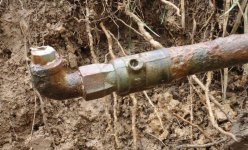
In my non professional opinion, there is a broken pipe in the area of the buried valve and the leak, which must be significant if you can hear it, is forming a sand slurry and that slurry is entering the drain opening when the hydrant is closed. When the hydrant is opened the drain hole is covered and the sand that was on top of the rubber plunger in the valve and pipe is delivered out the spigot.

When the supply is closed in the basement and the pressure falls to zero on that line some of that slurry could enter the pipe through the break but I don't believe that's where the majority of the sand from the hose connection is coming from.

At this time I don't believe you need a new repair kit. I don't see that being the problem at this time. Although when you do dig it up, as anyone would suspect, that would be an excellent time for a kit or complete new hydrant.

I've found over the years I've dealt with these hydrants that in sandy soil the gravel buried at the valve for drain purposes isn't necessary at all.

You have a better set up there than most by being able to isolate that one line and I wish you the best of luck.
 
   / Frost Free Yard Hydrant leaking down below #8  
Where the brass rod/plunger attaches to the handle, there should be a piece between the handle, that slides down over that rod. On one side, or the other should be a set screw, with an approx. 3/8" square head. This is where you adjust your shut off. You can raise the handle to about half open, loosen the set screw, then raise the handle up just a smidge. Reset the screw, and try it. You should just feel very little tension, just before it snaps over center. If there is a name on the hydrant, you should be able to Google it, and detailed instructions on how to do it...

More than likely though, sounds like you have other problems...

Not sure how far it is from the shut off, to the hydrant. But if you need to put in a complete new line, you may want to consider doing what I did, after learning the hard way about 35 years ago.

I now use 160 psi, 3/4" black plastic going to the hydrants, and fountain. I use 1-1/4" low pressure BP for conduit. If the line ever needs replaced, just dig up the ends, cut it loose, and shove a new 3/4" through. What ever size you prefer..., just make sure the conduit is 1/2" larger, for plenty of room, in case there are curves in the line, or a rock works its way to it, exerting some pressure.

I had to replace one of my hydrants about 5 years ago in Feb., so know where you are coming from.
 
   / Frost Free Yard Hydrant leaking down below
  • Thread Starter
#9  
I'll give the set screw a try and see but like both of you recent posters, I believe I am blessed with a turn-off valve to that line. There is no brand name on the hydrant when I was out there to night feeding.

If the set screw change doesn't do the trick (doubtful), I will dig it up with a new hydrant handy this coming Spring - ah, of course, when the mood stricks - hehehe.

thanks!
 
   / Frost Free Yard Hydrant leaking down below #10  
I've had problems with leaky yard hydrants, too. For the longest time I didn't know about the set screw and dug up one hydrant to replace it. Then a contractor friend showed me the set screw and it fixed the leak in a few seconds! But your's doesn't have water running at the faucet above ground, only underground correct? That could be more ominous, like someone else mentioned - i.e. a broken pipe. Did your installer use street elbows in the drain holes at the bottom of the hydrant? If not, sand can easily get in the hydrant and make it leak.
 
   / Frost Free Yard Hydrant leaking down below #11  
Hello,

I am sorry to change the subject, but instead of making a similar post, I figure I'd add to this since it already has information on my topic.

I have a frost free hydrant that was leaking (from the head at the top of the plunger rod) since I replaced the head a couple of years ago. I did some research and found there is a replaceable washer-type rubber piece at the bottom of the plunger, and wanted to unscrew the head and pull out the rod to see if the plunger washer needed replacing. The only problem is that I only had one plumber's wrench, so I couldn't secure the pole well as I tried to unscrew the head, and the pole ended up turning instead of the head. I turned the pole back to where it should have been, and moved on to making adjust the linkage.

I found out what they meant about the handle snapping shut which I never knew when I previously installed the new head, and made adjustments until the handle had a nice easy snap (it never snapped before which is likely why it leaked).

I turned on the water pump and there was no leak, but I heard a noise that sounded like water flowing even though the handle was turned off and the head was not leaking anywhere. Eventually as I feared the hole around the pipe that goes into the ground filled up with water. I tried adjusting the linkage and other parts several times, but the hole fills up every time I turn on the water pump, and if I pull up the handle the water comes out brown at first, then clear while the water continues to leak out of the bottom, and it seems like the pressure is getting weaker.

Because the hole got filled with water, the metal pipe is now looser than before, and will turn further tight (clockwise) than it used to, and can also be pulled up a little. Basically the pole is loose, but it still seems to be connected at the bottom.

I understand that I made a mistake. I am going to assume it was a really big mistake. If anyone who is experienced with this type of thing could be so kind and give me a lead on what would likely need to be done to fix this situation, I would be very grateful. I am going to assume that I have to start digging and replace or repair the pipe or connection to a pipe at the bottom of the pole.

At this point I do not know how to turn off the water supply to the hydrant, so my whole house it out of water until I fix this problem.

Thanks in advance for any advice to help me solve this problem!
 
   / Frost Free Yard Hydrant leaking down below #12  
Hello and welcome to the Forum !

This has happened to a lot of people, so hang on. Depending on the age of the hydrant, there is a metal or plastic elbow down below that has a hose barb on the end for attaching to common 'plastic' water line. Either this has twisted off or broken off, so the line is wide open down below. Since it is common for the hole to be filled with coarse gravel or sand, it should drain down fairly quickly.

Start digging. make a hole big (wide) enough for you to work in its usually 4 to six feet down there depending on the frostline depth and the length of the hydrant. I would be surprised if there is not a inside valve or an outside valve (sometimes called a street valve) where you can shut off the water pressure to this hydrant. Look for a steel cover about 5 to six inches across with a bolt head on top. Sometimes this is a 5 sided bolt, so you will need to obtain a wrench for it. The wrench also has at one end a notched head to fit into the street valve body (which is also down below the frost line).

Once you dig deep enough, you can access the broken water line and hopefully repair the connection. Plastic water line is fairly stiff, so the trick is to use a small propane torch to soften it up. Get a NEW hose barb for the end of the hydrant and screw it back into the end of the bottom hydrant brass fitting. A plumbing supply house may have a rebuild kit to give you the new rubber stopper that you originally were trying to change. Use a new stainless steel hose clamp. Make sure the screw bolt in the hose clamp is also stainless steel. I've had a few with a stainless band but an uncoated bolt and the bolt rotten away. Before you backfill the hole, make sure the coupling is not leaking.

If you have the time, watch a few videos on YouTube on how they change the rubber stopper and the brass upper pull rod and seal.

That's all there is to it. Try again to find a water shutoff! Good luck to you. It would be nice to share your experience back here on the Forum for future readers who want to know how it was fixed and the problems you may have had.

BTW: I once shoveled out a hole only big enough for me to lay down on the ground and reach down to the water line. Unfortunately, I slid into the hole headfirst and was unable to get out by myself.

When you get the time, install an inside shutoff valve for future needs. Stones sometimes perforate a water line and they will leak a good amount until you see water bubbling out of the ground. Your well will appreciate it.
 
   / Frost Free Yard Hydrant leaking down below #13  
I highly recommend using metal (i usually use brass) fittings with underground water lines. Our lines are at least 6' deep here. Those plastic ones are way more brittle and likely to get cracked as frost heaves and soil compaction occurs. STINKS to dig down that far in the winter....or the spring for that matter!
 
   / Frost Free Yard Hydrant leaking down below #14  
Thank you so much for your replies.

I will hopefully be digging soon to see if the problem is something that I can fix. Hopefully it is a simple part such as a hose barb as you say. I will not be able to heat the plastic with a blow torch, as I do not have access to one, so I don't know how I will be removing it if that is the problem. Perhaps some matches?

My main question right now is if the line is wide open, why does the water still come out of the head when the handle is lifted? Is it possible for the line to only be partially open?

Thanks again, and I will try to remember to post back with results if any are obtained.
 
   / Frost Free Yard Hydrant leaking down below #15  
A hair dryer works pretty well, too. Don't melt the pipe and don't drop it into any puddles ! Water coming out may mean many things. Maybe you just loosened the elbow. Maybe it just has a hairline crack. Maybe the hose clamp snapped and the pipe is still connected but not clamped tight.
 
   / Frost Free Yard Hydrant leaking down below #16  
It could very well be that the hose barb is cracked- generally if they freeze or are subject to movement the crack will occur at that joint.

I had an issue several years back on my old hand dug well (45 ft) where there was a frost-free right outside the pump house. Was losing water/pressure at an alarming rate and going through filters like crazy. Water line goes to two houses, at least 500' length. Dug it up where I knew there were joints (and at the frost free surrounded by concrete on a patio), got an acoustic guy in to find the leak, did all sorts of things. Turns out the elbow right outside the pumphouse below the frost free was cracked and was leaking the water back into the perforated well casing. So there was no surface indication of a leak, but that's where it was. 90 cent plastic barbed elbow just cracked. What a pain for a little part!

Could be something else- you'll know for sure if you dig it up! I wouldn't be surprised if you tweaked the joint/hose barb/ worm clamp when you tightened the head without securing the pipe. It's a giant pain but at least when you get down there you can plug it, fix it, or replace it and get water back to your house.
 
   / Frost Free Yard Hydrant leaking down below #17  
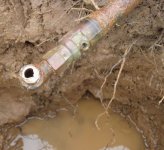
hydrantbase.jpghydrantbase2.jpg

Hello again,

I dug to the base of the hydrant, and the hydrant was completely loose. I am now going to continue to dig to uncover the pipe. The hole is full of water, so I don't know if I will be able to make the fix today.

I have attempted to attach photos. Hope they show up.
 
   / Frost Free Yard Hydrant leaking down below #18  
Looks like you need to replace the 90 degree ell as it has a deep pit in it that is about ready to pop. Any chance that you could get solid brass fitting to go from the hydrant to your water pipe. Do you have galvanized pipe for your water supply or PVC. I am surprised that the installer used a steel 90 and a plastic reducer unless you have pvc piping. I recently went thru an agonizing version of what you are doing when I added in a new line and faucet. The pipe (PVC) has only been in service 4 years but it became very brittle and hard to work with without breaking. I tied into the old line, ran my new line and found that I had broken the pipe further in toward the existing hydrant. DUG some more exposed the break, fixed that, more leaks further toward the hydrant. I started out about 6 feet from the hydrant and ended up digging all the way to the hydrant and replacing everything from my TEE-in point to the hydrant. The pipe was so brittle that any little tugging or bending when fitting in a new connection would break the pipe. It took me 2 days (allowing for overnight glue jobs to set in the 40F temps) to fix the little area of connections so it wouldn't leak.
Then about a week later, I found one joint on my 200 foot extension line leaking, had to dig it up, put in two couplings and add some pipe as the leaking coupling was just barely stuck in the fitting due to total line shrinkage it seems to have pulled out of the coupling. I think I also may have had some bad glue although it was a new can from the store. THANKFULLY I have a backhoe for most of the digging I had to do.
 
   / Frost Free Yard Hydrant leaking down below #19  
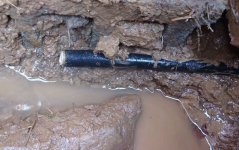
It is a black plastic pipe. Here are photos:

waterline.jpg waterline2.jpg

I am assuming that the white broken plastic piece is a barb that somehow attaches to the elbow. I am going to take the whole thing to a hardware store and try to get the parts I need. I hope the plastic is not brittle like the previous message mentions.

Do I need any kind of adhesive or can this thing just be plugged in and screwed on (assuming I can get the elbow to come off).

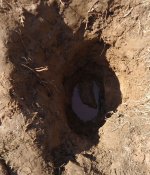
Here's a photo of the hole in case anyone is curious:

hydranthole.jpg
 
   / Frost Free Yard Hydrant leaking down below #20  
That's black PE pipe- standard stuff. You shouldn't have problems with it being brittle. Thin-wall pvc stinks for underground use, but your PE looks like a reasonable psi-rated pipe. Not super thick but thick enough for what your doing. When you replace the unit, I would advise filling the base of the hole with a bunch of gravel- makes it a lot easier for the frost free to drain down.
Edit: with barbs you generally don't need any kind of adhesive. Just some heat, the worm clamp, and driver to tighten it all up. You'll need some teflon tape to put a new elbow on. Good luck with that rusted sucker!
 

Tractor & Equipment Auctions

500 BBL FRAC TANK (A58214)
500 BBL FRAC TANK...
INTERNATIONAL DUMP TRUCK (A52707)
INTERNATIONAL DUMP...
2003 PETERBUILT PB330 DUMP TRUCK (A58375)
2003 PETERBUILT...
2023 MADJAX GENESIS 300 ELECTRIC CART (A57192)
2023 MADJAX...
2020 Freightliner M2 106 AWD Altec DC47TR Digger Derrick Truck (A60460)
2020 Freightliner...
SKID STEER ATTACHMENT MULCHER (A58214)
SKID STEER...
 
Top