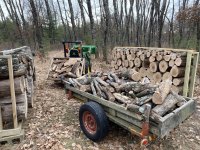
Gathering fallen timber for firewood

   / Gathering fallen timber for firewood #41  
So....the fire department or inspection agency assumes liability if the stove or chimney then catches the house on fire? Seeing how they collected money and certified it?
.....yeah, I didn稚 think so.
That just proves itç—´ a shakedown.

Not following your logic. That's like saying that if you pass a physical and get hit by a bus the next week the doctor somehow ripped you off. The inspection is just to verify that the stove is installed correctly. That doesn't mean once the inspector leaves you can put an upholstered chair right next to it and still be safe. Or if the house burns down because of a grease fire in the kitchen. It just gives you some proof it was a safe installation when the inspector was on the premises in the event your insurance company wants to dismiss a potential claim for a faulty installation.
It's not a guarantee you won't do something stupid or unsafe.

Can you have outside wood boilers where you live?These would tie right into your existing hot water or forced air heating system. This eliminates needing a chimney built for a wood stove. This eliminates a lot of cutting and splitting as you can throw big pieces in it. It doesn稚 matter if you burn junk wood, or pallets, no creosote worries, or if there痴 bugs or dirt in the wood, wet wood, etc. (other than there痴 less BTU痴).
Wood is a lifestyle. Itç—´ carbon neutral.

Agree that heating with wood is as much lifestyle as it is an economic move. If you count your time you rarely come out ahead.

I don't get the appeal of the outdoor furnaces except that it keeps the wood, smoke and ashes out of the house. You use a LOT more wood with one vs a woodstove, not really good in the off-season when you just want to take the chill off, doesn't work if the power goes out and between the upfront cost and installation can get quite expensive. Not to mention the joy of trudging out in sub-zero weather to fill it up, or get it going again if it burns down.
I suppose it's the only way to heat with wood if the layout of your house doesn't really allow for a stove (ie-a lot of small-ish rooms/little open space, not enough clearance).
 
   / Gathering fallen timber for firewood #42  
What in the world are we talking about here. A "permit" for a wood stove. Installed by a "licensed/certified installer". You would be laughed out of the store if you were to ask those questions around here. If you were to need help on the instal - the store may be able to recommend somebody that could help. Some of those wood stoves can get pretty heavy/bulky. Is this another one of those - east or west of the Mississippi deals, again.

I've been with State Farm since 1965. They knew I had a wood stove - then a pellet stove. There was never a premium increase because of that.

We need a permit for chimneys, additional electrical circuits, water heaters, furnaces, etc... so a wood stove is no different.

The wood stove store is the certified installer and pulled the permit. Easy peasy.
 
   / Gathering fallen timber for firewood #44  
Most new wood stove installs in Cali require catalytic converter in chimney....

The stove emissions requirements I know of in CA all require EPA certified stoves. While there are some stoves that meet that by using a catcon the majority use passive reburning technology. Supposedly the catcon stoves can get a little more heat out of the wood but the reburning stoves do really well already. There's little downside to running one. The catcons need periodic cleaning but my neighbor who burns a lot is happy with his.

CA has a myriad of air pollution districts, each with their own rules. When you understand the distribution of population, geography and prevailing winds, that isn't as silly as it sounds. The major population areas around SF and LA are both surrounded on three sides by mountains, with ocean on the other side. Since the wind comes from the ocean, the hills tends to trap pollution in those areas. In the past it had gotten pretty bad at times. When I was a kid in the '60s and '70s in the eastern part of the SF bay area the air could get really awful. Even though population is up by 50% and people drive more, it's much better now. While I don't agree with every air pollution regulation, they have been effective. (I'm writing this for folks who live far from CA, I'm sure Dale knows it).

The SF bay area's air quality board has banned wood stoves and fireplaces for new construction. Since the vast majority of houses in those counties are in suburbs or cities, and the winter temps are often in the 50s and 60s, there's not a lot of need. If I'd been writing the regs I would have allowed EPA stoves, but they didn't ask me.
 
   / Gathering fallen timber for firewood #45  
Not following your logic. That's like saying that if you pass a physical and get hit by a bus the next week the doctor somehow ripped you off. The inspection is just to verify that the stove is installed correctly. That doesn't mean once the inspector leaves you can put an upholstered chair right next to it and still be safe. Or if the house burns down because of a grease fire in the kitchen. It just gives you some proof it was a safe installation when the inspector was on the premises in the event your insurance company wants to dismiss a potential claim for a faulty installation.
It's not a guarantee you won't do something stupid or unsafe.
.

A Doctor who gives you a physical is responsible if you get hit by a bus? I wasn’t making that argument.
I’m talking about if there’s a fire that is a result of the installation. If they require you to pay them money to certify it, do they assume liability, like a structural engineer does when they certify something.
Or is it just a shakedown?

What’s does certified actually mean if there’s no assumption of liability?
 
   / Gathering fallen timber for firewood #46  
They don't certify it. They inspect it just make sure its not some tin foil pipe stuck out the window and its not sitting on carpet..... I know its just a money grab...
 
   / Gathering fallen timber for firewood #47  
One local volunteer fire department used to go around every fall cleaning chimneys; they said that they would rather do that in October than fight chimney fires in January. I heard they had to stop because of the liability involved. Some of the posters here seem like the type who made them stop...
 
   / Gathering fallen timber for firewood #48  
A Doctor who gives you a physical is responsible if you get hit by a bus? I wasn’t making that argument.
I’m talking about if there’s a fire that is a result of the installation. If they require you to pay them money to certify it, do they assume liability, like a structural engineer does when they certify something.
Or is it just a shakedown?

What’s does certified actually mean if there’s no assumption of liability?

Generally speaking, the inspectors cannot be held liable. It has something to do with "the good of the community" VS "the good of the property owner" as to why building codes are in place. The inspector's duty is to try to his best ability to see that the building codes were followed and enforce them if he sees violations. If he misses something, well, he tried.

The liability rests on the contractor, not the inspector. If you did the work yourself, the liability rests on you, not the inspector.

At least, that's the way I understand it.

It doesn't seem to be a shakedown. For example, if I want to add a new lighting circuit, it's $15 permit. I have to go downtown and pull a permit. The clerks have to gather all the paperwork, file it properly, etc... Then I have to make an appointment with the inspector, he or she has to come out to my house, look over the work, write his paperwork, etc... it's gonna cost them more than $15 in labor. It's not a money maker.
 
   / Gathering fallen timber for firewood #49  
Generally speaking, the inspectors cannot be held liable. It has something to do with "the good of the community" VS "the good of the property owner" as to why building codes are in place. The inspector's duty is to try to his best ability to see that the building codes were followed and enforce them if he sees violations. If he misses something, well, he tried.

The liability rests on the contractor, not the inspector. If you did the work yourself, the liability rests on you, not the inspector.

At least, that's the way I understand it.

Then what does “certification” mean?
Your (an other’s) definition has a very different meaning than mine.
When I give my word, or certification, it means something.
For others, maybe not.
Oh well, I’ve been in the minority before. Peace.
 
   / Gathering fallen timber for firewood #50  
One local volunteer fire department used to go around every fall cleaning chimneys; they said that they would rather do that in October than fight chimney fires in January. I heard they had to stop because of the liability involved. Some of the posters here seem like the type who made them stop...

Did they prohibit people from using their own chimney unless they paid?
Otherwise it seems very different.
Sorry for the interruption.

...and now...back to our regularly scheduled program...
the OP’s questions about gathering and burning wood.
 
Last edited:
   / Gathering fallen timber for firewood #51  
Been heating my home with mostly firewood for the past 30 years. I like wood heat but it’s definitely not a money saver in fact I think it winds up being more expensive than LP gas. Then one year the insurance company said they weren’t going to insure homes with wood heat anymore so I had to find a new insurance company but that was pretty easy. I live on 120 acres that’s mostly wooded, but if you figure in all the extra work , equipment and fuel wood heat definitely doesn’t make much sense but I keep doing it. One of my best friends got killed making firewood last spring.
 
   / Gathering fallen timber for firewood #52  
As a kid people were always offering to clean up storm fall oaks on the property... no one has for many years as burning on cold winter nights is not permitted and no wood burning in new construction to the point trying to get laws passed to remove existing by bricking up existing chimneys or remove.

For about a decade you could get paid going to gas but that ship pretty much sailed.

The bottom line is it all depends on local regs.

I shopped for insurance but having a permitted CAT fireplace ended that... simply a deal breaker

As for permits the cost started at $350 to pull and replace a toilet, connect a gas stove, or cut down the old walnut tree grandpa planted 50 years ago...

The new move is to require removal of wood chips...
 
   / Gathering fallen timber for firewood #53  
As a kid people were always offering to clean up storm fall oaks on the property... no one has for many years as burning on cold winter nights is not permitted and no wood burning in new construction to the point trying to get laws passed to remove existing by bricking up existing chimneys or remove.
What location are you talking about here?
 
   / Gathering fallen timber for firewood #54  
You can usually judge the BTU value of wood by its weight, not counting the water in it. Dead and or punky wood usually weighs almost nothing and has similar BTUs. It’s sometimes hard to control in a woodstove as it wants to burn instantly like paper (if dry).

Also, standing dead trees are some of the most dangerous trees you can cut. They are often unpredictable, and subject to snap their holding wood, or be hollow inside and have no holding wood, or have upper limbs that snap and fall and make you late for dinner (aka widow makers).

Agree 100%. Downed wood/timber usually has low firewood quality. Burning rotten wood does nobody or the environment any favors. Plenty of good wood to help manage the forest by thinning, saw log harvesting or clearing to consider. Heat with wood you want good fuel.

Have watched a huge red mulberry die in my front yard for decades. Planted or left centuries ago around the pioneer homestead. Dead 15 years ago, 4’ at base still some limbs 50-60’. Poison ivy and Virginia creeper vines cover most of it. It is a wildlife magnet. Preferred perch for hawks and owls. Pileated wood peckers use the dead limbs as sounding boards for their mating territory. Hummingbirds nest in it. Flocks of turkeys have roosted overnight. Home to raccoons and squirrels in the hollows. Always puts on a good show. My point is dead trees play a vital role in forest health. There are better options for firewood.
 
   / Gathering fallen timber for firewood #55  
What location are you talking about here?

SF Bay Area... but Olympia WA also has started with no burn periods and stringent wood stove requirements.
 
   / Gathering fallen timber for firewood #56  
I am glad there are still places you don’t need a permit to install a light circuit or a toilet.
 
   / Gathering fallen timber for firewood #57  
One year, it got Dow to 37 below F in Adams county WI. in February. I was ready. It was 78 in the cabin. I had no furnace. Here’s a great passage from the book, A Sand County Almanac by Aldo Leopoldo.

“There are two spiritual dangers of not owning a farm. One is the danger of supposing that breakfast comes from the grocery, and the other that heat comes from the furnace. To avoid the first danger, one should plant a garden, preferably where there is no grocer to confuse the issue. To avoid the second, he should lay a split of good oak on the andirons, preferably where there is no furnace, and let it warm his shins while a February blizzard tosses the trees outside. If one has cut, split, hauled, and piled his own good oak, and let his mind work the while, he will remember much about where the heat comes from, and with a wealth of detail denied to those who spend the weekend in town astride a radiator.”

IMG_0698.JPG
 
   / Gathering fallen timber for firewood #58  
One year, it got Dow to 37 below F in Adams county WI. in February. I was ready. It was 78 in the cabin. I had no furnace. Here’s a great passage from the book, A Sand County Almanac by Aldo Leopoldo.

We moved in our house on New Year's Day, 1985. It was 69 degrees for a high. Three weeks later, it hit -21, a record here in East TN. We were heating with a fireplace, and I had almost no wood cut ahead. Resolved THAT would never happen again, and since then, I've kept at least a year ahead cut. Last few years, I've keep 2-3 years ahead (4-6 cords/yr)

As soon as I move the contents of one of my four 4 cord sheds to the basement, I begin refilling for 2-3 winters out.

Sheds under construction: (Just barely slide out the 12' x10' roll up door in the shop)

enhance


Roof and hose 'em down with paint out in the driveway:

enhance


Drag to various locations around the farm, and fill:

enhance


enhance


4 cords in the basement:
enhance
 
   / Gathering fallen timber for firewood
  • Thread Starter
#59  
Wow, lots of great info and advice and I really appreciate it!

Equipment...
I do have a good chainsaw. For years I had used my Dad's old Poulan and was finally fed up with it and bought a new Stihl last summer. I've learned to sharpen it a lot better over the past year freehand, but the Stihl 2 in 1 easy file makes it a breeze. I still like to be able to do it well free hand though.
I figured a grapple would make light work of some things but I have considered just adding a thumb to the backhoe first before going all out for the grapple. I hadn't considered just dragging logs to a landing to cut to length or trailer home. That would be a good option.
My brother in law has a splitter that I could borrow if needed to get started, but I would prefer to eventually have my own.
I know a guy that does furnace and AC work that I could have set up an indoor wood stove or outdoor furnace if it had to be done 'professionally'. I was leaning towards an indoor woodstove mainly because of price, but I would have to check on insurance issues and it does concern me a little with the flu stack and so on. I wouldn't mind the outdoor furnace. I am constantly taking my dog out in the same area that I would place one, and the firewood, so that wouldn't bother me any. I'm used to it. It is more of an investment but may be worth it in the long run.
My basement is not finished at all, and no insulation on the walls. Just sealed and painted block wall and concrete floor. Not finished, but kept clean. It is all open floor with a man door, and a 7 x 9 utility door on one end. Can't call it a garage door or section off a garage area without getting into insurance issues due the house being overhead. We have a double wide on the foundation. It has the typical insulation on the under side, which is basically the ceiling for the basement. Even a kerosene or wall mount gas heater keeps the basement at around 60° on the coldest nights and it definitely keeps the house level furnace from running quite a bit. My oil heat tank is in the basement also,, which im sure any wood stove would have to be x feet away from it for safety and insurance reasons. Again,, maybe the outdoor furnace would be the better option. I've never looked in to insulation for the walls but that makes sense to be the best place to start to aid with any additional heat source.

The woods... it is on a mountain side. There are a few relatively level areas but 80% of it is not flat. The only good thing would be it is all downhill to get back to the truck. Easy dragging, hauling etc. I could access the majority of it with the tractor pretty safely though, other than a few really rocky spots. I'm glad several folks brought up the fact of dead fallen trees being important to replenishing the soil and homes for critters, hadn't thought of that. Obviously a lot of the already downed trees wouldn't be good for firewood, they've been down too long. But if I would start snagging some as they fall, especially the ones fall over trails, and using them for free firewood rather than go to waste. I don’t think all the more I would use or need would impact the woods too much. And that is the plan, to utilize this wood rather than just toss it to the side. Also glad that folks mentioned about the time frame for firewood to dry. It sounds like if I started anything this winter or spring it may be good for next winter.

You folks have given me a ton of info and advice to consider already and I'm very grateful. This is yet another thing that I can put my little tractor to work with. Any seat time on the tractor is time well spent. I'm anxious to learn more about my options and it looks like there is a wealth of experience and info to go over here. I'll probably contact the heating and AC guy that I know and get some specs and have him evaluate my specific situation before diving into anything. Glad I finally have some direction though.
 
   / Gathering fallen timber for firewood #60  
Any problems with bugs in the wood while storing in your house?
 

Tractor & Equipment Auctions

1968 Oliver Model 1950 2WD Tractor (A56438)
1968 Oliver Model...
2022 Horizon Trailer (A55973)
2022 Horizon...
Toyota 7FGCU25 5,000 LB Cushion Tire Forklift (A59228)
Toyota 7FGCU25...
SDLD25 MINI DUMPER (A58214)
SDLD25 MINI DUMPER...
GEARMATIC WINCH CABLE DRUM (A58214)
GEARMATIC WINCH...
(INOP) 2007 VOLVO A35D OFF ROAD DUMP TRUCK (A60429)
(INOP) 2007 VOLVO...
 
Top