Grass Seeders / Drills

   / Grass Seeders / Drills #1  

JeffInCO

Bronze Member
Joined
Dec 8, 2008
Messages
59
Location
Northern Colorado
Tractor
1952 Ferguson TO-30
I'm looking into buying some kind of drill or seeder for planting grass. I need to do all of the following:

1) Overseed already established grass pastures (16 acres)
2) Start from scratch with another pasture (2 acres)
3) Seed turf near our house (Kentucky Bluegrass), about 1/3 acres.
4) Seed native grasses (Blue Grama) a little further from the house. 2/3 sq feet. (and Blue Grama seed is pricey, so drilling vs broadcasting will have some payback!)

In total, I have 20 acres that are mostly grass and I will need to maintain on an ongoing basis.

I have both a Kubota Grand L 4740, a tiller, and a chain harrow.

My only experience so far seeding was on 1/4 acre, with annual rye. I tilled, dragged the chain harrow, seeded (with a human-propelled wheeled fertilizer spreader), then dragged once more. I found that the soil was probably not compacted enough, as the areas where the tractor tires ran sprouted much thicker and faster than the other areas.

What is the difference between a "drill" and a "seeder"? "Grain" vs "grass"?

Any suggestions for an all-purpose solution?

Thanks,

Jeff

 
   / Grass Seeders / Drills #2  
The difference between tractor mounted drills and seeders is that a drill precisely places the seeds in a row, while a seeder drops seeds either in a curtain or rotary broadcast across the travel path of the tractor. Both can control the rate at which the seed is planted, but generally you have better control of the flow and placement with a drill.

In order to control the rate of seed dropping, there usually is an adjustment mechanism for seed size; so this is where the main issue regarding grain vs grass comes into play.

Most grains and grasses tend to be fed through the hopper by gravity. Native grasses tend not to work so well by gravity alone, so usually you'll see manufacturers offer an optional native grass feeder mechanism that assists in pushing the seed out of the hopper.

There are a number of different rig setups, ranging from a simple rotary broadcaster that fits on your PTO, to mutli-tool rigs that may include some type of ground-engaging tool followed by a fertilizer spreader then the seeder/planter (some with multiple seed hoppers) and then a cultipacker.

I plant 8-16 acres of alternating rows of legumes and grasses each year, depending upon my rotation schedule. It usually doesn't take me more than 2 days to do this with my current rig. Because of the unique requirements of our particular operation, I own my own drill. But, for a once a year operation for 16 acres, it would likely be more economical to rent the equipment.

Here are two websites that will give you a feel for the types of seeders that are available. There are a number of companies that make good seeders and drills, these two just happen to be ones I was looking at recently:
Seeders | Land Pride
Drills & Seeders | Kasco Manufacturing Co., Inc.

The decision on which type of rig to use will have a lot to do with how much you are willing to spend and your particular situation. The best advice I can give you is to call up a manufacturer or two and talk to them about your operation.
 
   / Grass Seeders / Drills
  • Thread Starter
#3  
Thanks for the feedback... That definitely cleared some things up for me.

One other question: what is fundamentally different about the till/no-till drills? Is any drill that can over-seed considered a no-till drill?

I'd looked at the Landpride site, but had not yet checked out Kasco. It looks like they definitely have some interesting models.

I'll also look into renting, as I know drills are pricey.

Thanks,

Jeff
 
   / Grass Seeders / Drills #4  
The type of ground you are seeding and how much prep work you put in ahead of time will determine the type of seeder that best fits the purpose.

A simple broadcast seeder with no attachments can work out ok if you've prepared a good seed bed and you have good seed contact with the surrounding soil. The next step up would be to make a pass with a rake or cultipacker to incorporate/pack the seed into the seedbed.

At the other end of the spectrum would be a no-till seeder (some of which are a type called overseeders) which you don't need to do any seedbed prep. These rigs have devices that open the ground, plant the seed, and then cover/pack the seed.

In between these two extremes you have so-called minimum-till seeders/drills. These generally have some tool ahead of the seeder/drill that opens the ground to some degree, but not as much as a no-till machine, and generally require some amount of prep work.

Always assume that if the manufacturer doesn't specifically call the seeder/drill "no-till" you have to do some soil preparation, which will depend on the condition of your ground. Also, before choosing to use a "no-till" rig, you need to make sure that it will work on the type of ground you have. No-till can work very well in the type of conditions that it was made for, but not in all conditions.
 
   / Grass Seeders / Drills #5  
Thanks for the feedback... That definitely cleared some things up for me.

One other question: what is fundamentally different about the till/no-till drills? Is any drill that can over-seed considered a no-till drill?

I'd looked at the Landpride site, but had not yet checked out Kasco. It looks like they definitely have some interesting models.

I'll also look into renting, as I know drills are pricey.

Thanks,

Jeff

the best thing for you would be 1 of the 350lb broadcast seeders thats 3pt an runs off your pto.they work real good to boot.
 
   / Grass Seeders / Drills #6  
Here is a thought............

You can look at used golf course equipment for a secondary seeder.
Should be able to save a bunch of $...........

But remember it is a secondary seeder. Most don't work well as primary seeders.

Like was said, the germination rate is worth spending more for a seeder than just broadcast and drag seeding.

Good luck
 
   / Grass Seeders / Drills #8  
Anyone have an idea on what a 6/7ft NO-TILL would cost daily? I have 38acres to do this spring.
 
   / Grass Seeders / Drills #9  
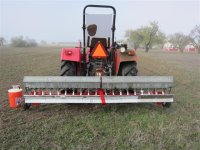
Woods Equipment offers a 3pt "renovator" that might fill your needs Jeff. I forget the name of the actual manufacturer that Woods rebrands the product. Perhaps in the past 4 years, they took over the manufacturing end of it too but at that time they were not. There was no way I could afford a new one so I really had to search for the one I bought that originally was used at a golf course. Woods sells them in the 4', 5', and 6' widths. Very simple in engineering, 3pt hook up, and there are two spiked steel rollers that you "cant" depending on how much soil preparation you require. The seeding part of the operation is a simple box holding the seed, at the bottom there is an auger of sorts that stirs the seed, with an adjustable opening to regulate the amount of seed you drop on the ground. Right behind that is another "fixed" spike drum that ensures that the seed is covered and compacts the seed base. That is it! Incidently, Woods labels it as STR72S-2 and the 72 refers to the width - 6'. I used it initially to put in my new lawn and since have used it for food plots, and ground cover planting. For landscaping, it does a beautiful and professional job as well as the other jobs I found for it. It was in excellent shape when I bought it used and paid $2 grand for it. I believe a new one might retail at $6 grand. I'm not promoting the name Woods in any respect but I like the concept. In the course of the 4 years I've had this one - there has been a steady increase of imports and their reliability has also been excellent and a whole lot less expensive but based on the same concept.

I hope this helps you a little Jeff!

Gary
 
   / Grass Seeders / Drills #10  
In Virginia counties, you can rent from county extension office. I'm not sure what the cost is, but this may be an option for you, it's worth a call.

Eddie
 
   / Grass Seeders / Drills #11  
I'm looking into buying some kind of drill or seeder for planting grass. I need to do all of the following:

1) Overseed already established grass pastures (16 acres)
2) Start from scratch with another pasture (2 acres)
3) Seed turf near our house (Kentucky Bluegrass), about 1/3 acres.
4) Seed native grasses (Blue Grama) a little further from the house. 2/3 sq feet. (and Blue Grama seed is pricey, so drilling vs broadcasting will have some payback!)

In total, I have 20 acres that are mostly grass and I will need to maintain on an ongoing basis.

I have both a Kubota Grand L 4740, a tiller, and a chain harrow.

My only experience so far seeding was on 1/4 acre, with annual rye. I tilled, dragged the chain harrow, seeded (with a human-propelled wheeled fertilizer spreader), then dragged once more. I found that the soil was probably not compacted enough, as the areas where the tractor tires ran sprouted much thicker and faster than the other areas.

What is the difference between a "drill" and a "seeder"? "Grain" vs "grass"?

Any suggestions for an all-purpose solution?

Thanks,

Jeff

Here is a link to our equipment related to seeding as of today. Ken Sweet
Used Covington 1 Row Planter with Cultivator and 3 Point, CAN SHIP CHEAP FAST items in Sweetfarmequipment store on eBay!
 
   / Grass Seeders / Drills #12  
till / harrow it down / broadcast spreader/ roller packer

This method always works for me as long as my soil samples(and added the right stuff usually 2.5 ton of lime a acre for me) have been done and I have rain . This is also the cheapest. I have family that lives close by that have both types of drills and they use the same method.

Were you want to overseed I'd go with the renorvator or anything to scratch the surface up then broadcast spreader before good rain
 
Last edited:
   / Grass Seeders / Drills #13  
In Virginia counties, you can rent from county extension office. I'm not sure what the cost is, but this may be an option for you, it's worth a call.

Eddie
I do not know about all Kansas Counties but my home County (Osage) extension office in Eastern Kansas also has drills for rent, cheap! In fact, when I first bought my little 40 they had a program going to establish native grass. They brought their drill full of their seed to my place and all I had to do was hook it to the tractor and put it back in the same spot when done.:D Now I am moving to horse pasture grass and I will be renting their drill:thumbsup: and using my seed.:( Not that bad actually. Even if I use a drill every other year (which I hightly doubt) it is still a bargain to rent versus buy, store and maintain. Good luck!
 
   / Grass Seeders / Drills #14  
You may want to check out the Truax Grass Drill and the Truax Grain Drill. These are often what some counties will rent to users. It is available with up to 3 seed boxes for all types of seed, and also has a no-till option. It competes with a Great Plains Drill and is a step above the Kasco.

I just bought a used one, a 5 footer, with no-till ability, for $4500. It is a beast, weighing about 3000 lbs. I have not used it yet but it has very good reviews and can plant just about anything.
 
   / Grass Seeders / Drills #15  
I'm looking into buying some kind of drill or seeder for planting grass. I need to do all of the following:

1) Overseed already established grass pastures (16 acres)
2) Start from scratch with another pasture (2 acres)
3) Seed turf near our house (Kentucky Bluegrass), about 1/3 acres.
4) Seed native grasses (Blue Grama) a little further from the house. 2/3 sq feet. (and Blue Grama seed is pricey, so drilling vs broadcasting will have some payback!)

In total, I have 20 acres that are mostly grass and I will need to maintain on an ongoing basis.

I have both a Kubota Grand L 4740, a tiller, and a chain harrow.

My only experience so far seeding was on 1/4 acre, with annual rye. I tilled, dragged the chain harrow, seeded (with a human-propelled wheeled fertilizer spreader), then dragged once more. I found that the soil was probably not compacted enough, as the areas where the tractor tires ran sprouted much thicker and faster than the other areas.

What is the difference between a "drill" and a "seeder"? "Grain" vs "grass"?

Any suggestions for an all-purpose solution?

Thanks,

Jeff

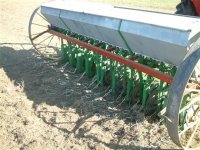
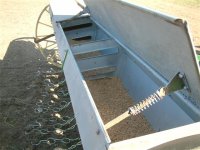
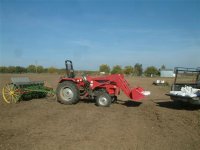
A drill (aka grain drill) is used to row-plant larger size seeds (wheat, oats, etc) in hayfields. Here's the one I restored--a vintage Minneapolis Moline P3-6 grain drill (10-ft wide, 20 drops, 6" between rows, single disc openers to make the groove to receive the seed).

Drill-3.JPGDrill--4.JPGDrill-6.JPG

The large seed box can also be used to spread fertilizer and seed/fertilizer mixes in rows.

A grass seeder is optimized to handle small size seed (ryegrass, vetch, fescue, etc). Grain drills sometimes have grass seed boxes attached to the larger grain/fertilizer box. You can see the grass boxers in the photos above.
One problem with this type of grass seeder is that it plants in rows. If you want to plant in a solid line (curtain seeding), you can use drop spreaders like those made by Gandy, Brillion, Landpride and several others.

I made a drop spreader using the grass seed boxes on my grain drills. I welded a tube frame to carry the boxes, a pair of 2-bounce seed chutes, chains, axles and drive wheels.

Drop spreader-1.JPGDrop spreader -2.JPGDrop spreader-3.JPG

I planted a Lana vetch/annual ryegrass mix with this custom drop seeder last Nov. The seed was pressed into the surface using my 9-ft wide cultipacker.

There are also several types of broadcast spreaders: ones that use a spinning disc; pendulum spreaders (google these names to see what they look like).

All purpose seeder: cheapest way to go is the spinning disc broadcast spreader. These devices work OK for larger size seed and pelletized fertilizers. Smaller seed is usually mixed with larger size particles (fertilizer pellets, sand, pea gravel, etc) to get the broadcast spreader to work adequately.

Good luck.
 
   / Grass Seeders / Drills #16  
Woods Equipment offers a 3pt "renovator" that might fill your needs Jeff. I forget the name of the actual manufacturer that Woods rebrands the product. Perhaps in the past 4 years, they took over the manufacturing end of it too but at that time they were not. There was no way I could afford a new one so I really had to search for the one I bought that originally was used at a golf course. Woods sells them in the 4', 5', and 6' widths. Very simple in engineering, 3pt hook up, and there are two spiked steel rollers that you "cant" depending on how much soil preparation you require. The seeding part of the operation is a simple box holding the seed, at the bottom there is an auger of sorts that stirs the seed, with an adjustable opening to regulate the amount of seed you drop on the ground. Right behind that is another "fixed" spike drum that ensures that the seed is covered and compacts the seed base. That is it! Incidently, Woods labels it as STR72S-2 and the 72 refers to the width - 6'. I used it initially to put in my new lawn and since have used it for food plots, and ground cover planting. For landscaping, it does a beautiful and professional job as well as the other jobs I found for it. It was in excellent shape when I bought it used and paid $2 grand for it. I believe a new one might retail at $6 grand. I'm not promoting the name Woods in any respect but I like the concept. In the course of the 4 years I've had this one - there has been a steady increase of imports and their reliability has also been excellent and a whole lot less expensive but based on the same concept.

I hope this helps you a little Jeff!

Gary

Clyde has the right one. I've rented this model many times for overseeding lawns only in a Frontier brand. There are the exact same thing just a different color. The last time I checked the Frontier was more pricey.

Like Clyde said they are simple but very effective. Sturdy heavy duty frame. The Woods STR-60 is on the list for my next purchase.
 
   / Grass Seeders / Drills #17  
Clyde has the right one. I've rented this model many times for overseeding lawns only in a Frontier brand. There are the exact same thing just a different color. The last time I checked the Frontier was more pricey.

Like Clyde said they are simple but very effective. Sturdy heavy duty frame. The Woods STR-60 is on the list for my next purchase.

Landpride APS 15 series is very similar, if not just a rebranded version.
 
   / Grass Seeders / Drills #18  
Landpride APS 15 series is very similar, if not just a rebranded version.

The Landpride is somewhat different from the Frontier and Woods but do the exact same thing the same way. Angle adjustable spiked rollers in front of the seed box and the stationary spiked roller in the back. All ground driven.

The spikes on the Landpride seem to spiral pattern around the rollers while the spikes on the Frontier and Woods are staggered.

I don't know if one works better than the other. Its all dropped seed and spiked rollers.

I don't think you could go wrong with any of them.
 
   / Grass Seeders / Drills
  • Thread Starter
#19  
Thanks to all for the feedback...

One question on the Woods STR60: Does anyone have experience with this implement and the small/fluffy blue grama seed?

Thanks,

Jeff
 
   / Grass Seeders / Drills #20  
Thanks to all for the feedback...

One question on the Woods STR60: Does anyone have experience with this implement and the small/fluffy blue grama seed?

Thanks,

Jeff

As long as it has the brush type agitator in the bottom, you will do fine. Ken Sweet


Tractor & Equipment Auctions

1992 AM General M998 HMMWV 4x4 Humvee Truck (A59230)
1992 AM General...
1998 PETERBILT 377 MIDROOF SLEEPER (A58214)
1998 PETERBILT 377...
HIGH END MINI GOLF CART (A58214)
HIGH END MINI GOLF...
2015 CATERPILLAR 259D SKID STEER (A60429)
2015 CATERPILLAR...
2015 Freightliner M2 106 Terex Hi-Ranger TL55 55ft. Insulated Material Handling Bucket Truck (A60460)
2015 Freightliner...
2020 PETERBILT 567 (A58214)
2020 PETERBILT 567...
 
Top