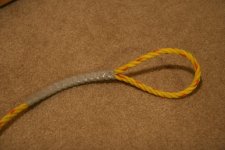
Great wire rope trick

/ Great wire rope trick #1  

bx24

Platinum Member
Joined
Jan 11, 2006
Messages
668
Location
Indiana
I have learned a ton of stuff from reading this forum, so I thought I would share some of my experience. If you have ever broken a winch line or wire rope and needed to put a new "eye" on the end, then this is the trick for you.

My crew worked for more than 10 years using a winch rated at 25,000 lbs and during that time, we snapped the 1/2 wire rope hundreds of times. We did not use "U Bolt" clamps on the line to make new eyes, we only used vinyl tape! With all those breaks, I cannot remember a single time where our eyes failed (often the factory built eyes would fail because they were old and abused - if we ever had any doubts, we would cut the factory "crimp eye" off and weave a new one.

This whole process took less than 10 minutes and worked like a charm. This technique will work for any rope (steel strand, nylon etc regardless of the number of individual strands), but it works especially well with wire rope.

ONE WORD OF CAUTION >>>> ALWAYS WEAR SAFETY GLASSES WHEN WORKING WITH WIRE ROPE!!!!!!!!!!!! <<<<

Once when I was tying one of these, one of the strands slipped out of my hand and swept right across my face leaving deep scratches in the middle of my safety glasses. Had I not been wearing them, I would really have screwed up my eyes. I don't always wear them like I should, but this is NOT the time to be lazy.

Concepts:

The larger the loop and longer the tail, the stronger the eye. This comes from the fact that more length means more friction, and more friction means more strength. When I worked with 1/2 inch winch lines, we made the loops between 8 and 12 inches around with 6 to 8 inch tails.

Now for the instructions. I used nylon rope for these pictures, but again, any rope (wire or otherwise) will work so long as it is woven strands.

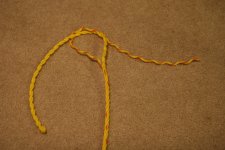
1- Decide how big you want the loop and unwind the rope 1.5 x that length. If the rope has three strands, separate one of the three strands. If it has 9, separate them into one group of 5, and the other group of the remaining 4 (you get the idea) Lets assume for this example we want the loop length to be 12 in (all the way around the eye), so unwind about 18 in of rope

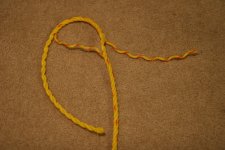
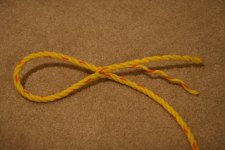
2- Here is the big trick, cross the two unwound groups and wind them back together so they fit back into the groves (so it looks like the rope started out)

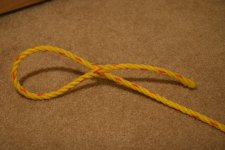
3- Once you get to the bottom of the loop, wind the remaining 6 inches together and tape up the end. You don't have to tape the end (we often didn't when we knew we would be tearing up the winch line otherwise. In case you were wondering, our winch started out with 2000 ft of line!)

With that you are done! Thats pretty much it for wire cable tricks, but I have a bunch for regular ropes if anyone is interested. Enjoy!
 

Attachments

  • First Unwrap.JPG
    First Unwrap.JPG
    168.1 KB · Views: 3,744
  • Cross the legs.JPG
    Cross the legs.JPG
    165.7 KB · Views: 3,621
  • Re Weave the legs.JPG
    Re Weave the legs.JPG
    159.7 KB · Views: 3,577
  • Finish the loop.JPG
    Finish the loop.JPG
    154.2 KB · Views: 3,510
  • Weave the tails.JPG
    Weave the tails.JPG
    139.3 KB · Views: 3,103
  • Woven eye.JPG
    Woven eye.JPG
    131 KB · Views: 3,528
  • Tape the tails.JPG
    Tape the tails.JPG
    143.1 KB · Views: 3,212
  • Finished loop.JPG
    Finished loop.JPG
    139.9 KB · Views: 3,982
/ Great wire rope trick #2  
Hey, that's especially cool! Even looks like it might work with polypro rope!
 
/ Great wire rope trick #3  
How far do you weave the rope back? do you have picks of wire rope being weaved? I have seen winch truck operators just tie a knot on thier cable and keep on working when the line broke. I would trust wire rope clips myself as long as one know how to apply them. Its faster than weaving. Thats why the wire rope industry went to a mechanical splice vs the hand splice-- which is what you are describing.
 
/ Great wire rope trick #5  
On a quick side note, you can cut wire rope very easily with just a comon tools in your shop. Take a hatchet or single sided axe and lay it down on concrete or an anvil. Now with the blade pointing straight up, lay the rope down across the ax. Take a hamer and drive the rope into the blade. When you are almost thru, be careful not to damage the blade by hitting it with the hammer. It is very easy and does not really dull the ax.
My dad learned this building a couple thousand foot suspension bridge (just for walking) in Missouri in the 50's. They cut wire rope that was over an inch thick this way. Works like a champ.
Dave
 
/ Great wire rope trick #6  
Seems to me that while it makes a simple loop, it also reduces the strength of the loop to 1/3 that of the rope. The tail section gives no strength. Therefore the side that has the single strand is the weakest point as it takes the full force of the pull.

To make the loop full strength, I would have thought that the tails should be woven back into the main rope. This then makes it similar to normal woven loop.

Cityfarma
 
/ Great wire rope trick #7  
We have used this for years on CJ's with PTO winches. Was always told this is a Steamboat Splice. The loop you weave will be just as strong as the cable itself.
 
/ Great wire rope trick
  • Thread Starter
#8  
txslowpoke said:
How far do you weave the rope back? do you have picks of wire rope being weaved? I have seen winch truck operators just tie a knot on thier cable and keep on working when the line broke. I would trust wire rope clips myself as long as one know how to apply them. Its faster than weaving. Thats why the wire rope industry went to a mechanical splice vs the hand splice-- which is what you are describing.

All I can tell you is what we have done in the past, we always made the tails about 1/3 the total amount we un-raveled.

As several folks have mentioned, when working and ultimately loading wire rope, things can and do happen. In the original post, I mentioned that we snapped the winch lines a LOT. Any time the cable has been choked, smashed, nicked or otherwise compromised, you should expect it to fail. Unlike chain, wire rope also stretches so it stores a lot of energy that will cause it to snap far faster than you can move. Never put yourself in line with the cable, either in front or behind what ever you are pulling on. We have shattered windshields the the broken wire rope flew over the top of the truck and hit the glass.

From my own trial and errors, the tails need to be there. As was also pointed out, tape is not critical, but it helps me not catch the tail on things. Even with the heavy 1/2 inch cable we used, I can weave an eye in a little over a minute. This trick will not solve all of your problems, but give it a try and I am pretty sure you will use this trick at some point. To get the hang of it, practice and play with nylon rope and you will see what different length tails do for you. I like this because you can easily weave this eye around fixed objects. One last thing, never choke winch cable, you will damage it!
 
/ Great wire rope trick #9  
Paul,

Interesting. I don't have any experience with wire rope and never would have thought of splicing it like you did.

In the Boy Scouts, we learned to weave the ends of rope to create an eye, splice to pieces together and to create an end to the roap so it will never unravel. In those cases, we always wove the strands into the rope at least three times.

I still do it to day when I want an eye on a rope, but all my ropes already have them and I haven't bought a new rope in years. For fun, I'd cut lengths of rope and weave eyes into them for my Dad's boat and friends of ours who had boats. Nothing as handy as a rope with an eye at the end when docking!!

Thanks for taking the time to post the pics and give the detailed instructions. It's something that I'll remember.

Eddie
 
/ Great wire rope trick #10  
barneyrb said:
We have used this for years on CJ's with PTO winches. Was always told this is a Steamboat Splice. The loop you weave will be just as strong as the cable itself.

I still disagree. While I agree that the rope loop will not slip, the loop of rope is only 1/3 the strength of the main rope. Look at the "re weave the legs" picture. Wind the 2 strands down just short of the the main rope. Without winding the 2 strand tail around the 1 strand tail, the weakest point is the single strand adjacent to the main rope. Now wind the 1 and 2 strands together. If the single strand breaks, the remaining twisted tail will simply pull apart.

If you disagree, please explain where I am wrong.

Cityfarma
 
/ Great wire rope trick #12  
No, guys it has full strength. Think of it in this way. You have divided the line in half that is true, but in the normal load pull direction BOTH halves are taking strain and that is why it is full strength. You are not pulling only on one side, but rather using both sides. It is full strength.

Mike
 
/ Great wire rope trick #13  
The theoretical strength should be at least 2/3 since the load is shared by the other side of the loop. so 2/3 of the rope gets 1/2 of the load and 1/3 gets the other half. The wound and taped tail will allow the cut ends to carry some load.
Check out this link! Look for the Farmer's Eye Splice. They say it is full strength when 2 or more clamps are used.
http://www.worksafebc.com/publications/health_and_safety/by_topic/assets/pdf/splicing.pdf
 
/ Great wire rope trick #14  
bx24 said:
All I can tell you is what we have done in the past, we always made the tails about 1/3 the total amount we un-raveled.

As several folks have mentioned, when working and ultimately loading wire rope, things can and do happen. In the original post, I mentioned that we snapped the winch lines a LOT. Any time the cable has been choked, smashed, nicked or otherwise compromised, you should expect it to fail. Unlike chain, wire rope also stretches so it stores a lot of energy that will cause it to snap far faster than you can move. Never put yourself in line with the cable, either in front or behind what ever you are pulling on. We have shattered windshields the the broken wire rope flew over the top of the truck and hit the glass.

From my own trial and errors, the tails need to be there. As was also pointed out, tape is not critical, but it helps me not catch the tail on things. Even with the heavy 1/2 inch cable we used, I can weave an eye in a little over a minute. This trick will not solve all of your problems, but give it a try and I am pretty sure you will use this trick at some point. To get the hang of it, practice and play with nylon rope and you will see what different length tails do for you. I like this because you can easily weave this eye around fixed objects. One last thing, never choke winch cable, you will damage it!
Being from a past as a commerical fisherman, I had almost forgot that knot. I used it all the time, I just opened the cable and stuck the tail in the main part, blow the eye. It keep the eye from pulling out. I used this splice for helping my friends with their cables also. I never had one fail. As stated always use proper safety, in doing this
 
/ Great wire rope trick #15  
I splice ropes the same way as EddieWalker describes, I learned it as a Boy Scout then had my memory refreshed when I took the rigging course during trade school. You pass the tails under three twists for maximum strength for an eye or a rope to rope splice, you can make the tails longer but no extra advantage is gained. I have never tried making that splice on wire rope but I know it can be done because the steel slings that were site made on a job I worked on in China were made from wire rope. I never timed them but they could make an eye splice in wire rope pretty quickly.
 
/ Great wire rope trick
  • Thread Starter
#16  
cityfarma said:
I still disagree. While I agree that the rope loop will not slip, the loop of rope is only 1/3 the strength of the main rope. Look at the "re weave the legs" picture. Wind the 2 strands down just short of the the main rope. Without winding the 2 strand tail around the 1 strand tail, the weakest point is the single strand adjacent to the main rope. Now wind the 1 and 2 strands together. If the single strand breaks, the remaining twisted tail will simply pull apart.

If you disagree, please explain where I am wrong.

Cityfarma

While I cannot argue the physics of the connection, I can attest by first hand experience that the winch line itself virtually always failed before the eye. On one specific occasion, we just go done putting some new line on the winch and it broke within a day or two (waaaayyyyy more quickly than normal even for us!). We took a section of the cable to the wire distributor and they quickly weaved eyes in the manor I described (no tape) on both ends and put the length into their "snapping machine" (basically a huge ram with a "pull" meter on it). They loaded up the cable and predictably, it snapped somewhere in the middle and NOT at the eyes.

Proof or not, this technique has helped me too many times to remember and has never let me down. Hopefully it will help others. If anyone still has concerns or questions, build some slings with nylon rope and break them between two car hitches .... see what works and what fails. Just make sure to make the eyes a little bigger since the nylon has much less friction, and keep them less than 8 feet so when they snap, there is not enough length to go too far. I know many farmers who call nylon tow ropes "widow makers" because they store so much energy. We had the heavy equipment to do this same thing with wire rope, but I would expect most of you don't have the ability to safely put that much tension on a sling. When I was at the wire distributor, they were making lifting slings and while they used a crimp on aluminum billet to "finish off the tails", they were weaving the eyes first.

One last tip I will share if you are concerned about any rope or winch line snapping. Consider tying some rope to something heavy (cinder block etc) and the other end around the winch line. When it breaks, this will absorb a bunch of the energy of the flying cable and if done right should keep the ends from flying too far.

Good luck all and be safe
 
/ Great wire rope trick
  • Thread Starter
#17  
Brad_Blazer said:
The theoretical strength should be at least 2/3 since the load is shared by the other side of the loop. so 2/3 of the rope gets 1/2 of the load and 1/3 gets the other half. The wound and taped tail will allow the cut ends to carry some load.
Check out this link! Look for the Farmer's Eye Splice. They say it is full strength when 2 or more clamps are used.
http://www.worksafebc.com/publications/health_and_safety/by_topic/assets/pdf/splicing.pdf

Great article Brad. I definitely agree with securing the tail to the pull line (we used tape) to avoid hang ups. We used our winches to pull in sections of communications cable the size of your arm. The longest section I remember pulling was about 1500' through conduit and the reel weighed about 12K lbs with only tape holding the tail.
 
/ Great wire rope trick #18  
MJPetersen said:
No, guys it has full strength. Think of it in this way. You have divided the line in half that is true, but in the normal load pull direction BOTH halves are taking strain and that is why it is full strength. You are not pulling only on one side, but rather using both sides. It is full strength.

Mike
Actually the loop is stronger since both sides of it are almost full strength and they share the load equally. I wager the loop is about 1.5X the rope strength.
larry
 
/ Great wire rope trick #19  
Cool Post!!! I worked for a company that built underground use winches. I took the completed winch to a company that would do what you do. The cable was 2 to 2-1/2" if I remember right. The guy would weave the ends and it was just cool to watch.

Dan
 
/ Great wire rope trick #20  
bx24,

Great tip. It is very similar to a eye spice for double braid class 1 Samson line. I have seen that splice used to secure very large boats and subs.

Here is the Samson site. Look at the class 1 double braid eye splice. A very strong splice.

Thanks,

Cary:cool:
 
 
Top