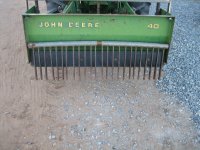
I have no experience in running a box blade and guage wheel but it would seem to me that the guage wheel is riding on a flat, graded surface with the only irregularities being the ones caused by the uneven movement of the tractor as it crosses potholes. That being the case, having the guage wheel closer would mean less vertical movement of the blade as the tractor crosses potholes.
Example A; tractor to cutting edge is 4', cutting edge to guage wheel 1'. While crossing a 5" pothole the cutting edge will lower 1". The secondary effect would be the guage wheel crossing this 1" deep irregularity and lowering the cutting edge .8" As for climbing out of this irregularity there would be a 1' lag and 80% correction per foot traveled.
Example B; If the distance between the blade and and the gauge wheel was equidistant the blade would lower 2.5" when the tractor crosses a 5" deep pothole. The secondary effect would be the gauge wheel crossing this 2.5" deep irregularity and lowering the cutting edge 1.25" As for climbing out of this irregularity there would be a 4' lag and 50% correction per 4" feet traveled.
In this scenario on paper the short gauge wheel seems to be the way to go. More consistent and quicker correction. That being said, my experience working with the box blade is negligible and I have never used gauge wheels so once I get out in the dirt I may find that this logic is flawed.