HELP welding a stub shaft

/ HELP welding a stub shaft #1  

Sodo

Elite Member
Joined
Apr 21, 2012
Messages
3,311
Location
Cascade Mtns of WA state
Tractor
Kubota B-series & Mini Excavator
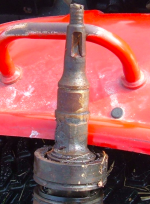
I bought this broken sickle mower thinking I could just weld on a stub shaft. But further discovery shows that this is a very highly stressed connection due to the cyclical loading of the wobble crank. Model is Massey Ferguson MF 31.

Here is a pic of my broken shaft.
353636d1389047168-mf-31-sickle-bar-mower-mf_sickle1.jpg


Here is a pic of Flusher's (TBN) complete, working MF 31 mower. It's the adjustable sheave at right. I suspect it's adjustable so speed can be "tuned" for minimum vibration @ 540 RPM (?).
353917d1389206725-mf-31-sickle-bar-mower-mf31-mower-pulleys-medium-.jpg

354302d1389374545-mf-31-sickle-bar-mower-mf31-drive-pulley-1-medium


Here is a pic of a (damaged) MF 31 shaft from TBN's Barry1.
354535d1389473063-help-welding-stub-shaft-mf-31-shaft-keyway-ruined.png


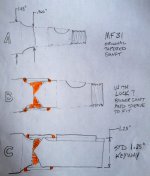
Here is a pic of 3 ways I might repair it.
354534d1389473060-help-welding-stub-shaft-mf_31shaftabc.jpg


A) Obtain an intact replacement shaft. This would be the best solution but it doesn't seem like there are any available. maybe all broken?

B) Find a larger tapered shaft and weld it on, with a sleeve over the weld. And find a sheave/hub that fits this tapered shaft.

C) Weld on a standard keyed shaft that is significantly larger than the original tapered keyway. And locate an adjustable sheave with a hole 1.25". I think this keyed sheave hub would have to tighten onto the shaft, there cannot be any slop whatsoever. Are there split sheave hubs that might tolerate this kind of cyclic loading?

I don't have a lathe. I have grinders and a welder, and the ability to do this kind of work if I can find the parts I need. I'd really appreciate any other suggestions, or if anybody has expertise in where to find the various parts that I'd need for any solution.
 

Attachments
  • MF_31shaftABC.jpg
    MF_31shaftABC.jpg
    267.1 KB · Views: 776
  • MF 31 shaft keyway ruined.png
    MF 31 shaft keyway ruined.png
    672.9 KB · Views: 791
Last edited:
/ HELP welding a stub shaft #2  
Perhaps a machine shop could turn another out for you.
 
/ HELP welding a stub shaft #3  
I would think that the shaft would for sure have to be remachined after welding to get it running true, especially given the cyclical nature of the load you mention. Is there another bearing that goes on the 1.48" diameter? Looks like a couple snap ring grooves there.
 
/ HELP welding a stub shaft
  • Thread Starter
#4  
Running true would be handy, but I wonder if it would be even noticable. I bet this thing is a shaker.

If I weld a stub onto the crank (similar to "C" above) and take THAT to a machine shop and turn it down to be like "A"…..and add the woodruff keyway and the threads. They would have to match the taper in the sheave. Any experienced guesses how much it might cost? If the machine shop bill is under $200 that might work out.

There is a main bearing at the ~1.48"
 
/ HELP welding a stub shaft #5  
I think welding would be a waste of time, try and find used gear box or shaft. if it viberates very much it will take out the gear box
 
/ HELP welding a stub shaft
  • Thread Starter
#6  
I would not even think of welding it if a used crank was available. All wobble cranks operating a sickle will vibrate. I suspect they will vibrate in a very violent manner. There is no gear box - the wobble crank moves the sickle back and forth.

Crafty folks do this kind of repair. As always it would be great if experience appears before I have to forge ahead on my own. (??) I'm often pleased with the clever repairs that members post on TBN!
 
/ HELP welding a stub shaft #7  
From what I can see it seems there is an inherent design flaw that renders all shafts to break over time. It would seem the stresses on the shaft when new are probably acceptable, but as the seemingly open bearing gets jammed with dirt the shaft takes the beating and cracks or snaps off, as would be the result in your case. Therefore if you seek a repair that will last a long time, IMHO, you would need to find a way to adapt a beefier shaft to the existing mechanism. If you take the pics and pieces of what you've shown here to a machine shop I believe they might be able to figure out a way to do just that.
Here's an idea. Think about boring the existing broken hub so that a rod with threads could be screwed into place and the mating surfaces could be welded? into place to have a 2 tier level of strengthening. I'm not a welder or machinist by any stretch of the imagination, but by thinking outside the box you could come up with an improved design to handle the flaws inherent in the original. JMHO.
 
/ HELP welding a stub shaft #8  
I do think that a split sheave hub with it's tapered OD would handle the loading but the key and keyway might be the weakest link. Probably would be hard to find an adjustable sheave though to fit the hub.
A "D-method", if the inboard part of the broken shaft isn't hardened would be to drill and tap it as large as possible in the area "under" the main bearing land. Then a replacement tapered end could be made with an integral threaded stud to match the tapped threads along with some Loctite. The direction of the thread (RH or LH) might best be determined by the direction of rotation so that it is self tightening. Could this be done for $200? Probably depends on if you can find a machine shop looking for work and it might be easier to just make a whole new shaft.
What is the purpose of the flats on the shaft next to the bearing land?
 
/ HELP welding a stub shaft #9  
Without a doubt the taper is there to prevent slippage that'd hammer any key on a taper-less shaft. (think small engine flywheel) Having a new shaft turned from 4140, 4340 etc would be my choice (PHT'd to say ~30 Rc machines easily (think gun barrel), and would combine o'all strength with toughness (threads, bearing seats, keyway), tho' Barry1's looks to be a forging).

Costly, perhaps but also may be the best result possible and IMO less likely than any welding mentioned to come undone and teach a lesson in two steps (do-overs?). btw: Matching the taper angle to hub would be 'cake' to any competent lathe hand, and all work easily done from a 'properly dimensioned sketch' if sent out.

It'd sure help to know a guy with the shop machines you don't have. (I bet many of us chip makers wish we knew more tractor guys...) I'm not so sure that a weld-up would hold up too long. Your welder should know which rod, how much stress-relieving could help that.

Not steer OT, but can I ask what OP's bar's cut width is and how/whether the mower will see use on the BX?
 
/ HELP welding a stub shaft
  • Thread Starter
#10  
I do think that a split sheave hub with it's tapered OD would handle the loading but the key and keyway might be the weakest link.

Thats why I'd want to increase to 1.25" diameter on the stub shaft……? Still a question a split sheave hub can handle the loading of the wobble crank.….

I don't know if it broke by fatigue or by backing into an "immovable object". Yes it looks like a forging, hard to imagine that a weld could survive where the original forging could not. The MF 31 sickle mower is 7 feet long and I'd use it on the BX24 until I get a (slightly) bigger tractor such as a B3030. I would mow weeds in a field maybe twice a year, it's not hard use and not much horsepower.

Here's a roughly dimensioned pic of Barry1's thrashed wobble crank showing where mine is broken
354630d1389499980-help-welding-stub-shaft-mf-31-shaft-keyway-ruined


And a repeat picture of my mower "wobble box" looking at the broken shaft stub
353636d1389047168-mf-31-sickle-bar-mower-mf_sickle1.jpg
 

Attachments

  • MF 31 shaft keyway ruined-dims.png
    MF 31 shaft keyway ruined-dims.png
    421.5 KB · Views: 1,198
Last edited:
/ HELP welding a stub shaft #11  
SODO, I am having difficulty matching up what you show in the first picture with the rest of the pictures. Because I am not familiar with that machine is makes it harder. In fact what does it really do that is not visible? Is it a PTO or belt operated machine? An infinite variety of split hub adjustable sheaves are available at industrial supply places that handle power transmission products. Split hub sheaves tend to be pretty spending, probably above your target of $200. That hole assembly appears to be pretty lightly built for withstanding a lot of vibration or other stresses especially the larger one on the left. A single belt like that is probably hard on belts especially with what appear to be idler and tension sheaves. Reminds me of a low end riding lawn mower. I was looking to get some machine shop work done a couple years ago and they wanted $150 just as a set up fee. And that was over here in low rent Port Orchard. Found a retired machinist over here that had a shop in his garage and he tinkered on small projects for neighbors and friends. he did the job for a bottle of JD and I furnished the material. He died last summer. Successful welding may depend on the material the shaft is made of; forged steel, cast steel, case hardened, cold rolled stock, alloy. From the apparent vintage it is probably machined from a forged billet. To do any welding you have to disassemble the shaft from the housing and pull the bearing off. The break may be allied to a worn bearing. I would plan to replace the bearing and any seals. Again there are infinite varieties and sizes available. I have always been able to find replacements even for obsolete machinery.

I may have some ideas if I understood the machine and how it operates; based on my industrial machinery repair past life. Bring it down to my place and lets brainstorm the problem over a beer.

Ron
 
/ HELP welding a stub shaft
  • Thread Starter
#12  
I was looking to get some machine shop work done a couple years ago and they wanted $150 just as a set up fee.
Thats what I'd expect…..I can't see enough value in this sickle to go to a machine shop. I think I need to just fix it fast& loose and use it with a small tractor & not t full speed.

I have always been able to find replacements even for obsolete machinery.
Now that would be IDEAL! I would like it to be good and strong as new but that may be a luxury that I don't get.

I may have some ideas if I understood the machine and how it operates; based on my industrial machinery repair past life. Bring it down to my place and lets brainstorm the problem over a beer.

And that I would enjoy. Only problem its in the central cascades, pretty far from Olalla...
 
/ HELP welding a stub shaft #13  
I'm sure Ron would agree that going up in diameter is only a matter of finding a bigger & tapered hub & suitable sheave, also(?) that it's a good idea. (Somebody had to keep mfg costs down, not your concern for a one off.)

btw: Tweaking the adjustable pulley to minimize harmonics within the attachment is the only reason I can see for having it, but I guess that's part of the deal.

Sodo, I'd be thrilled to have you drop me like a bad habit, :)thumbsup:).. forget everything I say, :eek: .. if you'll recognize that Tractor Seabee is gonna be your guy for answers (has done way more of this than I) and IMO would be worth paying good $ if you guys can get together somehow. In the trade, we say that doing it right means doing it once. ;)
 
/ HELP welding a stub shaft #14  
Old Grind,

I have no idea where you get that conception of me. I just try to be helpful when I think I may have something to offer. Based on the appearance of that mechanism I doubt increasing the shaft size will solve anything. If he wants a split hub sheave that requires a straight shaft. The hubs come in 1/8" increments and metric shaft sizes. Welding that is not a project for a novice. Keeping it straight and stress free will need pre-and post heating and setting up in some kind of jig. If it is a tempered steel that would defeat the temper. I would be a novice at tempering. Also I am not a machinist by any stretch and have no machinery other than a drill press that I have done some end milling with using a cross slide vise. My major experience is field repair and rebuilding using off the shelf components. Machine work we sent out to a specialist depending on the task. We used to scrape and fit Babbitt bearings but labor cost started to prohibit that so we started sending the parts to a machine shop for recasting and line boring. SODO's machine is a 4-6 hour round trip, just my mileage eats up his budget. It might be time to find a scrap dealer. If he could bring it here a six pack would pay me off to look at it and maybe find an easy fix.

Ron
 
Last edited:
/ HELP welding a stub shaft #15  
I'm a chipmaker ( machinist ) who has done this type of repair many times in the past. The unknown here is the stress on that part. That said, there is a formula for this type of repair. it is the stub is made 1.25 X original OD to start. Remaining good part is faced and threaded @ .625 X finished OD by 1.5 X the threaded stub in a NF thread. where the shafts come together, parts are V'd for welding @30 degrees and then welded. Only burn half a stick of rod at a time and let the part cool before resuming welding. Clean the welds removing all flux between passes. Start the next pass 180 degrees out away from the first. Continue until the weld is as big as the OD of the stub. Welding rod should be 7018 for mild steel shafts, and 10018 for alloy. Any good machinist will know how to re-machine the shaft from there. Costs for this process could run more than the price of a shop would charge to make a new shaft. Yours isn't a high tec part. In your case, I'd make a new shaft because it's hard to determine what stress is at that point on the assembly. Just sticking a stub on the end of the shaft and welding gives the process a 80% chance of failure due to load and vibration. Go to a shop, let them make you a new shaft, you will be happy in the end. If you had a shaft that was worth $10,000, different story, might be worth it, you don't.
Chris
 
/ HELP welding a stub shaft #16  
I do think that a split sheave hub with it's tapered OD would handle the loading but the key and keyway might be the weakest link. Probably would be hard to find an adjustable sheave though to fit the hub.
A "D-method", if the inboard part of the broken shaft isn't hardened would be to drill and tap it as large as possible in the area "under" the main bearing land. Then a replacement tapered end could be made with an integral threaded stud to match the tapped threads along with some Loctite. The direction of the thread (RH or LH) might best be determined by the direction of rotation so that it is self tightening. Could this be done for $200? Probably depends on if you can find a machine shop looking for work and it might be easier to just make a whole new shaft.
What is the purpose of the flats on the shaft next to the bearing land?

Great minds think alike :thumbsup:- I suspect you were writing the above as I posted what I did a couple of minutes before you. I do think a threaded shaft screwed into the existing broken hub might be the least expensive and possibly most effective way to remedy the broken shaft. And the possibility that the bearings played a part in the shaft's demise is certainly worth consideration too.
What say the OP about these concerns/solutions to the problem?:confused3:
 
/ HELP welding a stub shaft
  • Thread Starter
#17  
I don't know about threading it. Thats a big hole to drill, probably 3/4" hole? And I think I could center it better welding than choosing a center to drill and tap on two shafts and hope they align.

Chris, If I welded on an oversize shaft (as you described) and brought the wobble crank to a machinist, along with its mating tapered hub; do you think a machinist would do the taper, matched to the hub, woodruff, and threads for $200? I think that sounds like $500, and since I'm 10 years behind the curve actual cost will be $1,000.

Remember the goal is just to cut some weeds. I'd like this implement to be cutting weeds at $300. If the the finished project looks 95% as good Flusher's mower below I will be thrilled!
:cool2::cool2::cool2:
353917d1389206725-mf-31-sickle-bar-mower-mf31-mower-pulleys-medium-.jpg


:2cents:
At this point it seems like I should just weld on an oversize the shaft stub (1.25") and use a browning split hub with a 1/4" keyway and hope it survives a small tractor mowing weeds twice a year at half throttle. And if it comes loose maybe just weld the split hub directly to the shaft.

When I'm on my tractor on a warm spring day, out in the woods, making my retreat look nice with a tool that I fixed with my own hands, not admitting to the time spent, but not having blown a lot of money either, that is success to me. From this I will learn whether a sickle mower works for me. If it craps out but I LIKED having a sickle mower,,,, then I know that I need to buy a good one.

Anyway I'm enjoying all the ideas and experiences you guys have offered; elements from all of them are interesting and will play a part in what I finally do.
 
Last edited:
/ HELP welding a stub shaft #18  
Am I the only one with eyes that work on this forum?!!
Take another look at the pictures of that shaft!
The keyway is not only hopelessly wallowed out, but the pressure side is totally compromised. (Broken away)
And how about the bearing land? Does it look concentric?
How about the beat up threaded end ?
The cotter pin way?
This entire thread just HAS TO BE some sort of sarcastic joke to see how many people will sucker in.
THE SHAFT IS IRREPAIRABLE!!
There are only two sane solutions:
1) Find NOS
2) Draw it up and have it fabricated.

Geeeeeeeeeeeeeeezzzzzzze!
 
/ HELP welding a stub shaft
  • Thread Starter
#19  
Here is a pic of a (damaged) MF 31 shaft from TBN's Barry1.
354535d1389473063-help-welding-stub-shaft-mf-31-shaft-keyway-ruined.png

I think everybody can see that shaft is a total wreck. My shaft is broken off; missing the end. I'm showing Barry's wrecked shaft to help folks envision the part.
 
/ HELP welding a stub shaft #20  
Am I the only one with eyes that work on this forum?!!
Take another look at the pictures of that shaft!
The keyway is not only hopelessly wallowed out, but the pressure side is totally compromised. (Broken away)
And how about the bearing land? Does it look concentric?
How about the beat up threaded end ?
The cotter pin way?
This entire thread just HAS TO BE some sort of sarcastic joke to see how many people will sucker in.
THE SHAFT IS IRREPAIRABLE!!
There are only two sane solutions:
1) Find NOS
2) Draw it up and have it fabricated.

Geeeeeeeeeeeeeeezzzzzzze!

Doubtful. IF you actually read the thread you'd know the shaft you refer to is for reference ONLY. It is NOT the broken off shaft base shown early on in this thread. I guess reading and understanding two pages of thread with numerous pics is TOO difficult for some. Geeeeeeeeeeeeeeeeeezzzzzzzzzeeeeeee!:duh:
 

Marketplace Items

UNUSED ZJG ZJ-380 STAND ON SKID STEER (A60430)
UNUSED ZJG ZJ-380...
UNUSED SDLANCH 20'X20' HIGH END CARPORT (A60432)
UNUSED SDLANCH...
(2) 3"X24" HYD CYLINDERS (A60430)
(2) 3"X24" HYD...
CATERPILLAR 72" HANG-ON WHEEL LOADER FORKS (A60429)
CATERPILLAR 72"...
2004 FORD F-350 SUPER DUTY (INOPERABLE) (A58214)
2004 FORD F-350...
CHANDLER 500 BBL FRAC TANK (A58214)
CHANDLER 500 BBL...
 
Top