High Water Table

   / High Water Table #1  

gdicks

Member
Joined
Feb 12, 2013
Messages
37
Location
corner brook
Tractor
Kubota BX 2230
Ok, so after having provided some valuable feedback in another thread I have another dilemma. I am building a 18 x 24 shed / barn with a Pier and Beam foundation Piers will be poured concrete in sonotubes.

As Ive dug for the pier holes I am hitting standing water. Frost in my area is typically 4 feet so i need to get below that, however the standing water ranges from 3 to 4 feet down depending on the slope of the lot. My initial thinking is to raise the level of the lot such that I have 4 feet of ground above the water. Question is, how much above the water should I try to have my footing for the piers which will determine how much I need to raise the ground level, and how much larger than my 18 x 24 footprint should I raise the ground level?
 
   / High Water Table #2  
What about steel driven piers? No digging required. My house build in 2010 we did that works really well.
 
   / High Water Table
  • Thread Starter
#3  
Dont know of anyone in my area who does this and the location on my property precludes access by equipment of any magnitude.
 
   / High Water Table #4  
I have poured plenty of sonotube forms in water. Drill the hole with a post hole digger push down the sonotube. When ready to pour use a wet vac to suck out the water and mud at the bottom. I would not leave the tube in a wet hole for a long time. I pour the same day I put the tube in. Another note I have used a 12 inch auger and put 12 inch tubes in. 46 inches down. It s a little tight I have to wiggle the auger around for a while.
 
   / High Water Table
  • Thread Starter
#5  
I have poured plenty of sonotube forms in water. Drill the hole with a post hole digger push down the sonotube. When ready to pour use a wet vac to suck out the water and mud at the bottom. I would not leave the tube in a wet hole for a long time. I pour the same day I put the tube in. Another note I have used a 12 inch auger and put 12 inch tubes in. 46 inches down. It s a little tight I have to wiggle the auger around for a while.

What is the minimum size you would recommend for the sonotubes.
 
   / High Water Table #6  
This can be tricky depending on all the variables. If you can drill the hole w/o cave in you do not need the sonotube. What is at the bottom of the hole, mud, clay or well compacted material? despite the water table and the frost line you are not going deep enough for a friction to provide bearing so you need something firm at the bottom. You can place concrete in a hole full of water if you tremie or pump the concrete from the bottom up, it will displace the water w/o compromising your water/cement ratio. Raising the area has its own set of problems with compaction of the fill material to have the bearing capacity for what goes on the surface. This sounds technical, it is. Engineers get big bucks to figure this stuff out and prevent failure in the finished product. Lots of luck with your DIY engineering.

Ron
 
   / High Water Table #7  
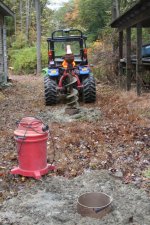
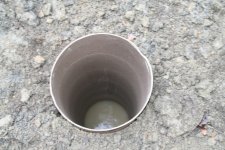
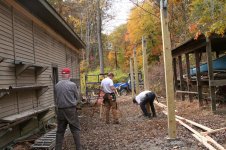
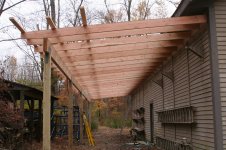
Size of tubes Depends on the load size of building, how many posts and snow load. You said 18 x 24 shed and you said frost at 48". You must be way north and so a lot of snow. A lot of posts are done by throwing a bag of mix in the hole and setting the post on that and filling the hole with dirt. I like to keep the posts out of the dirt completely. Lately I have seen pressure treated material fail in 3 years in contact with dirt. Out of the dirt seems ok. It is a little tricky doing 12 " tubes in 12" holes Because the post anchor hardware wants to be in the center of the concrete so the hole has to be in the right place. Tricky with a post hole digger. but it can be done. Need to stake the hole location local outboard of the hole and drill it plumb. Take your time. Enough about 12" tubes in 12 " holes. I would use 10" tubes for a shed. I have attached some pictures of 12 in 12 that I did for a lean to shed roof. I was going to use 10" tubes Building inspector IMG_6343.JPGIMG_6344_1.JPGIMG_6351.jpgIMG_6384.jpg made me use 12"
 
   / High Water Table #8  
Have you considered "Techno Post's'....

16bk3kn.jpg


Just google it for more info.
 
   / High Water Table #9  
Oh me boys, about the time I think we've got this pole barn posts figured out, me old haid starts spinnin' again. 1/2" I-Beam aluminum, that'd be the ticket I reckon! Techno Posts, eh? Ok, I'll research those thingamajigs too. Well OP (that'd be original poster for geezers like me), keep us posted...heheheheeee, that's a good one.
 
   / High Water Table #11  
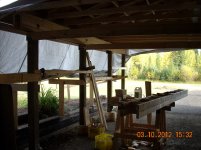
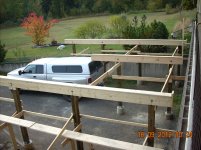
I used 12" sona tubes when I built my car port with I think, 4000lb concrete mix in 60lb bags.. I had a 42" long 12"dia auger with a 12" extension allowing me to go down to 54" depth. A few holes I was able to go down a bit deeper using a hand held post hole digger with handle extensions (pipe). I also carried the tubes (footings) about 15" above ground.

I put these down three years ago and so far everything seems fine. No noticeable up lifts yet from the cold winter temperatures though knowing my luck, that will probably change at some time.

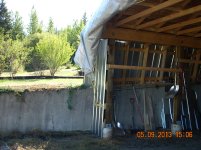
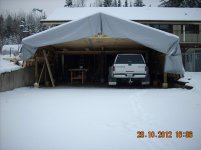
I am attaching a few photo's so you can see what I did - don't be too critical as they aren't perfect.
I will be installing the metal roof in a couple of weeks time - waiting on material. The tarps did the job for two winters - they actually only last about one year before they break down due to UV and other causes. They sport many patches and have done the job and will now be replaced with sheet metal (5 rib type) in a few weeks.

Anyhow, we get down to around -40C in the winter on occasions, so our weather is probably similar to yours.
 

Attachments

  • Carport project 8.jpg
    Carport project 8.jpg
    409.5 KB · Views: 209
  • Carport project 7.jpg
    Carport project 7.jpg
    533.4 KB · Views: 211
  • 5th Sept.2013 - 1.jpg
    5th Sept.2013 - 1.jpg
    540.5 KB · Views: 196
  • Carport project 16.jpg
    Carport project 16.jpg
    288.8 KB · Views: 196
   / High Water Table #12  
Forgot to mention, the carport actually measures 26ft long and 28ft wide - the roof trusses are 24ft between supports with 2ft overhang on each side. I had 100lb snow load for the trusses but should have gone bigger I think - maybe to 200lb. Normal house design snow load is 50lbs I believe for this area. Just something to think about when you do yours.
 
   / High Water Table #13  
And, finally (duh!!!), I used three pieces of rebar 5/8" dia. and one foot longer than the tubes, to stiffen the concrete in each tube. The extra foot length was driven into the soil at the bottom of the tube so the other end of the bar was just below the top of the tube. The post connector has a six or nine inch long piece of rebar attached to the bottom. When full with concrete (took around 10 x 60lb bags per tube) the whole lot is pretty solid.
I think I am finished now - ????
 
   / High Water Table #14  
Come on Jim, we all know it doesn't snow in BC...lol
Looks good.:thumbsup:
 
   / High Water Table #15  
I'd just pour the tubes using a tremie and then not worry about the water.
 
   / High Water Table #16  
If I hit table water, I would find another place to build. When water freezes, it expands and this force is what cracks foundations all the time.

Why do any of you put soni tubes inside a hole that you drilled and fill them with concrete? I only use them for above grade because I want the concrete to be in contact with the undisturbed soil on the sides of the hole. Most of the strength from concrete in a hole is from the sidewalls, so when you put a tube in there, all of the weight is now resting on the bottom of the hole and you get nothing from the sidewalls. It is impossible to fill and compact the space between the cardboard tube and the undisturbed soil to any measurable level. Add to that the fact that you have a layer of cardboard in the ground and it becomes even more impossible to get any strength from the sidewalls.

Eddie
 
   / High Water Table #17  
Photos of tough sonotube footing forms on the job - how to use footing forms

I think I would consider these for a pole footing. They have a bigfoot 'cap' for use in wet areas that is supposed to keep the water and concrete separated while pouring.

In ground freezing climates, you really don't want a tight coupling between a sonotube and the dirt around it. That will just help the ground heave get a grip on your piling. Better yet for preventing heave lift is a pyramid shaped form that narrows as it rises.

I picture a sonotube as something rot-proof that transfers the vertical load down to stable undisturbed soil below the frost depth, plus its weight provides an anchor for the post.
 
   / High Water Table #18  
In ground freezing climates, you really don't want a tight coupling between a sonotube and the dirt around it. That will just help the ground heave get a grip on your piling. Better yet for preventing heave lift is a pyramid shaped form that narrows as it rises.

I don't understand what this means. Are you saying that it's better for the sonotube to be loose in the hole? How does this keep water from entering the hole in the fill soil around the sonotube?

Eddie
 
   / High Water Table #19  
I don't understand what this means. Are you saying that it's better for the sonotube to be loose in the hole? How does this keep water from entering the hole in the fill soil around the sonotube?

Eddie

The tube is not going to be loose in the hole. I don't think it could be kept loose over time with settling, even if that was wanted. It means it should be smooth so that when the frost heaves the ground it doesn't have very much friction around the tube.

The friction would be caused by a hole with irregular sides, pockets, etc. in the wall of the hole. If a hole is bored and filled with concrete, the concrete will fill every little rough spot in the walls of the hole, that provides the friction.

One advantage of the 'bigfoot' foundation I linked is that flare at the bottom. Any frost lifting of the piling within the frost depth would have to pull that flared section up through the soil. That generally is not going to happen.

With decent overhangs, good surface drainage slope, and a reasonably well drained site, there shouldn't be that much water available around the sonotubes. There are areas where some of that is very difficult to achieve--flat as a pancake and a high water table in heavy clay soils--but people do build in those places by necessity.
 
   / High Water Table #20  
I agree that you can build anywhere if you have enough money and knowledge. But I disagree about your view on the tube not being loose in the hole. The biggest disadvantage to the bigfoot design is the amount of material that has to be removed to get it into the ground. There are augers that open up to do the same thing once you get down to depth that this product is trying to copy without the problems of trying to fill up the hole again after you pour the concrete. I think the bigfoot product is a waste of money and it fails to accomplish anything.

The problem with filling dirt back into a hole is that you are creating a sponge that holds water. It is impossible to get the fill material to compact anywhere close to the undisturbed soil, so now you lose the advantage of all the strength of the sidewalls, and you now introduce a place for water to collect. As you mentioned, frost heave requires water in the hole. Using a sonotube provides that source of water.

Why not just pour concrete in the hole and not use the sonotube at all unless you need to go above grade? Then just cut it to length and put it on top of the poured concrete in the hole?

How much more could it cost for concrete compared to the cost of the sonotube?

Eddie
 

Tractor & Equipment Auctions

2018 Toro Workman HDX Diesel Utility Cart (A59228)
2018 Toro Workman...
2021 CATERPILLAR 313GC EXCAVATOR (A60429)
2021 CATERPILLAR...
2013 Ford Edge Limited AWD SUV (A59231)
2013 Ford Edge...
2020 INTERNATIONAL MV607 26 FT BOX TRUCK (A59905)
2020 INTERNATIONAL...
2016 Dodge Grand Caravan SE Plus (A59231)
2016 Dodge Grand...
2019 DRAGON ESP 150BBL ALUMINUM (A58214)
2019 DRAGON ESP...
 
Top