Hobart stickmate LX

/ Hobart stickmate LX #1  

johnk

Elite Member
Joined
Jun 7, 2003
Messages
2,672
Location
western NY
Tractor
Kubota GST Grand L3130 w/ 723 loader, Ags
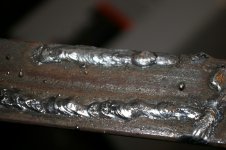
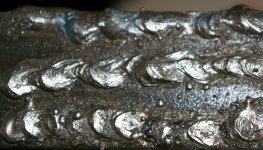
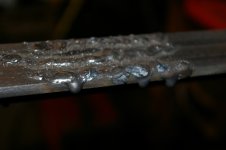
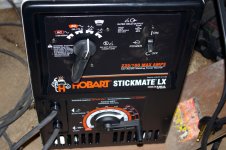
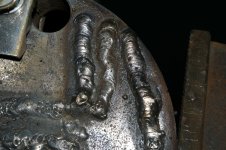
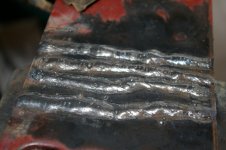
TSC had them on sale and I picked one up for $348.00 because they said they aren't carrying them anymore. So I picked one up and bought some 6011 and 7018 rods. I was welding at about 100 amps dc+. I am open to criticism of these poor welds. Too fast? Not enough juice. Too close?? Too far. I have a 110 lincoln mig and make good welds but it is soooo slow......... I don't think I would hang from these welds where my life was in danger. What are your opinions??
 

Attachments

  • Welding pics 008.jpg
    Welding pics 008.jpg
    171 KB · Views: 515
  • Welding pics 009.jpg
    Welding pics 009.jpg
    245.6 KB · Views: 507
  • Welding pics 010.jpg
    Welding pics 010.jpg
    77.6 KB · Views: 421
  • Welding pics 011.jpg
    Welding pics 011.jpg
    167.3 KB · Views: 692
/ Hobart stickmate LX #2  
It looks as if your travel speed is not consistent... too fast at some points, and too slow in others.

Watch the puddle, not the arc... the puddle will dictate your travel speed. Keep your puddle "round", about the diameter of the width of your bead... if you see your puddle getting oblong along your path of travel, you're travelling too fast. If it's getting oblong across your path of travel (getting wide), you're going too slow.
 
/ Hobart stickmate LX #3  
I agree with XL.But also,it could be your arc length has something to do with it.
6011 rods are kind of tough to make a real nice looking bead with unless you have a lot of expertise,7018's run smoother.But every rod has its purpose.
Something else....as far as porosity in the weld beads,rusty metal will cause this.6011 will generally cut thru rust and paint with no problem,but if possible the metal should be cleaned as much as possible first.
Just keep practicing guy,you'll get it:D .......Digger2
 
/ Hobart stickmate LX #4  
You'll learn to love your new welder. I learned to weld on my Dads Craftsman crackerbox that was built before the Ark. An out of work mechanic stopped by the house one day and offered me a welder exactly like yours for $200 cash. I checked his story out and after knowing it wasn't stolen I bought it. That was 5 years ago. I've only begun recently welding with it. I've burn't some 3/8 plate for make shift implements all the way down to 22 gauge galv sheetmetal for my dauhgters rabbit cages. It handled all of it. Keep practising.
 
/ Hobart stickmate LX #5  
You are moving too fast and have 0 penetration.It looks like you can not really "see" the weld pool. It's like the old Carnegie hall joke... Practice ,Practice ,practice.and an auto-darkening helmet would probably help a great deal also.
 
/ Hobart stickmate LX #6  
Not horrible...seems my first beads looked worse.Try a little more weaving back and forth and you might try some 6013 rod.They have become my all purpose rod around here and I almost gave up trying to weld until I bought the autodarkening helmet.Just noticed the polarity, make sure that you get DC rods!! The double duty (AC/DC) rods are not the best for DC welding.
Buddy of mine says "You don't have to be a good welder.just a good grinder."
 
/ Hobart stickmate LX #7  
Many good replies. Beginner in anything takes practice, along with a little knowledge. I'd suggest going to your local bookstore and buying a Basic Arc Welding handbook.
When I was an instructor the first thing we taught was how to "strike an arc", then progressed to "stringing beads". After theses steps were mastered, then we'd advance to actual weld joints.
One poster mentioned "watching the bead (actually it's called the puddle, not being sarcastic, just attempting to help you with the nomenclature of welding). The puddle is important as it will dictate amperage, arc length, and speed of travel. One poster recommended an auto darkening helmet. I'm recommended a "Gold Plated" lens. Not expensive at all from a local welding house. Eliminates the green glare, and you'd be surprised how well you can see the puddle. I'll never go back to a straight green lens. Been using the gold coated ones for years.
A good rule of thumb on arc length (the distance you hold the rod from the base metal) is rod diameter. 1/8" electrode, hold the arc at about 1/8". Electrode should be tilted about 10-15 degrees toward the direction of travel in the flat position.
Clean, clean, clean. Clean your base metal prior to welding. Not always possible if the weld joint is recessed, in a corner, etc. But, if it can be cleaned by grinding/brushing, do so. Even "new" steel has an oxide layer that should be removed prior to welding.
We used 6010 and 6011 electrodes for the string beads classes. They do require electrode manipulation (whipping back and forth to build up the desired bead height). 7018 rods are great to use. Lots of folks like the 6013. I tend to stay away from them because they are generally used on poor fit up, and have shallow penetration. When practicing, if your are using thin steel, watch for heat build up. If your practice metal gets hot your beads will change dramatically. For practicing purposes, quench after each weld.
I could go on and on.
Hope some of my input helps. Good luck with your new welder.
 
/ Hobart stickmate LX #8  
johnk said:
TSC had them on sale and I picked one up for $348.00 because they said they aren't carrying them anymore. So I picked one up and bought some 6011 and 7018 rods. I was welding at about 100 amps dc+. I am open to criticism of these poor welds. Too fast? Not enough juice. Too close?? Too far. I have a 110 lincoln mig and make good welds but it is soooo slow......... I don't think I would hang from these welds where my life was in danger. What are your opinions??

Im not the one to judge your welds..although its obvious you have a ways to go...but at least you have the right machine to do it! 7018 rods and DC I LOVE...( AC sucks..lol)
 
/ Hobart stickmate LX #9  
Pennsylvania Weldor said:
Clean, clean, clean. Clean your base metal prior to welding. Not always possible if the weld joint is recessed, in a corner, etc. But, if it can be cleaned by grinding/brushing, do so. Even "new" steel has an oxide layer that should be removed prior to welding.
We used 6010 and 6011 electrodes for the string beads classes. They do require electrode manipulation (whipping back and forth to build up the desired bead height). 7018 rods are great to use. Lots of folks like the 6013. I tend to stay away from them because they are generally used on poor fit up, and have shallow penetration. When practicing, if your are using thin steel, watch for heat build up. If your practice metal gets hot your beads will change dramatically. For practicing purposes, quench after each weld.
I could go on and on.
Hope some of my input helps. Good luck with your new welder.

Having a clean surface cannot be over stressed. I generally use the 6010 electrodes if I can't get the surface really clean; especially if I'm welding vertical or overhead. For me, reverse polarity DC seems to work best with that electrode for me with the 6010 rods. I haven't really used the 6011's much. I think the only real difference is that they can be used on AC as well as DC?

I mostly use 6013 or 7018 rods anyway. For a beginning welder, a decent bead can be had with a 6013 with relative ease if the materials are clean and the operator just uses the setting suggestions printed on that machine. Once a guy gets proficient with a 6013, it seems easier to teach him to get similar results with the 7018. Also, it seems that the 7018 rods are less forgiving if they get damp. I don't know how many times I've gone to weld something for someone at their place with their equipment and they hand me a 7018 rod that puts down a crappy bead because its been stored in his toolbox, in the open, for the last year. :rolleyes:

That Hobart is a great little machine though! It's what I put in the back of my RTV along with my generator to go weld something broken out in the field or in the woods. That's generally where I end up using the 6010 rods because I can't get a really clean surface. I've used some far more expensive SMAW machines that weren't any better than that Hobart you have. As others have said, practice a lot and get a decent book on technique. Unfortunately I've seen some guys practice, practice, practice and end up with a "pretty" weld that isn't worth a hoot because the wrong technique or settings were used. So a lot of practice with proper technique is your best bet.
 
/ Hobart stickmate LX
  • Thread Starter
#10  
All good pointers from everyone. I have been working quite a bit and haven't gotten the time to get practicing. The machine seems very smooth to use. I really haven't done any stick welding since I was in the service 40 yrs ago. My little 110 mig has seen a ton of use though. I'll get back to practicing and post some more pics. I think after 10 pounds of rods or so I'll get the hang of it. Maybe I'll try the reading glasses under the helmet so I can see better.....How can you tell the amount of penetration? By the height of the bead? The metal was cherry hot as I was welding so I just kind of figured the penetration was there...Porosity is more obvious I think...
 
/ Hobart stickmate LX #11  
The only real way to see how much penetration you're getting is to section one of your welds, then etch it with an acid... that will show your penetration.
 
/ Hobart stickmate LX #12  
Question for ya'll using the 7018 rods- I bought some 7018AC rods for my Lincoln AC tombstone, welds look good but dang that is the most difficult slag to get off I've ever seen...my weld area looks like crap after I beat the snot out of it with the chipping hammer:confused: Is this normal with these rods?
 
/ Hobart stickmate LX
  • Thread Starter
#13  
johnk said:
TSC had them on sale and I picked one up for $348.00 because they said they aren't carrying them anymore. So I picked one up and bought some 6011 and 7018 rods. I was welding at about 100 amps dc+. I am open to criticism of these poor welds. Too fast? Not enough juice. Too close?? Too far. I have a 110 lincoln mig and make good welds but it is soooo slow......... I don't think I would hang from these welds where my life was in danger. What are your opinions??

Just got home from work and ran a couple more beads. They look a little better to me. What do the pros have to say? I'm used to criticism...I'm married..
 

Attachments

  • Welding2nd try 5-18-08 001.jpg
    Welding2nd try 5-18-08 001.jpg
    141.9 KB · Views: 351
/ Hobart stickmate LX #14  
Wow, great price you got on that welder.

I just bought one on line and was happy at 419.. bummer.

I got the house wired and ran a few beads (neubie also) so I can say it worked. My wife told me the lights did not dim so I guess the wiring is right....

Your beads look much better than mine but all I had to work with were the tiny rods that came with my worthless walmart stick welder that this replaces...

Now on the other side of the world working for a bit. Can't wait to get back to play with my new LX also...

Darn that was a good price... :)
 
/ Hobart stickmate LX
  • Thread Starter
#15  
They had 2 left. One was in a box and the other wasn't. They had them next to the door as you entered along with a set of torches and some other stuff. They said they weren't carrying them any longer and had them discounted and also there was a 20 percent discount in their flier. Should have bought them both. I used up the discount in electricity already but thats what life is all about.
 
/ Hobart stickmate LX #16  
Hobart hosts a great board at Weld Talk Message Boards - Powered by vBulletin. There are a lot of welding pros there and they have always been extremely helpful in figuring out problems and fixes. I love using my Stickmate. It hasn't made me a good welder, but it has allowed me to build some great attachments.
 
/ Hobart stickmate LX
  • Thread Starter
#17  
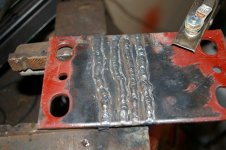
Thanks for all the replies. I have still have some questions as to why i would want to use a deep penetration rod EX 6011 VS a 7018 which is a low penetration rod. I thought deep penetration is good on all welding projects. Why would I want low or med??? Here are some pics of my 3 rd day welding. I 'm sure they would all hold but which weld is the best??? Thanks for your insight....
 

Attachments

  • Welding 3rd try 002.jpg
    Welding 3rd try 002.jpg
    129.3 KB · Views: 474
  • Welding 3rd try 004.jpg
    Welding 3rd try 004.jpg
    156.7 KB · Views: 574
/ Hobart stickmate LX #18  
johnk said:
TSC had them on sale and I picked one up for $348.00 because they said they aren't carrying them anymore. So I picked one up and bought some 6011 and 7018 rods. I was welding at about 100 amps dc+. I am open to criticism of these poor welds. Too fast? Not enough juice. Too close?? Too far. I have a 110 lincoln mig and make good welds but it is soooo slow......... I don't think I would hang from these welds where my life was in danger. What are your opinions??

I bought the same welder at the same price at TSC last year.
My problems are holdng a 2-3mm arc gap consistently and moving at a slow, even pace. I'm getting better now. When a pay attention to the edge of the weld puddle to make sure it's tying into the base metal evenly, then my welds are pretty good.
 
/ Hobart stickmate LX #19  
johnk said:
Thanks for all the replies. I have still have some questions as to why i would want to use a deep penetration rod EX 6011 VS a 7018 which is a low penetration rod. I thought deep penetration is good on all welding projects. Why would I want low or med??? Here are some pics of my 3 rd day welding. I 'm sure they would all hold but which weld is the best??? Thanks for your insight....

There are many variables depending on the desired end result. I can't recall exactly where I was taught the five basic principles (other than having clean rust free and grease free and paint free material) of:

1: The current setting

2: The length of arc

3: The angle of electrode

4: The approach or manipulation of electrode

5: The speed of travel...

Those are not principles that I can take credit for, but principles taught in classes and in books. As in most things, if you have the core basics down pat, the rest will come easy...or relatively easy. I still hate overhead welding. I've caught too many portions of my body and clothing on fire from doing that than anything else in my life! :eek:

Fortunately, as I mentioned previously, new welders come with charts on them that give pretty darn good advice as to the current setting suggested for different rods on different thicknesses of materials. The other items are just learned through practice to where they come as second nature and you don't ever even think about them.

And, to no surprise, not only are different types of welding a bit different (mig, tig, arc, brazing etc.), but many types of metal weld differently and you have to adjust your procedure to them. Seriously, try some 6013 rods on reverse polarity DC for a bit. The rods aren't that cheap. You will be able to lay down a decent bead easier than with most other electrodes. From there, move to different thicknesses of material with the 6013s. Once you feel you have that mastered, move to a 7018 electrode and practice the same. Then go to a 6010 etc. I just suggest the 6013 to start with because it will be the easiest. Then work your way up. When you can lay down a perfect bead, with good penetration, overhead call me. :D
 
/ Hobart stickmate LX #20  
I've got a hobart stickmatelx235AC.. I wonder why they aren't carrying them anymore?

I love my welder.. plenty of amps to weld big stuff like 1/2 " plate.

soundguy
 
 
Top