Home electrical

   / Home electrical #1  

1930

Platinum Member
Joined
Sep 9, 2018
Messages
933
Location
Brandon/Ocala Florida
Tractor
Kubota B6100E Kubota L 2501 Kubota T1460
Good morning, I can’t seem to find anyone that can give me a clear answer.
The video below is as close as I have come.
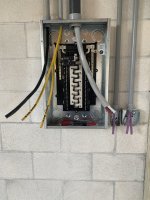
The question is: if the neutral ( in most cases white ) is connected to the same bus bar as the grounds and the neutral is what carries the electricity back to the source ( which is maybe a different topic ) than why are the grounds not energized within the panel ( including but not limited to the exposed ground that I’ve placed on the exterior of my wall to ground the system)
Thank you and I hope that you all have/had someone special to spend your holiday with.
Good video here
 
Last edited:
   / Home electrical #3  
It is my understanding (and also stated in the video) that the only reason the grounding conductors aren't energized is because the neutral bar and main connection is a "better" path to ground than going to the water pipe or rod.

I don't know (but I think) that if you were standing in a pool of water, barefooted on a concrete floor and touched the neutral bar, you could become the better path for current to flow.

Of course, if there is a fault condition (like the hot wire contacting the metal components of the outlet in the video) then the grounding conductor absolutely is carrying current.

The EE's and electricians will be along shortly to provide the correct answer.

Edit: Even though I just said that I don't trust that touching the neutral bar (while standing in a puddle) is safe, it is bonded to the main service panel, so it can't be any worse that touching the service panel.
 
Last edited:
   / Home electrical #4  
Ground wires are every bit as “energized” as the neutral wires. They’re essentially the same. They’re both derived from the exact same center tap point on your electric pole transformer (which is also physically grounded).
Ground also isn’t technically “the return path”, as it’s AC going back and forth, so both of your hots from the pole, plus your ground from the system are returning paths for 1/2 the cycle.
At the entrance of your home, the wires to be used as neutral are treated as grounded, and those to be kept as ground are deemed grounding.
The 120 volts from a hot to neutral, is 99.9% the same as the 120 volts from a hot to ground. A lightbulb will light, or you will get shocked the same if connected from a hot wire to a ground wire, as you would to a neutral wire, unless there is a GFI device in between.
 
   / Home electrical #5  
Ground wires are only intended to become energized when there is a fault (shorted circuit). When the unintentional high current flows on the shorted path, the over current protective device will trip de-energizing the circuit. So it is serving its purpose as a the safety component in the circuit.

The ground wire is there to prevent a fire or prevent you from getting electricuted.
It is at the same voltage potential as the "grounded conductor" (neutral), but its sole purpose is for your safety and protection of your property.
 
   / Home electrical #6  
Obviously in the main or house panel ground and neutral are the same. In your appliance they are not. Your appliance frame ground is a safety return path while neutral is used to complete the circuit. A wiring fault can carry the current to ground hopefully preventing a shocking experience. In an add on panel such as your barn the neutral bus and the ground bus are separate and generally the neutral is not grounded.
 
   / Home electrical #8  
   / Home electrical #9  
In reality, very rarely does a residential ground wire run prevent electrical shock, unless as I stated before, the load is downstream of a GFI breaker. Almost all shocks are from touching a hot wire, and either the neutral, or ground.
Look at all your 120v appliance plugs. You’ll probably see 8 out of 10 don’t even have a ground wire prong.
 
   / Home electrical
  • Thread Starter
#10  
Also don’t forget that the ground buss and neutral buss are separated in a sub panel.
I had read this but had not taken the time to look. Sure enough
Thanks for the reminder
Can you tell me why?
 

Attachments

  • image.jpg
    image.jpg
    5.6 MB · Views: 335
   / Home electrical #11  
That allows for neutral bonding, upstream of your panel, usually at your meter socket. Depending on jurisdiction , year done, and electrician , the bonding will be there or your panel, or both
 
   / Home electrical #12  
A lot of homes here date from the 1920's with no grounds or even a ground rod or bond to water pipe.

As long as it is in good as-built condition no code issues.

The problem comes when a 2 prong outlet is replaced with a 3 prong grounded outlet indicating ground where none exists...

Exception is GFCI can be installed where no ground exists.
 
   / Home electrical #13  
I had read this but had not taken the time to look. Sure enough
Thanks for the reminder
Can you tell me why?
that photo is not actually showing separate grounds, that's a shared neutral ground bar. a separate bus bar would be install if used as a sub panel, you can see the screw holes on the right side.

They only want one central ground to neutral point, deals with potential, they don't want current running over ground unless in safety as it reduces its safety as i "assume" the resistance is a bit higher when there is a current passing through it, that shouldn't be
 
   / Home electrical #14  
I had read this but had not taken the time to look. Sure enough
Thanks for the reminder
Can you tell me why?
A place to purchase ground bars for electrical panel. Low priced factory original equipment.

shttps://www.simplybreakers.com/products/eaton-ground-bar-gbk14
 
   / Home electrical #16  
I had read this but had not taken the time to look. Sure enough
Thanks for the reminder
Can you tell me why?
In the panel pictured, there is a jumper connecting both of the side bars. On some brand panels you can remove this jumper and add a bonding screw to allow grounds to land on the right bar and neutrals to land on left. But what most electricians do is simply add separate ground busses to the can. In this particular panel, there are also neutral rails added for afci and gfci breakers, so you CANT remove the jumpers. There are pretapped holes for this and every brand of panel sells the buss bars.

This allows for a cleaner installation and ease of wiring.
 
   / Home electrical #17  
Sub-panels can be ground-bonded, at least back when I learned NEC, and I would be surprised if that has changed. They are usually not, especially if within the same structure as the primary, but don't confuse convention with rules.

There are two ways to feed a sub-panel:

1. Bring ground + neutral from main panel, and remove the ground bonding tab in the sub-panel.

2. Bring only neutral from the main panel, and provide a new ground at the sub-panel, in which case you must ground-bond the neutral at the sub-panel.

Method 1 is generally used when staying within the same structure, method 2 becoming more common when feeding an external structure (pool house, garage, etc.), in order to save pulling a 4th conductor over longer distances.

What it comes down to is that the neutral tap on the transformer outside your house is floating, and must be tied to ground somewhere, lest any imbalance in loading the two hot legs causes the neutral voltage to drift away from ground. This all makes perfect sense when you consider the arrangement of the utility transformer, and the associated impedances, realizing that the neutral is only carrying any small difference in current between the loading of the two hots.

Put more simply, if you have 50A load on L1 and 35A load on L2, the neutral will see 15 amps of current. If the output impedance of the transformer runs around 2 ohms, then you're going to see the neutral floating up around 30 volts, without ground bonding.

As to why neutral is only grounded once at building entrance, and not duplicated at every panel, is about ensuring the neutral current on each branch circuit or feed stays on the neutral wire, and not the ground conductor. If you bonded them at every sub-panel, in case 1 above where you're running parallel conductors, then neutral current could flow on the ground conductor.

Personally, I think method 2 above is better for sub-buildings, and wouldn't be surprised at all if NEC heads (or already headed) this direction, for sub-panels in auxiliary structures. I say that because, when run over long distances, even neutral feeds can develop voltage, in proportional to the current flowing in that conductor.
 
   / Home electrical #18  
I should have zoomed on the photo. That’s a PON panel. I’ve never played with PON breakers before. I think you can still use certain standard breakers with it too.
 
   / Home electrical #19  
The option not to run a subpanel without also running a ground wire went away some time ago. Now you HAVE 2 run 4 wire subpanels, even within the same structure. I dont recall what nec revision this occured.
 
Last edited:
   / Home electrical #20  
Can you tell me why?
Because the neutral at the sub-panel may not be at ground potential.

This would be true if the load on the two phases in the sub-panel is not equal, so there is some current flowing in the neutral. With current flowing, and some small resistance in the neutral conductor, there is a voltage difference between the neutral buss in the sub-panel and the one in the main panel. Probably small, but some.

You want the ground busses in all panels to be a ground potential.
 

Tractor & Equipment Auctions

2025 CFG Industrial MX12RX Mini Excavator (A59228)
2025 CFG...
1999 WEST WIND 30FT PINDLE FLATBED DOVETAIL TRAILER (A58214)
1999 WEST WIND...
2019 FREIGHTLINER CASCADIA TANDEM AXLE SLEEPER (A59905)
2019 FREIGHTLINER...
2011 Freightliner Cascadia 113 S/A Day Cab Truck Tractor (A59230)
2011 Freightliner...
UNUSED I/A F10 TILT 10' HYD TILT BOX SCRAPER (A57192)
UNUSED I/A F10...
John Deere 6125R (A60462)
John Deere 6125R...
 
Top