Home electrical

   / Home electrical #61  
As an electrician that survived over 30 years working in live industrial and commercial panels…..i would NOT touch any live panel part…period.. they make insulated tools for a reason.
I figured this would be the response from an electrician, and for good reason. They're doing this stuff all day, everyday. With repetition, comes many more chances for stuff to happen. As an engineer, I'm looking at this stuff from my desk most days, and then working hardware in a controlled lab environment... rarely out in the field where things can be less ideal.

And when I said I connect to the neutral in my panel, it's also with an insulated square-drive screwdriver. I back the screw out a few turns, slip the branch circuit's wire into the hole while holding the wire by the insulation, and then snug it down. No reason to purposefully touch the neutral bar, even if it is safe when properly grounded.

I usually only kill the main breaker in my panel when running something big, like a sub-feed, and that's for purely mechanical reasons. It's easy to bend an AWG-12 or 14 solid conductor from NM-B out of the way, while you work. But when working with AWG-2 thru 6, which is typically stranded for residential app's, it's more like wrestling an octopus inside that panel. More chance for you to brush something you don't want, while wrestling that neutral or ground into place.
 
   / Home electrical #62  
Severity of injury / fatality from electrical shock does depend entirely upon the current passing through the body. GENERALLY under the same conditions, contact with higher voltages causes higher currents. More "pressure" pushing the amperage. There are variables that affect the outcome.

The path of the current through the body is one of the most important considerations. Back around '75 I took a hit on 277V while reaching into an energized relay cabinet (yup, dumb). The path was from a fingertip to a knuckle. Bit me pretty good, but the current path didn't interfere with my body except hurting my hand for a few minutes. Had the current path been from my fingertip to my foot, or my other hand the outcome could have been completely different. Touching an electric fence with 10KV is very unpleasant but almost never fatal. The electric fence current is limited.

People have been electrocuted when contacting voltages below 100V and survived much higher voltages. The difference is how much current passes through your body (mostly determined by the "quality" of the contact made) and the path it takes. The current flow is determined by a combination of the voltage contacted, the resistance in the contact and the path that current takes.
 
   / Home electrical #63  
A couple more safety tips for when working in live cabinets:

Wear dry insulated bottom shoes

Wear electrically insulated gloves.

Reach in with only a single hand whenever possible, and don’t let your body or other arm touch the enclosure

If you don’t have insulated gloves, check your hands for fresh cuts, and/or metal splinters. Don’t do live electrical work with either. Fresh cuts have a much lower resistance than unbroken skin. Metal splinters, bridge the insulating skin barrier.
Just 24 volts to a hand with a metal splitter will set you back, under the right conditions.
 
   / Home electrical #64  
So, cutting to the chase, knowing what you know, would you, personally, have any reservations about touching the neutral bar in a live service panel?

Say for instance, you want to install a new circuit. You run the conductors into the panel (live), prep the conductors, attach the black wire to the circuit breaker, attach the neutral and grounding conductors to the neutral bar. Then, plug the breaker into the frame.
In my case.... hell no. I won't work in a live box. Why? Because things happen. Heck, you could sneeze and stick your finger on the hot bus. You could have a brain fart. You can make a mistake. Someone before you could have made a mistake and left it for you to find. It's just not worth the risk. Kill the power, get a flashlight if you need it, do the work, return the power.

I work with a lot of guys that refuse to follow safety protocols set by our employer. Overwhelmingly, the excuse is... "I've been doing this for X years and I haven't f'd up yet."
 
   / Home electrical #65  
Having started in the trade before OSHA with a small contractor, we did all sorts of things that aren't advisable. After I worked there for about a year and a half, the owner became a member of a trade organization that offered an apprenticeship. There I discovered that some of our normal MO's were frowned upon by people who understood safety better than we did.

For example, swapping the incoming overhead lines on houses when replacing the main services should have been a "no-no". Probably more so because all we had was aluminum ladders. The power company looked the other way for a long time. Years later there was a superintendent who wanted to move his office trailer and was tired of waiting for the power company to disconnect a pole-mounted transformer. He put on a pair of HV gloves, drove a nail into a long 2X4 and pulled the fuse himself.

Surprisingly, I can only recall a few fatalities on projects since 1968. They were around 2007 or so and were the result of traffic accidents by passers-by. We were working on new lighting in PA Turnpike tunnels (separate tubes for Eastbound and Westbound). We had access to most of the wiring in air plenums above the part of the tube the vehicles traveled in, and performed a lot of work without impacting traffic. When we had to work in the roadway, one tunnel was closed and there was 2-way traffic in the other. Twice during this different traffic pattern drivers failed to stay in their lane.

A couple of us talked about writing a book on all the goofy stuff from over 50 years in construction. No *** involved, so it probably wouldn't sell:)
 
   / Home electrical #66  
Doing service upgrades early on as an apprentice, the regular method of operation was to disconnect the overhead utility conductors while they were live. Then re-connect them at the end of the day when the larger panel install was completed.

Fortunately the company required fiberglass ladders be placed on dry 3/4" plywood panels. They required us to have an extra pair of boots that had never been used on a construction site so there was no risk of anything stuck to the bottom of the boots that would make the soles conductive.
Then we used a systematic approach for every job to disconnect the correct conductors first while leaving the grounded conductor to be disconnected last. No one was ever shocked in all the service upgades we did. Reconnect was grounded conductor first.
We were never allowed to do a service upgrade in the rain.

Now the utilities require a kill (term used here to open the circuit) at thier transformer before performing any work. OSHA rules kicked in.
 
   / Home electrical #67  
I refed overhead conductors to new services many, many times. Used insulated crimp connectors and an insulated crimping tool. Never worried me, as i did it so many times
 
   / Home electrical #68  
I refed overhead conductors to new services many, many times. Used insulated crimp connectors and an insulated crimping tool. Never worried me, as i did it so many times
Yup, we did many of them back in the late 60's and early 70's and never had any incidents. For most of them it was to upgrade the service from a "Main, Range and Four" to 100A or 200A breaker panels. When that was the case we'd often just use small bugs because the power company was going to follow with heavier service drops. We used "official" crimps for permanent connections.

The power company only complained one time. In those days wiring was on poles along the street and service drops came to the house overhead. At some point someone decreed that any development with more than 4 houses would be served via direct burial from padmount transformers. For temporary power on new houses we planted a pole with a small weatherproofish panel mounted on it in the front yard. The power company connected to the temporary pole. They left a coil of triplex that was long enough to reach the house hung on the temporary pole.

We were wiring houses in a development for a builder who used plaster for walls and ceilings. There were about a half dozen houses that were in various stages of browncoat or whitecoat and the weather turned cold and damp. The contractor wanted heat right away and the power company hadn't come to swap the feeds over. A couple of us went to the development, cut and taped the triplex and dropped it on the ground. Then one of us would get on the roof and use a rope to pull the triplex up while a bud on a ladder connected it to the anchor with a wedge. Our crimper was a simple wood-handled affair (but we did have gloves). We used uninsulated crimps and taped 'em up. A couple days later a power company rep called the boss and told him that onsies / twosies wasn't bad but doing so many in one day was going a bit too far.
 
   / Home electrical #69  
   / Home electrical #70  
And the sub panel has a ground and neutral wire going back to the main panel.
The only reason NOT to ground a sub panel is to prevent ground loop currents.
Here is a good reference and explanation of them.
Ground Loops: What They Are and How To Avoid Them
But, otherwise, subpanels (panelboards) for separate buildings are now required to be provided with a grounding electrode system per NEC 250-32, correct? In the "old days" that wasn't required, but I think it is now.
 
   / Home electrical #72  
   / Home electrical #74  
Doing service upgrades early on as an apprentice, the regular method of operation was to disconnect the overhead utility conductors while they were live. Then re-connect them at the end of the day when the larger panel install was completed.

Fortunately the company required fiberglass ladders be placed on dry 3/4" plywood panels. They required us to have an extra pair of boots that had never been used on a construction site so there was no risk of anything stuck to the bottom of the boots that would make the soles conductive.
Then we used a systematic approach for every job to disconnect the correct conductors first while leaving the grounded conductor to be disconnected last. No one was ever shocked in all the service upgades we did. Reconnect was grounded conductor first.
We were never allowed to do a service upgrade in the rain.

Now the utilities require a kill (term used here to open the circuit) at thier transformer before performing any work. OSHA rules kicked in.
When we bought our current house, we wanted the meter moved from the back of the house to the side of the house and a proper riser off of the meter through the eaves and roof. Then a new service disconnect added under the meter, and a new panel in the house. The guy we hired installed the new equipment, then moved the wires from the old riser to the new riser hot. He said as long and he as on a fiberglass riser with gloves and boots, he'd be fine, and grabbed one of the legs to show me.

A few weeks after it was done, I get a call from the electric company wanting to know who cut the seal on the meter and moved the service on the house. They seemed a big miffed. I told them it was a guy I found in the Penny Saver and that was that. They installed a new seal and left.
 
   / Home electrical #77  
Right up there with "I'll be back", or "You talkin' to me?", in terms of memorable movie one-liners.

Here's one lots of you will be watching this month, and on-topic, considering how much of the film is dedicated to electrical problems: "If I woke up with my head sewn to the carpet, I wouldn't be more surprised than I am right now."
 
   / Home electrical #78  
I work with high voltage, and so there are some numbers we always keep in our heads. Those of us who drink coffee all day, and then a cocktail after work, usually have very dry skin. If I grab an ohmmeter between my two hands right now, it's going to measure several hundred k-ohms. Those who properly hydrate will be much lower, in the 10's of k-ohms. If you wet your hands, you'll get down closer to 1 k-ohm, in fact 3 k-ohm seems to stick in my head from my own testing.

We probably all remember Ohm's law from high school physics class: V = i*R, which is easily rearranged as i = V/R. In this case, since we're talking AC mains power, everything is RMS voltages and currents.

If you touch anything energized, it doesn't matter whether you're a "better" or "worse" conductor to ground, as you're a parallel path to a constant voltage supply. Current will flow through you according to this i = V/R, with you being the R, say maybe 30 k-ohm. Get your hands wet, and the current that will flow though you goes up 10x, due to 3 k-ohm.

Now, you've probably heard people repeat "voltage doesn't kill, current kills". That's really kind of stupid, as you can all see you can't have one without the other. V = i*R always holds, V being voltage, and i being current. What they really mean by this is that damage to you is dictated by the amount of current flowing through you, and the amount of voltage required to create that current varies enormously by person and temperature, as there's such a huge variation in skin resistance.

The threshold for sensation is around 1-2 mA, which for someone with wet hands at 3 k-ohm, will occur around V = 1.5m*3k = 4.5 volts. For those properly-hydrated individuals not dipping their hands in water, that's going to be somewhere in the 10's of volts (e.g. 50 volts), depending on your particular skin resistance.

Going above that, there's something called the "can't let go response", which occurs around 15 mA at 60 Hz, or V = 15m*3k = 45 volts, for a really sweaty electrician. This is very dangerous, as it is exactly what it sounds like, your muscles contract and cause you to involuntarily grab the conductor, with no ability to let go. I imagine some of the professionally-trained electricians here will tell you they were taught to use the back of their hand the first time they touch a circuit, for this reason... I'm not an electrician.

Side note, residential breaker panels in our older homes of the northeastern states are often in the basement utility room, right next to a screaming-hot oil-fired boiler, so the poor electrician is always sweating while working in the panel.

These are the rough numbers to keep in your head:

Threshold of sensation: 1 mA
Maximum "harmless" current: 5 mA
"No leg go" response: 10 - 20 mA
Onset of pain: 50 mA
Ventricular fibrillation: 100 - 300 mA (varies by individual)
Burning skin: 300 mA

Note that the "no let go" response is basically a forced contraction of your muscles, so it can also cause you to stop breathing, if the current happens to be passing thru your chest from one arm to another or from an arm to a leg.

When talking about residential electrical scenarios, I suspect the only time being a "better" conductor than something else matters, is when you have something like a loose connection causing current to a circuit to be interrupted. In those cases, grabbing the wrong thing will finally allow current to flow in the circuit... through you. But the current is still limited by old i = V/R, with R being the sum of you + the rest of the circuit.
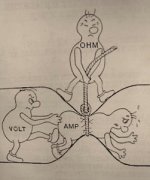
You've likely seen this a long time ago. It's out of an old Navy training manual, and graphically explains the formula. It's not mine so use as you wish.
 

Attachments

  • ohms law graphic (2016_11_04 15_44_22 UTC).jpg
    ohms law graphic (2016_11_04 15_44_22 UTC).jpg
    46 KB · Views: 97
   / Home electrical #79  
I like that, Ray! I've always used the plumbing analogy:

Pressure = voltage
Flow rate = current
Restriction = resistance

But in explaining it to someone else recently, I started thinking that a dam is actually a better analogy than plumbing, especially when trying to explain why a neutral wire at a load has nearly zero voltage to ground. Once water spills over the spillway or thru the sluice gate into the drainage basin, there's no potential (height) left in the water.

I guess the guy pinched in the middle of your cartoon should be labeled Coulomb, for charge. "Amp" is the measure of how many of those guys get through the pipe, over time.
 
   / Home electrical #80  
Right up there with "I'll be back", or "You talkin' to me?", in terms of memorable movie one-liners.

Here's one lots of you will be watching this month, and on-topic, considering how much of the film is dedicated to electrical problems: "If I woke up with my head sewn to the carpet, I wouldn't be more surprised than I am right now."
That's pretty low mister. If I had a rubber hose I would beat you
 

Tractor & Equipment Auctions

iDrive TDS-2010H ProJack M2 Electric Trailer Dolly (A59228)
iDrive TDS-2010H...
2020 PETERBILT 567 (A58214)
2020 PETERBILT 567...
1997 FREIGHTLINER WESTERN STAR DUMP TRUCK (A60430)
1997 FREIGHTLINER...
8ft Flatbed Truck Body with Axle (A55851)
8ft Flatbed Truck...
20FT X 30FT ALL STEEL CARPORT (A58214)
20FT X 30FT ALL...
2025 40ft 10-Door Shipping Container (A59228)
2025 40ft 10-Door...
 
Top