How agriculture works thread

   / How agriculture works thread #61  
I didn't say I was surprised. What is happening is quite predictable. Perhaps I am in the minority when I think that having 75 snowmobile manufacturers has advantages over having 4. If our priority is having cheap food and it having to be that way because the corporate farms is more economical and the family farm becomes a distant memory, we are certainly headed in the right direction. Just don't tell me it is "better".
Why on earth would you think having six family owned corporations farming 1,070 square miles is "better" than having hundreds of families making a living off the same land? That is an excellent example of the true cost of cheap food. The economics of scale are definitely true, but that doesn't always necessarily make it the best choice. The rich are going to continue to get richer and those who get squeezed out are going to get left behind. The economics of scale sent them to the unemployment line. And some of their kids may very well end up smoking meth in a house they can rent for dirt cheap in the dried up little rural town because their options for a good life are pretty damn dim (That isn't exaggerating, that is what is happening!)
 
   / How agriculture works thread
  • Thread Starter
#62  
Why on earth would you think having six family owned corporations farming 1,070 square miles is "better" than having hundreds of families making a living off the same land?
One of these "corporations" is my sis and her hubby. Its a family operation weather you call it something else or not.
 
   / How agriculture works thread #63  
The discussion can branch off to corporate farming versus family farms.

That should also lead into the discussion of what a corporate farm vs family farm actually means since filing the paperwork to change a family farm into a corporate farm owned solely by the farming family can make a lot of sense from some perspectives (e.g. separating liabilities and finances into "farm" vs. "household"). Incorporating can also make for more stable transition of the farm and it's assets between generations as the younger generations would potentially need to buy into the corporation as owners vs. it being an inheritance split among children (some of whom may have no interest in the farm and cause it to be broken up so they can get "their share").
 
   / How agriculture works thread #64  
Biggest change to farming in my area is the end of the family farm. They have been probably 95% sold off. Some were bought by developers, some by wealthy people or conservancies. With that, farming has completely changed. Wealthy land owners have no clue how to farm. They put that in the hands of farmers like me. There are more of us commercial, custom farmers than family farms.
 
   / How agriculture works thread
  • Thread Starter
#65  
I didn't say I was surprised. What is happening is quite predictable. Perhaps I am in the minority when I think that having 75 snowmobile manufacturers has advantages over having 4. If our priority is having cheap food and it having to be that way because the corporate farms is more economical and the family farm becomes a distant memory, we are certainly headed in the right direction. Just don't tell me it is "better".
Why on earth would you think having six family owned corporations farming 1,070 square miles is "better" than having hundreds of families making a living off the same land? That is an excellent example of the true cost of cheap food. The economics of scale are definitely true, but that doesn't always necessarily make it the best choice. The rich are going to continue to get richer and those who get squeezed out are going to get left behind. The economics of scale sent them to the unemployment line. And some of their kids may very well end up smoking meth in a house they can rent for dirt cheap in the dried up little rural town because their options for a good life are pretty damn dim (That isn't exaggerating, that is what is happening!)
If we still had 75 snowmobile manufacturers, none of them would be making any money. This is pretty basic manufacturing economics. They went bankrupt or sold to another for a reason. Agriculture isn't much different, if you did OK and ran your business well, when when neighbor Joe retires, you buy or rent his land. Most kids didn't want it either.
 
   / How agriculture works thread #66  
If we still had 75 snowmobile manufacturers, none of them would be making any money. This is pretty basic manufacturing economics. They went bankrupt or sold to another for a reason. Agriculture isn't much different, if you did OK and ran your business well, when when neighbor Joe retires, you buy or rent his land. Most kids didn't want it either.
Yep. And as more of your neighbors get old and sell off so you buy them too. Pretty soon you are the big corporate farmer that some people hate. When in reality you are a family farm operation that was willing to take the risk and double down. Those family farming operations are in the small minority. Around here it's less than 5%. I've spent my life here. There are three family farm names left out of the hundred or so that existed in the late 50s.

I much prefer this than "city" people coming in here and buying up land so they can hunt. Then they complain because that tractor or combine is in their way when they are trying to go to town....... Then they'll say stupid stuff like those machines shouldn't be allowed on the roads except an hour a day..... True story.....
 
   / How agriculture works thread #67  
Yep. And as more of your neighbors get old and sell off so you buy them too. Pretty soon you are the big corporate farmer that some people hate. When in reality you are a family farm operation that was willing to take the risk and double down. Those family farming operations are in the small minority. Around here it's less than 5%. I've spent my life here. There are three family farm names left out of the hundred or so that existed in the late 50s.

I much prefer this than "city" people coming in here and buying up land so they can hunt. Then they complain because that tractor or combine is in their way when they are trying to go to town....... Then they'll say stupid stuff like those machines shouldn't be allowed on the roads except an hour a day..... True story.....
That just reminded me of a story a coworker told me (he grew up on one of those family/corporate farms) when we were "talking shop" about past agricultural experiences.

He was driving a large articulated tractor pulling one (or more) implements through town and a compact car tried to pass him ....and on coming traffic caused the car driver to pull into a space between the tractor and towed implement ....as they were coming up to a red light.

Was resolved safely when the light changed .... but attempting to accelerate from a full stop at red light with a car parked between the tractor and towed implement (where the car driver can't see a thing). :LOL:o_O:LOL:

.....life sure can make fiction seem boring at times.
 
   / How agriculture works thread #68  
Biggest change to farming in my area is the end of the family farm. They have been probably 95% sold off. Some were bought by developers, some by wealthy people or conservancies. With that, farming has completely changed. Wealthy land owners have no clue how to farm. They put that in the hands of farmers like me. There are more of us commercial, custom farmers than family farms.

And that seems OK to me. At least they understand farming isn’t their expertise and they hire those that know.

MoKelly
 
   / How agriculture works thread #69  
And that seems OK to me. At least they understand farming isn’t their expertise and they hire those that know.

MoKelly
Not only is it ok, it’s a blessing for me. Extremely wealthy landowners and Land Conservancies are my biggest and best customers.
 
   / How agriculture works thread
  • Thread Starter
#70  
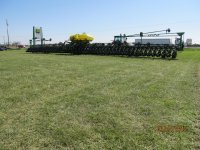
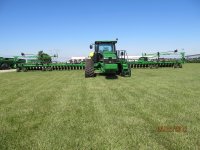
Laura in Nebraska got to test run a JD RX8 tractor which cost over 1/2 a million and sports 400+hp. The planter has 24 rows and I'm unsure of its cost. Ya, this is farming.
 
Last edited:
   / How agriculture works thread #71  
I didn't say I was surprised. What is happening is quite predictable. Perhaps I am in the minority when I think that having 75 snowmobile manufacturers has advantages over having 4. If our priority is having cheap food and it having to be that way because the corporate farms is more economical and the family farm becomes a distant memory, we are certainly headed in the right direction. Just don't tell me it is "better".
Why on earth would you think having six family owned corporations farming 1,070 square miles is "better" than having hundreds of families making a living off the same land? That is an excellent example of the true cost of cheap food. The economics of scale are definitely true, but that doesn't always necessarily make it the best choice. The rich are going to continue to get richer and those who get squeezed out are going to get left behind. The economics of scale sent them to the unemployment line. And some of their kids may very well end up smoking meth in a house they can rent for dirt cheap in the dried up little rural town because their options for a good life are pretty damn dim (That isn't exaggerating, that is what is happening!)
Cougsfan - Back in the 1970s I was project engineer for Gleaner's hillside combines - used only out in your country. Came across a family farmer in Whitman County north of St John, around Ewan. Started by father in the 1940s, was a schoolteacher, switched to farming. When I caught up with them in 1973 the family farm had grown to 20,000 acres. The father who started the farm is gone, as are his sons who joined him in the operation, but his grandsons are still running the operation. They incorporated when one of the two sons of that second generation got a divorce that nearly wiped them out. Result is still a little family operation, 20,000 acres in the most fertile wheat growing region of the USA (Whitman County produces the most wheat of any county in the USA due to its soil and climate). They would probably have incorporated anyway but a divorce forced the situation. Picture is from Steptoe Butte
1619192944858.png
 
   / How agriculture works thread #72  
We have a variety of farming in this state. We have the normal crops like corn, beans, hay, and wheat. Then we have all the farms that supply the canning company like sweet corn, green beans, peas, etc. We also have farms that will rotate in the seed crops for the seed companies.

Each of them are run a bit different than the others are. The canning companies dictate everything about the process so they need a farmer that is willing to follow their orders. The family dairy farm (250 milked) also does about 3000 acres of corn, beans, hay, so they stay busy. They also have some beef.

Then, some farmers have left the field work to others and focus on grain drying, storage, and trucking.
 
   / How agriculture works thread #73  
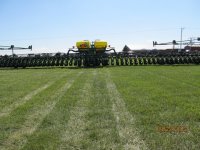
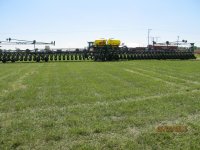
A few years back I posted a photo of a narrow row Deere corn planter on TBN that was something like 56 rows. It was so big I had to get back a couple hundred feet to get the whole thing in the photo. I can't find the picture but if anyone can please post it.

Also, yes, this is farming no matter the rows. Humans used to plant one seed at a time with a pointed stick until the American revolution made things happen faster. The planter of the era, in principle, is the same concept as the 56 row planter of today. There are some different bells and whistles but it plants seed in the same basic way.

In fact, most farm equipment of today is just new and imoproved versions of things from 100 years ago.
 
Last edited:
   / How agriculture works thread #74  
A few years back I posted a photo of a narrow row Deere corn planter on TBN that was something like 56 rows. It was so big I had to get back a couple hundred feet to get the whole thing in the photo. I can't find the picture but if anyone can please post it.

-----------------------------------------------
From the new search function, is this it? Wow--Biggest planter I have ever seen

253097-db03bd5e32210fbfe7943175b84634a4.jpg
253107-6c54ca920f1f35a2ce0ed4ed1cc24ae8.jpg
 
   / How agriculture works thread #75  
Thank you very much. I spend a fair amount of time and couldn't find it.
These should print bigger than above photos.
 

Attachments

  • planter 001.jpg
    planter 001.jpg
    706.3 KB · Views: 191
  • planter 004.jpg
    planter 004.jpg
    676.2 KB · Views: 176
  • planter 005.jpg
    planter 005.jpg
    714.4 KB · Views: 188
Last edited:
   / How agriculture works thread #76  
Thank you very much. I spend a fair amount of time and couldn't find it.
These should print bigger than above photos.
You're welcome.
Just click photos now with the new version and they open in the post. Use the arrow keys to cycle through them.
To close click the white X at the top right or push the escape key or backspace key.
 
   / How agriculture works thread #77  
Big agriculture isn't the farm that has 10,000 or even 100,000 acres under cultivation. Big agriculture is the companies that provide the equipment, the seed, the chemicals and buy the product -- companies like Deere, Monsanto, ADM, Cargill, Perdue, Tyson, Smithfield. All of them are far, far bigger organizations than even the biggest farms. So are the banks that provide financing. And all of them are effectively monopolies in the markets they serve. By their standards the guys who do the actual growing -- even the biggest ones -- are the little guys.

So why aren't the big guys in the growing business? Farming is risky. A farmer is at the mercy of the weather, energy prices, labor prices, input prices, commodity prices and interest rates. Farming is often physically dangerous work, with unpleasant working conditions and a lot of uncertainty. At the same time, in the production of a finished product there is only a certain amount of profit to be shared among everyone who had a hand in producing it. If you're in the production chain and you have a monopoly position, you can take an oversized share of the profits.

The growers are in a position where they buy their equipment and inputs from monopoly producers like Deere and Monsanto, and sell their products to monopoly buyers like Cargill, ADM, Perdue and Smithfield. The monopolists are perfectly happy to let the growers take all the risk while they enjoy most of the profits.
 
   / How agriculture works thread #78  
Yep, the big guys are the ones that make their money regardless and void of risk.
 
   / How agriculture works thread
  • Thread Starter
#79  
Laura did another video concerning the JD demo tractor-planter they have but this time included much more info. The tractor cost is $600,000 and the planter is at 400,000.. She is doing this demo as a promo for JD. This setup carrys 1500 gallons of liquid fertilizer. (not exact number wrong)
 
Last edited:
   / How agriculture works thread #80  
I wonder how much that pay for that?
 

Marketplace Items

TANK MANIFOLD (A58214)
5' MOWER (A52706)
5' MOWER (A52706)
2016 INTERNATIONAL PROSTAR TANDEM AXLE DAY CAB (A59904)
2016 INTERNATIONAL...
BETTER BUILT FUEL CELL (A58214)
BETTER BUILT FUEL...
2023 FORD F-150 XL CREW CAB TRUCK (A59823)
2023 FORD F-150 XL...
2018 Chevrolet Impala Premier Sedan (A59231)
2018 Chevrolet...
 
Top