
Chilly807
Elite Member
With any luck this thread will get locked down soon, it's really going to the dogs.. er tongs I mean...
Chilly
Chilly

By all means. ... The constructive response to any disagreement.With any luck this thread will get locked down soon, it's really going to the dogs
Chilly


Runaway thread! Runaway thread! Runaway thread!
the equipment maybe safer, the problem is that the operators aren't !The morons are the ones do don't learn from history. Do you seriously believe machinery and equipment was safer in the 1930's before OSHA?
bingo you get a cookie :licking:Common sense is uncommon.
So what you are saying is that a tired operator should still be operating ?Equipment and machinery operators get tired, bored and make mistakes. I don't see why equipment cannot be designed with that in mind given it is a near univeral human experience.
hmmmmmmRabid anti government types need to step back and appreciate that there is a positive role for research, regulations and enforcement even if those things are expensive, painful and sometimes really annoying. If OSHA isn't working for you then suggest positive fixes rather than whining about how great it used to be before they inflicted ROPS on us.
. Please don't get to carried away with giving OSHA credit. Mostly they are just a bunch of beaurocrats that wouldn't have a job if they weren't on the government gravy train
cj

after that I say get rid of the older generation{maybe 40 and up}
) my brother in law has a bulldozer. It could make it up the embankment but I don't think it can get through the woods to get to this tree without having to run over other trees.
Says the 39 year old...
} and sick and tired of big brother being up my #$%, that's why my post had sarcasm. My whole point is that no one wants to take responsibility for their actions, if something happens it MUST be someone/something elses fault.I have probably done some dumb things and probably done some moderately intelligent things. When involved in doing something dumb I usually have a bad feeling in the back of my head and try to be on the alert for as many 'gotchas' as I might be able to foresee.
Ultimately it's about risk management and making an educated game plan for the task/problem at hand.
Just last weekend, I was shown a dead oak tree that is leaning towards the gravel drive (far away from anyones home)
It is a LARGE and very tall oak tree and it's also in the woods. There is no way this tree is going to come down without causing other casualties (tree) during the process. Now we're debating do we wait and allow the tree to fall on its own, however unpredictable (anyone care to drive through the fall zone twice a day?) or do we take it down so we can focuse our attention to the moment it falls?
Fortunately, I have an industrial backhoe so I might be able to clean something out or after it falls, help muscle it around. Unfortunately, this tree is up a sharp bank and there is no real way to get my machine up there so it's essentially useless.
Fortunately (part II
Upper branches have already started to fall, noticed one with a diamater of maybe 8-10 inches laying on the ground (in the woods)
You can't eliminate risk in life so what I try to do is (hopefully) manage it and fear what can happen to me if I fail (thereby causing me to perhaps keep a sharper eye on it?)

Quote from Richard: Ultimately it's about risk management and making an educated game plan for the task/problem at hand.
:thumbsup: This is why I say no matter how much safety equipment is involved, in the end the operator is the one doing the deed. If the operator relys on safety devices to keep them alive......, well I quess we'll be seeing them on the other side.

The funny part of all this is that the logging winch actually pulls from the 3 ph, there is no attachment to the drawbar, nada, none... once you raise the winch off the ground, you're pulling from the 3ph.
So it would seem that any manufacturer of a modern logging winch is putting it's customers at risk whether they realize it or not.
Lucky for us we know better and are able to find innovative ways to eliminate that risk.
Sean
When I first came here, this was all swamp. Everyone said I was daft to build a castle on a swamp, but I built in all the same, just to show them. It sank into the swamp. So I built a second one. That sank into the swamp. So I built a third. That burned down, fell over, then sank into the swamp.
I think this is where a lot of the confusion comes from.
There are safe and not so safe ways to pull with the 3pt hitch.
When the applied load is high on the hitch, the top link is loaded in tension and applies a torque to the frame that tends to lift the front end.
When the applied load is low on the hitch, the bottom links are loaded in tension and apply a torque to the frame that tends to push the front end into the soil.
Most logging winches have a slotted rack that's mounted low on the back for attaching the choke chains so the applied load durring skidding is low on the hitch. This greatly reduces the tendency of the front to lift. This was what (as someone already pointed out) is exactly how the 3pt hitch was intended to be used. Of course, there's always someone who will find a way to make this arrangement dangerous, either through bullheadedness or pure stupidity.
There's no safe way to skid logs - it's just a dangerous activity. You have to be responsible for what gets done. You have to think about what you're doing the whole time you are doing it. You have to question every assumption and have a plan for when things still go bad.
-Jim
" I'll add to that time-worn adage and say "You can't fix stupid, careless, or just don't give a ****". What we can fix is inexperience. It was after that I built the log arch to tow behind.) of the way I would haul IF I was using tongs and had no way to shield the log butt. The chain going to the drawbar MUST keep the critical angle at 90 degrees or more, or you start to translate the pulling force into rotational pressure, which we all agree is a bad thing. Personally, I'd skip the tongs and use a chain choker. Attach an anchor shackle to the vertical choker once the butt was lifted then chain it to the drawbar. The downside is you're still dragging the log close to the ground. Not so good for larger trees.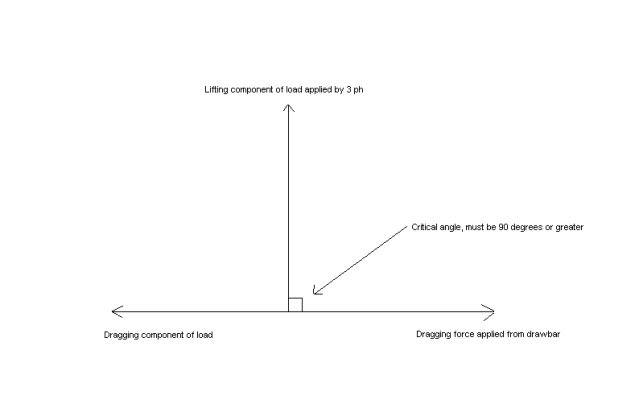
Any pics on how to actually hook the tongs to the draw bar?
... new Corvette in 1996 ... the dang think shook so bad at 135 MPH it scared me




