How many of you own generators and what size?

   / How many of you own generators and what size? #41  
Shimon said:
The problem arises because your main breaker only shuts off the two hot wires. The neutral wire is always connected to the power company unless you pull the meter.


What can happen is that you have a fault to ground but if your grounding wiring isn't up to snuff then the fault will travel back up the neutral which can shock a lineman. However, in most cases the generator cb will trip before anything bad happens...but it is still possible.

Remember, if you use your main breaker as a shut-off then you are not really shut-off from the power company. You need to have a switch that shuts off both hot wires and the neutral.

I guess I don't get it but I'm no electrician either. The ground and neutral are tied together, here anyway, and any short would either throw a breaker or go to ground? The first ground would be at the meter.
 
   / How many of you own generators and what size? #42  
BillyP said:
Bob, I guess I'm missing something here? You copied and pasted...

Edison cautions that special care be taken when patching the generator into the home's main power system. Improper hook-ups may send current backwards through the Edison Company's lines and become high voltage as it passes through transformers.
BillyP, scroll up a bit, here is what I wrote:
Bob_Skurka said:
... I have been told by an electrician (and I don't know this to be true) that even if you flip the house breaker off you can still backfeed through the neutral wire into the power grid if you are running a generator into your power panel through a breaker. ...
HomeBrew took that quote and then wrote this followup as a direct retort
HomeBrew said:
I have been told by an electrician that that is an urban myth. . .
What has been alluded to is that backfeeding is an urban legend.

However, if that is true, then why is there a caution from Edison? Or why did NIPSCO (the power company in my area) come around and force people to shut down their generators or prove they had a real isolator switchover when we had our week long power failure?

I don't doubt that the lineman forums say one thing and other forums say something else. I'm not an electrician, nor will I, as someone who clearly does not know, then suggest that something else is safe when I've been told by electricians, my power company and the laws here that it is actually unsafe.

Again, these are not my words, they are the words in the municiple code where HomeBrew lives . . .
Edison cautions that special care be taken when patching the generator into the home's main power system. Improper hook-ups may send current backwards through the Edison Company's lines and become high voltage as it passes through transformers.

This high voltage would be present in an otherwise downed circuit and may cause electrocution to worker s repairing the circuit. A qualified electrician should perform this work to prevent damage to your electrical system or Edison's transmission facilities.
 
   / How many of you own generators and what size? #43  
I got a Honda EU2000i.. It will run the fridge without a problem, but when the freezer cuts in it (only connected one at a time mind you) it really grunts, but didnt overload and shut down.. I got it primarily for winter camping, but it would some lights on if needed..

I made an auxiliary tank for it using a 6 gallon boat tank (check out the yahoo eu2000i groups if have an EU and want to build one) . Depending on the load it should run in the neighborhood up to 70 hours without refueling.. But I would need to change the oil about every 24 running hours..

Since I am on a crawl space I am seriously thinking of adding several outlets in the floor (for the tv/satellite dish, bedroom) and run them outside to a junction box of some sort. Then I could connect the generator to just this circuit (such as it is) and have the necessities (tv and a few lights lol) if we lost power..

brian
 
   / How many of you own generators and what size? #44  
Bob_Skurka,

As to taking "it" personally: Well, it just seemed personal when you personally quoted me so I personally responded to you. But, I didn't mean anything personal by anything I said.

I know you're just bored and playing with us today but, of course, THE reason for much concern, and laws in some areas, by the utilities, etc, is that the REAL danger comes from someone NOT shutting the main breaker OFF before they connect a generator. A properly installed transfer switch removes all but a freak chance that the generator cannot backfeed into the grid and doesnot require user action. The main breaker does the same thing but does require user action ... Kindof like being capable of using a brake on a car.
Additionally, the utilities have great concern that a generator user is not seriously injured or killed when they re energize the grid thru a main breaker in the "on" position.


Shimon,

Based on your experience that I gleened from your profile, I yield to your judgement. The licensed electrician, that I hired to direct my electrical work during my site development, told me that my connection was safe. And, agreeing with Billy_P, I believed that the neutral being bonded to ground insured that.

Cheers!
 
   / How many of you own generators and what size? #45  
Bob_Skurka said:
BillyP, scroll up a bit, here is what I wrote:
HomeBrew took that quote and then wrote this followup as a direct retort
What has been alluded to is that backfeeding is an urban legend.

However, if that is true, then why is there a caution from Edison? Or why did NIPSCO (the power company in my area) come around and force people to shut down their generators or prove they had a real isolator switchover when we had our week long power failure?

I don't doubt that the lineman forums say one thing and other forums say something else. I'm not an electrician, nor will I, as someone who clearly does not know, then suggest that something else is safe when I've been told by electricians, my power company and the laws here that it is actually unsafe.

Again, these are not my words, they are the words in the municiple code where HomeBrew lives . . .
Edison cautions that special care be taken when patching the generator into the home's main power system. Improper hook-ups may send current backwards through the Edison Company's lines and become high voltage as it passes through transformers.

This high voltage would be present in an otherwise downed circuit and may cause electrocution to worker s repairing the circuit. A qualified electrician should perform this work to prevent damage to your electrical system or Edison's transmission facilities.
Bob, I will agree, it is unsafe. The part that's not clear is when does it become unsafe? There's always unsafe ways of doing most anything.

Take for instance your quote from Edison. It never said it was unlawful to "patch" in a generator but that caution should be taken. It's only becomes unlawful if you failed to call them first.

Homebrew only mentioned urban myth about back feeding through the neutral wire. And from talking to an AEP lineman, that's what I'm getting too.
 
   / How many of you own generators and what size? #46  
Bob, what I think what was being called an urban myth was backfeeding on the neutral, not backfeeding in general.

I read this thread looking out at a couple inches of ice and a foot of snow and realizing that I dodged a bullet that folks a few miles from me did not. I intend to have the fully approved cut out installed by an electrician and get a generator before this happens again.

One thing that surprised me in this thread is the scarcity of PTO generators being mentioned. As a device that may be used very infrequently in its life, it seems a perfect candidate for taking advantage of our tractors. Any reason that I should be looking at something other than a PTO generator? I have a 300 gallon bulk tank of diesel that makes me feel much more confident of being able to feed the beast, and my tractor is quieter than any air cooled motor I've ever been around.
 
   / How many of you own generators and what size? #47  
Well I'll admit that I'm about 1/2 outlaw so,,,,but,no person from the power company is going to force me to do anything except pay the bill,,,I just can't imagine a power company truck pulling in my driveway and telling me they want to see the inside of my house,they own to the meter,,and that meter and transformer and in my case 3 poles,are on my property,,it wouldn't even work if they had state police with them,with out a search warrent that is,,,places are different,,but here in rural w.va.,the power company is busy trying to get power restored when it goes off,,and as far as I can tell,they don't have any electric police working for them.
Yes its dangerous hooking up a gen to a 220 plug in,in many different ways,but we gotta do what we gotta do,,and if the electric company can't provide the juice,[that we pay for],than they can but out when we have to.

While don't they start burying more electric lines,,they could leave transformers above ground on the poles,,I know it is way more expensive,[in the short term],but its not like they have just a limited amount of time to recoperate their investment,or a limited amount of time to do it in.thingy
 
   / How many of you own generators and what size? #48  
thingy said:
Well I'll admit that I'm about 1/2 outlaw so,,,,but,no person from the power company is going to force me to do anything except pay the bill,,,

But what if something was hooked up incorrectly and a lineman got killed on what was suppose to be a 'dead' line.. At that point in time, the power company would be your least worry, I think law enforcement would be more interested..

brian
 
   / How many of you own generators and what size? #49  
My generator transfer disconnect switch removes all three wires from the system. The two hots and the neutral. When I installed the transfer switch, I had to separate the grounds from the neutrals at the main panel, and run the grounds back to a series of grounding rods that were place in the ground. The wire had to be an unbroken #4 copper wire from the panel through the disconnects, meter socket, and then to the well casing. The neutral is tied to the generator when the generator is running and to the main line coming into the house, when it is not running. I believe that this system is known as an isolated ground system.
Dusty
 
   / How many of you own generators and what size? #50  
thingy said:
Well I'll admit that I'm about 1/2 outlaw so,,,,but,no person from the power company is going to force me to do anything except pay the bill,,,I just can't imagine a power company truck pulling in my driveway and telling me they want to see the inside of my house,they own to the meter,,and that meter and transformer and in my case 3 poles,are on my property,,it wouldn't even work if they had state police with them,with out a search warrent that is,,,places are different,,but here in rural w.va.,the power company is busy trying to get power restored when it goes off,,and as far as I can tell,they don't have any electric police working for them.
Yes its dangerous hooking up a gen to a 220 plug in,in many different ways,but we gotta do what we gotta do,,and if the electric company can't provide the juice,[that we pay for],than they can but out when we have to.

While don't they start burying more electric lines,,they could leave transformers above ground on the poles,,I know it is way more expensive,[in the short term],but its not like they have just a limited amount of time to recoperate their investment,or a limited amount of time to do it in.thingy

Sure they don't have any legal right to enter your house, but keep in mind that they are under no legal obligation to keep service on at your home if they feel in there sole determination that it is unsafe for there workers. You might own the pole, but I even doubt that, however, I know that you don't own the wire or transformer, or anything on the meter side of the electrical service. You also say that "here in rural w.va.,the power company is busy trying to get power restored when it goes off". What you fail to realize is that all the surrounding power companies come to West Virginia to assist in restoring power during massive power outages. Those workers from another state will just cut your power lines at the pole if they feel that it isn't safe for any reason. They do have the legal right to do that. If you chase them off the property, then they can always do it at the source that is off your property. You might want to re read the contract/permission slip/easement that you granted to them when they installed the poles and the power lines. You gave up all your rights when it comes to the poles, wires, meters, etc. I am also certain that there is a clause in there that they have the right to enter the property at any time for maintenance and repairs to those poles, wires etc. I remember a neighbor that mouthed off to one of the electrical works when he was asked to turn off his generator. They left and went to the pole that serviced the house and cut the wires, red tagged the service and pulled the meter. He didn't get service back until he brought everything up to code and had a proper disconnect switch. These electrical linemen don't mess around and they don't argue with you. They just cut you off.
Dusty
 
   / How many of you own generators and what size? #51  
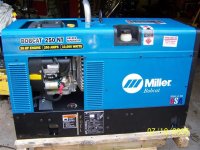
My generator is also a welder. Miller Bobcat 10,000 watt and will run my whole house.
 

Attachments

  • Generator.JPG
    Generator.JPG
    65.3 KB · Views: 152
   / How many of you own generators and what size? #52  
Here's my generator. By the way, no back feeding here :p

65556d1165360246-how-many-you-own-generators-gen.jpg
 
   / How many of you own generators and what size? #53  
You guys are just afraid of big brother,if he sees your scared he'll keep scaring you,,yeah they could cut my wire,they can take their meter and transformer too,,,but, if they do that,they can take those 4 poles that cross my land too and relocate them,cause I wouldn't be forced to play the game antmores,would I? yeah,sure they got a righta way,but I got a chain saw,,,,but seriously folks,,,,it would never come to that here,,,,they apparently don't care here in southern w.va,,,maybe cause the electric never hardly goes off here,,,been here for 14 years,,very remote,most of you would say,,longest electric ever been off [so far,knock on my head],is 14 hours,,thats when a guy burned a tree down,,,and besides,,if you turn off the main breaker,no juice is going to hurt big brothers little helpers anyways,,,ain't nothing going to leak out on a ground,,what a rumor that is,,,,thingy
 
   / How many of you own generators and what size? #54  
thingy said:
While don't they start burying more electric lines,,they could leave transformers above ground on the poles,,I know it is way more expensive,[in the short term],but its not like they have just a limited amount of time to recoperate their investment,or a limited amount of time to do it in.thingy

My power line is buried just because I know I would be the last one to get power restored in the event of an ice storm or such, also I didn't want any overhead pwr lines on my property.
 
   / How many of you own generators and what size? #55  
My powerline was buried and it was cheaper than poles. If you have to dig a trench, the cost goes up , but mine was plowed in. Started work at 7:00, had to wait half an hour while th epower coo. crew talked with their uniton guys to see if they should work with the phone co. guys who were not union (and who had the plow). They had to bring power from the plole across the street (ran a little digger under the street), then plowed it 1,200 ft. to my future house. Done before noon.

When I started work as a forester with the USFS, one of my first jobs was to do an environmental assessment on a project to bring power into Star Meadows, a little community in the middle of the district, 15 miles off the highway. Power co. was going to go on poles, I asked how much more to go underground, they said $150 to bring it down from the poles, then the same per mile after that. We made them bury it. Think of the outages they would have had going thru a lodgepole forest on poles!
 
   / How many of you own generators and what size? #56  
jeffinsgf said:
One thing that surprised me in this thread is the scarcity of PTO generators being mentioned. As a device that may be used very infrequently in its life, it seems a perfect candidate for taking advantage of our tractors. Any reason that I should be looking at something other than a PTO generator? I have a 300 gallon bulk tank of diesel that makes me feel much more confident of being able to feed the beast, and my tractor is quieter than any air cooled motor I've ever been around.

I use a PTO generator and since I only use it about a dozen times a year I don't mind. Advantage is cost and one less engine to maintain and smaller size. Disadvantage is you have to hook up the tractor to it (usually in the dark in pouring rain or freezing wind or both) and if you need to use your tractor for other stuff like moving fallen trees then you loose power. I think for a standby unit, the PTO generator is a good choice.
 
   / How many of you own generators and what size? #57  
BillyP said:
I guess I don't get it but I'm no electrician either. The ground and neutral are tied together, here anyway, and any short would either throw a breaker or go to ground? The first ground would be at the meter.

Yes, the ground and neutral are connected in your main panel (should not be connected in any sub-panels).

So, when you have an electrical fault, that current wants to find its way back to the source (ground). It can go through the ground wire or through the neutral (or through you if neither of the previous two are available). If your grounding wire is compromised due to a poor or broken connection or undersized grounding conductor then the current will flow back through the neutral wire and go back to the power pole and take the quickest way back to ground.

And remember when that current goes back to the pole, it may go through a transformer before finding ground so it gets juiced up to 10,000 volts (or whatever the line voltage is) at a low current.

I feel the chances of actually shocking a lineman are slim but it is in the realm of possibility. So before you use your main breaker as a generator cut-off I would find my grounding rods and make sure they are properly connected to the main panel.
 
   / How many of you own generators and what size? #58  
Shimon said:
Yes, the ground and neutral are connected in your main panel (should not be connected in any sub-panels).

So, when you have an electrical fault, that current wants to find its way back to the source (ground). It can go through the ground wire or through the neutral (or through you if neither of the previous two are available). If your grounding wire is compromised due to a poor or broken connection or undersized grounding conductor then the current will flow back through the neutral wire and go back to the power pole and take the quickest way back to ground.

And remember when that current goes back to the pole, it may go through a transformer before finding ground so it gets juiced up to 10,000 volts (or whatever the line voltage is) at a low current.

I feel the chances of actually shocking a lineman are slim but it is in the realm of possibility. So before you use your main breaker as a generator cut-off I would find my grounding rods and make sure they are properly connected to the main panel.

Interesting, out here, neutral and ground are always bonded in the sub panel. When you buy a sub panel, you will see the ground screw that mentions in some locals, you must bond the neutral to the ground. On our main panels, the ground and neutral are isolated.
 
   / How many of you own generators and what size? #59  
_RaT_ said:
Interesting, out here, neutral and ground are always bonded in the sub panel. When you buy a sub panel, you will see the ground screw that mentions in some locals, you must bond the neutral to the ground. On our main panels, the ground and neutral are isolated.


Hmmm...I have to disagree on this one. There isn't a copy of the NEC online but here are some excerpts relating to grounding and bonding of sub-panels: Click Link. Also here is another link to an article about sub-panels which is more in layman terms: Click Link (scroll down to the big yellow warning boxes).

Maybe we are talking about two different things and that may be causing confusion. Also, I am not an NEC electrician...I am a marine (ABYC) electrician...but the principles and most of the codes are the same.
 
   / How many of you own generators and what size? #60  
Rat...... I believe that you have that just the opposite the way it should be, and possibly it is a memory error? In CT, the first panel after the meter is considered the main panel. Everyone after that is considered the sub panels. I have a meter on the outside of the garage wall, and a 200 amp disconnect on the other side. That disconnect is considered the main panel. Then comes the 200 amp generator disconnect, and underground to the circuit breaker panel in the cellar. That panel has the grounds and neutrals separated and the neutrals are not bonded to the panel itself. The ground wires are bonded to the panel box. I have a 4# copper wire that starts at the panel and continues unbroken, through a few ground rods and eventually ends up being bolted to the well casing. It was done with the NEC standards in mind.
Dusty
 

Tractor & Equipment Auctions

Crown RM6025-45 4,500 LB Stand-On Electric Forklift (A59228)
Crown RM6025-45...
500 BBL FRAC TANK (A58214)
500 BBL FRAC TANK...
Unused 2025 CFG Industrial H15R Mini Excavator (A59228)
Unused 2025 CFG...
iDrive TDS-2010H ProJack M2 Electric Trailer Dolly (A59228)
iDrive TDS-2010H...
PARTS ONLY - Has Title - 2023 Ram 1500 Classic Pickup Truck - Hemi 5.7L - Automatic Transmission (A56438)
PARTS ONLY - Has...
2016 John Deere 4044R 42HP 4WD Utility Tractor (A59228)
2016 John Deere...
 
Top