
Diggin It
Super Star Member
I do have 12V LEDs scattered through the house wired to a 35Va battery on a trickle charger, but that won't run the refrigerator, freezer, water heater or furnace.

The 2 hots or phases (call them L1 & L2) in a 120/240V panel aren稚 split onto the left and right side.
L1 will be first row of breakers #1 & #2
L2 will be second row of breaker #3 & #4
L1 will be third row of breakers #5 & #6
L2 will be forth row of breakers #7 & #8
etc...
That痴 why a double pole breaker that痴 on the left or right side of the panel can span poles 1&3, 3&5, 2&4, 4&6, 6&8, etc.. and get 240v from L1 & L2.
You want to balance the load between L1 & L2 , not left and right side of the panels.


Getting your various facilites back in operation is important. But having light really is the first priority. It's why I like a main transfer switch so even with a small generator, you have all your lighting. If I had the time, I would make 12 Volt lighting systems too.

The earliest wiring was done this way. It is called knob and tube. Knob-and-tube wiring - WikipediaThough not esthetic, I visited a cabin once that the owner had ran two uninsulated bare wires down the middle of all ceilings with insulated standoffs tied into a big deep cell battery outside connected to one fairly large solar panel. It was all off grid.
The ingenious part was that he had 12 volt light bulbs with sockets with a short length of wire pigtailed to each one for positive and ground. The other end was alligator clips. He could fasten that bulb(s) anywhere along the length he wanted and as many.
Poor mans track lighting.
The earliest wiring was done this way. It is called knob and tube. Knob-and-tube wiring - Wikipedia
I recently moved into a new house with the pictured breaker box and outside generator connection.
I'm interested in running only the fridge, gas stove, propane heat control and well pump, plus a couple of LED light bulbs.
I understand the switching at the breaker box, and will disconnect at the meter (just as a fail-safe). But I haven't purchase a generator yet and I'm looking for advice as to what type and capacity I need. View attachment 629096View attachment 629097
They had PVC back then? I don't think so.Close. But not exactly.
I have a farmhouse built in the late 1700s and am familiar with knob and tube.
The cabin had two uninsulated wires ran down the center of each rooms ceiling for positive and negative.
By alligator clipping on ( or even twisting a wire around each one)
The owner could move and set lights wherever he desired.
The insulators? One inch chunks of PVC or pieces of a broom handle about an inch long.

As I read it, lennyzx11 was talking about two different buildings, a 1700s farmhouse and a cabin that a friend had setup a lot voltage knob and tube system in.They had PVC back then? I don't think so.

Close. But not exactly.
I have a farmhouse built in the late 1700s and am familiar with knob and tube.
The cabin had two uninsulated wires ran down the center of each rooms ceiling for positive and negative.
By alligator clipping on ( or even twisting a wire around each one)
The owner could move and set lights wherever he desired.
The insulators? One inch chunks of PVC or pieces of a broom handle about an inch long.

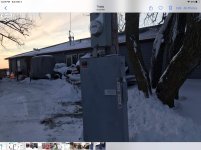

I struggled with transfer switch’s and interlock kits in my last few houses. Adding a transfer switch is expensive and limiting in the number of circuits you can move over. Interlock switches work well, if your code and existing panel support them. My current house has 400 amp service, so getting all my critical circuits under generator power wasn’t possible without serious rewiring ($$$$). Here is an easier way. GenerLink switch. Comes in 30 and 40 amp versions. Simple and safe. Best of all, you can take it with you when you move. I can’t post a link as I’m still under the min post count. Home Depot sells them. The 30 amp runs $650.
I agre it is a simple solution , though it is $650 for $25 worth of parts.That's a clean (although expensive) approach I hadn't heard of before. Pretty neat.
I agre it is a simple solution , though it is $650 for $25 worth of parts.


