How to repair carpenter bee damage?

   / How to repair carpenter bee damage? #21  
I have a big problem with them drilling into the bottom of 2x10 rafters on the overhang of the barn where the wood is bare or nearly so.

Have had pretty good luck with just giving the holes a shot of expanding foam insulation. It doesn't do anything to repair the structural damage, but after it dries, it's easy to just trim off flush with a knife or putty knife, etc. and then paint over. A good coat of paint will keep those bees away.
 
   / How to repair carpenter bee damage? #22  
I have filled mine with plain old silicone sealant in the past. Worked fine. Bondo or construction adhesive sounds good too, a little messy though.

The bees boring holes in my new(ish) cedar siding is frustrating enough. But the g0d d&^% WOODPECKERS that come afterwards trying to find the larvae are SO MUCH WORSE. The bees go in and then turn sideways. The woodpeckers take a shortcut and make their own path in. You can only run outside and throw tennis balls at the peckers so many times in a day, gets old.

Thankfully, somehow not too bad this year at all. I keep my carpenter bee traps hung up on all the house corners all summer long now.
 
   / How to repair carpenter bee damage?
  • Thread Starter
#23  
Have had pretty good luck with just giving the holes a shot of expanding foam insulation. ... A good coat of paint will keep those bees away.
It's pine wood being attacked. Bondo and foam sound interesting. And if bee larvae are in the holes, what are some options for treating those holes before filling? Are there off-the-shelf products that would work?

You raise a very important point. If fresh paint dissuades the bees, after painting they will focus on and more aggressively attack the unpainted wood on the barn interior. I already have significant damage there. But I need to better prepare for that.

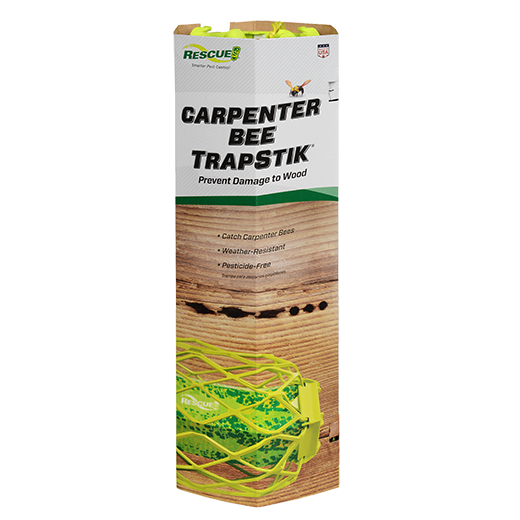
btw, the traps that look like a small bird house with a glass jar on bottom work OK. But the "sticky" traps are awesome-- catching hundreds. I need to up my "treatment" game next season ....

 
   / How to repair carpenter bee damage? #24  
It's pine wood being attacked. Bondo and foam sound interesting. And if bee larvae are in the holes, what are some options for treating those holes before filling? Are there off-the-shelf products that would work?

You raise a very important point. If fresh paint dissuades the bees, after painting they will focus on and more aggressively attack the unpainted wood on the barn interior. I already have significant damage there. But I need to better prepare for that.

btw, the traps that look like a small bird house with a glass jar on bottom work OK. But the "sticky" traps are awesome-- catching hundreds. I need to up my "treatment" game next season ....


I have never seen those trap sticks before, but I'm going to order some! I need to up my game on these guys too.

Strange thing is that I've NEVER seen one drill a hole into a framing member inside the barn. Why is that? They work on the overhang like crazy. They work on the run-in shed area. But never have I seen one drill a hole in the enclosed portion of a building.

Don't know why. Also don't know if we have the same species.

Someone posted a thread the other day about creatures they would ban from the Earth if they had the power . . . I'd nominate these carpenter bees.
 
   / How to repair carpenter bee damage?
  • Thread Starter
#25  
But never have I seen one drill a hole in the enclosed portion of a building.
The rear of my barn is open with no door. Probably a 12 x 14 opening-- maybe not being sealed / no door is why they attack interior wood there?
 
   / How to repair carpenter bee damage? #26  
I have filled mine with plain old silicone sealant in the past. Worked fine. Bondo or construction adhesive sounds good too, a little messy though.

The bees boring holes in my new(ish) cedar siding is frustrating enough. But the g0d d&^% WOODPECKERS that come afterwards trying to find the larvae are SO MUCH WORSE. The bees go in and then turn sideways. The woodpeckers take a shortcut and make their own path in. You can only run outside and throw tennis balls at the peckers so many times in a day, gets old.

Thankfully, somehow not too bad this year at all. I keep my carpenter bee traps hung up on all the house corners all summer long now.
We have cedar siding also and we discovered that it's necessary to keep the siding well covered with a solid color stain. I believe there are also additives to put in your stain to keep carpenter bees away.
 
   / How to repair carpenter bee damage? #27  
The rear of my barn is open with no door. Probably a 12 x 14 opening-- maybe not being sealed / no door is why they attack interior wood there?

I don't know. Always thought it was weird. Even with the barn wide open, they'd always work on the exterior wood here.

I keep a couple cheap tennis rackets laying around at the barn. You can nail a bunch of them in a few minutes. Doesn't do much to reduce the population, but it sure feels good. . . .
 
   / How to repair carpenter bee damage?
  • Thread Starter
#28  
I keep a couple cheap tennis rackets laying around
Well, there goes two months where I could have been doing something else. :LOL:

Seriously, the bee problem was neglected; as a consequence it exploded out of control two years ago. This year I applied countermeasures and "reduced the herd" by at least half-- I will keep it up but this is going to be a never-ending seasonal thing.
 
   / How to repair carpenter bee damage? #29  
To get rid of them (I'd do that first!) soak the wood with Citri-Fresh Bee Stop. Amazon sells it by the gallon jug.
 
   / How to repair carpenter bee damage? #30  
this seems to be a good argument for vinyl or metal siding.
They get into my garage door header in the polebarn. Not limited to just siding and whatnot.
 
   / How to repair carpenter bee damage? #31  
I want to prep my barn for paint, and carpenter bees have caused widespread damage to the wood. There are numerous holes in the siding-- typically the size of a dime, or a nickle.

The eaves have some larger holes/voids that are maybe 1-2 inches across. Typically where the boards under the eave join together.

What are some options to repair this? I previously used LiquidWood/WoodEpox for a wooden threshold repair, but that stuff is stupid expensive and might be overkill for something like this ???

Thanks!
I use Bondo wood filler to repair wood, but it's a two part mix which makes it's very time consuming and you waste a lot of Bondo because it dries so quickly. And, it has to be sanded!
 
   / How to repair carpenter bee damage? #32  
Screened porch has knotty pine for ceiling that extended to edge of roof as the soffit. The bees loved boring in that. Finally after several years I had enough and the soffit on the outside of the screens is now copper flashing over the knot pine. No more bees.
 
   / How to repair carpenter bee damage? #33  
After a summer or two of fighting them I found that painting the wood works and for EVERYTHING else I spray with a BIFEN IT concentrate mixed with water. A couple ozs/gallon works well. After spraying right way in the spring and again in the fall the Carpenter bees start finding someplace else to go. Do this for two years and then in the spring yearly after that. Bees return to their old habitat until you break their cycle. This stuff works good for CBs and spiders and fire ants.
I had so many holes inside and outside it would take a full make-over to be acceptable.
 
   / How to repair carpenter bee damage? #34  
I've had great success with

FenvaStar EcoCap.​


I treat in the spring and fall, it lasts 6 months+.

I've had 0 luck with the bee traps. I've ordered some of the sticky traps.

As for holes, I caulk and paint, two coats.
 
   / How to repair carpenter bee damage? #35  
woodepox is the best, but you already know that...

My mom has a modern wood cabin that had few logs where bees and wasps made a home.

Woodepox fixed that problem. It dries so hard they couldn't chew through it. I wish I could see their teeth get ground down when they tried again.
 
   / How to repair carpenter bee damage? #36  
Since it is not structural, but just wish ti gill the void for paint, I have decent luck with paintable caulk. Does not fo well for stains however. Allow plenty of drying time.
 
   / How to repair carpenter bee damage? #37  
Great carpenter bee traps from scrap!
materials: 4×4 post, pressure treated (a scrap of one is fine. You just need 7”); Mason jar (half pint or a regular mouth pint—most any container works fine; plastic lids are easiest).
1. Measure 7” up from the end of your 4×4. Then, draw a 45-degree angle that radiates down from this point. Cut along the angle. A 14” 4x4 makes 2 traps.
2. Flip your 4×4 piece over, so that the flat bottom is facing up, and mark its center. Then, drill a 7/8 “ hole at the center point, approximately 4” deep. Take care to keep your hole straight.
3. Now, mark the location of your entry holes on the four sides of your block. Each hole should be 2” from the bottom and 1¾” inches from each side. Use your ½” wood bit to make your holes at an upward 45-degree angle. Continue drilling until your hole connects with the hole that you drilled from the bottom. Then, repeat with the remaining holes.
4. Unscrew the lid from your jar, and punch/drill a ½” hole at its center. Leave the other holes as is. Attach the lid so the hole lines up with the 7/8” hole. Attach lid and screw on the jar. Hang using a screw eye, or fasten to house, joist, etc where bees congregate.​
How the Trap Works: Carpenter bees discover one of the outer holes and crawl inside it to lay eggs. Once inside, the 45-degree tunnel casts their entry point in the shadows. They see light coming up from the hole at the base of the trap, and move towards it, assuming it’s the exit. Instead of finding their way out, they find themselves in the jar, and can’t get back out.​
 
   / How to repair carpenter bee damage? #38  
Carpenter bees were horrendous this year near us. I used wood filler. Filler was probably a success because we also hung up traps and got rid of hundreds of them.
I thought about getting traps for our carpenter bees but it would spoil my wife's fun. She loves to "stalk" them out on our deck and whack them with a badminton racket. She's pretty good at it. She gets 5 or 6 a day during the season.
 
   / How to repair carpenter bee damage? #39  
It's pine wood being attacked. Bondo and foam sound interesting. And if bee larvae are in the holes, what are some options for treating those holes before filling? Are there off-the-shelf products that would work?

You raise a very important point. If fresh paint dissuades the bees, after painting they will focus on and more aggressively attack the unpainted wood on the barn interior. I already have significant damage there. But I need to better prepare for that.

btw, the traps that look like a small bird house with a glass jar on bottom work OK. But the "sticky" traps are awesome-- catching hundreds. I need to up my "treatment" game next season ....


Lookup Drione dust, it's the best way to treat holes before sealing up, both for adult bees inside and for larva that will grow into a bee. You can buy a small handheld duster (bellows with a puff tube) to get it inside the hole. I also have what's called a dust-stick that lets me treat holes as high as 20' up. Treat the hole and leave open for a day before sealing up, to allow other adults to find the dust.

I can confirm it's an old wive's tale that carpenter bees won't attack painted wood. My mother in law's place is fully painted and they loved drilling into her rafter tails. I read a scientific article about the bees once, and something in their eyesight/brain lets them detect woodgrain patterns through paint. I think you'd need super smooth/thick paint and/or cladding to make the wood invisible to the bees.
 
   / How to repair carpenter bee damage? #40  
I thought about getting traps for our carpenter bees but it would spoil my wife's fun. She loves to "stalk" them out on our deck and whack them with a badminton racket. She's pretty good at it. She gets 5 or 6 a day during the season.
We can get 5 or 6 every couple minutes down at the barn. They just hover and float around the eaves looking for a good place to drill a new hole. Double points when you catch them mating on the fly and get two with one whack! Tennis racket works best for me. I don't even play tennis, but my backhand has really improved.
 

Marketplace Items

UNUSED FUTURE RG63-63" HYD ROTATING GRIPPER (A60432)
UNUSED FUTURE...
5' MOWER (A52706)
5' MOWER (A52706)
2019 INTERNATIONAL LT625 TANDEM AXLE SLEEPER (A59904)
2019 INTERNATIONAL...
THREE POINT MAINTAINER BLADE (A58214)
THREE POINT...
2009 Bruton T/A Enclosed Livestock Trailer (A55973)
2009 Bruton T/A...
CATERPILLAR OFF ROAD WATER TRUCK (A60429)
CATERPILLAR OFF...
 
Top