HST Question/Concern....

/ HST Question/Concern.... #1  

duckhunt

Silver Member
Joined
May 13, 2009
Messages
129
Location
Central, Louisiana
Tractor
Kubota L4240HSTC
My brother just picked up a brand new Kioti CS2410 SCUT. Loader, Mid-mount Mower, and Backhoe. We both have little or no experience with HST trans, being my tractor is Gear and all ones we have ever had have been gear. We were working some dirt, fairly large pile and noticed when we went to load the bucket or push the pile some that the tractor would not spin over the tires. The engine doesn't necessarily load, but the transmission does the "HST Whine", and that's it..... Is this common in HST tractors? In my experience, my Mahindra 2816 tractor will spin/turn/breakover, all tires at idle in low range, and will in medium with some throttle. We were at 540 or operating RPM, in low range. I have a much larger tractor with only 4 more horse power. We were just concerned. Considering the tractor is new with only 15hrs. What are yall's thoughts? I'm not being brand specific, maybe SCUT specific, but any opinions welcome... THANKS

Jonathan
 
Last edited:
/ HST Question/Concern.... #2  
I can only give you the benefit of my experience with other HST tracors. With my Kioti DK35se and my previous tractor a Kubota L3400HST. They would both easily spin all 4 tires in LO range when pushing up against an immovable object. In MED, it is an iffy thing, It depends on what the ground condtions are like, Sometimes they would go into relief, sometimes they will spin. In HI either tractor will just go into relief and not spin any tires if you are in 4wd and push up against an immovable object.. Your HST relief valve is set to some pressure setting and when that pressure setting is reached then the fluid bypasses. This is normal. Now what that setting is and what the Little Kioti should do I don't know. I can tell you that my JD La135se Hydro lawn mower which only has 1 speed range, can also go into relief when climbing some extremely steep (too darn steep to safely mow) hills when I have my fat axx on it. I can get enough traction that the hydro will just stop moving and the two rear tires will not move or spin. But this is a small extremely weak sister of a transmission to start with. I would think that the little Kioti tractor would spin its tires in low range.. Now you can get a little more torque and less speed from a hydro by actually backing off of the pedal instead of flooring it. That seems counter intuitive but it is the way they work. Remember when you press the pedal harder you get more speed and less torque,. Back off and you get more torque and less speed. Possible mitigating factors would be type of tires, and weight on the 3pt, and surface conditions of the ground you are operating on, but My DK35se, with 800 lbs on the 3pt and fluid loaded R4 tires, will spin all the tires on a concrete or asphalt surface in LO range.

So I know I haven't answered your question completely but perhaps others who own this unit can offer more insight. And if your HST relief valve is set too low, it may be possible to adjust it.

James K0UA
 
Last edited:
/ HST Question/Concern.... #3  
I have ruts all over my lawn proving that they will spin all four in low, and to some degree mid range.
 
/ HST Question/Concern.... #4  
HST is not like gear tractors in that if you traveling slowly the HST may not spin the tires before the internal leakage of the components limits travel. Try pushing a little harder on the HST go pedal next time and see if the tractor engine bogs down or the tires spin. Any properly sized and functioning HST should either bog the engine down or spin the tires when given the go command.
 
/ HST Question/Concern.... #5  
The engine doesn't necessary load, but the transmission does the "HST Whine", and
that's it..... Is this common in HST tractors?

If you drive an HST tractor up against an immovable object in low range, full RPM, with excellent traction conditions (AG tires, high weight), one of 3 things will happen:
a) wheels will lose traction and spin
b) engine will bog
c) HST RV will open

Engineers have designed the tractor to do one of those things, based on how low the gearing
is, in combo with the HST RV pressure and engine power. I have hours of seat time in CUTs that
do all 3 of the above. All were intentional by the engineers, I am sure. The only one to do
c) have been Kiotis in my experience. It was a design choice, and it seems that not all Kiotis do
that, as James reports.

My opinion is that all CUTs should do a), and all gear CUTs I have had did that. All my Deere
HST CUTs did that. I found that the JDs use a 6000psi HST, and my Kioti CK30 uses a 4000psi
unit. DaeDong prob should have geared the LOW range a little lower, or beefed up the HST to
handle higher pressure.

Fortunately, I do not run into the problem you have very often, so I am still happy with my CK.
 
Last edited:
/ HST Question/Concern....
  • Thread Starter
#6  
Thanks for the replies. Apparently the relief valve is opening. Just wanted to make sure it wasn't something wrong that we need to have checked. We'll see how she fares after a few more hours, and trying different techniques as mentioned. Thanks again.
 
/ HST Question/Concern.... #7  
Instead of pushing the pedal down further, try letting off of it some. That ought to up your available pressure. Unless you're already hitting relief pressure.

xtn
 
/ HST Question/Concern.... #8  
Instead of pushing the pedal down further, try letting off of it some. That ought to up your available pressure. Unless you're already hitting relief pressure.

xtn

Pushing the pedal farther actually has the potential of increasing the pressure since you are now trying to force more flow over the RV.

Example: place the FEL against a solid object while on good traction. Now slowly start pressing on the HST pedal, you should hear the engine start to load up or the tires will start to spin. If on good enough traction the RV will open like df stated. Slowly back of the pedal pressure and the engine will change sound and or the wheels will stop spinning. You are still building some pressure but it is all be used to generate heat from the internal leakage of the components.
 
/ HST Question/Concern.... #9  
Make sure you're using the HST right. More power does not equal more pedal (i.e. pushing the pedal down further does not give you more power like throttle would). The pedal is basically an infinite gearing ratio, the further down it is pushed the higher the gear equivelant. So to get most 'pushing' power you want low range with the forward pedal pushed down only slightly (gives you the gearing with most torque, like 1st gear in a gear tractor). If you push it all the way down it'd be the equivelant of pushing into a pile on your gear tractor in a high gear, but in a HST instead of stalling the relief valve opens.

If you're doing all that correctly then I'd look into a relief valve. There were posts on here about a JD owner with a bad relief valve who couldn't push into piles or go up a steep hill (extreme case).
 
/ HST Question/Concern.... #10  
I don't see the OP mention what gear they were in. Last May we had a late snow storm. It was heavy enough that the snow turned blue as you pushed it together. My BX has loaded tires, 275 lbs on the 3ph. FEL was in float and the front wheels lifted off the ground, rear tires squealed on my paved driveway. But that would only happen in low gear.
 
/ HST Question/Concern.... #11  
Not sure about Kioti but some hydros have a pressure override valve that destrokes the swash plate when it approaches max pressure. The result is very low flow at high pressure. Since power is a function of pressure and flow very little power is used. It makes new owners concerned that something is wrong because they can push against a wall and the engine doesn't lug down. Beyond that some hydros have calving the destrokes the pump when it senses the engine is being pulled down below a selected speed and destrokes the pump so the engine will maintain peak operating power even if you mash the pedal to the floor. Bosch-Rexroth, probably the worlds leading supplier of hydros by monetary volume, calls this their DA valve. Now most suppliers are going to computer controls on the large hydros but purely mechanical controls like the POR and DA are still common in the less expensive machines.
 
/ HST Question/Concern.... #12  
I'm not sure that's the way it works.
 
/ HST Question/Concern.... #13  
Beyond that, some hydros have valving that destrokes the pump when it senses the engine is being pulled down below a selected speed, and destrokes the pump so the engine will maintain peak operating power even if you mash the pedal to the floor.

That's how John Deere's LoadMatch works in their eHydro transmissions.
 
/ HST Question/Concern.... #14  
Any pump with a tilting swash plate will push more volume at a higher tilt angle, but can make more pressure at a lower tilt angle. This is why you can get more torque at the wheels if you lift off the HST pedal some. Of course there are some other factors that weigh in to the equation of whether or not this will work for any one specific tractor in any one specific set of circumstances: whether the rest of your system is up to it, whether you're making such low volume that you're not exceeding the leak-back rate of the pump, whether your relief setting is high enough to make use of it, etc. But the basic premise is true.

xtn
 
/ HST Question/Concern.... #15  
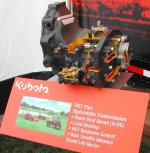
Some HSTs have an electrically-controlled dual-angle swash plate on their hydraulic
MOTOR, e.g. Kubota's HST+, JD's eHydro, etc. I am not aware of such a system on
the tractor's HST PUMP.
 

Attachments

  • Kubota_HST_plus_a.jpg
    Kubota_HST_plus_a.jpg
    98 KB · Views: 116
/ HST Question/Concern.... #16  
Any pump with a tilting swash plate will push more volume at a higher tilt angle, but can make more pressure [ ___ ] at a lower tilt angle. This is why you can get more torque at the wheels if you lift off the HST pedal some. Of course there are some other factors that weigh in to the equation of whether or not this will work for any one specific tractor in any one specific set of circumstances: whether the rest of your system is up to it, whether you're making such low volume that you're not exceeding the leak-back rate of the pump, whether your relief setting is high enough to make use of it, etc. But the basic premise is true.

xtn
At a given drive HP.
 
/ HST Question/Concern.... #17  
Some HSTs have an electrically-controlled dual-angle swash plate on their hydraulic
MOTOR, e.g. Kubota's HST+, JD's eHydro, etc. I am not aware of such a system on
the tractor's HST PUMP.

Well, I don't know if they're electrically controlled or dual-angle or any of that stuff, but I think most HST pumps in use on tractors these days have a variable swash plate. Yes... in the pumps. But even if the pump were constant volume at a giving input rpm, and the variable swash plate were only in the motor... the resulting output at the wheels would still be subject to the same effect.

xtn
 
/ HST Question/Concern.... #18  
Xtn is right. All of the tractors that I know of, including the JD eHydro are a variable displacement pump coupled to a fixed displacement motor. Here is a hydraulic schematic of an eHydro.
 

Attachments

  • Ehydro.pdf
    101.8 KB · Views: 193
/ HST Question/Concern.... #19  
All of the tractors that I know of, including the JD eHydro are a variable
displacement pump coupled to a fixed displacement motor.

The "LoadMatch" feature of your eHydro HST is the system that changes the swash plate angle of
the HST drive motor. The computer monitors various things like engine RPM, go-pedal position,
etc, and automatically changes the HST output. On some JDs, you can't even turn this feature off.
New Holland has this feature, too, tho I don't recall the trade name. Kubota's is "HST Plus".

If you have your service manual, look up the LoadMatch info. I don't know if ALL eHydros have
the LoadMatch feature, but it is integral to JD's HST.
 
/ HST Question/Concern.... #20  
The "LoadMatch" feature of your eHydro HST is the system that changes the swash plate angle of
the HST drive motor. The computer monitors various things like engine RPM, go-pedal position,
etc, and automatically changes the HST output. On some JDs, you can't even turn this feature off.
New Holland has this feature, too, tho I don't recall the trade name. Kubota's is "HST Plus".

If you have your service manual, look up the LoadMatch info. I don't know if ALL eHydros have
the LoadMatch feature, but it is integral to JD's HST.

What you are saying is right except the part about the hydraulic motor varying its displacement. It is the pump that changes its swash plate angle. You can see that in the schematic that I attached. LoadMatch compares thottle position with actual engine RPM, then decides if you are lugging the motor, and if so, reduces the current to the servo valves that control the swash plate angle of the pump, which of course, destrokes the pump.
The reason that the variable pump/fixed motor is popular is becuase it will produce a "constant torque", variable speed and power system. A fixed pump/variable motor would give you a constant power system, which, as you can imagine, wouldn't be real controllable.
 
Last edited:

Marketplace Items

2004 International 8600 Tender Truck (A63118)
2004 International...
2022 John Deere Z720E Zero Turn (A63116)
2022 John Deere...
Attention (A57148)
Attention (A57148)
YARD MULE (INOPERABLE) (A63569)
YARD MULE...
2014 FVCG TRAILER (A61567)
2014 FVCG TRAILER...
2004 Winnebago Adventurer 38G 38ft. Class A Motorhome (A59231)
2004 Winnebago...
 
Top