hyd gauge

   / hyd gauge #1  

retiredmgn

Platinum Member
Joined
May 8, 2010
Messages
547
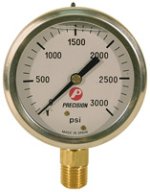
This the critter I need to 'T' into my FEL line?

gauge.jpg

GLYCERIN FILLED PRESSURE GAUGES
Brand new. Glycerin damps vibrations, protects against surge pressure.

SPECIFICATIONS0-3000 PSI
2 1/2" dia face
Chrome case
1/4" NPT lower connection
Glycerin filled
Shpg 1 lbs
 
   / hyd gauge #2  
That will work. 3,000 psi should cover your hydraulic max pressure. Glycerin filled nice to have (dampens needle movement for easy reading) but not absolutely required.
 
   / hyd gauge
  • Thread Starter
#3  
That will work. 3,000 psi should cover your hydraulic max pressure. Glycerin filled nice to have (dampens needle movement for easy reading) but not absolutely required.

What the heck, it's $16. I'll splurge. It's the $11 shipping that gets me.
So from what I've been reading I should mount it on the line out from the valve heading to the FEL.
I'm at a bit of a loss as to where to tap into said line. Not keen on just cutting into one of the metal lines to install. Have you performed this exercise?
 
   / hyd gauge #4  
This the critter I need to 'T' into my FEL line?

View attachment 287962

GLYCERIN FILLED PRESSURE GAUGES
Brand new. Glycerin damps vibrations, protects against surge pressure.

SPECIFICATIONS0-3000 PSI
2 1/2" dia face
Chrome case
1/4" NPT lower connection
Glycerin filled
Shpg 1 lbs

What are you trying to determine by knowing system pressure? The condition of your pump, line losses? Break out force? lifting capacity?

For me, the bucket goes up or it doesn't. Excuse me if you have posted about problem diagnosis.

Cheers

Cal in Vt
 
   / hyd gauge #5  
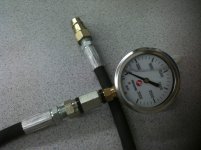
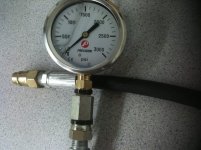
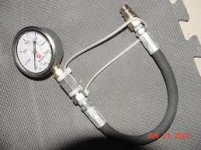
I dont think you need to Tee it in and mount it permanently, get a short (24") hose, a coupler and a QD nipple and just test it occasionally.

Here is mine:
Gauge-1.jpg Gauge-2.jpg

And a short video I made:
 
   / hyd gauge
  • Thread Starter
#6  
What are you trying to determine by knowing system pressure? The condition of your pump, line losses? Break out force? lifting capacity?

For me, the bucket goes up or it doesn't. Excuse me if you have posted about problem diagnosis.

Cheers

Cal in Vt

Yes. All those things. Currently I have no way of knowing what is going on with the hyd system. I don't know if the dealer set the relief pressure correctly and besides, I just like to be able to monitor things. While you are comfortable if it is simply working there is something to be said to educate, to understand, - what makes it work, how it works, how to determine if things are going south.
Different strokes for different folks.
 
   / hyd gauge #7  
If you want to leave it on permanately to monitor on a ongoing basis, then tee it inot the line between gear pump and inlet of the loader valve. This will give you reading of whatever pressure is required to complete any function at any load.
 
   / hyd gauge #8  
The gauge is a simple Bourdon tube type. Inexpensive and good for testing, but don't be surprised if it does not last a long time. Google Bourdon tube. Look for images. You will find illustrations of the internals, a curved tube that straightens with pressure, the amount of straightening being translated into dial movement. I have had gauges placed on the instrument panel for measuring the hydraulic load on some machines, but they were ruggedized for durability and were incredibly expensive compared to the general shop type gauge you have shown. Make sure to place your gauge where you can see it easily from the seat because after having the capability to monitor your system, you will find all kinds of interesting things to observe beside just checking to see if they set the relief right, like relief pressure with cold oil vs. fully warmed up, how close is that boulder on the edge of the field to my loader's limit, etc.
 
   / hyd gauge #9  
You can build one of these hyd test sets or mount the gage in the IN port, in a tee at the loader valve .

You can use it to monitor the hyd system, test the system and observe just how much pressure it take to do a certain job.
 

Attachments

  • 3000 psi hyd test gage set.jpg
    3000 psi hyd test gage set.jpg
    9 KB · Views: 168
  • 3000 psi hyd test gage set1.jpg
    3000 psi hyd test gage set1.jpg
    11 KB · Views: 182
   / hyd gauge #10  
Sorry for the delay.

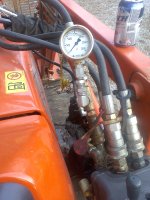
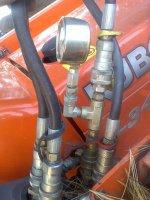
I have one on my lift circuit. Its teed in and stays on all the time. I can switch it to any of the circuits if need be. But I keep it on the lift, cause with a little creative math, you can get a good guess of how much weight you have in the bucket.

guage.jpgguage1.jpg
 
   / hyd gauge #11  
If you want to leave it on permanately to monitor on a ongoing basis, then tee it inot the line between gear pump and inlet of the loader valve. This will give you reading of whatever pressure is required to complete any function at any load.
Yes. This is where you need it. Teeing into the lift line will of course only measure the pressure in that line. More importantly, that line is not protected by the pressure relief when the valve is centered. It can see very hi pressure when carrying a load over bumps or when pushing with the bucket low. Also, as mentioned the bourdon tube will fatigue with enuf pressure cycles and pop, blowing the gauge apart. Be sure to include a flow restrictor in the gauge line to prevent hi flow when the gauge fails. One that lets thru only a few drops per second will still give pretty quick response and you wont be stranded by a gusher if the gauge fails.
larry
 
   / hyd gauge
  • Thread Starter
#12  
Ok, you guys are killing me. Makin' me want a gauge more than ever. So if a bourdon tube is not up to the task, which of the 600+ gauges on Surplus Center is? I certainly don't want to invest time in something that is going to fail. I'm willing to pay the price of quality and buy once.
Just ask my wife, it's been 35 years and I have no intention of trading her in - still works good, was a good investment.
 
   / hyd gauge #13  
There are more expensive guages out there, more commonly used in engineering/design testing. One factor that helps reduce fatique of the guage and gives most accurate reading is using a guage of adequate pressure rating. Rule of thumb in desing testing is use a guage with max psi that is 2x the desired or expected reading. As example if the relief pressure of your system is 2500 psi, use a 5000 psi guage. If 3000 psi relief, use 6000 psi guage.
 
   / hyd gauge
  • Thread Starter
#15  
Something like this or something similar at TSC

Surplus Center - 3000 PSI 2.5" LF LM GAUGE

OK, I'm lost here. J J, I think this is the same one I listed at the top of this thread. One poster said this is a "bourdon tube" and would be suspect to blowing out if permanently mounted. I know nothing of these particulars. Do you think this is a sufficient gauge for my application? I do like the price if it will hold up.
 
   / hyd gauge #17  
There are gauges that have a push button on them that only show a reading while you push the button down this style of gauge is less prone to fatigue as it is only operating for short periods of time while you are looking at it
 
   / hyd gauge #18  
I dont think you need to Tee it in and mount it permanently, get a short (24") hose, a coupler and a QD nipple and just test it occasionally.

That's what I did several years ago before & after installing a shim kit in a JD 790 with 419 loader.
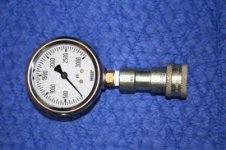
Then when I went to a Kubota B3030/LA403 I had to change couplers. Now that tractor is gone and I've got a Bobcat skid steer with big flat faced couplers. Looks like I'll have to switch up again.
Below is a photo. Not shown is the hydraulic hose between gauge and coupler.

gauge.jpg
 
   / hyd gauge #19  
Nelson, just to clarify for you - I'm just retiring from spending the last 35 years in two different rare metals mfg plants as an instrumentation/control tech, and I can tell you that anything you will want to pay for will be a bourdon tube instrument - the next step up is too complex for a tractor by the time you get all the components to read it, and will cost at least 20 TIMES the price of the gauge you asked about.

All the suggestions given, including temp hookups, restrictors, etc, are prudent because regardless of what you pay for a gauge, murphy's law eventually kicks in. Things WILL fail. Not IF, but WHEN.

So prepare for it - I'd consider also adding a shutoff valve along with that restrictor if you intend to permanently plumb in a gauge - as in, valve, restrictor, gauge.

That way, you have the option of leaving the gauge "turned off", as well as leaving it "on" but being able to shut it off WHEN it fails, with minimum mess.

I'd also agree with placing it between the pump outlet and the first valve, assuming your tractor is "open center" - that way, anything you use (FEL, 3-point, remotes) will show up on the gauge because there is almost NO pressure in an open center system UNTIL you move a lever - it's just circulating back to the tank until then.

HTH... Steve

 

Tractor & Equipment Auctions

WATER TRAILER (A58214)
Gravely Pro Turn 460 60in. Zero Turn Commercial Mower (A59228)
Gravely Pro Turn...
2006 Magnolia Dry Fertilizer Tender Trailer - Dual Stainless Compartments, Hydraulic Doors (A56438)
2006 Magnolia Dry...
2014 Magnum 7696BLA Light Tower (A59213)
2014 Magnum...
2013 ORTEQ ENERGY GN182 GOOSENECK HOSE TRAILER (A58214)
2013 ORTEQ ENERGY...
2005 JOHN DEERE 310SG BACKHOE (A60429)
2005 JOHN DEERE...
 
Top