I need advice on building a horse barn/shelter

/ I need advice on building a horse barn/shelter
  • Thread Starter
#21  
Thanks, that makes sense about the doors and the advantage to leaving it open. I'll doubt I'll but a gate any time soon for it, just a thought that if I need one or two, I can always add it at a later date.

My plan is to built it with 6x6 posts with concrete poured between the posts and 2x6 studs on the concrete, then use 3/4 plywood for the internal walls and Hardie Lap siding for the exterior walls. The storage room in the middle with be stick framed with 2x4's and have a concrete slab floor.

I've read that 7 feet is the minimal height for horses to get in and out of a room and that the walls should be 8 feet or more in height. One site said the walls should be ten feet tall, but that seems a big excessive. Are 8 foot walls and an 8 foot tall opening good?

Eddie
 
/ I need advice on building a horse barn/shelter #22  
I prefer 10'. Even the gentlest of horses rear occasionally. Stitches are expensive.
 
/ I need advice on building a horse barn/shelter #23  
Thanks, that makes sense about the doors and the advantage to leaving it open. I'll doubt I'll but a gate any time soon for it, just a thought that if I need one or two, I can always add it at a later date.

My plan is to built it with 6x6 posts with concrete poured between the posts and 2x6 studs on the concrete, then use 3/4 plywood for the internal walls and Hardie Lap siding for the exterior walls. The storage room in the middle with be stick framed with 2x4's and have a concrete slab floor.

I've read that 7 feet is the minimal height for horses to get in and out of a room and that the walls should be 8 feet or more in height. One site said the walls should be ten feet tall, but that seems a big excessive. Are 8 foot walls and an 8 foot tall opening good?

Eddie

Eddie,

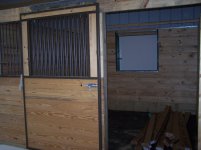
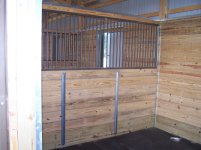
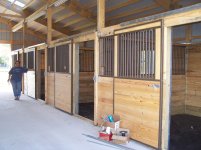
Size depends on how tall your horses will get and temperament. A grown horse can kick through plywood, especially a shod horse and after a few years of exposure to the weather. Then their leg is stuck and they can cut it to pieces thrashing about. Our 17 hand mare is a little claustrophobic and doesn't like narrow or low doors. Stalls and 3 sided loafing sheds are 12'X12' with 10' sidewalls. Stalls have doors that are 4' wide and 8' tall. Our stalls and loafing sheds interior walls are 2"X8" tongue and groove 8' tall. All corners are covered with metal trim to prevent cribbing or chewing on the wood. Stall floors have 6" of crushed rock covered with cushion sand and then rubber mats from TSC. Loafing sheds are bare dirt, the open side faces east. We used a 3:12 pitch so the front is 13' tall and provides good shade.

100_0778.jpg100_0783.jpg100_0779.jpg

You and Karen are welcome to come over to Athens and look at our stables and loafing sheds. Our stables were built by Morton which is one of the top builders of equestrian buildings. Horse and owner safety is a priority on their features. I had a local guy do the loafing sheds, they have metal framing. With your skills you could replicate either.
 
/ I need advice on building a horse barn/shelter #24  
Randy does bring up a good point. All corners of our soft wood (the posts) are protected by aluminum angle to prevent chewing. They can gnaw through soft wood like a beaver. Our kick panels are oak and we have had no problems with them chewing the oak. Cribbing horses are rare for us although we have had some over the years.
 
/ I need advice on building a horse barn/shelter #25  
....

I'm perfectly happy if they just eat grass.

Even grass can be a problem for horses, pastures have to be managed. A horse is a really finiky animal since it has just one stomach.

This is similar to what I'm thinking if I go with the simple idea of just creating two open stalls and a storage room in the middle. I'll make the stalls bigger then show in the pics and change a few things around, but overall, this seems like a pretty good starting point.

For a run-in that is a good start. A previous poster said to position it properly. To me that is with weather and sun light in mind. If the horses take a liking to it, it may become a bathroom for them. And, I'd keep the stalls together. Horses like to see other horses. Ours when stalled, stand nose to nose. Put your store room on the end.

I've read that 7 feet is the minimal height for horses to get in and out of a room and that the walls should be 8 feet or more in height. One site said the walls should be ten feet tall, but that seems a big excessive. Are 8 foot walls and an 8 foot tall opening good?

I'd go higher. A previous poster said to watch out for rearing up. I'd do at least 10' at the low spot.

I personally like being able to drive through any stall, run-in or barn. Makes cleanup and delivery much easier.
 
/ I need advice on building a horse barn/shelter #26  
In general, horses with a choice are healthier than those kept in a stall. The only time ours are stalled is when the farrier or vet is coming.

We do have a big area that they can get into when they want. They use it a lot now to get away from the heat and flies. They use it in winter to get out of the rain and cold. The only time I actually close it up is during really bad winter weather (34 degrees with heavy rain and wind). Then I may keep them in. Otherwise, they have free choice.

It is important that they have some shelter during bad weather and cold wind and rain is probably the worst. They especially need it if they don't have natural shelter in the pasture to get out of the wind.

I would suggest at least one secure stall in case you have to keep one stalled due to an injury or illness. Line it with good solid boards (I use 1-1/4" rough sawn oak.) We use regular gates on the stalls. The only problem was the time a mare apparently panicked when ice slid off of the roof and she jumped over the gate! I now have a board up high above the gate :)

If the male hasn't been gelded yet, you will need to have that done!
 
/ I need advice on building a horse barn/shelter #27  
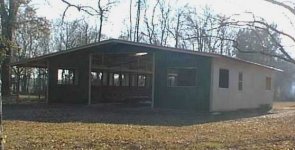
A barn is never big enough. First we built a barn with four 12X12' stalls and a 16' hallway. Three stalls were for our 3 horses that we keep inside at night and one stall for tack, hay etc. We give our horses a little feed each morning and each night so it is essential to keep them locked up individually when they eat so there are no fights over the food. Since we buy 120 bales of hay in the fall to last us through the winter when hay is hard to get and expensive, we had to build an additional 12X12' to keep the hay in.

Two horses will eventually require 2 saddles, at least 2 bridles, pads, blankets, a well stocked medicine cabinet, hoof equipment, brushes, buckets, wheelbarrow, manure forks and shovels, leg wraps, halters and lead ropes, fencing supplies, whips, and dozens of other necessary items, requiring you to add a 12X12' tack room sealed well enough to keep rodents and moisture out. Your 12X12' feed room will also have to be well sealed to keep out rodents and moisture.

Since we use shavings in the stalls we have to buy a trailer load at a time to keep the expense down and then we needed an additional 12X12' room for the shavings. Since horses are addictive we eventually wound up with 2 more requiring 2 more 12X12' stalls. We now have a 60' by 40' barn for the 5 stalls, tack room, hay room and shavings room and a 10'X60' overhang for the tractor, bush hog, box blade and disc all of which you will need to maintain your arena and pasture for the horses.

Yes, you will need an arena and round pen for training. Probably will need lights in them for training in the evenings in winter when it gets dark early. Young horses on pasture need even better fences than old horses so be prepared to do a lot of fence building and maintenance.

A covered hallway area in the barn is essential so the farrier has a place to work when it is raining or too sunny or cold and also needed when you saddle up or groom your horses. My first barn had a 12' wide hallway, my second barn a 14' one and my third barn a 16' wide one. I now wish I had a 20' wide one.

Cameras in the barn with a monitor in your house are nice to have especially when you have a pregnant mare which, for some reason, all women want after they have had their mare for a few years.

Then you need a few hours extra work each week to pay for everything mentioned plus the horse sitter that you will need when you go on a cruise. Is it worth it? Well, I wouldn't give up my horses for the world. :) barn122503A.jpg
 
Last edited:
/ I need advice on building a horse barn/shelter #28  
Eddie,
We had 4 horses when I was growing up. Dad had the barn stalls high enough to ride the horse into. Which was good because ole Salty was cantankerous. The stalls had gates and were separated with just a few boards. We only closed the gates at feeding time to keep the young one from eating old Grey Buck's feed. Dad opened the gates when all Grey Buck's feed was gone.ro

We didn't have a fancy barn. Dad built it with used tin he salvaged. The windows where 1x4 framed tin that hinged up with a prop up board to let air in. Hay was in the feed room and up in a true hay loft in the rafters. The feed and tack room was positioned such that you could feed each horse from the feed room. A 55 gallon, clamped lid, drum held all the feed.
hugs, Brandi
 
/ I need advice on building a horse barn/shelter #29  
Randy does bring up a good point. All corners of our soft wood (the posts) are protected by aluminum angle to prevent chewing. They can gnaw through soft wood like a beaver. Our kick panels are oak and we have had no problems with them chewing the oak. Cribbing horses are rare for us although we have had some over the years.

I still have a couple of chew marks on the top of the fenders of my old Bronco where our pasture ornaments decided that the paint might be tasty.

- Jay
 
/ I need advice on building a horse barn/shelter #30  
Two young horses together 24/7 are going to get herd bound. Good luck trying to to ride one and leave the other. One or both will go nuts.
you're making two stalls but in reality they'll probably both use the same one. Make it big enough. Horses are dangerous for even experienced horse men. please go with older quiet horses. you won't regret it.
 
/ I need advice on building a horse barn/shelter #31  
I still have a couple of chew marks on the top of the fenders of my old Bronco where our pasture ornaments decided that the paint might be tasty.

- Jay

Yep. My neighbors JD (was brand new) got tasted. :)
 
/ I need advice on building a horse barn/shelter #33  
They even have a taste for Japanese vehicles. My Toyota had teeth marks.

12x12 stalls lines with 3/4" plywood. 5/8" plywood outside. 12' stall height with a 4/12 composite shingles roof. Aluminum roof with no insulation was amazing loud at last place we rented. The shingle roof is much quieter when it is storming. 3' overhangs on the low sides and 2' overhang going up. Helps keep the rain out, No one has kicked through yet but we do not have kickers or my wife manages horses so the haters are kept away from each other. Horse inside with bad weather or if they are founder prone and have to kept off the pasture for a few or more hours every day. 12' barn aisle. We had one horse out on lease and she managed to kick through a metal sided barn. Permanently lame due to muscle damage.

9 acres chopped up into 7 turn out areas ranging from less than a 1/4 acre dry lot to 4 acres. Rotating the big pastures to allow the grass to recover from the horses. Dry lot with a 12x12 run in shed, 8' opening 7' tall with 10 foot wall height going up for a horse that foundered. That has happened to 2 horses so far. No to almost no grain. A 50# sack of grain could last 3 weeks or more and we have 7 horses. Our pastures although not fertilized and limed they way I like do keep the horse fat especially with the wet summer this year. During dry summers lots of hay bought.

I use 2,4d spot spraying every year and whole pasture spraying every few years to keep bitterweed and other junk at bay. Not a huge fan of spraying but sometimes the weeds get away.
 
/ I need advice on building a horse barn/shelter #34  
Eddie,

I have no experience with horses but do with cattle. At some point a while back you were talking about the orientation of the building. Research mono-slope dairy barns or feed barns. I found the following several times looking for good ways to feed hay under roof. The ones I have seen referenced all have the high side face south and the low side north. Saying a north wind will come in and slow down as it crosses the animals reducing wind chill and a south wind will come in and speed up increasing cooling ability.
 
/ I need advice on building a horse barn/shelter #35  
Just a few comments from a former horse owner and occasionally participating in Humane Society Rescue projects (where to stash seized neglected horses until the Legal Agencies sort it out).

You need 'loafing sheds': usually a two place 3 sided building with the opening away from the main weather direction. This is where they will sleep, snooze, nap, nuzzle, get out of the sun and hide from you.

Then you need a 'barn': a place where they are contained or stashed until the vet, farrier, trainer, or rider is ready for them. Catching them out in an open pasture sounds like fun, but it's not. This is also where we put them in inclement weather (freezing rain, tornadoes, mosquitoes, sore, hurt, being fed individually and cleaned.

The barn also serves as a storage area for grain, clothes, saddles, sawdust (for the stalls) and baled hay (which you may need when they have chewed down all your pastures). The barn also needs a wash stall (you don't want dirt and poop on your britches, do you?), maybe a toilet (got trees around?) sink for cleanup, cabinets for creams, salves, shampoo, bug spray, leather conditioner, (and also some stuff for the HORSES).

Just in case, a foaling stall is desirable by girlfriends, wives, relatives, and boarders. Its a double stall with a removable partition so a Mommy horse and her Baby horse can have some room to get to know each other. Nothing like a refrigerator for drugs, ice, and pop or brews. You need a lockup area too. A room with a lockable door.

Keep your design(s) open to the notion that someday, you won't have horses but may have some nice tractor equipment to store: mowers, cement mixer, snow plow, water tanks, windmill parts, lumber, extra roofing shingles, another tractor or two, a drone repelling device and a workshop. A slab to hold a horse trailer out of the mud is also a good strategic item.

All my barns and sheds are concrete block with concrete aisleways. I hay off the pastures now and sell the baled hay to neighbors. If you have excess pasture land, consider baling equipment. Its a LOT of fun once you get the kinks worked out. Having your own hay also keeps the horses healthy because you know the content. There are a lot of poisonous weeds around now and that can be expensive.

Nothing like a boarder or two to help with work and or costs. A 4H prospect is a pleasant experience.

Don't get me wrong, you don't need all of this. But, its just work and a little money. With the wonderful construction skills you have demonstrated, I'd imagine this will be a very enjoyable investment for your family (and your IRA).
 

Marketplace Items

excavator trenching bucket- one bucket per lot (A61306)
excavator...
2006 INTERNATIONAL 7400 6X4 DUMP TRUCK (A52706)
2006 INTERNATIONAL...
2010 CATERPILLAR 320DL RR EXCAVATOR (A60429)
2010 CATERPILLAR...
2021 Ford F350 XL (A57148)
2021 Ford F350 XL...
2018 PRINOTH PANTHER T14R ROTATING CRAWLER DUMPER (A60429)
2018 PRINOTH...
2010 MAXEY WELDING 20 T/A GOOSENECK TRAILER (A58214)
2010 MAXEY WELDING...
 
Top