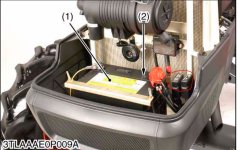
L3200 HST dead. No power to anything on the panel. Not even hazards

   / L3200 HST dead. No power to anything on the panel. Not even hazards #1  

RRX

Member
Joined
May 13, 2012
Messages
31
Location
Mt Juliet, TN
Tractor
Kubota L3200 HST
I'm so bummed. I've loved my Kubota since I bought it new a few years ago. I don't use it enough, and it mostly sits (only 41 total hrs). Last year I noticed it would sometimes require tapping the starter a few times to get it to start. I figured maybe it was just oxidized contacts in the solenoid. Now it doesn't start at all. Today I vow to removed the starter and inspect it, which I did. It appeared clean and would turn. I re-installed and tried to start it, only this time I get no "click" from the solenoid. I check the battery, and it is good, 14V. Cable at starter to ground and there is 14V. Then I try hazard lights, headlights. Nothing. I check all the fuses with a meter, and they're all good. What the heck???? What else is there? Could it be the key switch? I figure before I tear that out (How do you removed it anyway?) I'd better ask the experts on this forum. Arghh! Tractor dealer is closed. :mad:
 
   / L3200 HST dead. No power to anything on the panel. Not even hazards #2  
Check ALL your grounds.
 
   / L3200 HST dead. No power to anything on the panel. Not even hazards
  • Thread Starter
#3  
Okay, battery ground is fine. Anyone know where the ground is located to the panel? Don't the hazards work with the key off?
 
   / L3200 HST dead. No power to anything on the panel. Not even hazards #4  
Assuming the original battery . . . when not in use, do you hook the battery up to a trickle or maintenance charger?

If not, how are you testing the battery voltage? Just hooking up a voltmeter doesn't really tell you much without a load being placed on the battery. Lead acid batteries can get a "surface charge" but when hooked to a load the voltage falls way off. Check the battery with a load (e.g. turn on the tractor head lights (even if they won't come on) and recheck battery voltage.

If battery voltage is low with lights on, and you have a set of jumper cables, try jumping the tractor battery with another vehicle.
 
   / L3200 HST dead. No power to anything on the panel. Not even hazards
  • Thread Starter
#5  
Assuming the original battery . . . when not in use, do you hook the battery up to a trickle or maintenance charger?

If not, how are you testing the battery voltage? Just hooking up a voltmeter doesn't really tell you much without a load being placed on the battery. Lead acid batteries can get a "surface charge" but when hooked to a load the voltage falls way off. Check the battery with a load (e.g. turn on the tractor head lights (even if they won't come on) and recheck battery voltage.

If battery voltage is low with lights on, and you have a set of jumper cables, try jumping the tractor battery with another vehicle.

Thanks for your reply. Yes, original battery. And I haven't tested with a load. I did put a charger on the battery this morning and it did take a charge as in it started charging at 4 amps, and a couple hours later it was charging at 2 amps. I'll go try what you suggested and will report back then.
 
   / L3200 HST dead. No power to anything on the panel. Not even hazards
  • Thread Starter
#6  
Battery voltage is 15V with or without load. Tried jumping from my Tundra, and still no power. No lights. No nothing. Say, when I was removing starter, what if I shorted the pos cable when disconnecting starter? I when I first put a ratchet on the nut and loosened it, I remembered that I hadn't removed the gnd cable on the battery. So I did and resumed. But what if I accidentally shorted the battery with my ratchet? What would it blow? I don't think I did, but I want to check every possibility.
 
   / L3200 HST dead. No power to anything on the panel. Not even hazards #7  
Most likely you will find the battery is toast. Lead acid batteries typically discharge about 3 to 5% a month, depending on temperature, hotter is worse. And once the battery is self discharged down 30 to 50 percent, damage is in the offing. Plates sulfate and battery capacity goes down. Recharging doesn't undue the damage.

For seldom used equipment, best to use a good maintenance charger unless you are disciplined, and ****, enough to hook up a charger on a regular basis.

bumper
 
   / L3200 HST dead. No power to anything on the panel. Not even hazards #8  
How did you check load, turn the key ,headlights???? 15 volts is way high I am hoping you just took it off the charger??? Should be around 12.5 give or take. With a load I would venture to say the voltage would drop if the battery was connected or if the ground was bad. Look for main fuse or fixable link. If you shorted the battery that could have popped. Did you try jumping the solenoid, providing power directly from the battery to starter. Can use jumpers for that. So again my guesses would be flushable link or main fuse blown, wire shorted or disconnected or bad key switch (depending on wiring)
 
   / L3200 HST dead. No power to anything on the panel. Not even hazards #9  
Sounds like the main fuse is blown to me. Located just to the right of the battery positive terminal
 
   / L3200 HST dead. No power to anything on the panel. Not even hazards #10  
Sounds like the main fuse is blown to me. Located just to the right of the battery positive terminal

^ +2 What James said.
 
   / L3200 HST dead. No power to anything on the panel. Not even hazards #11  
Since that was my first option, I will third it. Don't have a Kubota, just going off general troubleshooting.
 
   / L3200 HST dead. No power to anything on the panel. Not even hazards #12  
I think you have a bad battery, and from the sounds of it you may have blown the main fuse (or fusible link).

Battery should read in the neighborhood of 12V when not running, and about 14.2V when being charged by the alternator.
 
   / L3200 HST dead. No power to anything on the panel. Not even hazards #13  
Looks like our posts crossed.

As you know, you should always remove the ground or negative terminal first so as to preclude accidentally shorting the battery. But, if you removed the positive first, you can almost be dead certain that you didn't short out the battery, as to do so would involve a big old arc, lots of molten metal, and a big gouge out of your favorite wrench as several hundred amps find their way through the frame back to the battery. It's an ugly and unforgettable experience!:eek:

Okay, since you have a volt meter, and know how to use it, let's proceed.

With the battery reconnected (hook up positive 1st, then negative!), connect the voltmeter to ground and bat +. Next, check at the back of the starter switch. You should have battery voltage on at least one terminal. If not, you'll need to go first to the fuse block and make sure that you have voltage there. Note that a number of fuses there will not have voltage applied until the "ignition" switch is on. What you are looking for is the "main" fuses. Note also, that many vehicles incorporate a fusible link - this will be located between the battery positive and the fuse block. If this has opened, that would produce the symptoms you have - - but so would a bad connection in the positive wire to the fuse block (or the negative from battery to tractor ground etc.). With a volt meter, with the "ignition switch" turned on or to accessory, if you measure from say the battery + terminal to a point downstream of that, where you would expect to also see positive voltage, but there is none, then stretch the leads (use a longer lead if need be) between those two points. There should be no voltage reading. But IF there is, then your open circuit is between these two points. You can use this principle to narrow down to the problem. You can also just take readings from ground to where there should be + voltage - either method works.

One old principle of troubleshooting, check the easy stuff first!

bumper
 
   / L3200 HST dead. No power to anything on the panel. Not even hazards
  • Thread Starter
#14  
My multimeter is kind old and wonky, but I took the battery to Advanced auto parts and they checked it with a load meter. 12.4V and good for 500 cranking amps. I guess it's the battery main fuse, if I can find it. I don't get it. I checked voltage at the starter, and I have voltage. That is the positive cable to the starter. Where is the fusible link? I unwrapped the cable a foot back and see only battery cable. Where in the world is the main battery fuse?
 
   / L3200 HST dead. No power to anything on the panel. Not even hazards #15  
My multimeter is kind old and wonky, but I took the battery to Advanced auto parts and they checked it with a load meter. 12.4V and good for 500 cranking amps. I guess it's the battery main fuse, if I can find it. I don't get it. I checked voltage at the starter, and I have voltage. That is the positive cable to the starter. Where is the fusible link? I unwrapped the cable a foot back and see only battery cable. Where in the world is the main battery fuse?

Just to the right of the positive red terminal under a cap (in other words in a little box)
 
   / L3200 HST dead. No power to anything on the panel. Not even hazards #16  
No, there are two positive circuits. One, the big heavy wire, goes directly from the battery positive to the starter solenoid (that's not the one where the problem is). The other circuit is a less heavy wire, but still substantial - - it runs to the fuse block, but probably also first through a fusible link. That's what you need to locate and check. In case there is no fusible link, then look at the main fuses in the block.

bumper
 
   / L3200 HST dead. No power to anything on the panel. Not even hazards #17  
Yes of course the starter has a direct connection to the positive of the battery, but that has nothing to do with the main fuse. The main fuse is in line with the feed to all of the rest of the tractor's electrics.
 
   / L3200 HST dead. No power to anything on the panel. Not even hazards #18  
No, there are two positive circuits. One, the big heavy wire, goes directly from the battery positive to the starter solenoid (that's not the one where the problem is). The other circuit is a less heavy wire, but still substantial - - it runs to the fuse block, but probably also first through a fusible link. That's what you need to locate and check. In case there is no fusible link, then look at the main fuses in the block.

bumper

It is an actual fuse.. 40 amp according to the schematic it is right by the positive terminal.. Actually there is one main, and several others there as well.
 
   / L3200 HST dead. No power to anything on the panel. Not even hazards #19  
L3200 main fuse.JPG

Look for you fuse inside the red circle..
 
   / L3200 HST dead. No power to anything on the panel. Not even hazards
  • Thread Starter
#20  
View attachment 388428

Look for you fuse inside the red circle..


Thanks a lot guys. I really appreciate your help and advice. My L3200 has 2 of those small fuse panels under the dash, not by the battery. I already checked those and they were good. There is another fuse panel with smaller fuses on the left side above the starter. I'll check them again in the morning since there is a monsoon tonight. And college football.
 

Marketplace Items

2014 Cadillac ATS Sedan (A59231)
2014 Cadillac ATS...
2019 FORD F-150 STX CREW CAB TRUCK (A59823)
2019 FORD F-150...
Sellick S80 (A60462)
PALADIN HP750 ASPHALT PLANER (A60429)
PALADIN HP750...
2019 FREIGHTLINER WATER TRUCK (A58214)
2019 FREIGHTLINER...
2001 Ford F-150 4x4 Pickup Truck (A59230)
2001 Ford F-150...
 
Top