L3800 3pt hitch operation

   / L3800 3pt hitch operation #21  
If I were buying another tractor the jerky 3 pt. would be a deal breaker for me. When I bought my L3400 HST new in 2005? the very first thing I did was try to dig post holes. It jerked so bad the dirt would fall back in the hole. I knew it was listed as an "economy" tractor but nobody told me you would not be able to drill a post hole!

I also got to go through the PTO issues and Kubota did take care of everything and it has been a fine tractor since but when I paid more for this tractor and some attachments than my last new car I don't think it is unreasonable to expect to work properly.

When I shopped for this tractor I looked at green ones and red ones as well as the Kubota. This "economy" tractor was not any less expensive than the tractors I was comparing with. No, I did not even think to check if the 3 pt. was smooth on any of them. I picked the Kubota based meeting my needs and reputation.

When it comes time for a new tractor I feel I am much more educated now than in 2005. I really am disappointed that problem with the 3 pt. even still exists. Economy or not it is a tractor and the 3 pt. should be smooth. Brian
 
   / L3800 3pt hitch operation #22  
...I also got to go through the PTO issues and Kubota did take care of everything...
Brian, do you have a thread on this... My tiller "slips" and I'm a little worried about the PTO...
 
   / L3800 3pt hitch operation #23  
I have a 2010 L3400 and the hitch jerks, although apparently not to the extent that the older ones do. I had no idea the new 3800 models have the same issue.

I love my tractor but the jerky hitch is b.s. when you consider what the machine costs. My dealer didn't say a word about it being an "economy" model, and neither does anything I've seen on Kubota's website. The only time you hear it addressed as such is when you contact somebody to complain about the hitch.

I don't have that much difficulty using it. As a matter of fact, it's convenient for jarring dirt off of implements. You can't feather with it, though. I just raise it quickly enough that it doesn't jerk, unless I want to knock dirt off of whatever's hooked up at the time. Regardless, my next one, if I ever get another one, won't have a jerky hitch. It's senseless and other brands in the same price range don't have that issue.
 
   / L3800 3pt hitch operation #24  
Brian, do you have a thread on this... My tiller "slips" and I'm a little worried about the PTO...

I tried to search on this for you with no luck. It is here somewhere. When I have more time I will look. There are pictures of the old and updated pto parts. The new one was much quieter and more positive engagement on my chipper. I do not have a tiller but that probably stresses the pto the most? Brian
 
   / L3800 3pt hitch operation #25  
I'll find it... just wanted to make sure you had a post of it!!!
 
   / L3800 3pt hitch operation #26  
I'll find it... just wanted to make sure you had a post of it!!!

It is here somewhere. One of the guy's had pictures of the old and new design pto cams. The old ones had a ramp and the new ones are square cut.

Since those early days my tractor has been flawless. The only other thing I did was bump up the hydraulic pressure so the loader would actually pick something up.

The embarassing part is it will be 6 years old in May and I have 70 hrs. on it. I really thought I would use it more and at that rate I can't justify a bigger or new tractor. Brian
 
   / L3800 3pt hitch operation #27  
What was the pressure on your loader when you checked it?

Sean
 
   / L3800 3pt hitch operation #28  
I don't remember the exact pressure numbers and there is a thread on that subject on here also. When I first bought it after I had so much trouble with the post holes I thought I would try the loader and spread some gravel. I drove up to a pile of 5/8 minus rock and it would not lift a bucket load out of the pile. It does now after bumping up the relief valve. Brian
 
   / L3800 3pt hitch operation #29  
Hi All,

I know this is an older thread and this issue has come up a number of times over the years. My situation is a bit different though. See what you guys think?

I bought my first tractor back in December of 2010. It was my first and really was to be my last. It is used 99% of the time for maintaining a 1300 foot little private road and about the same amount of private driveway. I bought a new Kubota L2800. But before I bought it, I did some research and discovered the jerky hitch issue. I went to my dealer, the one I decided I would be buying from, and asked about it. The owner, who has been a Kubota dealer for many many years, told me that he had not heard much of that issue for quite a while, but he did recall there being an issue. He said he thought that Kubota had dealt with the issue and thought there might be a Technical Service Bulletin on it. He did some research right then and there and found an "informational bulletin", which he showed me. It indicated that after a certain serial number and date, the issue had been corrected with another valve. The informational bulletin was dated, if I remember correctly, back in 2005. And my serial number was like 8000 past the serial number listed in the bulletin. So all seemed fine...I was satisfied that the issue had been corrected.

I bought the L2800 and found that it still jerked. I complained and my dealer came and picked the tractor up and took it back to their shop. A factory rep visited and called me that same day. He explained that they let some of the air out of the tires so it would not be so bouncy, and that they adjusted the 3pt hitch up down lever for some reason I don't remember. He told me I probably would not see much difference, that it was a standard tractor and as such did not have all the frills that the more expensive tractors have. He was right, I didn't see any difference. He also told me that there was another valve that would make it operate smooth, but that the mounting holes were different and so they could not put it on. I have used the tractor very little since it was delivered back to me. It has maybe 8 hours on it total.

Some people say it doesn't bother them. For what I use it for, it bothers me a lot. It seems that I always need the scrape blade or the box scraper to be just a hair higher or lower than it is after jerking to a stop. I would not have bought this tractor if I had known and it makes me mad because the dealer in good faith thought it had been fixed also.

A few days ago I wrote a letter to Kubota explaining my position and that I have an economy 2001 Toyota Camry, not the highest trim level, but the windows still roll up smoothly. Kubota could have fixed the problem by making an adapter bracket for another valve to fit.....it would have cost them pennies, but in the long run it will cost them thousands. I know they make great tractors in general, but I would have a hard time buying again from a company who doesn't stand behind their mistake. And it is a mistake. I should not be jerky. As others have said, there are too many other good tractor manufacturers out there. Orange isn't the only color on the planet.

I'll post what their reply is, but I'm not holding my breath. I really don't expect they will fix for me what they haven't fixed for many others who have also complained. I get the last laugh though, in watching my money go to another company, after I exhause all avenues with Kubota.

Alex
 
   / L3800 3pt hitch operation #30  
I stopped and looked at an L-3800 today. I like it... ALOT!

I could use a bit more power and the weight to apply it, but, if it has the same 3 point hitch issues as the other "so called economy tractors," I'll stand pat.. That jerky 3 point would be a deal breaker for me!

It seems so foolish on Kubota's part that this should still be an issue!
 
   / L3800 3pt hitch operation #31  
It seems all the "plain L" series have the jerky 3PT. My L4400 3PT is jerky, it is a 2010 leftover model. Its smooth when you just pull up on the lever but if try and lift the implement slowly it will bounce you all around.
 
   / L3800 3pt hitch operation #32  
That's the first time I've heard that the L4400 has the same problem.

Sean
 
   / L3800 3pt hitch operation #33  
Looking way back in a couple of threads about this, someone (maybe Harvest Moon?) tried swapping the lowering speed valve, but without much change.

From what I can see, the lowering speed valve is a check valve of sorts. It's spring loaded to allow full flow into the lift cylinder regardless of the valve setting, but fluid must bleed past it without lifting the poppet valve on the return path, thus controlling the lower rate.

I think this is part of the problem, or maybe part of the solution.

The position feedback system on the L series provides what I call "active position control" so the 3 PH will stay in the same position regardless of cylinder leakdown as long as the hydraulic pump is running. In other words, if the 3 PH starts to lower, the feedback linkage opens the supply valve and brings it back to the original position without any input from the operator.

If, and this is the key question, the flow into the lift cylinder is not damped properly and acts like an on-off switch, the lift will be jerky. Is it possible that is what's causing the problem??

I can't think of what else would make it jumpy other than that. To illustrate, if you have 2000 lbs of lifting force being applied suddenly to the lift arms, they will jump upwards. If you have 2000 lbs of implement on the lift arms and the lowering valve is fully open, it's tough to lower that smoothly also.

So, to get to the point, what would happen if we were to eliminate the check valve effect of the lowering valve?? There is only one path for fluid to get into and out of the lift cylinder, it's a single acting cylinder, remember.

If the spring arrangement on the lowering valve was eliminated, so that it restricted flow in both directions instead of only one, is there any negative effect to that? The only one I can see is that the relief valve on the 3 point system will bypass any excess flow back to the sump when you move the lever to the raise position. To illustrate, the L3400 hydraulic pump generates rough 9 GPM at 2300 psi at rated engine speed. When you move the position control lever, all 9 GPM is going to the lift cylinder unless the relief valve opens.

There's no flow divider or "splitter" in the system as far as I know. If you restrict the supply route to the cylinder via the lowering valve restricting flow in both directions instead of only one, you can reduce the flow rate into the cylinder as much as you want to, any excess will go through the relief valve and to sump once you reach the relief valve setting at 2300 psi. I can't see much harm in that as long as you don't do it continuously for an extended period, which could overheat the oil.

It's the same as trying to lift too much weight with the loader, it simply buzzes the excess flow through the relief valve as long as you hold the valve depressed. In fact, there would be less fluid going over the relief valve since there is some going into the lift cylinder at the same time, unless you have the valve totally closed.

This is all based on the belief that the lowering valve is installed between the position control valve and the cylinder itself, I can't imagine it being anywhere else in the circuit.

I thought of this because the lift action is noticeably smoother if there's another load applied to the hydraulic system at the same time, e.g. raising the loader. That's not practical in everyday use, obviously.

Looking for your thoughts on this, what am I missing in the equation??

Sean
 
   / L3800 3pt hitch operation #34  
Sean, that is a very thorough evaluation of what might be happening, and what it might take to fix it. Thanks so much for sharing. Although I worked with hydraulics some when I was doing tooling work, the circuts I worked on were usually designed by others so I sure am no hydraulics guy! What you are saying sounds very reasonable though. Still, I am amazed that Kubota hasn't smoothed this out on that series of tractors. I suppose that they are hoping to push folks to the grand L's, but like the lack of position control on the smaller B's, what they may do is just push Kubota folks to green tractors, or some other color instead of them moving just up in size. I like my B a lot, but if I were to get a larger tractor, I would look very hard at another color, or shade of Orange before I bought a jerky three point hitch. I'm not that loyal to that shade of orange, and I suspect a lot of other folks aren't either.
 
   / L3800 3pt hitch operation #35  
Thanks Chuck..

I think it would take a re-design effort on Kubota's part to cure the problem without resorting to baler-twine fixes like mine. They're still selling L series tractors like hotcakes on a Sunday morning, so I doubt they see any need to do anything other than lend a sympathetic ear to existing customers.

Apparently the "newer" tractors from 2005 onwards are better than the old ones, but they're still a far bit from good in my opinion. I own one, so that's no shot taking on my part.

Sean
 
   / L3800 3pt hitch operation #36  
I'm a little behind the curve on the L3800 but if I had to guess, and it may have already been stated, it's the same set up as the L3400.

It's inspiring to read Sean's explanation about the valve, it makes a lot of sense and it's easy to follow. It's nice to see some renewed/continued interest in this, so many seem content with subpar performance from their 3 pt. Too bad Kubota hasn't resolved this yet.

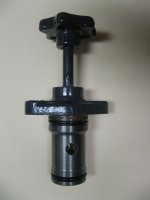
I haven't thought it through all the way but for a while now I've been considering a way to reduce the port size in the lowering speed valve (LSV) to reduce the flow and dampen the surge thought to be responsible for the jerkiness. I'm pretty sure restricting the flow would produce a slower lift and a smoother lift - possibly straining the relief valve some - but I'm not sure how to size the port/s in the LSV. The flow is restricted on lowing by the adjustable check effect so by restricting the flow in, the faster lowering speeds would be restricted as well.

In the photo, the port/s I'm referring to are the hole on the side and one matching it on the other side. They appear to be where the fluid enters and leaves the chamber to pass through the check function of the valve.

LSVtopview.jpg

After test swapping out the LSV on my L3400 with the LSV from the L3010 with minimal to no improvement, the only still notable difference between the two (that have many of the same components but none of the complaints) is that the cylinder is larger and takes longer to fill. Slowing the flow, should have the same effect.

If I remember correctly, there really isn't an easier way to access the line after the position control valve (PSV.) It would probably be a trip to the machine shop with the LSV and some decent engineering specs. Just need have the holes reduced in size in some practical way. Bit of a gamble without more knowledge.

Canoetrpr had a nice theory on restricting flow with an adjustable valve prior to the PSV in an earlier thread that is still worth testing for the determined.
 
   / L3800 3pt hitch operation #37  
I'm not sure if you can restrict the flow in front of the PSV valve without causing the circuit to go over the relief valve all the time, which is why I was looking at tinkering with the lowering valve.

I think the hydraulic circuit on an open center system needs free flow through all the valves unless one of them is being actuated to perform work. By fiddling with the lowering valve, you're tapping into one of the work ports (the only one actually) on the PSV valve.

The power beyond function shouldn't be an issue because the 3 point valve doesn't have that capability since it's the last valve in the series circuit.

I think I'll re-read the thread you started, HM, and the experiment with the 3010 lowering valve. I'd like to have a spare one to modify and try, but the budget's a little tight to be modifying something that's still under warranty..:)

I'd be ok with the valve being slow to raise if it was smooth, but thinking about it now, I wonder if it would be too slow lowering if I had it restricted enough to be smooth on the way up?? The hydraulic pressure is a lot stronger than the weight of most implements.

Your solution with reducing the hole size might be the answer. It needs to be adjustable in the down direction depending on implement type and weight, going up isn't so bad as long as it's smooth.

More thought on this is definitely in order.

Sean
 
   / L3800 3pt hitch operation #38  
...He also told me that there was another valve that would make it operate smooth, but that the mounting holes were different and so they could not put it on...
I have this valve, and yes it's pretty smooth... I don't believe the mounting hole "bit" but if that is the case, I would imagine that you can swap out the guts of the valve. #8

Would be nice if another company would make a replacement Control Valve that worked like the one in the Grand L tractor.

Anyone have parts diagram for the L3010 for the Control Valve? Doesn't look too hard to replace about $450.
 
   / L3800 3pt hitch operation #39  
Anyone have parts diagram for the L3010 for the Control Valve? Doesn't look too hard to replace about $450.


$450 is like putting garlic in front of a vampire for me..:laughing:

Mine's not that bad, more like a $200 fix at the outside. Come to think of it, that's a good way to rate how bad we find the problem, in terms of how much green we'd part company with to fix it.

It's good to see this old wound re-opened, or at least re-visited. It seems like there's always a new crop of owners (even prospective ones) with good ideas and feedback.

Sean
 
   / L3800 3pt hitch operation #40  
Anyone have parts diagram for the L3010 for the Control Valve? Doesn't look too hard to replace about $450.

Teg, You do, it's the same valve: 31351-39604. The only real difference between the the two lift systems is the L3010 has a larger cylinder and at that, it's offset some by a slightly higher flow rate if I remember correctly. That and no complaints about the hitch performance. Here are the bore specs:

L3010 Factory spec for the bore is 90.000 to 90.050 mm vs.
L3400 Factory spec for the bore is 75.000 to 75.050 mm
 

Tractor & Equipment Auctions

2019 F150 (A56438)
2019 F150 (A56438)
2014 Ford Fusion Passenger Car, 2.5L Engine - Only 90,875 Miles (A56438)
2014 Ford Fusion...
2010 CATERPILLAR 320DL RR EXCAVATOR (A60429)
2010 CATERPILLAR...
2019 INTERNATIONAL 4300 26FT NON CDL BOX TRUCK (A59905)
2019 INTERNATIONAL...
CATERPILLAR 255 SKID STEER (A52709)
CATERPILLAR 255...
2003 PETERBUILT PB330 DUMP TRUCK (A58375)
2003 PETERBUILT...
 
Top