Lightning

/ Lightning #1  

patrick_g

Elite Member
Joined
Jul 24, 2006
Messages
4,248
Location
South Central OK
Tractor
Kubota Grand L-4610HSTC
I think most of us are at least a little less safety conscious about lightning than is prudent. A "BOLT FROM THE BLUE" (lightning when you are under a blue (often cloudless) sky has killed several people. Lightning strikes several miles in front of an approaching storm or behind a departing one not only close to the main part of the storm.

By the time you hear thunder or see the flashes of an approaching storm you are already in the kill zone. I learned a stupid habit from my storm worrying folks but I no longer go rushing outside to look at approaching or departing storms (having read extensively on the topic.) A good source of accurate info is the National Weather Service.

Such as ==> NWS Pueblo Lightning Page

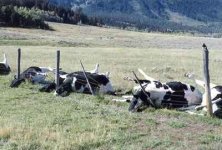
The attached photo is of cows who happened to be standing near a fence when lightning hit close to the fence.

According to insurance statistics there are people killed every year by lightning sending a high voltage shock through the phone wires while they were talking on a corded phone.

A friend of mine was watching TV in his living room to get storm information (many Oklahomans are storm conscious due to being in tornado alley) when lightning literally blew up his TV and sent a ball of glowing plasma the size of a basket ball shooting out of the TV across the room at him. It bounced on the floor glanced across him went through an open door and dissipated. He only got tingled and surprised and no other damage was done but the TV was a total loss. I didn't ask about his underwear.

Tractors without metal tops on fully enclosed cabs are not safe places to be in a lightning storm. I gave that up too. I used to like to sit on the porch and watch storms, gave that up too (but I still watch from an enclosed porch when it is facing correctly.) Statistics say you don't even want to be right next to a window. Darn.

I do recall something from personal experience that reminds me of just how smart many folks are about lightning. I was at Carlsbad Caverns in New Mexico. We were seated outdoors near an opening used by bats to ingress/egress to/from the cavern below. The rangers had a permanent podium with a PA system. You could hear lightning crash static over the PA from EMP from the strokes. The lead ranger went to the mike and announced that lightning tends to be attracted to discontinuities, things such as the opening into the cave used by the bats. He said that it was not safe to stay in the area and that he and all the ranger personnel were leaving out of consideration for personal safety and suggested that all we visitors do the same.

Immediately there are two or three folks who rush up to ask if they can stay to take pictures of the bats coming out anyway. The ranger with a pained expression on his face said the visitors should not stay but that the rangers were not police and would not make them leave but to be informed that the bats were too smart to come out during a thunderstorm! We left as the first few drops hit and were in hail before we got to the camper. A couple die hard BOZOS stayed to take bat pix. I guess they didn't believe the Ranger when he said the bats were too smart to come out in a storm. After the storm (really rocked the camper) there was a couple inches of hail in the parking lot.

Pat

Pat
 

Attachments

  • deadcows.jpg
    deadcows.jpg
    15.6 KB · Views: 628
/ Lightning #2  
Yeah...but think of the bright side...lightning helps clean the gene pool.
 
/ Lightning #3  
I think it was Jerry Pournelle, the author, that called it "natural selection in action".
One of the scariest moments I had in working on explosives for 28 years in the AF was having to build bombs for an actual mission (not training) when a thunderstorm was approaching. The manual lets you work up to lightning within three (miles), I had the guys quit at lightning within five.
 
/ Lightning #4  
patrick g:

Your friend had a close encounter with "ball lightening". Those floating orbs are amazing, but usually dissipate without catastrophy. They used to emanate from the well pump handle in my kitchen during T-storms :cool:. Jay
 
/ Lightning #5  
Jay, you are amazing.

I've looked for a solid explanation for ball lightning for some time & here you've seen the real thing right in your kitchen.

From what I have read it is not always benign & can burn things it touches so maybe I shouldn't wish that I'd been there? Still, you have had an experience that few other shave.

Stay safe
 
/ Lightning #6  
jbrumberg said:
patrick g:

Your friend had a close encounter with "ball lightening". Those floating orbs are amazing, but usually dissipate without catastrophy. They used to emanate from the well pump handle in my kitchen during T-storms :cool:. Jay

I have a friend that remembers when he was a kid, kneeling on his bed looking out the bedroom window during a thunderstorm. A ball of lightning came across the yard at ground level, through his closed window and blew his bed springs across the room, starting his mattress on fire. He described it with this distant look in his eyes and said he will never forget it. :eek:
 
/ Lightning #7  
Mom making us lunch in the middle of a huge Florida thunderstorm, very common, lighting hit close, and mom opened the metal breadbox and a ball of blue flame / fire danced out rolled across the kitchen counter bounced to the floor and petered out.

We all stood there staring at each other wondering what had just happened.

Had never heard of anyone else seeing this type deal before now.
 
/ Lightning
  • Thread Starter
#8  
RoyJackson said:
Yeah...but think of the bright side...lightning helps clean the gene pool.

Roy, I have to ask... are you referring to the cows who were into the grass is greener on the other side of the fence thing which is how they got zapped or do you refer to folks on the phone, or maybe the nut cases trying to qualify for a Darwin award at the bat cave?

My best guess is the nuts at the bat cave, holy electrocution Batman!

Now that I have read up on lightning stuff I will probably be a little (maybe a lot in some cases) more circumspect about my personal exposure to unnecessary risk.

In Australia there are about 10 deaths and 100 serious injuries to people every year from lightning.
Interesting read:
SpringerLink - Journal Article

Lightning deaths in the US:

Lightning Fatalities, Injuries, and Damage Reports in the United States - National Lightning Safety Institute

This second site shows deaths by lightning by state for 1990 through 2003. Florida leads second place Texas 126 to 52 while Oklahoma manages just 17.

I know that the gene pool could stand a little more chlorine but not all those killed were stupid people just often ignorant of the facts about lightning safety. We had drills for duck and cover to avoid broken glass and debris thrown out by the shock wave of a nuclear bomb why not a little more emphasis on lightning safety.

Just what is it about folks in Wyoming anyway? Their death rate adjusted for population is over 2 per million with Utah a distant second at 0.7 while California and Massachusetts are tied at 0.02 and Alaska, Hawaii, and Rhode Island claim 0.0 with no registered lightning deaths.

Many lightning deaths are preventable but the informationi is just not out there. Lightning safety should be taught in the schools.

Pat
 
/ Lightning #9  
patrick_g said:
Roy, I have to ask... are you referring to the cows who were into the grass is greener on the other side of the fence thing which is how they got zapped or do you refer to folks on the phone, or maybe the nut cases trying to qualify for a Darwin award at the bat cave?

My best guess is the nuts at the bat cave, holy electrocution Batman

The Bat Cave, Robin
 
/ Lightning #10  
patrick_g said:
Just what is it about folks in Wyoming anyway? Their death rate adjusted for population is over 2 per million with Utah a distant second at 0.7 while California and Massachusetts are tied at 0.02 and Alaska, Hawaii, and Rhode Island claim 0.0 with no registered lightning deaths.

That's a pretty interesting map. There appears to be something particularly dangerous about lightning in the Rocky Mountain states. Wyoming is the worst, but the rest of the Rocky Mountain states are also right up there. For some reason (I would guess fewer thunderstoms) the other western states, although also very mountainous, are about the safest states..

The strangest thing is that Vermont and Maine are both pretty high in the rankings, whereas New Hampshire and Massachusetts are near the bottom.
 
/ Lightning #11  
I have seen my share of lightning and it scares me.

Years ago I lived in Tampa which has quite a bit of lightning. My office was on the 3rd or 4th floor of a building and we just had cubes in a long narrow room. I would guess the room was 60-80 feet long and maybe 20 feet wide. On long side of the room was all glass. We saw a TStorm move in one day so we watched the strikes get closer and closer. One bolt came down and hit a utility pole right outside the building. We where looking down on the top of the pole! :eek: I think a bunch of use lost some fruit of the looms that day. The thought, along with some other stuff, passed through me that the room was not a safe place to be. :D

Leaving Tampa one day we headed south on I75 and we ran through a Tstorm. The bolts where hitting on both sides of I75. We could see them hit the trees and ground. Many, many strikes. Cool to see but very scary. The thunder was unreal.

A few years ago we were at the beach a few months after a small hurricane had hit. There was quite a bit of mess and roofs still where being fixed. I was out in a kayak and got caught by a storm. I paddled my fanny back to the house as fast as I could go since the only "safe" place I could see was to hide along the face of a dune. :eek: People stayed on the beach sitting in metal chairs. There where two guys on the house next to house fixing the roof. You could see bolts striking near by as the storm moved in and these guys finally got off the roof when the rain hit. A few minutes after that I saw a bolt hit a utility pole a street or two to the north. It had come in from the south. Those guys where very luck to be alive.

We live on the highest ground for about a mile or so. No real high but we are about 100 feet higher than our nearest neighbor. I have seen bolt strikes nearby killing trees. After reading some of the links I guess we should look at installing a system.

The buildings I work in have rods every 3/6 feet along the perimeter of the roof....

We have been wondering if our house is "safer" because we don't have metal plumbing pipes. We have PEX and PVC. No copper or iron. We still avoid the baths when the storms are in the area but I wonder if we are "safer."

Later,
Dan
 
/ Lightning #12  
Dan:

Before we completely gutted our house and rebuilt it we had all plastic plumbing as well. We would still get sparks flying out of our circuit breaker box and surges through our electric lines and tripping breakers, etc :eek:. Since we added an external ground fault interrupter house system I have noticed a significant reduction with electrical surges during T-storms. Jay
 
/ Lightning
  • Thread Starter
#13  
Dan, I too have no metal pipes and have thought that the shower was not particularly more dangerous than any other part of the bathroom. Maybe you will read about me getting a Darwin award if I am wrong.

You can buy large powerful MOV (metal oxide varistor) devices from electrical supply houses or over the net. These are the "active ingredients" of surge protectors. They are easy to install at your breaker box and do for your whole house what a surge protector does for something plugged into a little power strip type surge protector.

Something to know about surge protectors in general whether they are little power strip type units or the INDUSTRIAL versions installed at a breaker box. Over time as they intercept surges and protect devices downstream they are depleted (used up.) If you have been using the same old surge protector for quite a while for your computer or whatever it may not have much if any life left.

All things considered, I think it is cheaper and more practical to install big units at the breaker box rather than a bunch of overpriced bought at retail power strips. A couple good power strip types can cost over a hundred bucks. Whole house protection costs about $200.

Pat
 
/ Lightning #14  
Several years ago my neighbor wanted me to work on his truck because the engine would not crank over. It was an early 1970's Ford pick-up. A couple of days earlier a storm had come through. Anyway, I traced the problem to the starter motor. When I removed the starter there was a hole the size of my finger burned through the housing. It looked just like some one had tried to weld and burned the hole. Wish I would have kept the starter but turned it in for the core charge. Amazingly, all of the lights worked and we found no other damage.

Someone commented about lightening being so bad in Colorado. My theory on that is due to higher altitudes the air is less dense and air is an insulator to electrical charges. In spark ignited engines, as the compression pressure increases so does the voltage needed to fire the plugs. I watched a video on TV that showed a guy on a bicycle in a park in Colorado or one of the western states. It was a suuny day without a cloud in the sky. Out of no where a lightening bolt strikes this guy and kills him. Did not hurt the many bystanders. It was traced several miles to a storm no one realized was there.
 
/ Lightning
  • Thread Starter
#15  
wrenchturner said:
Someone commented about lightening being so bad in Colorado. My theory on that is due to higher altitudes the air is less dense and air is an insulator to electrical charges. I watched a video on TV that showed a guy on a bicycle in a park in Colorado or one of the western states. It was a suuny day without a cloud in the sky. Out of no where a lightening bolt strikes this guy and kills him. Did not hurt the many bystanders. It was traced several miles to a storm no one realized was there.

I watched that also and I think the cloud that had the lightening that got the cyclist was 10 miles away out of sight behind a hill. A bolt from the blue, of course, refers to lightning from a clear blue sky. Somewhere out of sight to the observer there is a cloud which generated the bolt. There are direction finding stations all over the US which triangulate on and log lightning strikes. The stats are available. There are maps that show the analyzed data depicting the locations, frequency and severity. If I recall correctly, that system is what gave the location of the strike that got the cyclist.

You are dead on with your surmise regarding the insulation ability of air under changing pressures. As the pressure goes down the voltage required to ionize the gas is reduced. Ionization potential is also a function of the electric field vector strength. Convex shapes concentrate the field. The smaller the effective radius of curvature the easier it is to start the arc. Sharp things like needles and such really lower the required potential a lot. Colorado has a lot of sharp topography. I wonder if that is part of the reason for more lightning too. If it is then it is probably much less of a factor than the altitude's effect on air pressure. Ionizing radiation also makes it easier to start an arc (lightning strikes are arcs.) Surface deposits of radioactive isotopes might also have an effect.

About the lower pressure letting arcs start easier: NASA electronic stuff headed for orbit has to take that into account as does airborne gear.

Way back when in the olden days (THE LARGEST ROCKS HADN'T COMPLETELY COOLED YET) when I built a 6000 Watt pulse LASER I used the reduced air pressure making it easer to arc as a switch to fire the LASER.

I took a throw away refrigerator compressor and used it for a vacuum pump. I plumbed the vacuum pump to a tee using plastic tubing (good dielectric strength) and from the tee to my DIY flash tube (quartz tube with home brew electrodes.) You charge up the 15,000 volt pulse capacitor and then turn on the vacuum pump. When you place your thumb over the open hole in the tee you start to pull a vacuum. At some point as the pressure is dropping the ionization potential is reached inside the flash tube and the capacitor discharges through the flash tube and gives a really strong flash of light like a strobe for a camera but way cheaper.

Sometimes the flash tube would explode and send out lots of quartz shrapnel which is a good reason to make them yourself for a fraction of buying strobe tubes. When it didn't blow up the bright flash would "pump" energy into the LASING medium (liquid solution of various florescent dyes) and YAHOO!! you put out a powerful LASER pulse.

For lots more power I could have tried to go the Dr. Frankenstein route and use lightning as an energy source but that didn't seem like an altogether provident extension of my experiments.

Pat
 
/ Lightning #16  
The closest I’ve come to a lightning strike or maybe I should say the closest lightning has come to me is about 200 ft.

There are two things that stand out as being different when you’re that close to a lightning strike. The first is that you see the lighting and hear the thunder at the same time, no delay. That really gets your attention!!. And the other is that the thunder is extremely LOUD!!
 
/ Lightning
  • Thread Starter
#17  
hitek, I have experienced a few "simultaneous" (or so they seemed) flash-bangs and they do get your attention. The closest was when I was living for 9 months in a pick up camper off the truck inside a metal shop bld (building a house.) Lightning hit one of my catalpa trees (aka cigar tree) and it blew a limb off.

That is one of the non-electrocution hazards of lightning. When a tree takes a hit you might not see any immediate evidence but the power dissipated by the current passing through the resistance of the tree can be enormous, Steam pressure can build up and literally cause a steam explosion and send shrapnel (jagged chunks of tree) flying out with great force.

In the case I witnessed first hand the limb split mostly lengthwise and broke off. There was a carbon track inside the limb where the current ran. When oiut in the woods, every so often I notice trees with damage on their trunks that sure looks to be from lightning. Some ofthe trees survived just fine and some died. My Catalpa has never really recovered.

Pat
 
/ Lightning #18  
Guys, I may be wrong but I believe the problem with being in the shower is not whether you have metal pipes or not. It's the water itself since it conducts electricity. A tree out by the road gets zapped and the "juice" follows the roots over to the water line by the road which is metal, it is conducted into the line going to your house which is pvc, pex, or whatever, runs in your shower and you don't need to blow dry your hair. This happened to my neighbor across the road. He was not in the shower but it did splode his water meter.
 
/ Lightning #19  
shane said:
Guys, I may be wrong but I believe the problem with being in the shower is not whether you have metal pipes or not. It's the water itself since it conducts electricity. A tree out by the road gets zapped and the "juice" follows the roots over to the water line by the road which is metal, it is conducted into the line going to your house which is pvc, pex, or whatever, runs in your shower and you don't need to blow dry your hair. This happened to my neighbor across the road. He was not in the shower but it did splode his water meter.

Water (distilled/deionized) is a poor conductor of electricity. The contaminants in the water make typical potable water a conductor-- better or worse depending on the contaminants.

If a shower head get charged up by lightning, looking for a way to get to the drain, the bag of salts standing in the shower makes a far better conductor than the normal water people shower with. So, needless to say, said bag is the path of least resistance and is what gets zapped if there is an arcover.
 
/ Lightning #20  
Horse7- I agree with you :).
Patrick g- I saw a guy get crushed to death by a falling tree during a T-storm's micro-burst. It appeared that the tree was simultaneously hit by lightening, split, and gusted over on the guy in his car. There were a lot of simultaneous bursts and claps that day. You could smell the ozone in the air. Jay
 
 
Top