loader to counter weight calculator

   / loader to counter weight calculator #1  

ironman1952

Silver Member
Joined
Dec 7, 2023
Messages
117
Tractor
2023 Kioti RX7320pccb
Is there a calculator that takes into consideration the following:

1 Lifting cap of the loader
2 weight of the tractor
3 counter weight in the rear Loaded tires, extra plates etc

+ anything else I have missed

Thanks, Joe
 
   / loader to counter weight calculator #2  
Lot your missing…probably why there’s no easy calculator.

Grade +/-
Distance from front wheel to pins.
Distance from pins to center of gravity on the load.
What pint in the lift (lowest part it’s actually closer to the tractor then moves away then back closer to the tractor)
Height the lift starts at (see above)
 
   / loader to counter weight calculator #3  
Lot your missing…probably why there’s no easy calculator.

Grade +/-
Distance from front wheel to pins.
Distance from pins to center of gravity on the load.
What pint in the lift (lowest part it’s actually closer to the tractor then moves away then back closer to the tractor)
Height the lift starts at (see above)
All of the above and watchout for uneven ground, potholes, loose soil on slopes.
Operate with the slope if at all possible.
Center of gravity is an ever changing variable when you are moving or changing the height of the bucket, Slowing down until you have a feel for the area you are working in.
 
   / loader to counter weight calculator #4  
You may wish to consider the effective weight on the loader versus the load limit on the front of the tractor. You could possibly break the frame or front axles. Remember the loader places a load on the tractor when it's empty so you have significant weight on the front before lifting a thing.
 
   / loader to counter weight calculator #5  
I recently took my Rhino 172 brush cutter off as i felt I didn't need the extra counterweight while building the rest of my cabin. A couple close tip-overs had me putting it back on Wednesday. The box blade I had put back on isn't as heavy and the weight isn't farther back like the cutter. I had gotten so used to how it performed it now had made me nervous lifting anything on any slope.
 
   / loader to counter weight calculator
  • Thread Starter
#6  
scary business :) I will be on fairly level ground
Weight of truss is only about 150lbs + the weight of the truss boom
I wont lift to final height until I am at the building and vigilance from that point forward.
 
   / loader to counter weight calculator #7  
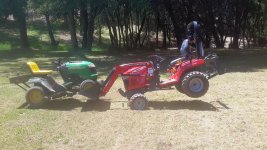
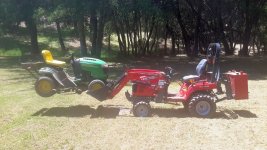
Keep in mind the further out the "weight" is in from FEL the more it effects the stability of tractor.... Its sort of Archimedes principle of "give me a lever and fulcrum and I can move the world".... The front axle is the fulcrum. The weight in FEL can be the lever or the ballast weight on rear can be the lever....

20190513_134020.jpg 20190513_134501.jpg

IN the case above the JD mower is 520 pounds, the ballast weight in second image somewhere between 500-600 pound's
 
   / loader to counter weight calculator #8  
scary business :) I will be on fairly level ground
Weight of truss is only about 150lbs + the weight of the truss boom
I wont lift to final height until I am at the building and vigilance from that point forward.
Tough to calculate precisely, and if you did, the calculation would change as soon as the machine started moving or you lifted the loader or the ballast on the three point. On the surface, you're just calculating the forces on a lever. Problem is, the forces in this case are distributed unevenly along the whole lever, not just at a point on either side a certain distance from the fulcrum (your front axle). FWIW, on fairly flat even ground, it would be tough to have too much counter weight. Within the capabilities of the machine, the more the merrier, till the front end starts feeling light.
 
   / loader to counter weight calculator #10  
I'm very confused by this picture. How is that lawn tractor not tipping backwards out of the bucket?
Red lawn tractor doesn't have enough counterbalance on it's rear to offset weight of front of green lawn tractor therefore red lawn tractors rear tires rise from ground. Counterweight in photo below makes up the difference.
Screenshot 2024-01-14 072516.png
 
   / loader to counter weight calculator #11  
There was a discussion of this picture some time ago. As I recall, there is some part of the John Deere that is extending out in front of the wheels and is hooked under the edge of the bucket.

Doug in SW IA
 
   / loader to counter weight calculator #12  
Red lawn tractor doesn't have enough counterbalance on it's rear to offset weight of front of green lawn tractor therefore red lawn tractors rear tires rise from ground. Counterweight in photo below makes up the difference.
View attachment 846616
Not asking about the red tractor. It appears as if the green tractor is being supported entirely by it's front wheels in the bucket of the red tractor.
There was a discussion of this picture some time ago. As I recall, there is some part of the John Deere that is extending out in front of the wheels and is hooked under the edge of the bucket.

Doug in SW IA
Figured it had to be something like that. I just can't see what it is.
 
   / loader to counter weight calculator #13  
I'm very confused by this picture. How is that lawn tractor not tipping backwards out of the bucket?
There is a bumper on front of JD mower and it is wedged under lip of bucket.... Not photoshopped ....

Discovered I could wedge JD into bucket when it was on back property and quit running like a deer.... These later pictures on level ground and on controlled condition are to show that ballast weigh really works...
 
   / loader to counter weight calculator #14  
If you are interested the lift capability you can find it in the manufacturer's specifications. Then considering that the bucket moves in an arc you could manually fill in the curve between the min and max heights for say every 10 degrees or whatever to get the derated weight at each point of interest. This you can do on a simple piece of graph paper.

A calculator is possible and it is in it's simplest form is a right triangle inside a circle. The height scaled on the Y and the X as weight. The higher you go the lower the weight. They are proportional and define the arc. This part is not too hard to do with excel although I have never seen it done.

It becomes more complicated when the lever arm that represents the tractor and the effective counter weight is added to the lower corner of the triangle. Together they create an axis of rotation at the front wheel axil around which the whole assembly rotates when the back end starts to lift. BUT... like the other guys have mentioned it all goes out the window, even the manufactures specs when the ground is even a little uneven and when the risk of a more dangeruous side flop can happen. So the best calculator is the operator in the moment.

A good way to visualize could be to think of a torque wrench on a bolt. The wrench is the loader, the bolt the front wheel axil and welded to the bolt a piece of flat bar for the torque from the tractor. When you push down on the wrench it represents load. So, if you had the time and enough curiosity to experiment you could put scales under the back wheels and some weght in the loader and watch the numbers to see where the exact sweet spot would be for your specific rig.. Might be fun to do.
 
   / loader to counter weight calculator #15  
scary business :) I will be on fairly level ground
Weight of truss is only about 150lbs + the weight of the truss boom
I wont lift to final height until I am at the building and vigilance from that point forward.
Just try it as a "dry run" in the clear a couple of times. If you are using your 73HP Kioti there should be no problem.
 
   / loader to counter weight calculator #16  
Check the owner’s manual for your loader, typically you will find require ballast specs here. It typically is not in your tractor manual as without the loader, rear ballast is typically not need (might need front ballast in a non loader situation). Often it is listed in various arrangements—filled tires plus rear ballast, wheel weights and rear ballast, or rear ballast only. I have never seen a spec to use just wheel weights or filled tires. By using rear ballast it is possible to reduce some weight from the from axle (see a recent youtube post by Messick’s on this topic).
 
   / loader to counter weight calculator #17  
As a rough starting point:

From several small-tractor manuals I've read, the recommended counterweight on the 3pt hitch was around 2/3 loader lift capacity.

Bruce
 
   / loader to counter weight calculator #18  
Yes. The calculator is located behind you between your lower back and the top of your legs. When it gets that funny "tingle", set the loader down and do it fast. It also works as an angle calculator. It works in conjunction with that thing on your shoulders, though some of us have a bad connection between the two (like me! 😬).
 
   / loader to counter weight calculator #19  
I understand the ballast takes weight off the front axle but how much help is the ballast preventing a rollover?
 
   / loader to counter weight calculator #20  
By lowering the center of gravity
 

Tractor & Equipment Auctions

2023 CATERPILLAR 262D3 SKID STEER (A60429)
2023 CATERPILLAR...
CABINET OF HOSE ENDS (A58214)
CABINET OF HOSE...
2008 Ford Escape XLS SUV (A59231)
2008 Ford Escape...
Honda EM3500S Portable Gasoline Generator (A59228)
Honda EM3500S...
2017 Chevrolet Tahoe SUV (A55853)
2017 Chevrolet...
Honda EM3500S Portable Gasoline Generator (A59228)
Honda EM3500S...
 
Top