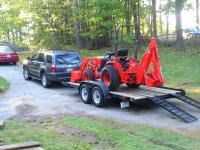
Loading tractor

   / Loading tractor #1  

garcia

New member
Joined
May 15, 2010
Messages
9
I noticed when I loaded my new kubota with front loader and box blade for the first time from dealer that the back end of my 16 foot low boy trailor came way down and raised the back of my truck way up.
I have the regular angle iron single ramps. I want to add some kind of brace,
but not to make it to heavy.
Any ideas will help.
 
   / Loading tractor #2  
A couple of logs or 6x6's cut to the right length. Just put them under the back of the trailer when loading. I've seen this done many times. Not very elegant, but it works.
 
   / Loading tractor #3  
I put some jacks on the back of my trailer. They are removable or can be swung on the pipe holder for storage. :D
 

Attachments

  • PB110003.JPG
    PB110003.JPG
    175.9 KB · Views: 464
   / Loading tractor #4  
A couple of logs or 6x6's cut to the right length. Just put them under the back of the trailer when loading. I've seen this done many times. Not very elegant, but it works.

That's what I do when I am unloading my utility trailer if it has been unhitched from the tow vehicle. Just a block of wood under the back end is all it takes, simple and effective.
 
   / Loading tractor #5  
That's what I do when I am unloading my utility trailer if it has been unhitched from the tow vehicle. Just a block of wood under the back end is all it takes, simple and effective.

You can also use concrete blocks ,floor jacks or jack stands. Just be careful to support the frame and not a single board in your floor. Don't ask me how I know this.:laughing:
 
   / Loading tractor #6  
That's what I do when I am unloading my utility trailer if it has been unhitched from the tow vehicle. Just a block of wood under the back end is all it takes, simple and effective.

I'd never load or unload a tractor onto a trailer not being connected to the tow vehicle:eek:,......... especially if he's already stating the weight of the tractor is lifting the rear of his truck being connected to the trailer as it is,
...................................................................................................
Do you have hinged ramps? if so you should have some braces weld onto them that would extent to the ground when the ramps were let down, if no hinged ramps you can do as others have suggest a couple of stacked 6x6 blocks or what ever size would take to sure up the rear of the trailers frame, another option would to have some hinged ramps with down braces installed, would sure make life much easier,;)
...........................................................................................
You could also have some square tubbing approx 10" long weld to the sides of the back end of the trailer and use the next size smaller tubbing to fit just inside the larger one have sets of holes drill into the smaller tube that a Pin can be put into when adjusted down to the ground,
kind of on the principle of jack stands for supporting cars etc, ....
in fact might could use a pair of trailer tongue jacks that are built on swivels and locking pins, one bolted/welded on each rear side corner of the trailer,
Here is a quick sketch of what I'm trying to describe
 
Last edited:
   / Loading tractor #7  
Like others, I just usually crib under the rear of the trailer with wood.

Don
 
   / Loading tractor #8  
And, avoid concrete blocks as props since they can crumble easily with a point load. Wood blocks are cheap and simple.
Jim
 
   / Loading tractor #9  
I would say that Egon has the best set up.:thumbsup: With trailer tongue jacks at the back side corners you would always be able to adjust for ground variations thus always being able to have your trailer supported evenly.
 
   / Loading tractor #10  
Whatever you do, just remember that your trailer will probably ride a few inches lower once the tractor is in place. You want to prevent excessive sagging, but once you are loaded you don't want any weight remaining on the cribs/floor jacks etc so you can remove them without having to jack up the trailer. Beleive me, its a pain.
I like Egons tonque jack idea....
 
   / Loading tractor #11  
I like Egon's tonque jack idea....

That really isn't Egon's idea.:eek:

The pipe stubs for the jacks were welded on when the trailer was built. :thumbsup:

Trailteck in Gravelburg, Saskatchewan.
 
   / Loading tractor #12  
I used box tubing to make drop legs for my trailer. Five years of use with no problems. Notice with the empty trailer the legs are a few inches off the ground. These drop legs will contact when loading but should rise back up enough to remove them from a bind when tractor is positioned on trailer for transport. I have multiple holes in the inner tubing for adjustment too.
 
   / Loading tractor #13  
My 16' Woodworth has hinged "loading legs", just a hinged 2" x 2" tubing with a 4" square "foot" that is a couple of inches off the ground when empty. When your loaded, just back up a few inches so you can swing them up to transport position! Simple & a lot cheaper than jacks. ~~ grnspot110
 

Attachments

  • Picture 001.jpg
    Picture 001.jpg
    61.1 KB · Views: 301
   / Loading tractor #14  
I noticed when I loaded my new kubota with front loader and box blade for the first time from dealer that
1* the back end of my 16 foot low boy trailor came way down and raised the back of my truck way up.
I have the regular angle iron single ramps. I want to add some kind of brace,
but not to make it to heavy.
Any ideas will help.
1*The problem is not enough tongue weight.
The proposed solutions will only coumpound the problem
By adding even more weight to the rear of the trailer.
 
   / Loading tractor #15  
1*The problem is not enough tongue weight.
The proposed solutions will only coumpound the problem
By adding even more weight to the rear of the trailer.

I see where you're coming LB from but my trailer does the same thing....it has nothing to do with not enough tongue weight but all to do with all the weight of the tractor on the tail while driving the tractor on (therefore lifting the front of the 16' trailer up due to leverage), my trailer ramps do not have the legs under them so the all these suggestions of adding corner jacks and brace legs are welcome to my situation also.....

Once loaded and the tractor balanced properly, it has excellent tongue weight and trailering stability, I know my trailer is lighter than most but it fits my pulling rig and tractor awesome.....:thumbsup:

Maybe the OP's problem was balancing properly, or just while loading.....

All these ideas are great!!!!:) Keep em comin':)
 

Attachments

  • springtract 001.jpg
    springtract 001.jpg
    1 MB · Views: 278
Last edited:
   / Loading tractor #16  
I use the jack stands, but I would rather have the swing down legs for the ease and the backing up to get them out. always leave about 1-2 inches of space above the jack stands or you will be jacking or unloading again. but definately do one of the fixes, a friend of mine lost a pickup and nearly his tractor doing this. he started up the ramps picked up the rear of his truck(so no e-brake or park anymore) and his truck took off and hit a tree turned left and went in a pond. trailer and tractor stayed on land. be safe and smart.:ashamed:
 
   / Loading tractor #17  
I use jackstands but also have a "farm jack" or "sheepherder jack" (one of those 4 ft. long heavy duty ones). The jack is used to lift the rear end enough to remove the jackstand on each side when the trailer is loaded.

It takes a bit more time to do it this way but then there is no lifting of the front of the trailer / rear of the truck.
 
   / Loading tractor #18  
1*The problem is not enough tongue weight.
The proposed solutions will only coumpound the problem
By adding even more weight to the rear of the trailer.

I think you are missing the point. This is happening when the trailer is being loaded. Tongue weight is important for transport but weight transfer is inevitable when loading or unloading. The back of the trailer must be supported in some fashion in order to overcome that transfer, plus it makes it easier on the trailer.
 
   / Loading tractor #19  
I have the same problem as most do however with my GN it's not so severe that "at this time" do'nt feel the need to do anything about it. It doesn't raise my vehicle completely off the ground.

Good luck.
 
   / Loading tractor #20  
Living in the mountains with steep grades it is imperative to keep the truck on the ground. I use wheel chocks for the trailer combined with the drop legs pictured in the above post. My drop legs are clear of the ground to start with, while driving the machine over the tail the drop legs contact the ground. When I pull forward to the transport parking position the drop legs are free of the ground again. I simply pull the pins, slide the tubing up and pin in place. Couldn't be simpler than that.:thumbsup:
 

Tractor & Equipment Auctions

UNUSED 89" LAND PLANE (A52706)
UNUSED 89" LAND...
2013 Ford C-Max Energi Hybrid PHEV Hatchback (A59231)
2013 Ford C-Max...
2010 Case 580N (A60462)
2010 Case 580N...
Caterpillar 2PD5000 5,000LB Diesel Forklift (A56857)
Caterpillar...
2016 VERMEER PD10 PILE DRIVER (A60429)
2016 VERMEER PD10...
2019 FREIGHTLINER CASCADIA TANDEM AXLE SLEEPER (A59905)
2019 FREIGHTLINER...
 
Top