Egon
Epic Contributor
Concrete has gota work!


I was once pronouced by a group of phychiatrists that I worked for in college to be the most sane person they knew. This thread may prove them wrong.
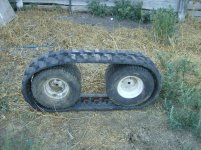
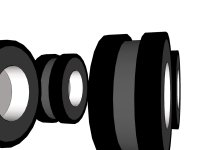
Here's what I want to do: I want to take a rear lawn mower tires in the first picture and make each one into two narrower tires. And, I want to do this without ever taking the tire off the rim or the rim off the axle.
Crazy, huh?
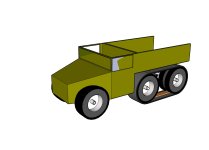
The whole purpose is to make drive wheels for the tracks in the second picture. It could work quite nicely. The wheels are the same width as the track, and the diameter of the wheels works real well with the size of the tracks to. All I need is a gap in the middle of each wheel for the chain in the middle of the track to ride in. The project is a small scale half track for the kids (and me) to drive around. I'm planning to use the transmission from the mower to drive the half track.
Here's how I plan to do it. I'll remove the valve stem and fill each tire with enough of some kind of resin or liquid something-that-hardens to make one side of the tire. I'll set the whole assembly on end to allow the stuff to cure. Then I'll flip the whole thing over and do it again. When everything has set, I'll cut the middle of the tire out. Voila! One tire is now two.
Here's the question: What kind of liquid something-that-hardens should I use?


There are adhesives specifically designed for adhering rubbers. Unfortunately, most require vulcanizing.I'm still hoping to get some kind of input as to an adhesive that would permanently glue the truck tread to the outside of the mower tire. Google searches are bringing up thousands of unrelated adhesives for everything from paper to RV roofs.
There are adhesives specifically designed for adhering rubbers. Unfortunately, most require vulcanizing.
Cyanoacrylates hold pretty well if the surface is clean and good contact is made. Both surfaces need to be smooth and a very thin application is stronger than a thick coating.. Several industrial suppliers like Loctite make versions far superior to the consumer type Superglue / Krazyglue from the local store. All CAs are weakened by long term exposure to water.
I have no idea how well you could get it to work on the treaded tire.


How do you plan on steering this contraption if you do succeed in getting the tracks on? You have to have independent control over each side so that one side can be either stationary or in reverse while the other is going forward. Otherwise it goes only where it happens to be pointed and that's it.
What did the tracks come from? A little walk behind skid steer? Maybe you should just look for one of those and skip the science project.

if you're still undecided...
Regular epoxy would fracture and break up...you might check into "poly" epoxy...
What first came to mind when I read the original post was silicone but that application would take several days to cure....
Another option may be a fibered casting resin (polymer)
Dear Sir
I viewed the photo of the track and wheel profile. I believe there are going to be greater forces at work on the tires than you hope for and the rubber tire assembly will fail. I built a scale model of a Case 450 under carriage in metal. When you look at army tanks they use 2 wheels to run the track profile that you are using through. These are mini digger tracks and slow speed and heavy. I have some tires that came from an airport ground equipment that are the size of camper trailer tires but solid rubber 4 bolt pattern. Somthing similiar could be matched front and back = 8 tires. Or cut the middle sprocket out and make skid steer types on thick tires.
Craig Clayton
Just so happens I'm looking for someone to unload an old rider on.....That's the point in using the lawn mower axles.
Just so happens I'm looking for someone to unload an old rider on.....