Measuring tongue weight

   / Measuring tongue weight #1  

Dan Hunter

Platinum Member
Joined
Nov 1, 2011
Messages
550
Location
Enid, OK
Tractor
2012 John Deere 3720 eHydro
I checked my tongue weight against my jack weight today using a Sherline scale and was surprised. The Sherline site seemed to indicate that the tongue weight would be less than the jack weight but that wasn't the case. I had 220# on the tongue and 200# at the jack. Since I know that my loaded trailer will be 7100#, I'm aiming for 700# at the jack but I thought it odd.
 
   / Measuring tongue weight #2  
Was the the front of the trailer at the same level when you weighed it? The trailer weight balance will change depending on its attitude. And especially if it has tandem axles.
 
   / Measuring tongue weight #3  
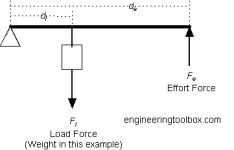
It seems to me that a trailer can be generalized as a second-class lever...
levers-second-class.png

...with the axle acting as the fulcrum, and the weight of the cargo lying, on average between the axle and the coupler. This generalization works even if there is cargo rear of the axle, because the trailer should always be tongue-heavy, therefore the center of mass of the cargo is always going to be ahead of the axle.

The relevant formula is Fe = W * d1 / d2, where Fe is what a scale would show at a given distance (d2) from the fulcrum / axle, and d1 is the distance from the fulcrum where the weight is placed on the lever. We can see that as d2 increases (you get further from the fulcrum / axle), the resulting Fe decreases, because d2 is in the denominator. Therefore, the further you are from the axle, the lighter a scale should read, all else being equal.

Hosspuller is right that having the trailer as level as possible is essential to getting a good measurement. If the trailer is on unlevel ground, place the scale under the coupler and then raise or lower it using blocks or a jack or whatever until the trailer is level. Use a torpedo level or something like that if necessary, as eyeballing level without a good reference can be tricky.

EDIT: This Sherline page seems to agree with me: Trailer Loading and Towing Guide

For the ultimate in accuracy, note the actual difference in weights and calculate the ratio by dividing the full hitch weight by the weight at the tongue jack.
Example:
Weight at hitch = 950 lb.
Weight at jack = 1000 lb.

950 ÷ 1000 = .95
Future measurements at the jack multiplied by .95 will yield the exact weight at the hitch itself.
 
   / Measuring tongue weight #4  
Something is definataly wrong. As others said, make sure you keep everything level. But with a load on the trailer, I dont see how it is possible to have more tongue weight than jack weight unless you changed something when measuring (trailer angle)??
 
   / Measuring tongue weight
  • Thread Starter
#5  
Thanks for the replies. I did have the hitch higher at the ball.

I went out to the garage for another sample. Unlike before when I was weighing the bare trailer, it now had the bucket for the FEL, the grapple and the shear on it with a bias about 3' or so forward of the center of the two axles and a total load of 1400#. Results:

Ball: 700#

Jack: 450#

I took multiple samples resetting each time to verify and it was consistent. The trailer was as level as I could get it. It seemed like a broad discrepancy when the difference in the arm is about 2 feet. I figure the jack is about 8' from cg and the ball about 10' but I can't be sure and stink at math.

I don't get it
 
Last edited:
   / Measuring tongue weight #6  
There is hysteresis in the Sherline device which may be effecting you.
If you put the tongue on the scale and it weighs 500# and you then push down on the tongue and it goes to 600# when you stop pushing down does it bounce back to 500 or only 550-575 or so? Point being, the first weight on the scale is the most accurate. I have found it necessary to lift the tongue off the scale then gently lower it back down without any dropping or bumping and use that weight. When weighing the jack point use a floor jack and lift it at the tongue/ball point, then lower it onto the scale at the jack to get your most accurate number. Unless your jack is well behind the ball a spread of 450 to 700 seems unreasonably large and reverse of what it should be.
 
   / Measuring tongue weight
  • Thread Starter
#7  
Moron Alert! Moron Alert!

I was mixing the scales.

Multiple readings using a level on the trailer are 750 on the ball and 900 on the jack. Whew! It seems like a big variance but then this is a short but heavy trailer.

Also, it'll be easy to remember to put 1000# on the jack when loading to achieve a 750# ball weight and 9.5 to 10 % of the total weight.
 
   / Measuring tongue weight #8  
What kind of scale are you using, just out of curiosity?

The shorter the trailer, the more of a difference you will see between the jack and the coupler.
 
   / Measuring tongue weight
  • Thread Starter
#9  
sherline scale.gifThis...
 
   / Measuring tongue weight
  • Thread Starter
#11  
Here's some math fun.

To determine the CG, the jack is the reference and the ball is an additional 2 feet from the reference. If weight * arm = moment, then the arm can be determined by comparing the moment for both measurements on the same load with X being the arm or length the jack is forward of the CG.

950 * X = 750 * (X+2)

If this kind of thing hurt your head as it does mine go to Mathway: Algebra Problem Solver and type in your equation.

The answer is 7.5 putting the cg 7.5 feet behind the jack...not exactly how I'd like to trailer but reasonably reflects the present load of 1200 pounds of tree shear and grapple forward of the axles for storage purposes.

Or did I do something wrong?
 

Marketplace Items

New Holland T2420 (A53317)
New Holland T2420...
2020 BOMAG BM8500 TRENCH COMPACTOR (A60429)
2020 BOMAG BM8500...
SKID STEER ATTACHMENT CEMENT MIXER (A58214)
SKID STEER...
UNUSED RAYTREE RMLS18T-18 TON HYD LOG SPLITTER (A60432)
UNUSED RAYTREE...
JLG SKYTRACK 10054 TELESCOPIC FORKLIFT (A60429)
JLG SKYTRACK 10054...
John Deere 5103 (A53317)
John Deere 5103...
 
Top