MIG amperage

   / MIG amperage #1  

jake98

Veteran Member
Joined
Nov 10, 2007
Messages
1,881
Location
Dingmans Ferry PA
Tractor
53 Cub, 70's JD 410, Kioti 25hst
Do wire feed MIG welders increase amperage by having more 'connection' as the wire speed increases? I just ordered one, and I'm trying to get the picture of how they 'know' to increase the amperage..:confused2:
 
   / MIG amperage #2  
They ''know''*to increase the amperage when you turn up the amperage with the knob.
 
   / MIG amperage
  • Thread Starter
#3  
They have a voltage knob, and a wire feed speed knob. Voltage only varies by about 15v., or something.. thus my question..
 
   / MIG amperage #4  
What welder are you purchasing ? Not sure about " Voltage " but my Lincoln SP135 goes from "A" to like "J" on amperage which is like 20 amps up to some were around 130 amps . Wire feed is the same and unless it is really thin gauge metal , I am always around 3 to 4 on the wire speed .

Fred H.
 
   / MIG amperage
  • Thread Starter
#5  
What welder are you purchasing ? Not sure about " Voltage " but my Lincoln SP135 goes from "A" to like "J" on amperage which is like 20 amps up to some were around 130 amps . Wire feed is the same and unless it is really thin gauge metal , I am always around 3 to 4 on the wire speed .

Fred H.

Are you sure you have an 'amps' control? All I've been looking at (which aren't that many) have voltage control and wire speed. What it's got me wondering is if the amps gets controlled by the wire burning off and then re connecting at different rates.. like the full amps potential is always there, it just keeps getting interrupted, the less interruptions, the more amps?
Come to think of it, how can they put 200 amps thru a .035 wire without it melting right in the hose?
I ordered the Hobart Ironman 230.

Edit: I googled and found this http://www.millerwelds.com/resources/basicMIG/wire_feed_speed.htm
 
Last edited:
   / MIG amperage #6  
OK, now that you have a handle on wire speed / amps, and volts, next you'll want to learn how to set a wire feeder up on an old school engine drive like in my avatar. :D
 
   / MIG amperage #7  
You are not just feeding voltage/amps through the wire, but you must consider the metal spiral cable that the wire runs through. If you look inside the welder, you will see that the wire housing is one leg of the current flow, and the very end of the wire is the short circuit, and melts the wire.
 
   / MIG amperage #8  
They have a voltage knob, and a wire feed speed knob. Voltage only varies by about 15v., or something.. thus my question..

When you change the voltage, the amperage changes as well. The amps is what does the work. On a stick welder for example, the amps is constant, no matter what you do with the stinger. On a mig welder, the voltage is constant, no matter what you do with the mig gun. On a stick welder when you increase the amperage, it decreases the voltage. And why the wire doesnt melt in the hose, is because it doesnt carry any current in the hose, the current is carried in a differnt wire, and the contact tip is what energises the wire,right before it goes to the puddle. The reason the amperage changes is the way the transformer works, it has nothing to do with anything else.
 
   / MIG amperage
  • Thread Starter
#9  
OK, now that you have a handle on wire speed / amps, and volts, next you'll want to learn how to set a wire feeder up on an old school engine drive like in my avatar. :D

Yeah, right now I'm thinking I should have just bought a wire feeder and hooked it up to my tombstone.. Oh well, I love new toys anyway..:)
 
   / MIG amperage #10  
I don't know anything about tombstones, but you have to be real careful with a lot of CC power sources, sometimes they put out too many OCV for some wire feeds to operate properly. Some of Lincoln's old wire feeds would only accept 49-OCV, the minimum result would be no wire feed until you struck and arc.
 
   / MIG amperage #11  
from another site: Welding machines are usually classified as constant current (CC) or constant voltage (CV); a constant current machine varies its output voltage to maintain a steady current while a constant voltage machine will fluctuate its output current to maintain a set voltage. Shielded metal arc welding will use a constant current source and gas metal arc welding and flux-cored arc welding typically use constant voltage sources but constant current is also possible with a voltage sensing wire feeder.

The nature of the CV machine is required by gas metal arc welding and flux-cored arc welding because the welder is not able to control the arc length manually. If a welder attempted to use a CV machine to weld with shielded metal arc welding the small fluctuations in the arc distance would cause wide fluctuations in the machine's output. With a CC machine the welder can count on a fixed number of amps reaching the material to be welded regardless of the arc distance but too much distance will cause poor welding.
 
   / MIG amperage #12  
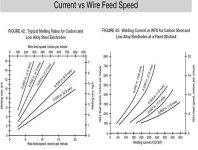
I found this.
 

Attachments

  • current.JPG
    current.JPG
    59.5 KB · Views: 273
   / MIG amperage #14  
Mig process is typically a Constant voltage process. The taps (detents) are preset voltage levels. Some welders have a lot more taps, with ranges to provide more selections. Other welders such as inverters allow you to change the Voltage infinitely. Once set, the voltage is held constant while welding (theoretically).

Wire speed and amps are directly linked. Increasing wire speed automatically delivers more amps. Some mig welders have an scale for amps...Others for wire speed, but they do the same thing. The faster the wire feeds, the higher the amps go.
 
   / MIG amperage #15  
Perhaps this will help. Admittedly I'm shooting out my butt on this, but it follows basic electrical theory...sort of... I know I'm going to get flayed for this, but I'll try to make some sort of layman sense out of it. No I'm not an EE, but I stayed at a Holiday Inn Express last night :)

1. It's a CV source, so it tries to maintain the voltage at the setting.
2. Every time you short the wire to the work as it feeds out, the voltage wants to drop as there is less resistance when it shorts than when it is holding an arc across a gap.
3. Since it tries to keep the voltage constant, it will boost the power to keep V constant.
4. Since V is held constant, A must increase and the wire melts back a bit.
5. The faster the wire moves, the more often this must happen, thus the higher amp draw on average.

Anyone agree with me? Maybe I got that wrong, but on a Fri night, it sounds good:D
 
   / MIG amperage #16  
Perhaps this will help. Admittedly I'm shooting out my butt on this, but it follows basic electrical theory...sort of... I know I'm going to get flayed for this, but I'll try to make some sort of layman sense out of it. No I'm not an EE, but I stayed at a Holiday Inn Express last night :)

1. It's a CV source, so it tries to maintain the voltage at the setting.
2. Every time you short the wire to the work as it feeds out, the voltage wants to drop as there is less resistance when it shorts than when it is holding an arc across a gap.
3. Since it tries to keep the voltage constant, it will boost the power to keep V constant.
4. Since V is held constant, A must increase and the wire melts back a bit.
5. The faster the wire moves, the more often this must happen, thus the higher amp draw on average.

Anyone agree with me? Maybe I got that wrong, but on a Fri night, it sounds good:D

I am buying into it.. I am not a EE either, nor do I play one on TV, but it sounds about right to me.

James K0UA
 
   / MIG amperage #17  
Just to make more variables the larger diameter the wire the, more current. I also started mixing my gases and found other characteristics. I just used 2 flow meters to mix gas.
 
   / MIG amperage #18  
Wire speed and amps are directly linked. Increasing wire speed automatically delivers more amps.

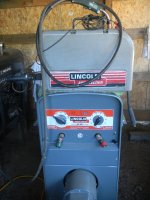
That doesn't work with this combination! Turn the wire speed up with this setup, and the wire will bang into the puddle! ;):D
 

Attachments

  • LN-25.JPG
    LN-25.JPG
    191.2 KB · Views: 239
   / MIG amperage #20  
My best guess is that some machines have taps for different voltage, the there is an open voltage, and current drawing voltage, and even that is variable within a narrow range, based on the air gap between the wire and the puddle.
 

Tractor & Equipment Auctions

54in Loader Fork Attachment (A59228)
54in Loader Fork...
2015 Ford F350 XL (A57148)
2015 Ford F350 XL...
2016 INTERNATIONAL PROSTAR TANDEM AXLE DAY CAB (A59904)
2016 INTERNATIONAL...
2015 Ford Transit Connect Passenger Van (A59230)
2015 Ford Transit...
2015 BMW 328i Sedan (A59231)
2015 BMW 328i...
24017 (A56859)
24017 (A56859)
 
Top