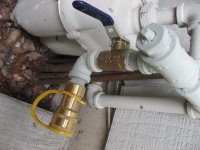
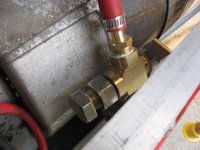
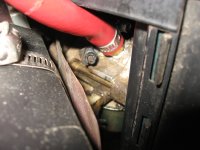
Natural gas conversion - where to feed the gas

   / Natural gas conversion - where to feed the gas
  • Thread Starter
#21  
This is what I did, yes it egg shaped the hose a bit.
Looks simple enough. Does the end of the hose just terminate under the plate?
 
   / Natural gas conversion - where to feed the gas #22  
yes about center with the inlet, I used a tapered ream to size the hole for the hose in the air box , tight enough I had to wiggle the hose all the way into place , after a good seal around the hose, If you over shoot the size use some RTV sealant around it .
 
   / Natural gas conversion - where to feed the gas
  • Thread Starter
#23  
yes about center with the inlet, I used a tapered ream to size the hole for the hose in the air box , tight enough I had to wiggle the hose all the way into place , after a good seal around the hose, If you over shoot the size use some RTV sealant around it .
Great. Thanks so much for your help.
 
   / Natural gas conversion - where to feed the gas #24  
Great. Thanks so much for your help.

It was my pleasure to share with you, Glad to find someone that has a interest in this area, not much in print about it and what you find is not a step by step instruction . Even the manufacturer acts like it is a secret . I have been waiting on your progress report with your generator . I converted my Cub Lowboy over to propane this past week end with great success ,I had to reduce my vapor line to 1/8 inch ID hose to lean it out to find the sweet spot. I will have to take a few pictures .
 
   / Natural gas conversion - where to feed the gas #25  
i converted two EU2000 inverter generators using the US Carb 'snorkel' kit to run on propane.. took longer to figure out where to mount the regulator than do the actual conversion..

Ran both generators for a total of 30 hrs a few months back without any issues.. Much better set up than trying to store 15 gallons of gas

brian
How many gallons of propane was used to run 30 hours? Generator running at 100% or....?
 
   / Natural gas conversion - where to feed the gas
  • Thread Starter
#26  
It was my pleasure to share with you, Glad to find someone that has a interest in this area, not much in print about it and what you find is not a step by step instruction . Even the manufacturer acts like it is a secret . I have been waiting on your progress report with your generator . I converted my Cub Lowboy over to propane this past week end with great success ,I had to reduce my vapor line to 1/8 inch ID hose to lean it out to find the sweet spot. I will have to take a few pictures .
I have procured all the parts and fittings. I tapped the air cleaner housing with a 3/8" barb and made a metal hood / extension to the carb throat to maximize the vacuum at the natural gas inlet. Next step is to mount the natural gas regulator to the generator frame and install the quick disconnect on the gas meter. I made my own adjusting valve by screwing a 5/8"-18 (fine) bolt into a 3/8 NPT T fitting. It should give me a wide range of adjustment. The photos are of the modified air cleaner housing.
 

Attachments

  • IMG_6362.JPG
    IMG_6362.JPG
    3.8 MB · Views: 246
  • IMG_6363.JPG
    IMG_6363.JPG
    1.9 MB · Views: 287
   / Natural gas conversion - where to feed the gas #27  
How many gallons of propane was used to run 30 hours? Generator running at 100% or....?

Propane has fewer btu/power per gallon so “100%” is only 80ish% of gasoline.

I’d be interested in the consumption as well.
 
   / Natural gas conversion - where to feed the gas #28  
Lots of interesting info here.

I can contribute a few additional items to consider..

Yes propane carbs will freeze as this is mainly due to 'venturi effect', (even carb equipped cars have that problem, early VW's beetles were very susceptible)
Under the hood you would notice some device to pre heat the incoming air.
VWs had a lever marked 'winter/summer'.
American cars simply had an all year round heater set up.

LOL, I drove an early VW that once slowly came to a near stall. I popped the hood and flipped the lever and was good to go once the ice melted.
Small aircraft also suffer from 'carb ice' so provisions are in place to handle that situation. In fact it is standard procedure to pull carb ice on final approach just in case you need to do a 'go around'.

The colder it gets with propane the lower the pressure will be so if operating in very cold temps you will find that come summer you still have 30% or so propane still available.

Big difference between natural gas and propane is the pressure of delivered gas.
To convert (forget exactly) systems it is as simple as drilling out the orifice to accommodate. (I suspect natural gas is the lower pressure hence enlarging the orifice would be is all it takes.)
 
   / Natural gas conversion - where to feed the gas #29  
How many gallons of propane was used to run 30 hours? Generator running at 100% or....?

I was able to use 'eco' mode almost all the time after start up..

im guesstimating - first tank I changed before it ran out but it was pushing empty, the second tank based on weight only had about 20% remaining.. The second tank really seemed to go a lot faster than the first one though..

Here are my calcuations - full tank is 4.7 gal - but they are only filled to 80% capacity = 3.8 gallons available..

Consumption - ~3.5 gal in the first tank and probably ~3 gallons in the second tank = 6.5 total gallons best guess

So that makes it about 4.6 hrs per gallon..

it could have been that the second tank wasnt fully filled though.. - i have about 6 tanks i swap around and it should have been full.


brian
 
   / Natural gas conversion - where to feed the gas #30  
Most places that have the cage outside that you exchange bottles only fill them with 15 pounds of propane, the label they wrap them with admits it . That would make them 3.5 gallon in the 20 pound store bought tank. 1 gallon of propane weighs 4.2 pounds. A "full" 20 lb cylinder containing 20 pounds of propane should have 4.7 gallons or propane in it. The tank weighs 18 pounds empty making a total of 38 pounds . Because it does not go bad like gasoline you can not have to much on hand . You might check into 100 pound cylinder , it is usually filled by the gallon not by the pound at the propane depot and you exchange them as well.
 
   / Natural gas conversion - where to feed the gas #31  
Lots of interesting info here.

I can contribute a few additional items to consider..

Yes propane carbs will freeze as this is mainly due to 'venturi effect', (even carb equipped cars have that problem, early VW's beetles were very susceptible)
Under the hood you would notice some device to pre heat the incoming air.
VWs had a lever marked 'winter/summer'.
American cars simply had an all year round heater set up.

LOL, I drove an early VW that once slowly came to a near stall. I popped the hood and flipped the lever and was good to go once the ice melted.
Small aircraft also suffer from 'carb ice' so provisions are in place to handle that situation. In fact it is standard procedure to pull carb ice on final approach just in case you need to do a 'go around'.

The colder it gets with propane the lower the pressure will be so if operating in very cold temps you will find that come summer you still have 30% or so propane still available.

Big difference between natural gas and propane is the pressure of delivered gas.
To convert (forget exactly) systems it is as simple as drilling out the orifice to accommodate. (I suspect natural gas is the lower pressure hence enlarging the orifice would be is all it takes.)

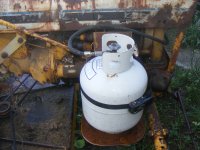
The freeze up problem I have is the 20 pound tank . On a humid day in the shade mowing the tank will get a 1/8 inch of frost and start loosing power until I go out into the sun ,then it melts and all is good again. It is a Toro GM72 , with the Renault 4 cylinder engine 839 cc . I have it set up on a vapor on demand regulator from a floor scrubber, pulling that much vapor is on the edge of what a 20 pounder can keep up with .
 
   / Natural gas conversion - where to feed the gas #32  
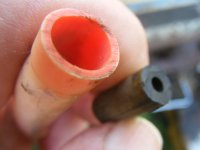
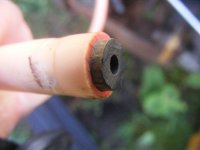
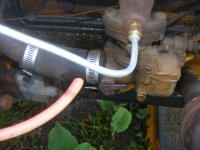
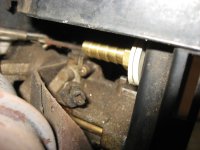
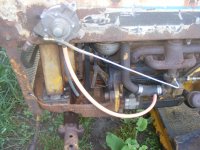
DSCF1308.JPG DSCF1309.JPG DSCF1313.JPG DSCF1312.JPG DSCF1311.JPG DSCF1310.JPG Pictures of the 1964 Cub Loboy converted to propane . You can see the homemade orifice I made from a piece of rubber hose and inserted into the vapor feed line, the full 3/8 red rubber line would not even try to start the engine, the next orifice I cut was to small and would only idle , then this one in the picture is perfect .As you can see I cut a round hole into the rubber connector from air cleaner and carb to wiggle the hose into tightly , Starts cold, carry's the mower and bounce of the governor. These tractors are known for being low power and mine is no exception but this did not seem to effect it when mowing, might of improved it. I will mention the small brake line tube ,this is a safety device built into the regulator that knows when the engine quits because the lack of vacuum and shut off the propane.
 
   / Natural gas conversion - where to feed the gas
  • Thread Starter
#33  
Pictures of the 1964 Cub Loboy converted to propane . You can see the homemade orifice I made from a piece of rubber hose and inserted into the vapor feed line, the full 3/8 red rubber line would not even try to start the engine, the next orifice I cut was to small and would only idle , then this one in the picture is perfect .........
I'm curious why you didn't use an adjustable valve, like a ball valve, to get the right flow? The commercial conversion kits have what they call a load block that is just a flow restrictor, right at the regulator. 3/8 NPT X 3/8 Hose Load Block Power Valve Generator Engine Propane Natural Gas: Amazon.com: Industrial & Scientific
 
   / Natural gas conversion - where to feed the gas #34  
I should order some for the next project, but I get excited and can not wait and once I make a orifice I do not need one . the smaller the engine the more critical the adjustment is . I will probably order a box full from China on aliexpress.com.
 
   / Natural gas conversion - where to feed the gas
  • Thread Starter
#35  
I should order some for the next project, but I get excited and can not wait and once I make a orifice I do not need one . the smaller the engine the more critical the adjustment is . I will probably order a box full from China on aliexpress.com.
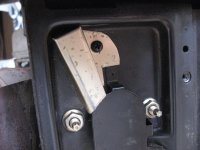
I made my own by threading a 5/8" fine bolt into a 3/8" NPT Tee fitting.
 
   / Natural gas conversion - where to feed the gas
  • Thread Starter
#36  
OP here. I finished this project and thought I'd post a few photos and comments for anyone interested now or in the future. I mounted the Garretson regulator to the generator frame and made an adjustment valve out of a 3/8" NPT Tee fitting and 5/8 fine (18 TPI) bolt. This allows you to fine tune the gas mixture. With this set up I could use low pressure natural gas or propane. I have added a quick disconnect to my gas meter that feeds a 12 foot hose to the generator.

My initial attempt to feed the gas into the throat of the carburetor did not work properly. I needed more cranking vacuum and vacuum variability so I drilled and tapped the side of the carburetor right at the venturi (narrowest) point. This gives enough cranking vacuum to open the regulator and allow gas to flow and also enough vacuum "signal" to allow the regulator to open more under loaded conditions. There is an additional adjustment on the regulator to dial in the gas feed under load.

The generator still works as before on gasoline as I did not damage the carburetor when I drilled it (watch for the low speed jet passages). I've seen a number of YouTube videos where engines are converted, but they don't show them operating under load. The key to doing it right, IMHO, is to load the engine down and adjust both the regulator and the mixture valve to ensure it has the right mixture under no load and high load conditions.
 

Attachments

  • IMG_6372.JPG
    IMG_6372.JPG
    2.9 MB · Views: 274
  • IMG_6373.JPG
    IMG_6373.JPG
    3.4 MB · Views: 262
  • IMG_6374.JPG
    IMG_6374.JPG
    3 MB · Views: 249
  • IMG_6375.JPG
    IMG_6375.JPG
    1.9 MB · Views: 264
   / Natural gas conversion - where to feed the gas #37  
Thanks for the great writeup and very interesting conversion. Lots of ingenuity and creativity.
 
   / Natural gas conversion - where to feed the gas
  • Thread Starter
#38  
Follow up. I recently replaced my breaker box and added a generator interlock so I can plug the generator right into the whole house. We had a power outage and I hooked up the natural gas line, plugged in the generator and we were off to the races. Ran my well pump and everything in the house except AC and range. The regulator does adjust automatically depending on the load on the generator. It is really nice not to have to worry about stale or insufficient gasoline.
 
   / Natural gas conversion - where to feed the gas #39  
It was nice to hear that it was a success . It is nice to not have to clean a carb by flashlight or siphon gas from tractors and mowers because of poor planning when you are surprised with a outage .
 

Marketplace Items

2019 CATERPILLAR 326FL EXCAVATOR (A60429)
2019 CATERPILLAR...
UNUSED FUTURE REMOTE CONTROLLED TOY (A60430)
UNUSED FUTURE...
2017 FORD F-550 SERVICE TRUCK (A58214)
2017 FORD F-550...
2009 Bruton T/A Enclosed Livestock Trailer (A55973)
2009 Bruton T/A...
208735 (A60430)
208735 (A60430)
(INOP) 2007 VOLVO A35D OFF ROAD DUMP TRUCK (A60429)
(INOP) 2007 VOLVO...
 
Top