New Home Begins

/ New Home Begins #182  
It is difficult, if not impossible, to achieve a minimum of 95% compaction with a smooth drum roller on soil in 8" lifts. If they have a sheeps foor drum that is different but an 8" lift is still difficult and usually ends up as a 12" lift. I would pay for a geotechnical firm to take some soil density tests. I know I will get the poo, poo but this is my expertise and you will experience future settlement if adequate density is not achieved. Maybe 10% of contractors actually understand what compacting soils mean because they have had to do it on Federal, State, or Local projects where it was required and tested. The rest have zero clue.
 
/ New Home Begins #183  
Thanks for the pics and documenting the wall process. Sure helps for those of us not familiar with that building technique.
 
/ New Home Begins #184  
I know you have a ton of stuff going on with the build, so thanks a lot for posting the pictures and describing the process.

It is interesting to follow a technique that one is not familiar with. Good luck with the build!
 
/ New Home Begins
  • Thread Starter
#185  
It is difficult, if not impossible, to achieve a minimum of 95% compaction with a smooth drum roller on soil in 8" lifts. If they have a sheeps foor drum that is different but an 8" lift is still difficult and usually ends up as a 12" lift. I would pay for a geotechnical firm to take some soil density tests. I know I will get the poo, poo but this is my expertise and you will experience future settlement if adequate density is not achieved. Maybe 10% of contractors actually understand what compacting soils mean because they have had to do it on Federal, State, or Local projects where it was required and tested. The rest have zero clue.

I do not know the science of smooth vs sheeps foot compaction but I have to go by the people doing the work.

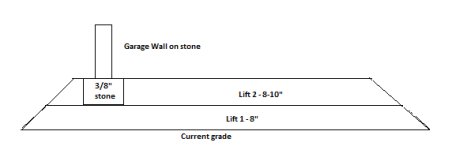
Only a single 8" lift was necessary to get to the required height of the stone footing. Going higher simply allowed the excavator to dig out the trench to put the stone in. Although superior walls and the architect only required a minimum of 6" of 3/8" stone above the single 8" lift, we have a 10" stone base. The garage walls are only about 200# per linear foot and the loads on that will be pretty minimal ... walls, trusses, sheathing, shingles for the garage.

Here is a rough drawing of the garage buildup.

garage footing - lifts.png

The excavator has been in business 30+ years and has the utmost reputation and experience.
 
/ New Home Begins #186  
I do not know the science of smooth vs sheeps foot compaction but I have to go by the people doing the work.

Only a single 8" lift was necessary to get to the required height of the stone footing. Going higher simply allowed the excavator to dig out the trench to put the stone in. Although superior walls and the architect only required a minimum of 6" of 3/8" stone above the single 8" lift, we have a 10" stone base. The garage walls are only about 200# per linear foot and the loads on that will be pretty minimal ... walls, trusses, sheathing, shingles for the garage.

Here is a rough drawing of the garage buildup.

View attachment 291958

The excavator has been in business 30+ years and has the utmost reputation and experience.

If it was just the stone footing the roller would be fine. I thought they bagan filling and compacting the surrounding grade. A smooth drum roller on rock is the right compaction equipment. I must had read things wrong...sorry. I love the idea of precast basement walls.
 
/ New Home Begins
  • Thread Starter
#187  
If it was just the stone footing the roller would be fine. I thought they bagan filling and compacting the surrounding grade. A smooth drum roller on rock is the right compaction equipment. I must had read things wrong...sorry. I love the idea of precast basement walls.

You did not misunderstand. They used a flat roller for a single 8" lift for the entire garage area. This is the level that the gravel would begin. They brought in a second lift and repeated with the roller. They then dug out the trench for the gravel to go in. The depth of the trench brought it down to the height of the first lift. This was filled with gravel and re-compacted.

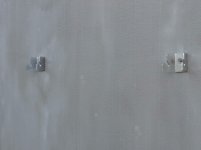
Anything else above this will be done with a small roller (I will inquire about a sheep's foot roller) and jumping jack. Rebar will be attached to the brackets on the back wall (see photo below) and bent out. This gives more rebar embedded in the slab to keep it from sinking.

P1020131.jpg
 
/ New Home Begins #188  
Anything can achieve compaction given the proper useage, correct procedure, and optimum moisture levels. A wacker packer (jumping jack) or smooth drum rollar is good for a maximum of 4" loose lift height. Wheel compaction below a bobcat maybe 6" maximum loose lift. A large payloader or sheepsfoot roller with a loaded bucket maybe 12" lifts of loose fill height. A fully loaded scraper 2' loose lift height. Nothing will compact dirt in greater than 2' lifts (dynamic packing by dropping large weight a great distance is an exception).
 
/ New Home Begins #189  
Anything can achieve compaction given the proper useage, correct procedure, and optimum moisture levels. A wacker packer (jumping jack) or smooth drum rollar is good for a maximum of 4" loose lift height. Wheel compaction below a bobcat maybe 6" maximum loose lift. A large payloader or sheepsfoot roller with a loaded bucket maybe 12" lifts of loose fill height. A fully loaded scraper 2' loose lift height. Nothing will compact dirt in greater than 2' lifts (dynamic packing by dropping large weight a great distance is an exception).

Very good information! If I'm not mistaken another couple of feet needs to be added to get at pad level. I would be watching closely and as sdkubota mentioned, moisture levels play an important part as well.
 
/ New Home Begins #190  
I would pay for a geotechnical firm to take some soil density tests. I know I will get the poo, poo but this is my expertise and you will experience future settlement if adequate density is not achieved.

I think this is a good idea considering how much the OP has to raise the level of the garage slab. Better to spend a few bucks now and correct it if need be then blow it off and have the hideous expense of replacing a garage slab later.

This gives more rebar embedded in the slab to keep it from sinking.

View attachment 291983

Are you saying the garage slab will be tied to the foundation walls? Does your soil conditions permit that? Did the structural engineer say that is OK to do? The reason I ask is that if that were done here with our expansive (hot) soils; you would more than likely end up with major damage down the road. Yesterday my wife and I toured a neighbor's house built by the same clown who built our place. Their problems make ours look minor. Besides shoddy workmanship by the builder, our hot soils finished wrecking their house. From what I saw of it, at a bare minimum the finished basement has to be gutted and the concrete floor blown out and redone; but based on additional damage caused to the main floor and exterior by the heaving soils it would be better to scrape the house off and start over. Be careful tying slabs to the foundation is my only advice, especially since you have such a high water table.
 
/ New Home Begins
  • Thread Starter
#191  
I think this is a good idea considering how much the OP has to raise the level of the garage slab. Better to spend a few bucks now and correct it if need be then blow it off and have the hideous expense of replacing a garage slab later.

Are you saying the garage slab will be tied to the foundation walls? Does your soil conditions permit that? Did the structural engineer say that is OK to do? The reason I ask is that if that were done here with our expansive (hot) soils; you would more than likely end up with major damage down the road. Yesterday my wife and I toured a neighbor's house built by the same clown who built our place. Their problems make ours look minor. Besides shoddy workmanship by the builder, our hot soils finished wrecking their house. From what I saw of it, at a bare minimum the finished basement has to be gutted and the concrete floor blown out and redone; but based on additional damage caused to the main floor and exterior by the heaving soils it would be better to scrape the house off and start over. Be careful tying slabs to the foundation is my only advice, especially since you have such a high water table.

As I said, the soil was unknown when the house was designed. But all is good with the soil when they started digging. The slab will be tied to the basement walls which sit on a traditional footing
 
/ New Home Begins #192  
The proceeding post brings up some good points. Where there is freeze/thaw cycles never tie a slab to a foundation. Reason being as soil freezes and thaws it can move as much as 3" or more. If you tie the slab to the foundation the concrete will break as the soil freezes and expands. The same can happen to a lesser degree by small settlements. If the slab was ties would create hollow conditions under the slab causing eventual failure. I alkways specify the slab remain floating next to any type of foundation and have a 5/8" expansion board placed between sections to ensure seperation and allow for expansion.
 
/ New Home Begins #193  
As it happens, across the road from my property a guy is building in fits and starts. Last summer (2011) he leveled off a built-up pad to build on. This October he put in a footer and frost wall foundation, then had that filled with sand. Don't know how much compacting was done other than driving on it a lot with a skidsteer. Then they poured a slab inside the frost wall, flush with the top of wall. Since then, they have done nothing, which surprised me since local custom is to not leave a slab exposed over the winter. People usually at least put a closed-in shell over them if nothing else.

Out of curiosity I checked it today. The slab is almost 1/4" above the top of the frostwall now that we have had some ground frost penetrating. It can't be good for the waste lines that are under and coming up through the slab with no sleeves of any kind. They will probably survive 1/4", but 1" or more is possible by Spring. I couldn't see any cracks in the slab, but that could easily come later.

There is no expansion break between the frost wall and slab either, they just used the frost wall as a form to pour the slab in. At least, they back-filled around the frost wall to within about 6" of its top.
 
/ New Home Begins #194  
I have watched my patio rise up nearly 3" because of frost during severe winter temperatures.anything piercing the slab needs to be isolated from the movement. Expansive soils are a whole different nightmare.
 
/ New Home Begins #195  
I have watched my patio rise up nearly 3" because of frost during severe winter temperatures.anything piercing the slab needs to be isolated from the movement. Expansive soils are a whole different nightmare.

Yep, just for giggles I am going to see how high the slab goes. It's been relatively mild so far, but no snow cover yet which makes a lot of difference here in frost penetration depth.
 
/ New Home Begins #196  
Yep, just for giggles I am going to see how high the slab goes. It's been relatively mild so far, but no snow cover yet which makes a lot of difference here in frost penetration depth.

We can have frost reach depths between 4 and 5 feet during cold winters with little snow. This year it is bone dry so there will be less frost.
 
/ New Home Begins
  • Thread Starter
#197  
These talks about frost heave for slabs will make me double check with the architect and structural engineer. Thanks for the feedback.
 
/ New Home Begins #198  
We can have frost reach depths between 4 and 5 feet during cold winters with little snow. This year it is bone dry so there will be less frost.

I was told, the drier the soil, the deeper the frost line will be, is this correct? And would there be less near the surface as you said?

Dave
 
/ New Home Begins #199  
I was told, the drier the soil, the deeper the frost line will be, is this correct? And would there be less near the surface as you said?

Dave

Not really, totally dry soil will not freeze. I suppose wherever the cold finds moisture will be the first place to form ice. Problem is the lower the depth the warmer the soil. It would by my opinion that there is less frost during dry soil conditions. I have been wrong before....well I thought I was wrong but actually was right. :)
 
/ New Home Begins #200  
I have always heard frost follows the moisture down, so wet soil = deeper frost. Deep (18" +) snow cover = less frost depth.

Tom, I don't think you have any worries about slab heaving since yours will be covered in a relatively short time and your location has much higher average temps than here. But, it never hurts to ask. I don't think they put any insulation under the slab across the road either. It's down a ways from our house, so I can't be too nosy :laughing:

It really wasn't intended as something you should worry about, we were talking slabs and the neighbor created a test case to observe.
 

Marketplace Items

2014 TIELKE TRAILER 20 FLOAT UTILITY GOOSENECK TRAILER (A58214)
2014 TIELKE...
12' CONTAINER (A60432)
UNUSED RAYTREE RMDB82-DIGGER HYD BACKHOE (A60432)
UNUSED RAYTREE...
FUTURE 6' CLIP-ON FORK EXTENSIONS (A60432)
FUTURE 6' CLIP-ON...
John Deere 855DXUV Gator (A57148)
John Deere 855DXUV...
500 BBL FRAC TANK (A58214)
500 BBL FRAC TANK...
 
Top