
Well, I meant as the grounding conductor back to the panel? Wouldn't it make more sense instead of running three wires through emt? Isn't that allowed with nec? I'm just curious and want to learn. My pole barn up north was Inspected and passed 8 yrs ago using emt As the grounding conductor. I might change it up and run a third dedicated ground if it's not safe. As I said I'm not a licensed or certified electrician however I have worked with a few that were and a lot more knowledgeable than me.
You are using an out of date browser. It may not display this or other websites correctly.
You should upgrade or use an alternative browser.
You should upgrade or use an alternative browser.
New Metal shop
- Thread starter woody
- Start date
- Views: 11021
More options
Who Replied?
/ New Metal shop
#21

DaBear3428
Platinum Member
it can be nec compliant but not a good idea, it was done for a long time but we in the industry noted that after the buildings had aged the conduit connections had become lose and or corroded leading to lack of continuity for the grounds. this is also subject to be found by some unsuspecting person that touches the equipment and becomes energized. In a metal shop building that may be a wet environment, saving a few cents for the cost of a copper wire may cost the life of someone. to me not worth the chance.Well, I meant as the grounding conductor back to the panel? Wouldn't it make more sense instead of running three wires through emt? Isn't that allowed with nec? I'm just curious and want to learn. My pole barn up north was Inspected and passed 8 yrs ago using emt As the grounding conductor. I might change it up and run a third dedicated ground if it's not safe. As I said I'm not a licensed or certified electrician however I have worked with a few that were and a lot more knowledgeable than me.
The NEC 250.118.(4) 2017 edition identifies EMT electrical metallic tubing as an acceptable equipment grounding conductor as long as you are using UL listed fittings and proper methods, so yes it is legal but my professional experience from older professional installed electrical distribution systems points out that there are a lot of issues that can come together as the building ages even when installed by an experienced professional. there is much less room for error with that system that a solid cheap conductor avoids.
in short run a conductor and using proper technique is not fool proof but it is idiot resistant.
I'm not trying to be the TBN electrical hall monitor, just passing on some experience.
Last edited:

EddieWalker
Epic Contributor
On a side note, I have a client with a house that used her Natural Gas pipe to ground her electrical panel. When lightning hit a tree in her back yard, the electricity went down the tree, to the Black Iron Pipe in the ground, then into her house and then her panel, where it melted everything in her panel and fried just about everything electrical in her house.
I don't know if she could of avoided this if she had a proper ground rod instead of using the pipe, but this is the only house that I've ever seen lightning do this.
For me, it's pretty easy to run a ground wire inside conduit and pound in one or two ground rods. For my electric fence, I put in 3 ground rods, but that's totally different then grounding a house.
I don't know if she could of avoided this if she had a proper ground rod instead of using the pipe, but this is the only house that I've ever seen lightning do this.
For me, it's pretty easy to run a ground wire inside conduit and pound in one or two ground rods. For my electric fence, I put in 3 ground rods, but that's totally different then grounding a house.
DaBear3428
Platinum Member
per the NEC (from 2017 NEC handbook) it should have been the metal pipe AND several other things including a ground rodOn a side note, I have a client with a house that used her Natural Gas pipe to ground her electrical panel. When lightning hit a tree in her back yard, the electricity went down the tree, to the Black Iron Pipe in the ground, then into her house and then her panel, where it melted everything in her panel and fried just about everything electrical in her house.
I don't know if she could of avoided this if she had a proper ground rod instead of using the pipe, but this is the only house that I've ever seen lightning do this.
For me, it's pretty easy to run a ground wire inside conduit and pound in one or two ground rods. For my electric fence, I put in 3 ground rods, but that's totally different then grounding a house.
i was involved as an expert witness in a case where a Home automation contractor installed a lot of home av equipment and automation equipment along with surge suppressors (think 100 of 1000s of $s) only to have lightning strike the exterior of the home which was stucco clad with the metal lath on the exterior, the lath was grounded to the grounding system but the system was not effectively grounded (older home remodel) so the lightning strike bypassed the surge suppressors (lots of $s worth) and fried the entire home automation system. all that damage just to avoid installing some grounding jumpers and proper ground rods. the home owner canceled the law suit after we pointed out the flaw.
Grounding is viewed as simple but is in fact one of the most complicated parts of my job. one of the purposes of a grounding and bonding system is to direct unwanted electrical currents to a safe destination and to keep the building or personnel from becoming the path of least resistance. funny how the human body and buildings are alike in that they hate stray currents.
Last edited:
EddieWalker
Epic Contributor
The client is an elderly widow in her 70's that bought the house because it was cute. It's a 1930's Tudor that is falling apart, but still cute looking. I've been repair issues as they happen, but she can't afford to fix everything. And to be honest, she puts more money into closets for all her clothes then she does for wood rot.
After the lightning strike, I called an Electrician that I trust, and I had him look over the house. He replaced her panel, and did something to protect the house from lighting in the future. I didn't follow up on any of that, she dealt with the Electrician once I introduced them.
After the lightning strike, I called an Electrician that I trust, and I had him look over the house. He replaced her panel, and did something to protect the house from lighting in the future. I didn't follow up on any of that, she dealt with the Electrician once I introduced them.
OP

woody
Veteran Member
- Joined
- Sep 20, 2010
- Messages
- 1,173
- Location
- Central Alabama
- Tractor
- Kubota B26, Kubota ZG222, Kubota L45, 1980 Ford 1700
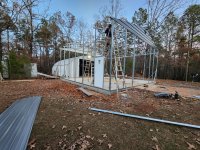
It's coming on and looking good. I do have some electrical experience and that maybe why I enjoy a good electrical discussion because I continue to learn and sometimes it just reminds me of things I have forgotten. I have a ground rod at the building now but I plan on installing another

dieselcrawler
Elite Member
Nice to see you are getting a new garage/shop. Have to admit, I'm a bit jealous, I need one of my own, as the farm we moved to recently doesn't have a good space for vehicle repair and such, away from the barn animals.
I have a few comments on the electrical aspect, been in the trade for 25+ years. I can't quote NEC chapter and verse, but may look it up if needed. These are simply my thoughts and general practices, not 'hard and fast' rules, all subject to applicable NEC guidelines. And you may be in an area, as I am, where there is no inspection or authority having jurisdiction, and anything goes. Proceed with common sense!
PVC conduit inside... rule of thumb here has been to not do it. PVC when burnt puts off toxic fumes, so I've always avoided using it in homes, basements, structures inhabited by humans. Perhaps, in a garage situation, it may be acceptable, but I dont know for sure. Personally, I would use EMT and/or MC cable inside your garage, but no closer to the floor than 24". In a true mechanic shop, where gas fumes may be present, which settle to the floor, up to 24" can actually be considered a hazardous area, and requires explosion proof conduit and fittings.
Please take the time to run the actual ground wire in the EMT conduit. Required or not, it is your safety net, and you want that in top condition. All it takes is one loose fitting at a rusty box to open the ground continuity. I would also make sure you have GFI protection on all 120v outlets.
Grounding grounding grounding... I would put ground rods in for your new building, even if you're not putin in a full-blown electrical service (breaker panel, etc) and be sure the ground from the power supply and new ground rods/wire are bonded properly. And, always be sure to not tie grounds and neutral wires together anywhere past the power source where the main breaker is (AKA the 'service entrance equipment')
I may be repeating what others a have said, or you already know, but once I get on a train of thought, it all just comes out.
Enjoy your new building... I'm sure it will be nice to have the extra space.
I have a few comments on the electrical aspect, been in the trade for 25+ years. I can't quote NEC chapter and verse, but may look it up if needed. These are simply my thoughts and general practices, not 'hard and fast' rules, all subject to applicable NEC guidelines. And you may be in an area, as I am, where there is no inspection or authority having jurisdiction, and anything goes. Proceed with common sense!
PVC conduit inside... rule of thumb here has been to not do it. PVC when burnt puts off toxic fumes, so I've always avoided using it in homes, basements, structures inhabited by humans. Perhaps, in a garage situation, it may be acceptable, but I dont know for sure. Personally, I would use EMT and/or MC cable inside your garage, but no closer to the floor than 24". In a true mechanic shop, where gas fumes may be present, which settle to the floor, up to 24" can actually be considered a hazardous area, and requires explosion proof conduit and fittings.
Please take the time to run the actual ground wire in the EMT conduit. Required or not, it is your safety net, and you want that in top condition. All it takes is one loose fitting at a rusty box to open the ground continuity. I would also make sure you have GFI protection on all 120v outlets.
Grounding grounding grounding... I would put ground rods in for your new building, even if you're not putin in a full-blown electrical service (breaker panel, etc) and be sure the ground from the power supply and new ground rods/wire are bonded properly. And, always be sure to not tie grounds and neutral wires together anywhere past the power source where the main breaker is (AKA the 'service entrance equipment')
I may be repeating what others a have said, or you already know, but once I get on a train of thought, it all just comes out.
Enjoy your new building... I'm sure it will be nice to have the extra space.
DaBear3428
Platinum Member
Good points and I agree with all you have said, the point about GFI outlets is infact code for most areas in a shop as we are discussing as it is more like a home garage. It is highly likely that someone some time is going to decide to plug into one of those outlets and run a cord outside to power something.Nice to see you are getting a new garage/shop. Have to admit, I'm a bit jealous, I need one of my own, as the farm we moved to recently doesn't have a good space for vehicle repair and such, away from the barn animals.
I have a few comments on the electrical aspect, been in the trade for 25+ years. I can't quote NEC chapter and verse, but may look it up if needed. These are simply my thoughts and general practices, not 'hard and fast' rules, all subject to applicable NEC guidelines. And you may be in an area, as I am, where there is no inspection or authority having jurisdiction, and anything goes. Proceed with common sense!
PVC conduit inside... rule of thumb here has been to not do it. PVC when burnt puts off toxic fumes, so I've always avoided using it in homes, basements, structures inhabited by humans. Perhaps, in a garage situation, it may be acceptable, but I dont know for sure. Personally, I would use EMT and/or MC cable inside your garage, but no closer to the floor than 24". In a true mechanic shop, where gas fumes may be present, which settle to the floor, up to 24" can actually be considered a hazardous area, and requires explosion proof conduit and fittings.
Please take the time to run the actual ground wire in the EMT conduit. Required or not, it is your safety net, and you want that in top condition. All it takes is one loose fitting at a rusty box to open the ground continuity. I would also make sure you have GFI protection on all 120v outlets.
Grounding grounding grounding... I would put ground rods in for your new building, even if you're not putin in a full-blown electrical service (breaker panel, etc) and be sure the ground from the power supply and new ground rods/wire are bonded properly. And, always be sure to not tie grounds and neutral wires together anywhere past the power source where the main breaker is (AKA the 'service entrance equipment')
I may be repeating what others a have said, or you already know, but once I get on a train of thought, it all just comes out.
Enjoy your new building... I'm sure it will be nice to have the extra space.
Last edited:
DaBear3428
Platinum Member
Nice! Be sure and bond that building frame to the ground systemView attachment 771082
It's coming on and looking good. I do have some electrical experience and that maybe why I enjoy a good electrical discussion because I continue to learn and sometimes it just reminds me of things I have forgotten. I have a ground rod at the building now but I plan on installing another
DaBear3428
Platinum Member
I had a project where the electrical contractor was installing parking lot lighting poles near a overhead 69kV transmission line they were just outside the required safety clearance. I get a call that something was wrong because the electricians were getting shocked while in the lift everytime they touched the pole. Instead of arguing with them I went out to the site and asked for a safety ground strap to be applied between the lift Frame and the ground point on the pole. Magicaly the issue disappeared, the electrical Forman is looking at me with a question on his face so I tell him that it wasn't the light pole that was charged it was his lift picking up inductive currents from the transmission lines.
Point being you never know where or what may become charged and a few dollars worth of copper and some fittings may save your life.
Point being you never know where or what may become charged and a few dollars worth of copper and some fittings may save your life.
OP
woody
Veteran Member
- Joined
- Sep 20, 2010
- Messages
- 1,173
- Location
- Central Alabama
- Tractor
- Kubota B26, Kubota ZG222, Kubota L45, 1980 Ford 1700
Thank y'all for your replies, I had thought about putting in a GFI breaker in but I had not really decided yet. when I wired my other shop 20 years ago I did not install any GFI's until later when I installed a RV box for my Dad to use when he came to visit and it has a 50A, 30A and a 120 volt GFI so that makes all my 120 outlets that are outside of shop or house GFI protected and I use the one at the shop most of the time when power is needed outside. I am going to finish the rear wall that goes over the old shop and install the front door from my old shop before I start the wiring process. physically anyway mentally I have been wiring this building since the day I decided I wanted it. I got up at 5AM and told my wife I was going to see how the lights look in the shop I worked on them all night while trying to sleep.
PS: no the GFI's at the shop and house are not connected was just saying all outside 120 plugs are GFI.
PS: no the GFI's at the shop and house are not connected was just saying all outside 120 plugs are GFI.

plowhog
Elite Member
- Joined
- Dec 8, 2015
- Messages
- 4,055
- Location
- North. NV, North. CA
- Tractor
- Massey 1710 / 1758, Ventrac 4500Y / TD9
Another consideration of using a ground wire instead of using the EMT for grounding is the amount of movement in a metal building. They creak and move as they heat up and cool down, plus wind can bend the structure back and forth.
I hired an engineer to be involved when I built a metal building shop. One of the first things he did is advise me to pay for extra stiffening of the building. I believed it was the "deflection" factor or something like that. The metal bldg manufacturer knew exactly what I was asking, and yes, they did have the option to ship me a stiffer built building ($$).
I was surprised that the standard metal building spec allowed for a certain amount of movement in wind. It was something like 1" either way at a corner. The stiffening I purchased cut that in half.
Anyway, my point is ... if concern about using EMT for grounding is that a rusty box or loose fitting could compromise the ground ... I believe building movement could contribute to that.
PS Congratulations on the new building!!!
I hired an engineer to be involved when I built a metal building shop. One of the first things he did is advise me to pay for extra stiffening of the building. I believed it was the "deflection" factor or something like that. The metal bldg manufacturer knew exactly what I was asking, and yes, they did have the option to ship me a stiffer built building ($$).
I was surprised that the standard metal building spec allowed for a certain amount of movement in wind. It was something like 1" either way at a corner. The stiffening I purchased cut that in half.
Anyway, my point is ... if concern about using EMT for grounding is that a rusty box or loose fitting could compromise the ground ... I believe building movement could contribute to that.
PS Congratulations on the new building!!!
OP
woody
Veteran Member
- Joined
- Sep 20, 2010
- Messages
- 1,173
- Location
- Central Alabama
- Tractor
- Kubota B26, Kubota ZG222, Kubota L45, 1980 Ford 1700
Good point, I plan on running a ground wire from the panel and grounded the building also.
OP
woody
Veteran Member
- Joined
- Sep 20, 2010
- Messages
- 1,173
- Location
- Central Alabama
- Tractor
- Kubota B26, Kubota ZG222, Kubota L45, 1980 Ford 1700
Yes the new building over laps the Quonset hut about 6 inches so when I finish the new building it will be all closed in, metal to metal and electrical
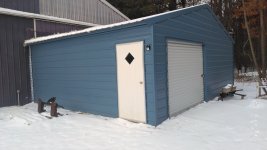
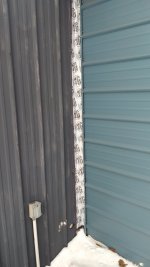
OP
woody
Veteran Member
- Joined
- Sep 20, 2010
- Messages
- 1,173
- Location
- Central Alabama
- Tractor
- Kubota B26, Kubota ZG222, Kubota L45, 1980 Ford 1700
That is what I was trying to avoid when I decided to over lap the buildings, the new metal should land just behind the first ridge on the old building
Unfortunately in my case in order to save a few bucks my steel sheets on addition run horizontal, the gable/ wall of existing barn run traditional/ vertical. I at least planned and researched, enough the peak of roof has a three pitch und tucked/ fit underneath the awning of the old sliding door.That is what I was trying to avoid when I decided to over lap the buildings, the new metal should land just behind the first ridge on the old building
OP
woody
Veteran Member
- Joined
- Sep 20, 2010
- Messages
- 1,173
- Location
- Central Alabama
- Tractor
- Kubota B26, Kubota ZG222, Kubota L45, 1980 Ford 1700
Your temporary solution is like mine, I tend to leave it as long as it works
DaBear3428
Platinum Member
GFIs are a good idea in most cases, depending on the location of your panel sometimes it is better to install gfi outlets, you just need the first one in the run to be GFI and use the down stream protection feature to protect the rest. GFi receptacles are cheaper and more convenient to reset instead of going back to the panel when they trip (depending on your shop layout).Thank y'all for your replies, I had thought about putting in a GFI breaker in but I had not really decided yet. when I wired my other shop 20 years ago I did not install any GFI's until later when I installed a RV box for my Dad to use when he came to visit and it has a 50A, 30A and a 120 volt GFI so that makes all my 120 outlets that are outside of shop or house GFI protected and I use the one at the shop most of the time when power is needed outside. I am going to finish the rear wall that goes over the old shop and install the front door from my old shop before I start the wiring process. physically anyway mentally I have been wiring this building since the day I decided I wanted it. I got up at 5AM and told my wife I was going to see how the lights look in the shop I worked on them all night while trying to sleep.
PS: no the GFI's at the shop and house are not connected was just saying all outside 120 plugs are GFI.


