nitrogen on corn

   / nitrogen on corn #1  

Kodiak45

Gold Member
Joined
Feb 11, 2013
Messages
328
Location
SC
Tractor
long 2460 - belarus 250 - JD 4230 - Kioti DK40SE
Is it possible the 20-0-0 pasture fertilizer from asc to spray my field corn and sweet corn in a backpack sprayer?
if so, any tips or warnings?
other recommendations?
what if i don't add any nitrogen, due to the cost?
 
   / nitrogen on corn #2  
Most liquid fertilizers are knifed in to get it below ground ASAP. But if this is just a food plot, you could give it a try. Do it with the ground moist or just before a rain would be best so it is incorporated. If the liquid is too expensive or too hard to transport, you could use urea (46-0-0) granulated. Again, broadcast it just before a rain if possible so it does not volatize as quickly. If this corn is for production, it really helps the plant if it has the proper nutrients. Hopefully you did a soil test prior to planting so you know what is recommended for your fields. No sense spending good money on seed if you won't be adding fertilizer if you are hoping for a decent crop.
 
   / nitrogen on corn #3  
Without a soil test , I'd at least put out something like a granular 13-13-13, or 32-10-5, something like that. Your feed/fertilizer store should know what "generally" works in your area. As FF said, hard to know for sure without a $20 soil test. Corn is a nutrient hog, so it likes fertilizer and plenty of water. Indians planted it with a dead fish, so they knew it grew best with some form of added nutrients. (What I have read anyhoo)
 
   / nitrogen on corn #4  
What ? You do not put the N on the plant , you put in the soil .
 
   / nitrogen on corn
  • Thread Starter
#5  
the soil test recommended 2 tons of lime per acre, but its a little late for that, so I will just do what I can and see what happens. Im definitely not trying to grow for $, just for the simple enjoyment of watching it grow and to feed my deer. I just don't know if it is worth the time and money to try and fertilize and how much of a difference it will make. I broadcast about 1/2 an acre a few years ago and did nothing to it and it produced, how much, I wouldnt know any difference between good and bad.
Soil test said I need 100/20/30 of NPK. This would cost a few hundred, not to mention how I would actually apply it as I don't have a side dresser.
Is it worth it since I need so much lime?
I want to do what I realistically can, but spending a few hundred bucks on fertilizer without knowing if I will see any sizeable gains is the question.
Seed only cost me $40 andI enjoy the tractor time discing and prepping and using the planter, so I don't factor that in the equation.
Ive planted a few acres of sunflowers every year without lime or fertilizer in the same field and they all produce along with some wheat, I just cant see getting that much more benefit out of fertilizer and the added expense.. getting off the main topic, which is corn, but still..
thoughts?
 
   / nitrogen on corn #6  
A little late for this idea also, but you can plant a legume with your corn and that will help a little with the nitrogen. I fertilize my plots always, yes you can see a difference and I believe deer can tell "good" food over just field corn. But it is just corn, and really not that nutritious for deer anyway, but they like it! . You might put out 200-300# on one acre and see for yourself.

BTW I hardly ever plant corn for deer, to easy to buy it for a feeder, but I do plant Oats wheat, clay/field peas and so on.
 
   / nitrogen on corn #7  
Seriously...fertilizer applied banded or otherwise will make a big difference for most any crop. Liming for correct ph will enhance nutrient uptake. Lime takes more time to work. You can always apply half in the fall and the rest next spring plus incoporate part of the total fertilizer before planting.

How much corn have you planted. How tall is it now? Are you cultivating rows? Why cant you just broadcast some before a good rain?
 
   / nitrogen on corn
  • Thread Starter
#8  
I planted about an acre. It is about 12" in most places(planted when it was finally dry enough). I haven't cultivated yet. I can broadcast some 46-0-0 before the next rain and see what happens.
 
   / nitrogen on corn #9  
Looks like your P and K are in pretty good shape. 2 tons/acre of lime really is not much, more for maintenance of what the crop takes up. Yea, if you are just growing for animals, urea (46-0-0) or any dry fertilizer would be easier to apply than liquid. Very basically, nitrogen (N) helps the plant with photosynthesis production to grow the plant strong and tall. Phosphorus (P) helps in fruit and flower production and Potassium (K) helps getting a good root structure to stabilize the plant and help it absorb nutrients better. They do much more, but that is the very basics of the 3. Of course lime allows the soil to be more neutral so the soil nutrients are available to the plant. Too alkaline or too acid and the various nutrients stay attached to the soil particles. Again, very basic plant agronomics. Good luck with your project !!! Have fun !!
 
   / nitrogen on corn #10  
The 20-0-0 pasture fertilizer is not a cost effective source of N. 34-0-0 AN or urea will be alot more bang for the buck.
 
   / nitrogen on corn #11  
Sounds like all are good advice. Another thought came to mind - plant white/ladino clover next February and leave in this field for 2 or 3 years both for deer and nitrogen fixing. That is assuming you have other plots you could rotate for your other deer plantings.
 
   / nitrogen on corn #12  
Judging by your soil recommended lime requirements I'm guessing your ph is in the mid 5's or low 6's but your NPK recommendations are not too terrible. The biggest thing with ph off is it locks up your nutrients and has them bind to the soil instead of the plant being able to uptake them.

Depending on how tall your corn is if you want to add N would also recommend going with urea. two bags of 46-0-0 will put you at 96 lbs of N for your 1/2 ac. Once your corn is about 10" tall it's primary nutrient needed is N and it uses a lot of it. Like others have said, apply it before a heavy rain so it doesn't volatize in the atmosphere and you should be good to go.

I agree with you 100% corn is pricey to grow. I do some for food plotting also and it always stings buying the fertilizer. Planting legumes as long as it is innoculated with the correct rhizome can add up to a 100# of N in a season.
 
   / nitrogen on corn
  • Thread Starter
#13  
ok. so I'm going to open the wallet and buy some fertilizer today. I can get 46-0-0 or 33-0-0. Which one should i get if it doesn't look like its going to rain before i apply and see method of application below.
I was thinking about hand spreading down the rows and then cultivating the rows to some what work it in, or should i cultivate, spread down rows and then cultivate again. I don't think the cultivator with sweeps will actually get it that deep in the ground, but cultivating and then driving back over should get decently worked in the soil. Or i can just take the easy road and broadcast.
What do you think?
 
   / nitrogen on corn #14  
IMO, best would be to spread it at the base of the plants, then cultivate it in. More work, but more control. Either way you decide is better than nothing. If I had the choice, I'd go 46-0-0. you're getting 13 units more per acre. A large plot would make the application more to broadcasting methods, but for what your doing to prove a point with results you can see, spread by hand.

Be careful when cultivating corn to, the roots like to "get in the way" and you dont want to damage them. You probably know this, but wanted to throw it in.
 
   / nitrogen on corn #15  
I also would go with 46-0-0 urea instead of 34-0-0. Usually it is easier to find and cheaper on a basis of $ per unit of N. Urea readily dissipates with water (you can actually put 5# of in 5 gals of water agitate it and it will quickly dissolve). Farmers sometimes do this if they have liquid fertilizer injectors on there cultivators. Applying right before or during a good rain will give you the same results.

If no rain is in the forecast you can apply it and as long as you cover it with soil and you shouldn't loose too much N to the atmosphere. I can't remember the % N lost to atmosphere volatilization but I believe it is somewhere near 50% in the matter of just a few days without rain when broadcasted and not incorporated into the soil.

If it were me I would buy the stuff now and broadcast just before a good rain. If the rain doesn't produce a significant downfall than go ahead and cultivate it in the soil.
 
   / nitrogen on corn
  • Thread Starter
#16  
Well after a 7 hour day hand fertilizing the corn and a very sunburnt back I am sore. I used my earthway hand planter to spread the urea down each row and then I went back and cultivated it in the soil. I also spread some 14-14-14 with the broadcast spreader. I planted some late corn the other week and I might leave a few rows of it unfertilized to compare with another fertilized section.
Just a few questions to you experts so I can gain some knowledge-
Fertilizer- I understand that nitrogen can float and move around in the soil, so broadcasting is ok without considering volatilization. What about P & K, is it effective to broadcast them or should they always be worked into the seed depth prior to planting, etc. I guess my question is revolved around me spreading the 14-14-14 after the plants are already up and growing. Thoughts?
How far can the nitrogen move in the soil? meaning- How close does it need to be to the row and does each row need to be fertilized or just every other row? How long is it good for after application?
Just trying to do it right since I have so much invested in my part time hobby.
 
   / nitrogen on corn #17  
The idea is to put the fertilizer where the plant roots can reach it so it can do the most good. Generally fertilizer is banded several inches out and down from the row at seeding. Any excess P & K not taken up by the plants will stay in the soil
 
   / nitrogen on corn #18  
The way I remember NPK on fertilizer is Up, Down and all around.
N works on the growing part of the plant above ground. With corn after it's about a foot tall it craves N.

Phosphorus (P) works for health of the roots. Tubes such as carrots, beets, potatoes, are high phosphorus users. A lot of soils usually low in P because of it has a tendency to leech. A soil with a good % organic matter and in cover crops will help hold the phosphorus in place when not in corn. As your cover crop decomposes it will go and reintroduce the P to your crop instead of leaching and getting into the watershed.

K (Potassium) Is for overall general health of the plant to prevent it from diseases and stress such as short term drought. Generally K can hold for several years and of the three I would consider the least critical.

As for application. Generally if you are running a planter with fert. hopper you wan't to go with a fert with low N. Usually something like 6-24-24 is used. I've used up to 19-19-19 but have to be careful on the application because too much N side dressed to young plant can burn and stunt their growth. Seedlings spend most of there energy going down initially so P (down) is most utilized at this stage. Once a foot tall or so it's N that they crave and the Urea 46-0-0 is applied with a cultivator and a side dresser. This is generally the way things are done with conventional corn since after cultivation and N application the corn will grow fast enough to shade out any weeds that might compete with your corn for the N.

An alternative is you can apply all the fertilizer and shallow till under prior to corn planting. For me I have had really good results spreading 50# Trip 19 and 50# 46-0-0 per 0.5 acre, cover with shallow dirt, wait about 10 days or weeds to emerge than spray with roundup and than plant my corn. Conventional corn can be used because it has zero residual effect on seeds and only kills actively growing plants. If you spray after the corn has sprouted than a Roundup Ready variety corn must be used.

I'm by no means an expert on corn or fertilizers but trying to share what I know and what has worked for me but everybody's situation/soil is different.

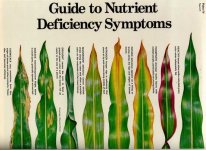
Here's a visual aid to be able to tell what corn is deficient in by looking at it's leaves.
12cpo07a3f1.jpg
 

Tractor & Equipment Auctions

500BBL WHEELED FRAC TANK (A58214)
500BBL WHEELED...
2012 GROVE TMS900E TRUCK CRANE (A58214)
2012 GROVE TMS900E...
2010 Honda CR-V SUV (A59231)
2010 Honda CR-V...
light tower (A56857)
2008 TRANSCRAFT 48X102 STEEL FLATBED (A58214)
2008 TRANSCRAFT...
10 Lug Wheels Full Set (A57453)
10 Lug Wheels Full...
 
Top