Not an ordinary creek crossing

   / Not an ordinary creek crossing #1  

StormVet

New member
Joined
Oct 8, 2010
Messages
14
Tractor
Long 460
I'm stumped about the best option to go with. Been reading several threads on creek crossing but none with my type of situation. I live on 65 beautiful acres. My homestead sits on 22 acres of it. 43 acres are on the back side of a creek with the name Bodan Creek. It's a major creek that feeds the neches river which is about. 5 miles from my house.
My wife and I inherited the place 28 years ago from her grandmother.
A little history on Bodan Creek. Several farmers have rented the place before we got it. So all they would do is bulldoze the crossing. It has a pretty good slope on one side but it's clay and very slick when wet. The other sorta sets in a bend. It keeps a steep slope because of how the water flows and is sandy mix and can stick a tractor if not careful. The banks on Bodan is roughly 12-15 ft deep depending on where you stand. It's about 20 ft wide at the crossing.
Thought about a ford but after the recent rains it's 3-4 ft deep now. I've had 4, 4x5 concrete coverts that the county gave me. They worked well but when the spring rains came they always washed out.
I use a Long 460 two wheel drive tractor. So a box blade is about it as far as dirt moving goes.
So.... What would you do?
 
   / Not an ordinary creek crossing #2  
Being really honest StormVet - your situation sounds like one where you might benefit from the review/advice of a highway engineer. Your situation does not sound like a small, little crossing. Its almost certain that you will need to secure some type(s) of permits for this venture, also. This would be particularly important if this crossing is going to be permanent and used year round. Pictures of this crossing site would surely result in much more specific recommendations. However, as I read your post - this is a fairly major crossing site.
 
   / Not an ordinary creek crossing #3  
You might be well off to buy a 40' flat bed trailer and put it across for a bridge. pour a foundation on each end and you are good to go.:2cents:
 
   / Not an ordinary creek crossing
  • Thread Starter
#5  
What size of foundation would it take for a trailer that size
 
   / Not an ordinary creek crossing #6  
What? No stories about the Bodan Creek spook light? Sounds like that's right in your area? :)
 
   / Not an ordinary creek crossing #7  
Foundations 3ft or deeper in the ground depending on where you are, inches thick with plenty rebar. Set the 40ft trailer on that, build the earth up to it and be done for the next 40 years.
 
   / Not an ordinary creek crossing #8  
Foundations 3ft or deeper in the ground depending on where you are, inches thick with plenty rebar. Set the 40ft trailer on that, build the earth up to it and be done for the next 40 years.

How much does it flood?

A mile and a half down the road (and down the creek), a guy put in some nice piers, a truck flatbed trailer, and built up the approaches. First good gully washer we had, washed out the approaches and shifted the trailer half off the piers. The second gully washer washed the deck downstream a couple of hundred feet and buried 90% of it. Just the one corner is visible.
 
   / Not an ordinary creek crossing #9  
I would set the trailer up a couple feet above the creek bank and fasten it to the footer.
 
   / Not an ordinary creek crossing #10  
First good gully washer we had, washed out the approaches and shifted the trailer half off the piers. The second gully washer washed the deck downstream a couple of hundred feet

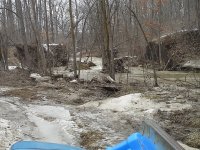
This is what your up against being so close to the point where the creek empties into the river. Didn't take this pic to demonstrate the ability of water to move massive objects, but you can make out some very large, heavy abutments that have washed down steam from the the bridge location if you look closely. Pretty similar situation being just upstream of the point this "peaceful" creek empties into the river. My plan is to build a log bridge and secure it by cables to well established trees at each end with a couple other little design enhancements to maybe keep this one in place (already lost my first attempt ;)).
 

Attachments

  • 20140328_162713.jpg
    20140328_162713.jpg
    526.5 KB · Views: 822
   / Not an ordinary creek crossing #11  
How much does it flood?

A mile and a half down the road (and down the creek), a guy put in some nice piers, a truck flatbed trailer, and built up the approaches. First good gully washer we had, washed out the approaches and shifted the trailer half off the piers. The second gully washer washed the deck downstream a couple of hundred feet and buried 90% of it. Just the one corner is visible.

My first bridge washed out twice. I used a 4' and 2' tin horn with 2'X2'X4' limestone blocks. The blocks held but all of the road base and fill kept getting washed out when the water went over. It was only a matter of time before the entire thing got swept away.

I ended up replacing it with a concrete low water crossing and two 2' tinhorns for drainage. I might not be able to cross during high water events but the water drains away within a day. If you build a bridge make sure it can handle the floods.
 
   / Not an ordinary creek crossing #12  
Strongly second the advice to consult with a civil engineer with expertise in road and bridge building before trying to do anything permanent. Especially if you're downstream from heavy woodlands. It would be a shame to spend several thousands of dollars putting something in, only to find out after the next big storm why the local farmers for years have done nothing but bulldoze the crossing as needed. :eek: A trailer bed on a sturdy foundation may be all you need to clear high water, but if the rushing water carries a large fallen tree along with it, you've got a battering ram that can take out most anything it runs into. Here in No. VA, the County tried several solutions to a popular trail washout over a couple of decades: Fords, Irish Crossings, double 4' culverts, flat, raised timber bridges. Nothing was a match for heavy debris swept along by flood-stage water. They finally put in a very expensive, engineered steel bridge arched high enough to allow for most debris. Not practical for most homestead owners unless it's the only point of ingress/egress!
 
   / Not an ordinary creek crossing #13  
I have seen some old bridges that hold up for years using culverts like you said you have. Their trick was not to force the water through the culverts when it flooded. The culverts were cut at a 45 where the water entered, and the complete bridge was not very high. They also used concrete between the culverts, smoothing and tapering the concrete to the water line. 90% of the time the bridge was fully functional. During flooding the water and debris went over the bridge. After a flood there may be some branches and debris to get off the bridge, but the bridge was still there. It didn't try to resist or direct the water through it, it just let the high water run over it. You just have to make sure it's wide enough so the water doesn't wash out the approaches to the bridge.
 
   / Not an ordinary creek crossing #14  
I have seen some old bridges that hold up for years using culverts like you said you have. Their trick was not to force the water through the culverts when it flooded. The culverts were cut at a 45 where the water entered, and the complete bridge was not very high. They also used concrete between the culverts, smoothing and tapering the concrete to the water line. 90% of the time the bridge was fully functional. During flooding the water and debris went over the bridge. After a flood there may be some branches and debris to get off the bridge, but the bridge was still there. It didn't try to resist or direct the water through it, it just let the high water run over it. You just have to make sure it's wide enough so the water doesn't wash out the approaches to the bridge.

The bridge on our driveway is like that. It floods once or twice a year but only for a short time. County Engineer told me I needed twice the size to avoid water going over the bridge. ($$$)

The flood water was washing away the rock sopports under the approaches. Good solid concrete bridge though.

I poured a solid concrete block, about 4'cubed to protect the bridge pier and then dumped rip-rap (12" rock) on the upstream side and then poured concrete over it. Its holding well, almost ten years now. Probably will need a little more concrete in a few years

After a major gulley washer i may find a 20' log stranded on the bridge but the basics are holding.
 
   / Not an ordinary creek crossing
  • Thread Starter
#15  
Thanks for all the input. I've lived here now 27 years. Seen it flood ( get out of banks) 3 times. I have an 18 acre hay field that the creek runs beside of. All 3 times about 2/3s of the field was under water. Anywhere from 6 inches to 1 foot deep. Most years it only gets level banks. Lots of water rolling for about a day or so. Mother Nature can be a beast some times. I guess I'll figure something out.
 
   / Not an ordinary creek crossing #16  
I have seen some old bridges that hold up for years using culverts like you said you have. Their trick was not to force the water through the culverts when it flooded. The culverts were cut at a 45 where the water entered, and the complete bridge was not very high. They also used concrete between the culverts, smoothing and tapering the concrete to the water line. 90% of the time the bridge was fully functional. During flooding the water and debris went over the bridge. After a flood there may be some branches and debris to get off the bridge, but the bridge was still there. It didn't try to resist or direct the water through it, it just let the high water run over it. You just have to make sure it's wide enough so the water doesn't wash out the approaches to the bridge.

Yep - this is exactly how mine is. We call them hill country crossings. It required two full cement trucks of rebar reinforced high strength concrete to make the road and downstream outlet properly. The outlet extends 20' past the culverts to prevent erosion from undermining the road. The concrete is 5.5" thick between the culverts.

When it was done my neighbor joked I should have erected a bronze plaque. Its not going anywhere.
 
   / Not an ordinary creek crossing #17  
Thanks for all the input. I've lived here now 27 years. Seen it flood ( get out of banks) 3 times. I have an 18 acre hay field that the creek runs beside of. All 3 times about 2/3s of the field was under water. Anywhere from 6 inches to 1 foot deep. Most years it only gets level banks. Lots of water rolling for about a day or so. Mother Nature can be a beast some times. I guess I'll figure something out.
I would not spend thousands of dollars to build a bridge to access a itty bitty plot like 18 acres.
I have 60 acres on the other side of a small river on one of my quarters, there's no way i can recoup the money for a bridge in a hundred years.
It can bloody well stay natural, a home for wildlife,..they got to live too.
 
   / Not an ordinary creek crossing #18  
I would not spend thousands of dollars to build a bridge to access a itty bitty plot like 18 acres.
I have 60 acres on the other side of a small river on one of my quarters, there's no way i can recoup the money for a bridge in a hundred years.
It can bloody well stay natural, a home for wildlife,..they got to live too.

Hmmm. It doesn't have to pay off with money to be worth it. I would do it if I liked what the bridge allowed me to access.

Assuming it does...

You have to decide if you want to take on the risk of non-approved bridge building. If you ask the county, you might get caught. But you will probably learn more if you ask. Building a bridge with some steel and a rented welder and tying it into the ground with foundations isn't that tough, but with construction, permission is easier than forgiveness if you know what I mean.
 
   / Not an ordinary creek crossing #19  
Hmmm. It doesn't have to pay off with money to be worth it. I would do it if I liked what the bridge allowed me to access.

Assuming it does...

You have to decide if you want to take on the risk of non-approved bridge building. If you ask the county, you might get caught. But you will probably learn more if you ask. Building a bridge with some steel and a rented welder and tying it into the ground with foundations isn't that tough, but with construction, permission is easier than forgiveness if you know what I mean.

I know some people need gov intervention and rules sometimes to save themselves from well, themselves. I guess there are a lot of people out there without much common sense, but all this gov regulation makes me tired after awhile.

I can see a poorly designed bridge damming the whole creek up and flooding out the neighbor upstream, or suddenly giving way and flooding everything below stream. That's the beauty of the low water bridge. The stream doesn't really know it's there during a flood.
 
   / Not an ordinary creek crossing #20  
Building Bridges

Oh I would definitely ask your local Government for advice on how to go about this project!! So many times I've heard people say " those folks down at City Hall are SO helpful, I'm so glad I got them involved "

NOT!!

Buy another tractor for the other side of the River and hang a rope swing from a big tree!!

Mi dos centavos!

BN
 

Marketplace Items

2016 KOMATSU D65EX-18 CRAWLER DOZER (A60429)
2016 KOMATSU...
2008 TEXAS BRAGG GOOSENECK FLATBED (A58214)
2008 TEXAS BRAGG...
2020 CATERPILLAR 306 CR EXCAVATOR (A60429)
2020 CATERPILLAR...
2017 PETERBILT PB337 HYDRA-TAIL FLATBED TRUCK (A59823)
2017 PETERBILT...
(1) 36"X7' ADS DRAINAGE PIPE (A60432)
(1) 36"X7' ADS...
GIYI VB59-59" HYD VIBRATING BUCKET (A60430)
GIYI VB59-59" HYD...
 
Top