Overhead or Buried

   / Overhead or Buried #1  

heitjer

Bronze Member
Joined
Sep 21, 2009
Messages
88
Location
Houston, TX
Tractor
LS R4041 & LL4100 FEL
All,
I have been reading up on some post here and I am trying to figure out some basic costs before I start speaking with the local Energy Company.

I purchased a 6.3 acre lot and I have already two power poles & meters on the lot (two mobile homes in the past). Here is a sketchup shot of the front lot. You can see the two meters. #1 is in the middle of nowhere and I like to remove it. Number #2 is close where we like to have our future house.
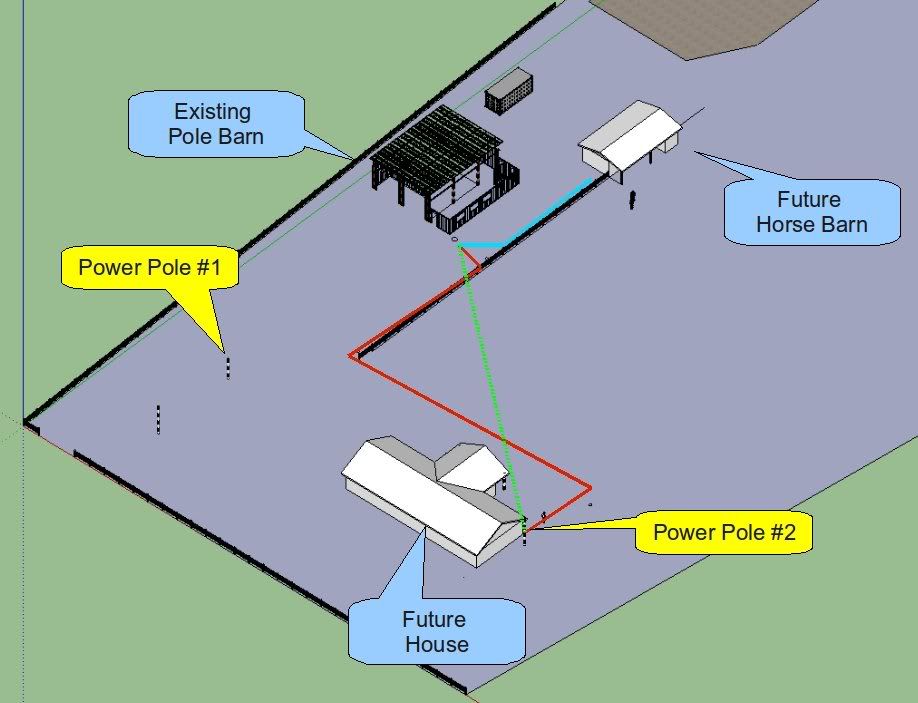
electrical.jpg


The red line (~275 ft) indicates a power line that I can envision running on telephone posts that also can use to illuminate (separate electrical line) the riding arena behind the house. The green dottet line (~195 ft) indicates a possible buried power line. The blue-turquoise line (~75 ft) indicates a buried line from the existing pole barn to the future horse barn.

I figured I need 100A at the pole barn and about a 20A at the horse barn (max).

I would like to hear some recommendations from you whether I should go buried or overhead (i prefer buried but I am afraid this cost 3 times more...).

I meet with the power company rep sometime in the next two weeks and will get his opinion but like to come prepared with good questions. So please throw your wisdom at me.

Thanks in advance!
 
   / Overhead or Buried #2  
Your red line would follow the green line as well - it would not make the zig-zag for only 300 feet. They wouldn't put in that many posts. Think straight lines. They won't go for the zigzag.

Ask if they would move the current meter to the barn location - it could possibly be cheaper to keep the 2 meters rather than eliminate one & run your own wire. Utilities can have odd policies like that - doesn't hurt to ask. You'd be charged 2 minimum bills, but would have very little wire expense & have good power available!

I myself prefer underground. We had overhead here at the farm which was placed in service in the 1950s - 60 amp main service. I replaced it a few years ago with underground, 200 amp service, with 60 amp available at all 11 buildings. Yes it was expensive. My coop REA utility was very friendly at doing their part up to the new transformer wherever I wanted it, 50 cents a foot for undergound; overhead woulda been free. Any wire after the transformer was of course on me.

I would expect you want a 200 amp service, with 200 amp run to the pole barn (anyhow 150amp), and at least 60 amp run to the future barn. It costs money to do whatever you do, the cost of upgrading the wire to a 60 amp to the far end is pretty cheap now; costs a great deal to redo it over a second time in a few years. Twenty amps won't run lights, water warmer, and a bale elevator at the same time. 20 amps isn't enough. Try to run an air compressor & a set of lights at the same time on 20 amps - it don't work. Why have issues just trying to inflate a tire on your wagon????? Seems worthless - if you bother to run the juice, run 60 amps and then you & future owners will have something.

Maybe you will end up putting in another building to the right of the future horse barn, and will then be able to branch off 30 amps to that. If you only wire in 20 amps, you are done, and have to start over....

I can't see the lay of the land, future expansion might not work the way I say, but the principle is there. Do it right the first time - plan for 60 amp anyhow to the fartherest building. It costs less than having to redo it a 2nd time.

It's easy for me to spend your money. Use the advice you like, build it how you want it. Just some friendly thoughts. :)


Just another random thought, after looking this over: If they will place a transformer for you pretty cheap like mine did, have a transformer 200 amp service placed at the exsisting barn. Run a short run to the house of 300 feet, and a short run of 200 feet to the future barn. Shorter runs have less voltage drop which uses thinner wire, which costs you less. A centrally located transformer would cost you less then a transformer on one end. See what policies your utility has, use them to your advantage.....

--->Paul
 
   / Overhead or Buried #3  
First and most important. Go seek the advice and knowledge of an actual , licensed electrical contractor in your area. He will most likely know what your power company will require and what would be expected of you.
Rules, regulations and requirements differ from state to state and from one electrical provider to another. The advice your seeking from this forum is on a "this is what I would do if it was me" basis. Some of it may well be correct and sound. The world is full of arm chair electrictions. I spent about 12 years in the electrical contracting field myself working with my Father. That doesn't mean I have a clue about what is required in your area of Texas. The "National Electric Code" is a complex and ever changing code. Please get the proper and qualified advice in order to do this job only once and most of all Safely.
Go see your local power provider, I am sure that they will give you some names of qualified electrical contractors. They may well be able to and willing to survey your site and tell you what needs to be done to do the job properly, adequetly and safely.
 
   / Overhead or Buried #4  
You power company surveyor will advise you on what he can do for free and what the alternatives are. They may move the one pole to another location for free. When I asked about putting in another pole on my place to get the overhead wire out of my way somewhat it was $1100 to put in a pole. Needless to say, I moved my building 15 feet. Your roof line has to be at least 15 feet back from the overhead wires. Your diagram if accurate shows the line cutting across your roof which isnt allowed. Discuss with the power company the possibility of relocating the existing power poles and meters to a more workable solution. It may be free to do that since all the material is already there. All my overhead lines are free but underground is close to $10 per foot for 200 amp service. I am waiting for a survey of my new house site now to see what the best way is to get my power in. and not have a pole in my front yard.
 
   / Overhead or Buried
  • Thread Starter
#5  
Thanks for your tips!

I am definitively will seek professional help and only do what will be indicated to me as a possible option when it is in my capabilities (i.e. trenching).

I will go 60 amps for the horse barn as indicated by Paul as I may have some other use for electricity at the fish pond and further down the pasture. Thanks!

I also like the comment to ask the power company to bring the transformer onto my property and closer to the pole barn. I will ask about that. Currently the transformer for pole #1 sits in the corner (far left in picture) of the property. The transformer for pole #2 sits in the other corner (bottom of picture). That will result in the shortest runs. And when we build the home in 2 years we may even use the second electrical pole closer to the home.

Drawing of property, barns and possible house is to scale.
 
   / Overhead or Buried #6  
Everyone right on the money with advice on talking to local power company and electricians.

I like everything buried. Less lightning problems, looks better. One piece of data missing here is who makes and owns the trenching if you go this route. I had a small backhoe, and dug about 1200 feet of trenches for power, phone, lighting and the like. An advantage of this approach (the "I can put what I want in the trench" is you can also run low voltage (phone, security, data) and water to these locations. If you can do this, it spreads out the cost over all these pieces of infrastructure.
If the utility company just puts in wire (no conduit), then you're going to be digging for these other things anyway. Local ground conditions (rocky, sandy, etc and problems with burrowing critters) also affect this decision.
You have about 350 feet of trenches on your map. Note that if you go down deep enough, and make good records of where the trenches are, you could do a direct path. 350 feet seems like about a days work for a real backhoe. A direct path would be less time but still a full day if you went deeper (like 3-4 feet deep). You could contract someone to dig it for you, then put the pipe in for power, low voltage, and water. Post if this option is interesting, then you can get lots of advice on sizes and cost of conduit and wire. Make sure you get the power company to agree on the size for the power.

Also agree that 20A into the horse barn is too small. 60 amp-ish is much better. Note that the right size conduit give you more room to make mistakes.

Pete
 
   / Overhead or Buried #7  
You've had lots of good advice on sizing your service . . . your question though was about overhead vs. underground. Whatever size of service you decide on to each location, the over/under topic remains. I can't advise regarding the costs- only you can do that. When we built our house/shop/barn etc. we decided on underground. The primary reason we did it was aesthetic. It's impossible to put a dollar figure on the value of aesthetics, but after visiting Amish country in Pennsylvania a few years ago, I realized that one of the most prominent visual features of the area was the lack of power line everywhere. To me it's big deal, and worth the money. Clearly a personal thing. Your mileage may vary.
 
   / Overhead or Buried #8  
Just to be the devil's advocate for a minute.

The simplest solution I see is to use pole #2 for your house.

It is a shorter, straight shot from pole #1 to the barn underground. 200A service as stated, then sub-panel over to the horse barn.

20A @ 240vac might be enough...thats the same power/wattage as 40A @ 120vac. However I think I'd lean towards 30@240vac if you were trying to save.

My REA has a simple rule for underground service: you get two bends, both of them turning up from the buried horizontal run to both of the vertical legs feeding the: (power pole, meter base). Everything else has to be a "natural curve" that the 2-1/2" PVC conduit will flex to. Otherwise pulling the wires thru would be a nightmare.

I do also prefer the "clean" look of minimal overhead power lines.
 
   / Overhead or Buried #9  
My first thought is to go overhead from post 1 to barn (200 amp) and then underground to the house (100 amp) and everywhere else. I've done similar before and it has worked for me.
 
   / Overhead or Buried #10  
My first thought is to go overhead from post 1 to barn (200 amp) and then underground to the house (100 amp) and everywhere else. I've done similar before and it has worked for me.

I like that idea too. 100 amp at house at first seems low, but it is not feeding any other subpanels. But be sure you get enough at the house.

See if the power company will remove pole #2 but maybe not until after the house is built. It will give you power for the construction job.

Also, consider putting your house electrical panel in the corner of the future house nearest the existing barn.

I also like the idea of 1 trench for power, water, and low voltage. Check on how much separation is required from those services. Also, consider how you would perform repairs on a given utility in a shared trench. If one fails, you don't want to disturb others. Maybe make them in the same but wider trench and place them in separate conduits as separated as possible and well documented.

You don't want future work by you or future owner to hit this stuff with a post hole digger or something.
 
   / Overhead or Buried
  • Thread Starter
#11  
My first thought is to go overhead from post 1 to barn (200 amp) and then underground to the house (100 amp) and everywhere else. I've done similar before and it has worked for me.


Thanks! If I go overhead from pole one to the barn I may just use pole 2 for the house without coming across. That way I have no underground to worry about other than for the horse barn.
 
   / Overhead or Buried #12  
One more thing to think about -- Some utility companies have a minimum monthly service fee -- if you have two meters you may be paying more than if you have just one.
 
   / Overhead or Buried #13  
2 minimums aint bad, if you keep 2 seperate lines of service you wont be causing interferance withb the house when you are welding/ectra at the barn. you will also have some where to plug in freezers and such in an emergency when house wires/mains/panel box/what ever messes up.

I know of some places with 3 meters, house, barn, gate. so its not that uncommon.
 
   / Overhead or Buried #14  
I don't know what the laws and rules/regulations are in your state, but there may be a thing or two to think about.

1. No matter what, make sure you get them to put a can (transformer) on your pole.

2. Buried wires never get knocked down by wind or drunks hitting poles, or have problems with freezing rain/ice, hung cables never get dug into or flooded.

3. Don't go 200 to your house if you can go 400. 400 is the future, 200 is the past.

4. some electric companies will let you run your own underground utilities (as long as they meet their inspection requirements, and some will let you drop your own poles.

5. grey (electrical) PVC has come down in price substantially since about 1.5-2 years ago. It is easy to setup, and easy to pull (with a little help).

6. Some places may make you have a panel at the pole, meaning everything else is a sub panel.

7. Figure out what all your inspections will total either underground or hung.

8. Consider running 100 amp to your barn/outbuilding. It allows many more uses and can be run from that panel elsewhere.

9. If you can keep two poles I would. I have everything off one main panel to a couple of subs. When I do woodworking stuff I draw alot of juice and it does affect the house.

The only reason I list these things is because I was where you were about 2 years ago. I decided to run underground, dropped my own pole on my land and ran my own electric. I had to sign off with the elec co that everything from the pole to my house was my responsibility. I think running the wire to the house underground with the PVC, all the inside wiring, all the buried wire to the sub in the polebuilding, hiring a electrician to check my work, and buying a friend some beer, and my inspections cost me about 1400 for everything. It may be 100-200 more, but I had some stuff on hand and did some bartering for some 3" sweeps (pricey). I love the underground wires and only having to cut around one pole on my land. The electric compnay gave me a quote of around 7400 for a pole on my land, an above ground transformer, and then everything underground from there.

Good luck.
 
   / Overhead or Buried
  • Thread Starter
#15  
Thanks for all your comments - I will post my update when I spoke to the Utility Company.
 
   / Overhead or Buried #16  
I have burried power to my house... never regretted it.. no 600' issue for a new pole. etc.. and no downed poles due to storm.. at least on that leg anyway.

soundguy
 
   / Overhead or Buried #17  
I have buried power, and we still get outages frequently--at lease once every two months, just because I am near the end of the line.

I like the looks of buried better, but I am getting ready to do a couple of projects which might involve digging near the lines. I wasn't home when the contractor plowed them in, and I have no idea where they are.

If you go underground, take plenty of pictures.
 
   / Overhead or Buried #18  
I like underground for aesthetics and other reasons; but it's costlier. If you go underground and you do your own trenching and fill, get some 2" - 6" wide traceable marker tape to place 6" - 12" below final grade. It should be detectable with a metal detector, and if you're digging around a few years from now and snag the tape first, it will give you an early warning that something is not too far below. As I recall, code required that electrical lines be buried a minimum of 18"; but I've heard that's been increased to 24". Does anyone have information on that?

Regardless of whether you go overhead or underground, keep the distances as short as possible to minimize voltage drop; otherwise you have to go bigger with the wire to compensate.
 
   / Overhead or Buried #19  
It seems to me that most of the posts here are correct. Go direct underground to each barn instead of following the redeline. It gets expensive and you get more of of a power drop due to resistance if following the red line. burying deep enough will not have problems. 20 amps at the barn?! sorry , its not gonna cut it. chances are if the inspector sees that, it will fail.

This is not the place to skimp and try to save money. my advice, 1. bury electric line deep in straight line following green. 2. add couple empty conduits from house to first barn for future upgrades in same hole 3. go with 400 amps and subfeed to barn. cheaper bills
 

Tractor & Equipment Auctions

2014 Chevrolet Express 3500 Cargo Van (A55852)
2014 Chevrolet...
13042tx (A55973)
13042tx (A55973)
159120 (A60430)
159120 (A60430)
2008 Bobcat S250 Compact Wheel Loader Skid Steer (A59228)
2008 Bobcat S250...
Honda EM3800SX Portable Gasoline Generator (A59228)
Honda EM3800SX...
2001 John Deere 6210 (A60462)
2001 John Deere...
 
Top
