PA160 STH unboxing!

   / PA160 STH unboxing! #101  
Try working with a 2nd year apprentice who already knows-it-all. :mur: I was supposed to be a shop supervisor(a long story) at a place that had kind of a secondary shop to the side of the main shop. They built box shaped incinerators from 1/4" plate about 5' square and lined them with refractory cement. The guy acting as lead hand for these was a 2nd year and too full of himself to listen how to make a proper corner joint. He was putting one plate inside the other and welding the inside and outside of the corners. In his mind it was stronger this way. He took real offence when I suggested fitting inside corner to inside corner to leave a perfect joint for a full strength fillet weld from the outside!:talktothehand: Anywhere else they would have told him to shut and listen or hit the road. I heard after the fact that the guy didn't like working with me. What's even sadder is the foreman before me didn't have a clue either. It boggles the mind sometimes how some people in the trade don't even know the most basic stuff.
 
   / PA160 STH unboxing! #102  
He took real offence when I suggested fitting inside corner to inside corner to leave a perfect joint for a full strength fillet weld from the outside!
Well I'm no engineer, far as I can remember I've only been on 1 train in my life:D.
But that is exactly how I would have done the corner joint. Unless the prints said otherwise.;)
 
   / PA160 STH unboxing! #103  
Well I'm no engineer, far as I can remember I've only been on 1 train in my life:D.
But that is exactly how I would have done the corner joint. Unless the prints said otherwise.;)

Not disputing you and Arc Weld but why would two lap joint welds be less strong than a single full fillet weld of a corner? I can see that it would take less time to do a single weld but is it also stronger?
 
   / PA160 STH unboxing! #104  
IslandTractor said:
Not disputing you and Arc Weld but why would two lap joint welds be less strong than a single full fillet weld of a corner? I can see that it would take less time to do a single weld but is it also stronger?

I think he was agreeing with your way.
 
   / PA160 STH unboxing!
  • Thread Starter
#105  
Not disputing you and Arc Weld but why would two lap joint welds be less strong than a single full fillet weld of a corner? I can see that it would take less time to do a single weld but is it also stronger?

Depending on the thickness of the material, the welding process used, and the skill of the weldor, the overlapping joint might lack penetration compared to the open corner. With the open corner, you can see the keyhole while putting it in, and by inspecting the back side of the weld. If you penetrate on the root and then fill the joint, you can be assured of full penetration.

Realistically, this probably was not a situation where full penetration was critical. The main advantage of the open corner method was probably just that a sound weld could be run with a single pass vs. two passes, cutting weld time in half. Maybe the guy didn't like the look of the back-side of a full-pen fillet and preferred to have two front-side beads where anybody could see them. Hard to imagine anybody would care what a joint on the inside of an incinerator would look like, though.
 
   / PA160 STH unboxing! #106  
Depending on the thickness of the material, the welding process used, and the skill of the weldor, the overlapping joint might lack penetration compared to the open corner. With the open corner, you can see the keyhole while putting it in, and by inspecting the back side of the weld. If you penetrate on the root and then fill the joint, you can be assured of full penetration.

Realistically, this probably was not a situation where full penetration was critical. The main advantage of the open corner method was probably just that a sound weld could be run with a single pass vs. two passes, cutting weld time in half. Maybe the guy didn't like the look of the back-side of a full-pen fillet and preferred to have two front-side beads where anybody could see them. Hard to imagine anybody would care what a joint on the inside of an incinerator would look like, though.

I understand your comments. I would think though that seeing heat effect on the other side of a lap joint weld would be pretty good evidence of penetration too. I imagine the single vs two welds is the strongest argument but was just wondering if there is technically a reason why a good single outside corner weld is any better than two good lap welds.
 
   / PA160 STH unboxing!
  • Thread Starter
#107  
just wondering if there is technically a reason why a good single outside corner weld is any better than two good lap welds.

I can't really speak to that. I do agree that, on 1/4" material, you could probably get enough heat into the metal to be reasonably assured that you were getting full penetration. Only for somebody like a pipe weldor would you really need to be 100% sure.

I have done overlapping corners like that, and I am never really happy with the results if I don't bevel them, even on 1/8" material. Sure, the weld is probably penetrating at least half the metal's thickness, but I am always fighting to keep from melting off the corner of the on-edge piece, and the result never really looks neat. With an open corner, you have a nice valley to fill up with weld, and if you nip the corner, it doesn't look as bad (to me, anyway). So the open corner provides all the benefits of beveling without having to spend any time on the grinder.
 
   / PA160 STH unboxing! #108  
Man Joshua you are really catching onto this welding trade in the last few weeks!:thumbsup:
Reasons I prefer the corner to corner joint. A corner to corner joint with a slight gap almost certainly ensures 100% penetration.
When the two inside corners meet, or slight gap. The outside is a perfect trough for the weld to lay in. Easy as pie to make that weld! If at all possible, I would still make both inside, and outside welds! Then I know I'm getting 100% penetration!;)
 
   / PA160 STH unboxing!
  • Thread Starter
#109  
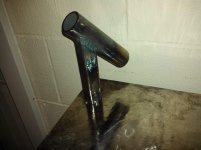
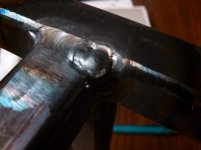
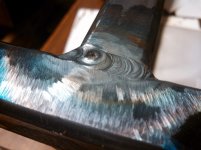
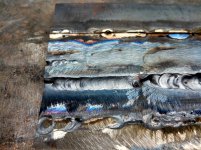
I made a holder for my TIG torch out of some scrap tubing. The most fun part was manually grinding the square tube to fit the round. Also, a few more shots of some welds. I am having a lot of trouble feeding enough filler to avoid cratering. The Miller calculator suggests 3/32" for 1/8" material, but I'm using 1/16" because somewhere else I got the idea that's what I should have. I suspect I would be a lot happier with the larger filler. I have been half tempted to hold two rods together and feed them at the same time, essentially making a 1/8" filler, but I just try stabbing the 1/16" in faster instead.
 

Attachments

  • 2013-06-06 21.04.40.jpg
    2013-06-06 21.04.40.jpg
    605.2 KB · Views: 166
  • 2013-06-06 21.06.23.jpg
    2013-06-06 21.06.23.jpg
    351.4 KB · Views: 187
  • 2013-06-06 21.06.55.jpg
    2013-06-06 21.06.55.jpg
    502.1 KB · Views: 183
   / PA160 STH unboxing! #110  
The rule of thumb for fillet welds (this was a 90 deg. corner) is the leg length should be equal to the thickness of the plate to have the same strength. Over this is a waste and an overestimation of strength. If you get some penetration to the inside is good but as long as you get penetration to the heel, you'll have the strength. It also leaves a very smooth rounded corner that requires very little clean up and/or grinding. The time savings are more than half. Consider if there wasn't a big enough opening to get at the inside to weld it? Many tanks are built this way with just the outside weld.

There were no blueprints for these things. The owners of the company were too worried someone would steal their ideas. It was a real pain trying to build stuff without proper prints or even diagrams.
 
   / PA160 STH unboxing! #111  
I have been half tempted to hold two rods together and feed them at the same time, essentially making a 1/8" filler, but I just try stabbing the 1/16" in faster instead.

Joshua the best Tig weldor I was ever around, I think he could Tig weld faster than I could stick weld! I seen him take two filler rods, place the ends in a vice, chuck the other ends in a drill motor, and spin the rods over each other to make one rod. Worked great for him!;)
 
   / PA160 STH unboxing! #112  
Shield Arc said:
Joshua the best Tig weldor I was ever around, I think he could Tig weld faster than I could stick weld! I seen him take two filler rods, place the ends in a vice, chuck the other ends in a drill motor, and spin the rods over each other to make one rod. Worked great for him!;)

I've done that with mig wire for tig use. Not as stiff as I would like, but it works.
 
   / PA160 STH unboxing! #114  
Yep. You are right. Short hoods weld differently than long hood red faces, and well anything with an octagon barrel won't weld any thing like the other two, but still plenty of them in use.

As far as the 125 amp stick thing. The spec for the US is indeed 160 amp on stick. We contacted the factory to verify to find out where the confusion was. We received some units that were built with a build card for one of our other distributors located in another country on this side of the pond. The main difference is the addition of a resistor on the top board. Everything seems to be the same. For the US, the resistor is left out. That's what happened. Contacted Joshua and almost quicker than you can say "vasectomy" we snipped it out.(well maybe a little longer than that) Now it's up to full power. It's sort of isolated in its position and easy to identify. If anyone else has received one with only 125 amps output, let me know. It's an easy walk through.

Hi Mark,

I received an Everast 160 sth this week with the 125 amp on stick issue. Can you please email me with a solution. With pictures included would be great. I need to get this fixed because I don't want to have to send the unit back for an exchange.

I did leave a message on your voice mail yesterday but have not heard from you so email will be fine.
 
   / PA160 STH unboxing! #115  
Hi Joshua,

I left the following message for Mark. If you can help me with this it would be appreciated.

I received an Everast 160 sth this week with the 125 amp on stick issue. Can you please email me with a solution. With pictures included would be great. I need to get this fixed because I don't want to have to send the unit back for an exchange.

I did leave a message on your voice mail yesterday but have not heard from you so email will be fine.
 
   / PA160 STH unboxing! #116  
It's easily done. I took yesterday afternoon off. These days I generally don't work with tech support unless it was a customer I sold to...but I'll still be glad to help in this case. It is better and more quickly done over the phone, than email. Safer that way too. All units sold through me or sold directly through Everlast should be corrected in the last couple months. Give me a call again tomorrow. Have the welder close, and a small wire snipper in your hand. Remove the rear cover and the metal cover first before you call, AFTER you have unplugged it and waited 15 minutes for the caps to discharge. Did you buy it from Amazon?
 
   / PA160 STH unboxing! #117  
It's easily done. I took yesterday afternoon off. These days I generally don't work with tech support unless it was a customer I sold to...but I'll still be glad to help in this case. It is better and more quickly done over the phone, than email. Safer that way too. All units sold through me or sold directly through Everlast should be corrected in the last couple months. Give me a call again tomorrow. Have the welder close, and a small wire snipper in your hand. Remove the rear cover and the metal cover first before you call, AFTER you have unplugged it and waited 15 minutes for the caps to discharge. Did you buy it from Amazon?

Yes I did buy from Amazon. I will call tomorrow with the unit open. Thanks for the reply Mark. BTW, where are you located so that I know what time zone I am calling to?
 
   / PA160 STH unboxing!
  • Thread Starter
#118  
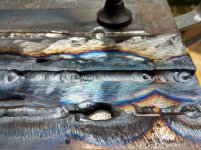
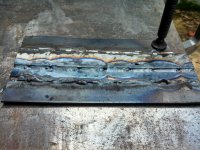
A small update for y'all, just for fun. Here's some lap joint work I did today. I was at about 100-110 amps max pedal. For simplicity, I used a lay-wire technique and tried to focus on torch angle and travel speed/consistency. Other settings were: 3/32" 2% lanthanated (blue) electrode, 1/16" and 3/32" filler, but mostly 1/16" as the 3/32" was really too much. About 5-6 lpm of gas, which I think was a bit too low, as I got some porosity on the back side--but there may have been contaminants, as there was also a little boiling and sputtering. Metal was 1/8" mild steel.

2013-08-06 13.31.31.jpg

2013-08-06 13.44.08.jpg

2013-08-06 13.31.18.jpg

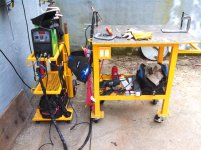
Here's my current setup.

2013-08-06 13.33.03.jpg
 
   / PA160 STH unboxing! #120  
Could use a bit more gas, unless you were using a very small cup.

And could use more filler. Some times one size of filler is too small, and the next bigger is too big for using lay wire technique. Time to start to learn to feed wire.

Have you wached all the TIG videos from www.weldingtipsandtricks.com
They are very good.
 

Marketplace Items

2019 KOMATSU D65WX-18 CRAWLER DOZER (A60429)
2019 KOMATSU...
2012 FREIGHTLINER CASCADIA TANDEM AXLE DAY CAB (A59904)
2012 FREIGHTLINER...
INTERNATIONAL DUMP TRUCK (A52707)
INTERNATIONAL DUMP...
2022 Caterpillar 906M Compact Articulated Wheel Loader (A56857)
2022 Caterpillar...
Rotadairon RD145 Pull-Behind Rotary Tiller Tractor Attachment (A59228)
Rotadairon RD145...
2015 Chevrolet Impala Sedan (A59231)
2015 Chevrolet...
 
Top