please help identify this plow

/ please help identify this plow #1  

ampsucker

Platinum Member
Joined
Dec 6, 2007
Messages
576
Location
Southeast Kansas
Tractor
BX24
howdy, all!

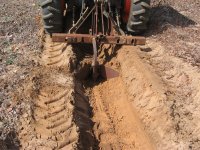
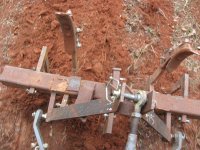
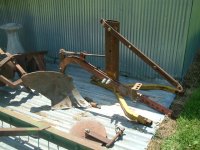
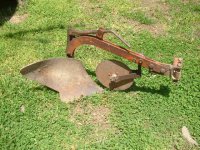
not being around farm implements much, i wonder if some of you very handy folks would mind telling me what i have here. my uneducated mind tells me it might be a single bottom plow, but i'm not even sure about that. i read about folks who have middle busters, subsoilers, etc, but that doesn't mean much to me. hoping someone can help.

i'm also curious about pulling the thing. right now, the only way i could attach it is to my draw bar hitch or to a draw bar mounted on the 3-point. the way i'm seeing it, neither option would allow me to raise and lower it at the end of each row for turn around.

my understanding is the digging depth is controlled by a combination of the angle of the plow tip (crank handle), the guage wheel disk, and somewhat by speed. then, there is that piece of angle sticking off the back which may have something to do with it or maybe just keeps the thing tracking in the furrow?

is this just a cobbled together piece or is it pretty much as designed from the factory and how do you get the thing to lift at the end of each row without an upper link to the top three point attachment?

thanks for any help on identification and operation! here are the pics....

amp
 

Attachments

  • DSCF0612.JPG
    DSCF0612.JPG
    84.8 KB · Views: 814
  • DSCF0613.JPG
    DSCF0613.JPG
    81.3 KB · Views: 595
/ please help identify this plow #2  
ampsucker said:
howdy, all!

not being around farm implements much, i wonder if some of you very handy folks would mind telling me what i have here. my uneducated mind tells me it might be a single bottom plow, but i'm not even sure about that. i read about folks who have middle busters, subsoilers, etc, but that doesn't mean much to me. hoping someone can help.

i'm also curious about pulling the thing. right now, the only way i could attach it is to my draw bar hitch or to a draw bar mounted on the 3-point. the way i'm seeing it, neither option would allow me to raise and lower it at the end of each row for turn around.

my understanding is the digging depth is controlled by a combination of the angle of the plow tip (crank handle), the guage wheel disk, and somewhat by speed. then, there is that piece of angle sticking off the back which may have something to do with it or maybe just keeps the thing tracking in the furrow?

is this just a cobbled together piece or is it pretty much as designed from the factory and how do you get the thing to lift at the end of each row without an upper link to the top three point attachment?

thanks for any help on identification and operation! here are the pics....

amp
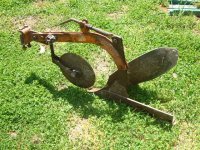

Allis Chalmers. Someone more familiar with models can tell you which tractor specifically, I'd GUESS it's for a model B. That is a factory built plow. A standard 3-point hitch or fixed drawbar isn't going to work without a fair amount of "re-engineering".

The coulter (gauge wheel disk as you call it) has NOTHING to do with operating depth, nor does speed. The angle of the bottom has SOME bearing on depth, but not so much as the hitch itself. The tractors hitch will determine operating depth. The coulter is to slice through sod or surface crop residue so the plow has a clean path.
 
/ please help identify this plow
  • Thread Starter
#3  
Thanks for the quick reply!

If it all has to do with the tractor hitch, does anybody have a pic of a proper type hitch design? I wouldn't even know where to begin.

Does it have to do with height relative to the tractor wheels?

The plow itself has a double bolt hitch which I guess helps keep it straight behind the tow vehicle. It has about a 3-4" bushing which might allow it to ride up and down that distance when mounted.

any thoughts?

amp
 
/ please help identify this plow #4  
I have an old 10" Brinly (manufacturer)plow that looks very much like the picture you've posted. I bought it in the early 70s to use on a Ford 14Hp. garden tractor (I believe the tractor was made by Jacobsen). I think the hitch was called a "sleeve hitch" but I'm not sure. I remember it had a tube for the hitch pin. The tube fit inside the "C" type attachment on the plow. The plow was offset from center by using one of the hole sets in the "C" for the pin. There was also a plate which hung over the tube on the tractor hitch and which was pushed against the mid section of the "C" to keep the plow from swaying side to side. At that time (1970s)Brinly marketed many attachments for lawn and garden tractors.
Try this web page Brinly-Hardy Co. | Gardening Equipment | Plows | PP-51BH
Hope this helps,
Barney
 
/ please help identify this plow #5  
FWJ, how do you go about setting plow depth? I've figured out by trial and error a good bit of my plows proper set up but depth still just seems like a matter of fate. I just assumed in my case that it was the level of the hardpan that determined how deep I could go.
 
/ please help identify this plow
  • Thread Starter
#6  
thanks at ton for posting up that link, barneyhunts! i think that is exactly what i have. i read through the pdf manual at that site, and it gives complete adjustment instructions. it looks like a little work to get it all adjusted right, but i think i'll give it a try. my neighbor and i both have some garden spots i can work on, plus i want to plant some trees next spring, so i can start soil prep this year.

i'm thinking i may be able to attach it to the lower draw bar and use the lower link arms and a chain to raise and lower it. otherwise, i can use the 3pt draw bar and see if that will work without the upper link.

n80, check out the link barneyhunts posted and click on the manual so see a complete set of instructions for adjusting a plow. it may help you adjust yours depending on the options you have.

amp
 
/ please help identify this plow #8  
N80 said:
FWJ, how do you go about setting plow depth? I've figured out by trial and error a good bit of my plows proper set up but depth still just seems like a matter of fate. I just assumed in my case that it was the level of the hardpan that determined how deep I could go.

A plow should be operated at a depth of + or - 1" of half of an individual bottom's width. (ie, 12" @ 5" to 7", 14" @ 6" to 8", ect)

Some brands offered "deep draft" plows. John Deere as an example, once the "NU" style bottom was offered, had a deep draft 16" bottom that would operate efficiently at depths of 10" to 12". You'll rarely, if EVER see those style bottoms on smaller mounted plows (3 or less bottoms).

A plow with shares in decent condition have what is called "suck". That's the plows tendency to pull itself deeper into the ground. Worn shares will reduce that suck to a point where the plow struggles to get to proper depth.

3-point hitch geometry has some effect on a plows tendency to get to a desired depth. Look at the length of a typical top link vs. the over-all length of the draft arms. They're different. Their implement ends travel in a slightly different arc. As the hitch works through it's range of motion, the plow (or whatever implement is mounted) does NOT travel in a constant plane. As the plow raises, the tail end tends to lift more than the front of the implement. (Harry Ferguson designed and intended his hitch to do just that. Reason? To improve transport clearance when implement is raised fully) . As the hitch is lowered into operating position, a plow tends to retain a slight nose-down attitude (ever so slightly) Once the draft arms become parallel with the ground, and begin to place the implement ends BELOW the end attached to the tractor, the tail end of the plow lowers more SLOWLY than the front end. That's why a plow needs to be leveled IN OPERATING POSITION, and NOT while it's raised. That raised position is almost totally irrelevent to its OPERATING position. A plow that's properly designed and fit to a specific tractor will result in the draft arms being extremely close to parallel with the ground as the plow is at it's designed operating depth.

Ideally, the tractors DRAFT CONTROL holds the plow at proper operating depth, countering the plows suck from taking it too deep. Some tractors don't have draft control. Then you're at the mercy of position control, or in some cases, a gauge wheel on the plow. That gauge wheel "unloads" the plows suck from the hitch, reducing the traction advantage of a mounted plow. That suck pulling against the draft control (or position control) gives the effect of added weight on the rear wheels, resulting in increased traction. The plow has a tendency to rotate around the hitch, placing compression on the top link, therefore downward force applied to the front end of the tractor. That is the genious behind "The Ferguson System". Instead of wasting the energy generated by the plow, it's applied to the tractive efforts of the tractor. (smaller tractor does the same work as a larger, heavier tractor)

A plow bottom in good condition works simular to an airplane wing as it slices through the air. The landslide and tailwheel (if equipped) provide a certain amount of "lift" as the share and moldboard contour provide the downward force. In a perfect world, those 2 forces should be ALMOST equal with the plow at the desired depth of operation. Set PERFECTLY, a plow should only apply a marginal amount of compression on the top link.

By the same principal, the side-to-side skew achieved with the rotational adjustment of the offset drawbar applies pressure to the landslide to counter the force of the moldboard to make the plow trail directly behind the tractor. Set properly, no stabilizer bars/sway chains/ect are needed. The plow should follow CENTERED (on the plows draft line) behind the tractor.

Have you ever stuck your hand outthe window of a fast moving car and felt the air try to make your hand move up or down as you turn your hand? When you hold your hand "just right", you feel no pressure. Much the same principal with a plow. Adjusted "just right", it tends to want to travel in the desired path, be that up and down, or, let or right.

Soil conditions will have an effect on how well a plow operates, but its SHOULDN'T be the determining factor in the operating depth.

MOST, if not ALL tractors built these days had little, IF ANY design consideration for pulling a plow. Hitch geometry may possibly be less than ideal for working with a plow. The plow itself may not be of ideal geometry for the brand of tractor. Plowing with most "modern" tractors is an exersize in compromise. With the plow oriented perfectly while at operating depth, you may or may NOT have the ideal orientation as it ENTERS the ground. (or vice/versa) You do the best you can with what you have.
 
Last edited:
/ please help identify this plow #9  
Farmwithjunk said:
MOST, if not ALL tractors built these days had little, IF ANY design consideration for pulling a plow. Hitch geometry may possibly be less than ideal for working with a plow. The plow itself may not be of ideal geometry for the brand of tractor. Plowing with most "modern" tractors is an exersize in compromise. With the plow oriented perfectly while at operating depth, you may or may NOT have the ideal orientation as it ENTERS the ground. (or vice/versa) You do the best you can with what you have.

That probably sums up my experience using a generic tractor with a generic plow. I'm pretty sure my plow is a 14" and I may get it down 6 inches sometimes, rarely 8. I can feel the 'suck' when I have it set up properly. But I also noticed something else you mentioned. The front tip of this plow, which I guess is the 'share' is a bit rounded off. I wouldn't call it blunt but it isn't a distinct angle point either. Other than the bolts being rusty, it looks like it would be easy enough to put a new share on it. They are made by Crescent which is still making plow parts. I don't know the exact part number or anything but someone said it looked like a Ford 'type' set up. Temco has Crescent shares and the flush plow bolts too.
 
/ please help identify this plow
  • Thread Starter
#10  
thanks for the very informative posts so far! really appreciate it. ;-)

i did a test pull this morning in what should be decent soil - a garden about two years ago with little ground cover. i hitched it to the stationary draw bar at the bottom of the tractor axle just to see what would happen. it was definitely a no go. there was only one mounting hole on that hitch and the plow unit wobbled from side to side and couldn't get decent penetration even more than an inch into the ground.

this weekend, i'm picking up my 3 pt draw bar with mounting holes all along the length. that should give me extra stability plus allow me to experiment with off-setting the plow left and right of the tractor centerline to get the wheels of the tractor into the previously plowed furrow. i should also get some ability to raise the plow at the end of each run for turn around.

i realize my set up may never be ideal. i'm thinking i may have something workable once i get a decent hitch and experiment with all the different angles available for adjustment.

as for sharpening the tip, i'm guessing there is a lot of finesse involved in doing that correctly. angles for maximum strength vs. penetration, etc.

so does this type of plow have name and what is it's usual purpose? my neighbor has what he is calling a "hard pan" under his garden which i think is just the same clay soil on top that his tiller tines haven't been able to reach and not a truly different type of soil - just more compacted but the same as above. from what the previous posts have said, if this is a 10" plow, i'll be lucky to get it 5" into the soil and that isn't much deeper than a tiller tine could go anyway. i guess there seems to be some value to "turning over" the soil as opposed to just busting it up, but there again, my farmer instincts and education fail me.

i'm sure it's been posted before, but can someone give me the basic advantages of plowing vs. tilling, vs. discing vs. harrowing, etc. it it all about particle size, root depth, type of soil, etc?

thanks, sorry to be so ignorant.

amp
 
/ please help identify this plow #11  
You'll get better answers than mine but I'll take a shot at a couple of your questions. As for names, this type of plow is frequently referred to as a turning plow, bottom plow or moldboard plow. I don't know which ones is technically proper (if any). The type you have is referred to as a garden plow because of its small size and simple hitch design (for garden tractors).

From what FWJ has said, I imagine getting 5" is about right with a 10" plow.

I think its advantages over a tiller are probably pretty small. It is probably cheaper, lighter and maybe a little faster. Probably does not do as good a job as tilling. I have found, in my very limited experience that my soil needs to be disked after plowing to make a good seed bed. In other words, the plow turns the soil and sod over in long, wide rows. The disk chops and mixes all of this into a more 'loamy' seed bed.

Technically a disk is a harrow but when most people talk about harrowing they mean pulling something over the soil once the seed has been laid down. This covers the seeds and even things out. Harrows come in an endless variety of manufactured and homemade forms (the most common of which is a section of chain link fence dragged behind the tractor.) I have heard of using a disk as this type of harrow and I tried it this year on sunflowers and cow peas and they are coming up great. I set it to the least aggressive gang angles just to get a little coverage. However, the brown top millet mixed in with the sunflowers has not emerged so the disk may have put it too deep. We'll see.

Hope you get more and more technically accurate answers but that's what I know.

There is also an issue of soil compaction which plowing is known to do. Not sure how a tiller compares in this area. Not sure it matters at all in a small garden.
 
/ please help identify this plow #12  
Here is a picture of how I attached this sort of stuff to my tractor. Not pretty but it works..

Rob
 

Attachments

  • middle-buster (5).JPG
    middle-buster (5).JPG
    211.8 KB · Views: 460
/ please help identify this plow
  • Thread Starter
#13  
ah, so that's a middle buster!

i guess i have a middle buster type plow too, in addition to the one i asked the question about. we also called it a tater digger, water line trencher and railroad tie planter! it was designed to be pulled by a chain and had two handles so the second guy (the actually worker as opposed to the driver) could bear down on it and guide it where he wanted it to go.

i like your 3pt adaptation better! since ours needs some reworking, i may try to make it a 3 pt mount like yours so it's easier for one person to handle.


amp
 
/ please help identify this plow #14  
I 've gotten a ton of use out of this funny looking bar. :D
 

Attachments

  • food-plot (9).JPG
    food-plot (9).JPG
    148.1 KB · Views: 703
  • middlebusters (10).JPG
    middlebusters (10).JPG
    202.7 KB · Views: 337
  • food-plot (4).JPG
    food-plot (4).JPG
    221.4 KB · Views: 381
/ please help identify this plow #15  
For me, the plow and disc are much easier to use in rocky soil. On a small tractor (SCUT & CUT) the tiller will "rattle your teeth" and it really feels like you're abusing the equipment. I've been told that on a large tractor the tiller will smash and bury rocks, but I've not seen it.:rolleyes:
 
/ please help identify this plow #16  
Barneyhunts said:
I've been told that on a large tractor the tiller will smash and bury rocks, but I've not seen it.:rolleyes:


A "large tractor" will smash something alright. THE TILLER. I've used my tiller on a 60HP Deere 2440 in rocky conditions a time or 2. That's when I found out how easy it is to buy new tines from King Kutter. Ideally, I don't want to use a tiller in rocks on ANY tractor. High horsepower makes just as much, maybe even MORE noise and isn't nearly as forgiving as a moderate amount of power.
 
/ please help identify this plow
  • Thread Starter
#17  
i got my little brinley plow converted over to a 3-pt hitch set up (kind of). it was what that little plow needed. i plowed our small garden plot up today, even though it was pretty wet. i had some organics sitting on top i wanted to turn under. i think if i keep adding organics and turning every month or two, i should have some pretty decent loam for next spring. right now, it is very thick clay.

thanks for all the advice. i am still tweeking my angles, but it worked pretty well, had good "suck" and i think would have been even better if i had a few more rain free days to let things dry out. unfortunately, that hasn't been an option around here, lately!

should have taken some pics, but had too much going on today. maybe next time!

amp
 
/ please help identify this plow
  • Thread Starter
#19  
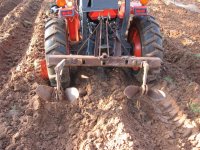
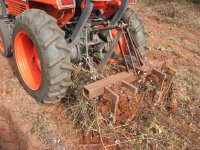
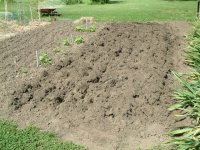
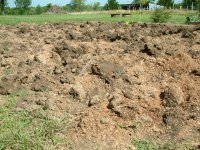
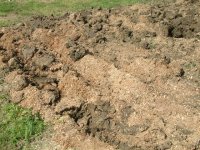
got around to charging the camera batts and taking a few pics today.

first photo is of of the plow in 3-pt conversion mode. it isn't pretty, but functional. i adjusted everything by putting the left side wheels up on 5x5 blocks as suggested to simulate plowing with the right side wheels down in the previous furrow. i then leveled the plow share through manipulation of the top link, the threaded bar on the plow itself and the grading adjustment on the lower link of the tractor's 3pt. i maintained a slight downward angle on the front tip of the plow but otherwise tried to make things pretty level. i was eventually able to get a good compromise between performance in ground and getting the plow high enough when raised to make moving forward and backward pretty functional.

rest of the photos are of it's handiwork on the neighbor's garden and my plot extension i'm preparing for next spring. i was able to get better penetration in my plot. i think the neighbor had a much higher hard pan because of his regular tilling with a small tiller.

the next time i hook it up, i'm going to try adding a little weight to the plow itself to see if it will dig a little better through our hard clay. i think that might help and might be why others seem to get better performance with a two bottom plow with one share removed. the extra weight helps compensate somewhat for the different hitch geometry of the newer compact tractors.

the bx pulled it pretty well and i got good "suck" and overall am pretty happy with it.

next project is a dedicated sub-soiler to break up underneath and get better drainage.

thanks to all for the help and feedback on this! great site and great folks!

amp
 

Attachments

  • plow three point conversion.JPG
    plow three point conversion.JPG
    124.9 KB · Views: 261
  • neighbors garden.JPG
    neighbors garden.JPG
    96.6 KB · Views: 227
  • plowed garden one.JPG
    plowed garden one.JPG
    89.8 KB · Views: 198
  • plowed garden two.JPG
    plowed garden two.JPG
    84.9 KB · Views: 250
/ please help identify this plow #20  
looks like might fit a allis chalmers c model tractor.


Marketplace Items

2019 Ram 2500 4x4 Crew Cab Pickup Truck (A60352)
2019 Ram 2500 4x4...
John Deere HPX615E 4x4 Diesel Utility Cart (A59228)
John Deere HPX615E...
2014 Lamar Trailer (A55973)
2014 Lamar Trailer...
2014 Cadillac ATS Sedan (A59231)
2014 Cadillac ATS...
2010 Case 580N (A60462)
2010 Case 580N...
2013 PETERBILT 367 DAYCAB (A58214)
2013 PETERBILT 367...
 
Top