Plowing with LS

   / Plowing with LS #1  

Avenger

Veteran Member
Joined
May 16, 2018
Messages
1,531
Location
North Idaho
Tractor
LS XR4145C
I am actually dreading asking this question, but I need some advise.

I need to plow a large field.

*sigh* What size plow should I get?

:mur:

I know, it depends on all sorts of things. Soil types, moisture, weight of tractor, HP of tractor, hills, tire types, size of moldboards, etc. Here is what is going on:
I have been asked to maintain a large field of... weeds. I am being "contracted" for this work. Thats not important here. The owner would like me to turn this field to dirt, get the roughness out, plant a grass mix, and "maintain it like a lawn." Its just under 10 acres. First things first, I need to turn it to dirt, and in doing so will take out much of the roughness.

I have a 6ft rototiller, but it only goes down about 5 inches and will take several passes. The tiller is great for smaller areas, like a garden plot or food plot. Not a field. Here is my plan that I have come up with.

Plow the field, disk the field with a pull type disk (looking at the DHP Pull Disc Harrows - Bush Hog), use a spreader to seed the field, then run it over with a cultipacker. Maintain the grass with a boomless sprayer and finish mower.
Fist things first though. Gotta plow it.

The general rule of thumb for plowing is 20hp per moldboard. But that SOOOO depends (see list above) but following this rule, I can only pull a 2 bottom plow. Here is my exact situation: LS gear tractor with 45hp, Filled R4 tires. I am crossing about 10 acres of rather steep hills, some of the terrain is dry (southern facing steep hill side that does not hold water) but in the valleys, it is mostly wet (damp in the early fall). I am guessing some rocks, but this was a wheat field about 10 years ago, so hopefully not many rocks. A 2 bottom, 14in plow seems like the solution. Plowing 7" deep, 28" per pass. It will take forever, but faster than rototilling and I only need to do it once. I am worried though, that it will be too much plow for my setup. Thoughts?

And do you have any recommendations on plows? Have you plowed with your LS? How did it go?

I have plowed fields before. The largest was a 9 bottom plow working in dry land wheat fields. The smallest was a 4 bottom roll over plow that pulled a cultipacker in the row crop fields. I have experience plowing. But not with this tractor.
 
   / Plowing with LS #2  
Strange that the “rule” is on a H.P./moldboard basis. Seems like it should be on a tractor weight /moldboard basis.
I’d rather have weight than H.P. ....and then have the H.P to plow faster.
 
   / Plowing with LS #3  
What I plan on doing with my fields, one at a time. Spray to kill weeds and brush. Wait for weeds to die. Mow it down as close as I can. Run the sub soiler to break hard pan. Disc at least 3 times, from different directions. I hope to have most of the set out of the disc for the last time. Depending on how it looks, I may drag the field. Run cultipacker to firm the ground. Seed it and run cultipacker again. I do not plan on a plow as I do not want to bury what little top soil I have.
 
   / Plowing with LS #4  
I did this a couple years ago with my LS4155HC. I opted for a spring chisel instead of a plow. It worked out great even though my hydrostatic drive isn't the "right" choice choice to "plow" with. After the chisel I ran a disc over it and it was really smooth. Those fields are now hay fields.

I ran a wheeled chisel so I could limit the depth to keep from killing my tractor. I had some roots and a few rocks and from past experience I knew the chisel would work well with that. I picked the chisel up cheap at a farm auction. Nobody seems to use a chisel much anymore in this area. You could probably get your money back out of it if its a one time use deal.

Don't be afraid to buy a 9 shank. You can pull shanks until your tractor can handle the load depending on soil and depth ect..
 
   / Plowing with LS #5  
I'm thinking you will be jamming the differential lock most of the time.
 
   / Plowing with LS #6  
I have a similar sized Kubota L4240 HStC;I have run a 2x14 bottom plow;you don't want any bigger.Most farmers today don't deep plow for a lot of reasons.
 
   / Plowing with LS #7  
Avenger what i would do is first bush hog grass then disk with a good HD disk (i have a hyd cyl on my center hookup) i generally raises the back disks Up to load the front of the double disk then double cut (over half of original cut) after doing whole field i then come back with both front and rear disc . I then use my tiller to smooth out completely & loosen the soil. This has worked for me as the tiller alone just cant seam to break through the soil very well without the disk.
 
   / Plowing with LS #8  
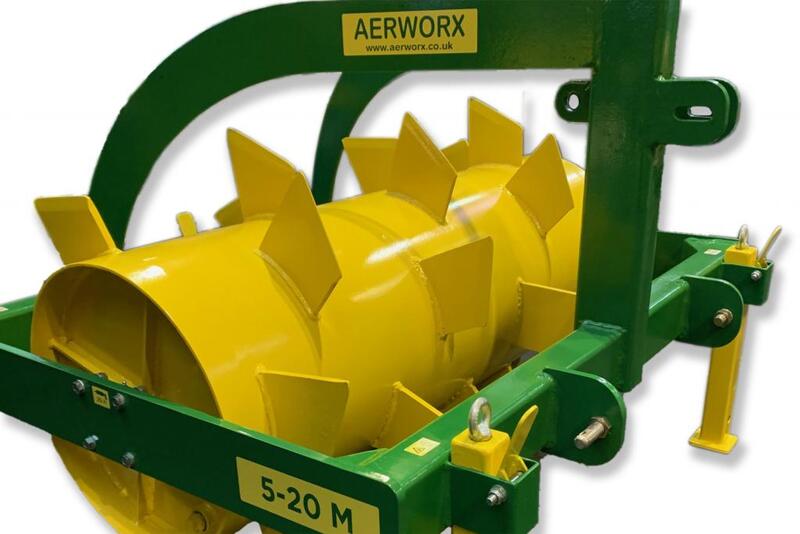
Going thru the same decision making process for the hay field. I decided on a heavy duty subsoiler, tiller or disk and rolling field aerator. I was surprised at the amount of soil break-up between passes with the subsoiler going down 14" or so. I drive over the the first pass so I wind up with about a 18" spread between passes.

I have a hunting buddy that has a custom metal work business, he just bought a $1m laser cutter, he's going to order me some AR 4" wide plate material and cut blades to mimic these, without the knife edge. I already have the propane tank to make the aerator drum out of

full-25419-239258-aerator_a.jpg
 
   / Plowing with LS #9  
I have used my 28 hp tractor to pull a 2 bit plow before and it did fine, but i would not want to do 10 acres. I agree with the chisel plow idea . i dought an 11 shank one for 100 bucks a few yrs ago. Itis to much for my 2538 but raising 4 shanksdid the trick.
 
   / Plowing with LS #10  
This might be one of those situations where it might be better to look for a farmer with larger equipment to do the plowing. Hard to justify spending $$ on something that will be used just once but plows can be bought pretty cheaply at auctions these days. As you know from experience, If not done right you can spend more time trying to level a field after plowing than the problem initially if done incorrectly. A large tractor with multiple moldboards is going to give you a much more level field then a smaller tractor ripping at various depths and widths. Those first few runs discing after are brutal from having the smaller sized tires of a compact tractor.
 
   / Plowing with LS #11  
I recently converted a 5-acre plot to a smooth surface for clover using a sprayer, brush hog, disc and a cultimulcher. Sprayed the entire thing, once it was pretty well along, used the brush hog to grind everything down as far as possible, then spent several hours using the disc with multiple passes to break everything up. Then hooked up the cultimulcher and dragged it around until everything was smooth. Worked very well for me. I don't know how much soil you want to move, but perhaps a back blade would help level some of the spots after discing.
 
   / Plowing with LS #12  
I would avoid the plow if you can and I won't use Roundup again with all the crap that is coming out about it. We have a 30 acre pasture that was really bad on our place when bought it. It had been overgrazed for years and then the big drought was really hard on it. I shredded close a couple of times (eroded away a set of blades just cutting down the giant ant hills that were everywhere) and let everything rot on the ground and then used a medium duty 12' disc and tied the 10' cultimulcher behind it. After about 4 passes it smoothed out pretty nice and left enough vegetation to hold the soil together when it rained. I then used a conservation seeder and planted a nice winter cover mix with a lot of legumes and vetch and clover. After shredding it down the next spring after everything flowered out (the mix had grown to about 3' tall and was full of bees and other beneficial insects) the old coastal bermuda came back very nicely and looked like a hay field. Got busy with the new building so cut it very late this year but I think it should make some good hay later this month if we get one more rain.
 
   / Plowing with LS #13  
I have not seen the field in question so I have no idea of why plowing is desired.
Steep ground that gets plowed will erode from rains,
stony ground that gets plowed will have a lot of rocks on the surface.

My preference would be to brush hod it close to the ground,
let it green back up then spray with "Roundup" wait a few days and go in with a no-till drill
and seed in the grasses you want to grow and possible a cover crop such as rye.
Many locations the county extension services will have no-till drills available.
If the ground is very steep you might consider having a farmer come in with a bigger tractor and no till drill,
also have the soil analyzed to see what is needed for fertilizer to be applied,
this needs to be done regardless of the process done.
 
   / Plowing with LS
  • Thread Starter
#14  
Thank you all for the responses! :thumbsup:

A few things:

I do not plan on spraying glyphosate on this field. In my opinion, that is over used and not necessary in this situation. I do use glyphosate in certain applications, but not for this.

I desire to plow the field mostly because that is what I know. Turn the soil over, to put the vegetation into the ground to decompose and feed the soil, while loosening the hard pan and bringing new soil to the surface. In the Palouse (google it if you don't know what that is) I managed a dry land wheat farm for several years. Every fall, we plowed all the fields, cultivated them once, again in the spring just before seeding. The row crop fields where I grew up in the Columbia Basin got plowed about every 2-4 years depending on what we were growing. Someone mentioned plowing a hillside will increase erosion. Yes, absolutely! If not done properly. Again, google the Palouse to see the types of fields I have plowed. You typically plow uphill, as in, the moldboard puts the dirt on the uphill side of the plow, never downhill, unless you simply cannot make that happen. Over the course of cultivating and erosion, the soil will 'fall' back to its original position. And this field will likely get plowed this one time and probably never again for a few decades. So, not really a concern.

In my opinion, plowing is like hitting the reset button.

I do understand that there maybe better, faster, more effective ways. I have run chisel plows, disks harrows, etc without plowing, and it works. But never seems to work as well as a plow. But, I am open to these types of suggestions!

Also, hiring a farmer to do the initial plowing. Fantastic idea! I could advertise this locally and see what comes up (or the land owner could), and we may indeed go that route. But there is something I also left out of my original post: I do have plans for the implements after I am done with this field. Those plans include using a plow. ;) So, if I need a plow for my own uses, why not use it on this land too? Yes, it will take some time to get it done, but then I will have a plow!

About the only implement I would need to acquire for this project that I do NOT have another use for is a finish mower, like a batwing 15ft, cut low and fast mower. I simply dont have another use for it, yet. The only implement I currently own for mowing is my POS rotary mower, which sucks at cutting grass. I could, for my uses, get and use a fail mower with Y blades. I could then use that to mow this grass, but that would take a long time to mow as well.

I would need to acquire just about all the implements to do this job. Yeah, expensive! But I do have uses for them in the future. Except for the batwing finish mower. That is still undecided.

My initial questions were about pulling a plow with a compact 45hp tractor with R4 filled tires over rough terrain and a steep hillside. What plow to use? I am convinced that the 2 bottom, spring trip plow would be best for me. Any recommendations?

In detail, this is what I am planning on this field:
-Get the backhoe out there and make the creek drain a bit better. Currently there are some low areas that turn to mud sink holes. This may include the addition of drain tile. TBD
-Mow, using the rotary mower as close to the surface as I can.
-Plow the field
-Disk the field pulling a cultipacker (ring packer, roller, etc) to smooth the field in preparation for seeding. This will likely happen a few times in different directions.
-Take soil sample for nutrients for fertilizer application
-broadcast spread a mix of grass seed and fertilizer, pulling a cultipacker behind the spreader to push the seed into the seed bed.
-Once established, mow on regular basis.
-fertilize and spray for weeds on a regular basis if required.

Time frame to get this done: TBD. We are in no rush to even start. This could happen this fall, or 3 years from now. The sooner the better. But I do always plan on either plowing in spring or early fall.

The process is not complicated. About the only complicated aspect is knowing what my tractor can do with the tilling. So far, as far as tilling goes, my tractor has only run the rototiller on small plots. It does it very well, but not practical in this situation. If I had a larger tractor, like I have run before, this would not be a thread.

Someone once mentioned that people (I assume like myself) buy these little sub-compact/compact tractors and try to do big boy farming with them, end up hurting their tractors, biting off more than they can chew, and making mistakes. I agree. This tractor probably is not ideal for pulling tillage equipment though the ground. And when I bought my tractor, I never thought I would use it for such an application. Hence why I need to purchase these implements. But here I am.
 
   / Plowing with LS #15  
I say go for it. You have enough hp and close to enough traction for a 2x14" plow (no bigger). CUTs don't have as much traction as their heavier AG cousins, but I suspect you can do this. It would help if you could add a wheel weight for your non-furrow wheel. Make one with bolts and concrete if you have to. My only question is, why not use a drag harrow after discing. They smooth things out nicely.

 
   / Plowing with LS
  • Thread Starter
#16  
My only question is, why not use a drag harrow after discing. They smooth things out nicely.

Because I never considered it. :laughing:
But I am now. :thumbsup:

Thanks for the encouragement!
 
   / Plowing with LS #17  
 
   / Plowing with LS #18  
Good video with explanation. Coulters needed to go ~ 2" to the left and the 3rd link still needed more extension as the front was digging deeper still.
 
   / Plowing with LS #19  
A little more on a drag harrow. There is the traditional spike tooth drag and the chain harrow. They don't take much power to pull, so you can pull it right behind your disc, or gang two together side by side (and even attach a third behind) to give you a wider working width. You can use a 2" well pie or a 2x8 as your "drawbar" to connect them together.

You can usually find these drags on Craigslist. Sometimes, you can find good deals on a pony drag, or a cart drag which is multiple drag sections on wheeled transport. We used to drag perpendicular or diagonally to the grooves left by the disc, and it left a really smooooth surface.
 
   / Plowing with LS #20  
I'm in the same field as y'all, I'm looking at picking up a subsoiler. Now how close do you run the next pass on a single subsoiler?
 

Tractor & Equipment Auctions

UNUSED AGT SSPOC HYD LOG GRABBER (A52706)
UNUSED AGT SSPOC...
2004 DCT PUMP TRAILER (A58216)
2004 DCT PUMP...
Toyota 8BPU15 3,000 LB Electric Forklift (A59228)
Toyota 8BPU15...
500 BBL FRAC TANK (A58214)
500 BBL FRAC TANK...
2019 KOMATSU D65WX-18 CRAWLER DOZER (A60429)
2019 KOMATSU...
2014 JOHN DEERE  544K WHEEL LOADER (A58214)
2014 JOHN DEERE...
 
Top