Pole barn reinforcement

   / Pole barn reinforcement #1  

scrimshaw33

Bronze Member
Joined
Sep 30, 2009
Messages
81
Tractor
JD 4520 w/ cab and FEL
I'm making a very large pole barn out of hand hewn white oak beams (100 years old from four tobacco barns I salvaged) that are very heavy, probably 700 lbs each or more (?). They are 20 foot long on average. I've already got all the posts set 4 foot in ground with dirt tamped, but after a heavy rain and some wind the poles still are moving laterally even with reinforcement from 2x6 girts. I don't have the roof trusses up yet. One thing I haven't done that I'm going to do is place a cross base at each corner and perhaps place a cross member between each post.

For the post holes I placed a 6 inch pad of concrete slab at base, and again I tamped hole with dirt around post.

My question is, would I rot the post if I dug around each post individually about 2 foot down and placed concrete to reinforce the posts, or is this just not necessary and is the lateral movement normal without the trusses? I would really feel more comfortable with the concrete around the posts but have read differing accounts as to whether it will rot the posts or not.

I've also considered using cables run from the corners inward to meet in the middle of each wall, separately down to a anchor. Any other ideas?
 
   / Pole barn reinforcement #2  
6" sounds a little light on the footing for the size of post you are describing. Local codes required thicker footings under my posts. The girts should keep the side walls from racking, but you'll need diagonal (knee) bracing to keep the posts plumb. During the construction phase,temporary ones are usually nailed to the posts at one end and anchored to the ground at the other prior to the backfill. Once the framing is assembled they can be removed before the siding goes on, assuming the framing is done right.
 
   / Pole barn reinforcement
  • Thread Starter
#3  
I do have temporary bracing up and with it, the structure doesn't budge, but still considering whether or not concrete will possibly cause any issues underground rotting post if poured around it, that's my main question.
 
   / Pole barn reinforcement #4  
Scrimshaw-

I built pole barns for a living in another life...

A 6" pad sounds pretty substantial to me....but your codes, if any, may require more...some settlement is going to occur, even in the most substantially consolidated subsoils, so dealing with some amount of settling is going to be part of your future unless you are lucky enough to plant your poles on top of bedrock...an advantage of a soil backfill is: in the future, if the need arrises, you can jack up a low point, dig out a footing and pour additional concrete under the pole as a shim...

Until your building is sheeted, the unconsolidated soil around the poles, even tho thoroughly tamped, will still be soft enough to allow some motion of the poles...expect it...be ready to deal with it by having a couple of good come-alongs and some slings around to straighten things up when you sheet.

Do not put concrete around your poles...you will hold water in contact with the wood, accelerating rot, and you will create a 'stress riser' between the wood and concrete at the top of the concrete column, concentrating the bending forces that wind racking with put on the pole, rather than allowing them to be distributed down the full length of the pole.

Keep your temp bracing in place till you sheet....then get rid of it....you should not need much in the way of permanent diagonal bracing in a fully enclosed structure....straighten your poles as you sheet the structure...pull your temp bracing and even the fasteners out of nearby girts and rafters if you have to allow you to plumb the poles and walls and then re-install the structural members as you go...refasten any re-worked structural members with, and add tek screws to the existing structural members as you go...the screws are far more resistent to withdrawl forces than even the most agressive pole barn nails....then, your siding should be more than enough to provide the lateral support to withstand racking forces...

Cables are not a good idea, even in an open structure that requires serious wind-bracing....I would always use a minimum of 2x6 lumber screwed and thru-bolted to the poles and girders for wind-bracing...the old man who taught me how to build used to say..."If you need bracing, you may as well go BIG..."

Hope this helps...how about some pictures?

BE SAFE OUT THERE....

Terry
 
   / Pole barn reinforcement #5  
If you set oak posts in the ground,they will rot no matter what you do.
 
   / Pole barn reinforcement
  • Thread Starter
#6  
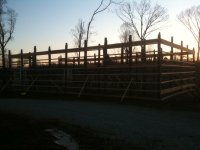
Photo of barn I took this morning:

photo (5).JPG
 
   / Pole barn reinforcement
  • Thread Starter
#7  
Thanks Terry, very good information. I've got it stabilized now with support from the outside and inside which you can see from the pics which like you said I'll remove as I need to when adding trusses and finishing outside. I'm glad to know that it should stabilize as I go. The 2x6's are a great idea. I have 20 foot 8 inch cedar poles called tier poles from the tobacco barns and also might use those. They are solid and I have over 50 of them. These of course I'd use for the cross members at the corners.

Is there any reason I should use the cross members along the walls as well in addition to just the corners?

And, any reason to sheet the outside with plywood/OSB first for extra strength vs just sheeting with the metal?

Scrimshaw-

I built pole barns for a living in another life...

A 6" pad sounds pretty substantial to me....but your codes, if any, may require more...some settlement is going to occur, even in the most substantially consolidated subsoils, so dealing with some amount of settling is going to be part of your future unless you are lucky enough to plant your poles on top of bedrock...an advantage of a soil backfill is: in the future, if the need arrises, you can jack up a low point, dig out a footing and pour additional concrete under the pole as a shim...

Until your building is sheeted, the unconsolidated soil around the poles, even tho thoroughly tamped, will still be soft enough to allow some motion of the poles...expect it...be ready to deal with it by having a couple of good come-alongs and some slings around to straighten things up when you sheet.

Do not put concrete around your poles...you will hold water in contact with the wood, accelerating rot, and you will create a 'stress riser' between the wood and concrete at the top of the concrete column, concentrating the bending forces that wind racking with put on the pole, rather than allowing them to be distributed down the full length of the pole.

Keep your temp bracing in place till you sheet....then get rid of it....you should not need much in the way of permanent diagonal bracing in a fully enclosed structure....straighten your poles as you sheet the structure...pull your temp bracing and even the fasteners out of nearby girts and rafters if you have to allow you to plumb the poles and walls and then re-install the structural members as you go...refasten any re-worked structural members with, and add tek screws to the existing structural members as you go...the screws are far more resistent to withdrawl forces than even the most agressive pole barn nails....then, your siding should be more than enough to provide the lateral support to withstand racking forces...

Cables are not a good idea, even in an open structure that requires serious wind-bracing....I would always use a minimum of 2x6 lumber screwed and thru-bolted to the poles and girders for wind-bracing...the old man who taught me how to build used to say..."If you need bracing, you may as well go BIG..."

Hope this helps...how about some pictures?

BE SAFE OUT THERE....

Terry
 
   / Pole barn reinforcement
  • Thread Starter
#8  
I sure hope not Barry. Maybe you're right though. I researched all I could and talked to many local farmers and they said white oak was rot resistant. I know the beams are white oak as they all had some bark left on them, which I stripped off before setting. I also researched online and most pole barns and timber frame barns that are old were made out of white oak due to its rot and insect resistance. Even ships were made from white oak. These beams are also 100 years old so they are dry as heck...not to mention they've been dried from tobacco smoke from years of use.

But please correct me if I'm wrong, at least I know what I'm getting into if I am. That was a concern initially but then the more I researched I thought I was OK. I also planned on using something like Timbor and other wood preservative products by drilling holes at the base, when I'm done and inserting the chemicals to ward off rot. Currently all the beams are solid through and through.

I do know red oak is not rot resistant but again white oak is supposed to be. Also the wood is all heart wood as opposed to a newly cut white oak where the sap wood is still intact.

If you set oak posts in the ground,they will rot no matter what you do.
 
   / Pole barn reinforcement #9  
White oak is real good for siding,but it rots in the ground.Every old tobacco barn I've seen,slowly sinks into the ground.It might last for 20 years??? at least pour some insect killer around each post. My barn was white oak,and I had to jack up the posts,pour a pad,and scab together the end with treated wood,before I set them on concrete. The outer posts were the worst,but even the center(real dry) ones were rotten and eaten up with grubbs and termites.
 
   / Pole barn reinforcement
  • Thread Starter
#10  
Bummer...did you use anything like Timbor or Boric acid to prevent rot Barry? The tobacco barn beams were placed horizontal on rock foundation...I believe they are built a lot different here than in KY. The tobacco barns there are built looking like barns from what I've seen where ours in NC are almost like cabins. Anyway, doesn't matter here in this situation other than that my logs don't have rot in them (now;)).

I guess you're saying that worst case if I notice rot in 10 years or more, I can put foundation under them and cut off the rotted part?


White oak is real good for siding,but it rots in the ground.Every old tobacco barn I've seen,slowly sinks into the ground.It might last for 20 years??? at least pour some insect killer around each post. My barn was white oak,and I had to jack up the posts,pour a pad,and scab together the end with treated wood,before I set them on concrete. The outer posts were the worst,but even the center(real dry) ones were rotten and eaten up with grubbs and termites.
 
   / Pole barn reinforcement #11  
Here in KY,everyone just set them in the ground,and at the time,there was no such thing as treated,unless you could find creosote. They might last a lifetime if you use a preservative ?? The big barns I grew up seeing in Ohio,were all built on rock foundations.The rare New tobacco barns use treated posts,and a few were set on footers here.All the old ones had to be fixed,or are falling down.
Worst case,it can be fixed,but I would treat them with something.
 
   / Pole barn reinforcement #12  
Thanks Terry, very good information. I've got it stabilized now with support from the outside and inside which you can see from the pics which like you said I'll remove as I need to when adding trusses and finishing outside. I'm glad to know that it should stabilize as I go. The 2x6's are a great idea. I have 20 foot 8 inch cedar poles called tier poles from the tobacco barns and also might use those. They are solid and I have over 50 of them. These of course I'd use for the cross members at the corners.

Is there any reason I should use the cross members along the walls as well in addition to just the corners?

And, any reason to sheet the outside with plywood/OSB first for extra strength vs just sheeting with the metal?

I just got a good look at the photo...NICE WORK, young Padawan...I wish I had such a wonderful source of salvaged materials..! Fine wood and history....all in one...

Cross Members - Heavier thickness steel sheeting often does not need this embellishment AND you can put it in AFTER you install the steel, if you feel the wall is not flat enough....

I am not sure how to properly utilize the round stock...but an additional 2x6 nailed perpendicularly to the top of a few equally spaced girts is known as a "strongback"...this will help flatten your walls and provide a bit more resistance to deflection of the steel in high winds...a good idea if you are using shallow rib (the old fashioned corrugated), thin material or salvaged materials for sheeting.

Run a stringline down your wall or just eyeball it and see how far out your girts have warped...a good straight strongback will flatten some pretty messy girts...screw the ends of the strongback to the girt and you can even shim if needed to flatten the run...about 4' between strongbacks is a lot of reinforcement...

Plywood Underlayment
- One of the WORST things you can do is lay untreated plywood or OSB under your steel....condensation will invariably form between the materials, and your plywood will rot out in no time at all, leaving the steel unsupported....attach your steel directly to the structure with a good quality neoprene washer screw...be SURE to use the right screw for wood, one sporting an aggressive woodscrew thread...the expense of locating self-tapping wood screws is a waste....most of the folks I see building long-houses like chicken sheds just whack the butt of their screwgun to get things going...

On more demanding work, where a "doily" of scratches from a bad start would have to be touched up with paint, use chalklines to line up the fasteners and make pilot holes for every fastener...I put a point on a 1/8" pin punch and tap it into the steel for a starter hole...even self tappers need at least a dimple to get a start in if you don't want the occasional doily...

Wood Treatments - OH MY...I just read about your untreated oak poles...WELL...treated IS better....no question there...but salvaged materials are the BEST...

....listen to the old fartz in your area...and count how many tobacco sheds built with such poles are still standing and HOW OLD they are before you get all in a lather...

"Timbor" is a wonderful product, but you wanted to treat the post with that before embedment...HOWEVER...and alternative utilizes one of the main ingredients of Timbor...borates...and good old laundry borax is an excellent source...

Borates are a human and animal safe wood treatment that can be applied at any time, is resistant to insects and microorganisms and is considered relatively neutral environmentally...."google" it...boron in the form of borate salts is quite common...think "Death Valley" and dry lakes here...

Using the biggest stainless steel cauldron you can find, mix the borax (with a wood paddle) into almost boiling water until no more will dissolve...while the mix cools, dig a shallow trench around the soil-line of your test pole to contain the solution....your objective is to slowly saturate the soil around the pole... then pour the borax mix slowly around the pole...several gallons each is required...depending on how porous your soil is, the liquid will saturate "X" amount of dirt as it percolates down....treat one pole and then, after a day of drying time, dig a post hole down the side of your test-pole and see how far you got...repeat as needed...

The borax will remain in the soil for a very long time, and you can even bury some granular product in the ditch you dug at the top if you like...rainwater will perc down thru it and replenish the "treatment" in the top few inches at least...the borax will come out of solution and remain in the soil for as long as you might care to have a pole barn...

The main caveat to the use of this potion is...it kills all vegetation and will continue to do so for DECADES...so be careful of where you put it...

I have used this method to treat existing wood products in sheds fences and houses and use the laundry powder as a chemical "death strip" around the slabs of several houses down here in termite / ant / roach country...no grass will grow along the slab...keeping any termite tunnels easily visible...and no ants have attempted to tunnel thru the treated soil...

The powdered borax also goes into our cabinets, puffed along the corners and edges with an old ketchup bottle...and goes into the wall cavities during repairs or additions...with all the roaches around our neighborhood, the only time we see any of the small German variety is when we bring them in in cardboard or paper grocery packaging...and even the large ones, AKA "palmetto bugs", die within days of entering the house...

For such large building as yours, you may want to get your borax from a commercial laundry supply in drums...purchasing it by-the-box from Wallyworld can get a bit pricey...

Anyway...you are a natural builder, Brother...so like the man said...."Keep Calm and Carry On"...

...I say...

BE CAREFUL OUT THERE...

Terry
 
   / Pole barn reinforcement
  • Thread Starter
#13  
Very, very helpful...thanks so much for taking time to respond.
 
   / Pole barn reinforcement #14  
Very, very helpful...thanks so much for taking time to respond.

Oh no problem Buddy...

I have had so many brilliant mentors over the years....some real giants....and they all gave so freely with the sole requirement that I pass on the skill to someone else...

Go and do Good Work...more pics!!!!!!

T
 
   / Pole barn reinforcement #15  
Terry & Barry beat me to the point on the un-treated white oak poles/posts. be sure to use treated T&G Skirt boards the 1.5" thick by 8" is best for skirting around a pole barn at the soil level. these need to be ground contact rated. Eventually these skirt boards will be also supporting some of the barn weight as the pole footers sink as weight is added and time settles it which is why I like the 8" over the 6" ones. I also added several extra skirt boards on mine so the wood/metal sheeting is up higher away from ground level. I later added more dirt slope to shed water away better so my siding (T1-11) is 6" up away from ground. The Grasses are on the siding on mine so I SHOULD have gone one or two more skirt boards higher...

Terrys post above about mixing 20-mule-team borax is a good one. I simply poured it out of the boxes around all my Treated Poles as additional insect repellant & around all the cracks in the concrete.. I think I went thru about 10~12 boxes (about half box per pole) as it was back filled and tamped. a year or so later I went thru 5 or 6 more boxes simply pouring it out around the outside. this was maybe 6 or 7 years ago and grass grows fine there. maybe I didnt have enough? on mine to kill the grass. I Love the idea of Mixing it with Water until no more will dissolve in solution. It could then be sprayed and poured onto the poles & actually absorb into the Oak better. The SOONER the BETTER in your case as the wood is in ground and getting WET. Get the solution to actually enter the wood pores is best.

The White Oak WILL ROT it does take longer than 80% of the other wood. Tobacco juices/smokes might HELP keep the rot away, then again some Bugs/Bacteria my just LOVE it more now? If you still had it out of the ground I would tell you to treat it and or burn the in ground contact wood prior to burying it.

Old timers would start a REAL HOT fire & build up a bunch of coals. they would then stick the fence posts and poles into the fire but end. this would char/burn the surface at which time they would pull it out and douse it with creosote mixture. the combination would treat the post/pole for many decades against rot/bugs.

In the pic it all appeared OK other than at the far end you left the top 2x12's headers out, I'm assuming a garage door will be there. this will let both of those Corner Poles move, (IN or OUT) not good. the headers should be solid all 4 sides and a garage door opening should be below those tied together headers. Get those installed and you should have very little movement after those are installed...

I wish you luck...

Mark
 
   / Pole barn reinforcement
  • Thread Starter
#16  
Thanks again guys; I did only use nails for the girts. Should I go back in and screw everything in as well at each joint? Also for the headers, are lag screws OK or do I need to use lag bolts? Good tip on the skirtboard. I'll stick another 8" treated board above the current one.

As far as siding...I was going to use the metal, but do like the T1-11 look better. Any recommendations from past experience between the two?

The truss company recommended for my 40 ft. wide trusses placing them every 3 feet. I thought that seemed overkill, but wasn't sure. They said they didn't have any such thing as ag or pole barn trusses just residential or commercial so they recommended residential trusses every 3 ft. I'm zoned ag so my county doesn't require a permit which is part of the reason I'm asking the questions as I'm sure some are wondering.

Terry & Barry beat me to the point on the un-treated white oak poles/posts. be sure to use treated T&G Skirt boards the 1.5" thick by 8" is best for skirting around a pole barn at the soil level. these need to be ground contact rated. Eventually these skirt boards will be also supporting some of the barn weight as the pole footers sink as weight is added and time settles it which is why I like the 8" over the 6" ones. I also added several extra skirt boards on mine so the wood/metal sheeting is up higher away from ground level. I later added more dirt slope to shed water away better so my siding (T1-11) is 6" up away from ground. The Grasses are on the siding on mine so I SHOULD have gone one or two more skirt boards higher...

Terrys post above about mixing 20-mule-team borax is a good one. I simply poured it out of the boxes around all my Treated Poles as additional insect repellant & around all the cracks in the concrete.. I think I went thru about 10~12 boxes (about half box per pole) as it was back filled and tamped. a year or so later I went thru 5 or 6 more boxes simply pouring it out around the outside. this was maybe 6 or 7 years ago and grass grows fine there. maybe I didnt have enough? on mine to kill the grass. I Love the idea of Mixing it with Water until no more will dissolve in solution. It could then be sprayed and poured onto the poles & actually absorb into the Oak better. The SOONER the BETTER in your case as the wood is in ground and getting WET. Get the solution to actually enter the wood pores is best.

The White Oak WILL ROT it does take longer than 80% of the other wood. Tobacco juices/smokes might HELP keep the rot away, then again some Bugs/Bacteria my just LOVE it more now? If you still had it out of the ground I would tell you to treat it and or burn the in ground contact wood prior to burying it.

Old timers would start a REAL HOT fire & build up a bunch of coals. they would then stick the fence posts and poles into the fire but end. this would char/burn the surface at which time they would pull it out and douse it with creosote mixture. the combination would treat the post/pole for many decades against rot/bugs.

In the pic it all appeared OK other than at the far end you left the top 2x12's headers out, I'm assuming a garage door will be there. this will let both of those Corner Poles move, (IN or OUT) not good. the headers should be solid all 4 sides and a garage door opening should be below those tied together headers. Get those installed and you should have very little movement after those are installed...

I wish you luck...

Mark
 
   / Pole barn reinforcement
  • Thread Starter
#17  
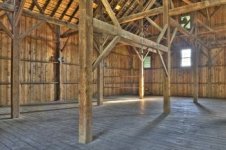
Another question: Here's a picture of the "look" I'm going for on the inside of the barn. I was going to use sheet metal on outside and then white pine on the inside. However, that uses double the material. Can anyone think of any wood or other I can place vertically like on photo to get same look inside and outside (probably would paint outside, stain inside). Would be OK if small gaps b/t wood...but I can't think of anything affordable.
 

Attachments

  • 283423-3246-19.jpg
    283423-3246-19.jpg
    28.6 KB · Views: 4,613
   / Pole barn reinforcement #18  
Thanks again guys; I did only use nails for the girts. Should I go back in and screw everything in as well at each joint? Also for the headers, are lag screws OK or do I need to use lag bolts? Good tip on the skirtboard. I'll stick another 8" treated board above the current one.

As far as siding...I was going to use the metal, but do like the T1-11 look better. Any recommendations from past experience between the two?

The truss company recommended for my 40 ft. wide trusses placing them every 3 feet. I thought that seemed overkill, but wasn't sure. They said they didn't have any such thing as ag or pole barn trusses just residential or commercial so they recommended residential trusses every 3 ft. I'm zoned ag so my county doesn't require a permit which is part of the reason I'm asking the questions as I'm sure some are wondering.

Ah yes...More Questions....Excellent, Young Padawan...the only bad question is the one un-asked...

Screws - Nails are excellent fasteners when used in SHEAR....your fastener engineering assumes that the the forces exerted on the nail are perpendicular to the long axis of the nail (from the side)...the nail has far less strength when the force is acting parallel to the long axis of the nail (acting to pull the nail out of the wood)....thus the use of ring or spiral shank nails to enhance the friction between the wood fibers and increase resistance to withdrawal.

Racking forces applied to your pole building will apply twisting and shearing forces to your connections...no amount of bracing will stop this...and those twisting forces will work nails out of their holes...look at an older pole building and you will see a lot of nailheads standing proud of their original fully embedded position. When nails have been pulled sufficiently from their embedment, the fastener can then bend and failure of the connection can occur.

Screws, especially the latest "tek" screws that have been specifically designed to work in treated lumber, have immensely more contact area between the wood fibers and the fastener, thus immensely more resistance to the racking forces that are trying to pull it out of the wood....the recommended fastening for a 2x6 girt is three, 16d (3.5") pole barn nails, ring shank or spiral shank, hot dip galvanized. Adding just one tek screw will increase both the weight bearing capacity and the resistance to racking for any connection thus treated. If you remove a girt, refasten it with tek screws.

I find myself using more and more tek screws for critical joints....and in the "barn-do-minium" I am building now (I FINALLY get to build one for ME!!!!!) I am using tek screws exclusively for all the critical girder/pole and girt/pole connections. The additional cost of the tek screws, tho substantial, is a tiny percentage of the total cost of the structure....easily justifiable.

The cautionary note here is that "DECK" screws are NOT the same as "tek" screws....deck screws are great in non-critical applications...but they are brittle and will not support the shear weights found in a pole barn...tek screws are designed from the ground up to support the loads and work in the latest generation of treatments...the "AQC" treatment seems to be pretty tough on fasteners...the "star" pattern drive on the screws I am using is SUPERB...I have yet to cam-out a bit and the screws drive into fresh wet poles like I am setting them in butter...one charge on my impact tool lasts all day...or as long as I care to work at least...

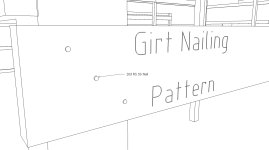
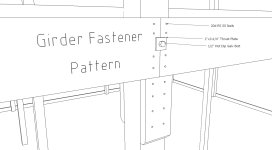
Header - I assume that you mean "girders" here...and that you are nailing your girders directly to the pole face and not "dapping" or notching the tops of the poles to support the load....and my advice is to use tek screws in a one-to-one ratio according to your fastener schedule, and then use a thru-bolt with large "shoulder" washers or plates on either side to resist the racking-withdrawal forces discussed above. A 1/2" hot dip galvanized bolt is plenty....be sure to add extra support below each girder by nailing a block equal in length to twice the width of your girder and screwing it to the pole with roughly the same pattern you attached the girders. I will send you a sketch of the girder fastener diagram for my current project for illustration.

Remember that your fasteners are bearing the weight of the girders, which bear the weight of the trusses, which bear the weight of the roof....all that weight....the shear forces can be enormous...and the only thing holding it all in the air is the shear strength of your fasteners....stronger is better...more is better...

Siding - One of the joys of pole frame building is the versatility....put whatever siding you like on it...I chose steel since there is a huge brushfire danger in my area...google "bastrop texas brushfires" and you'll understand why...I have used steel, T111, board and batten....they can all produce a beautiful finished structure....when you use 4x8 panels, set some blocking to reinforce the seams between the panels...run a full 1x4 from top to bottom and the fill in the gaps with 2x4 blocking...or whatever 2x4 material you have at hand...a little construction adhesive in the joint areas, and a few extras screws along the seams (the cheap ones work well on the paneling) and you will never have to worry about a joint swelling and "smiling" at you...]

Truss Spacing - Trusses are some of the most highly engineered wood products you will ever work with...a careful balance between the forces expected and the cost of the end product....when you give the truss company your dimensions, they will simply look up the correct design in their chart...I would never alter the spacing after-the-fact and NEVER EVER physically alter a truss without consulting with an engineer...

Ag Zoning - Yep....Precious Bride and I are retiring to an "Ag" zone...a mile outside city limits, out in the county, no building codes, no inspectors....the only thing I am bound to have inspected is the installation of my septic tank system....and THAT is done by the installer....a little slice of heaven...

Building out here in the Country (capital "C") is wonderful....

However - I like to caution anyone who cares to listen regarding codes as follows....my old Master Chief Petty Officer used to hold up whichever rule. reg or operational procedure that was the subject of our daily safety meetings and say the following - "Every line in this document was written in somebodies blood...and we WILL show it due respect"

I urge anyone tackling large projects like yours to familiarize yourself with the pertinent codes...ADA, structural, HVAC, plumbing, fuel gas and ESPECIALLY electrical...there are lots of great books available and a little study will pay off later in a safer end product....

Yep...its nice to be out in the Country...when Precious Bride started looking at properties I told her my only requirement was being able to pee off the front or back porch without alarming the Church Ladies...she found us a nice small-hold a mile from her Mom and Dad with a 1200 foot driveway from the main road and about 2000 feet between our house-site and the nearest neighbor on the other three sides...

I like that woman...

T

40x50x10 Wood Frame GIRT FASTENER PATTERN.jpg40x50x10 Wood Frame GIRDER FASTENER PATTERN.jpg
 
   / Pole barn reinforcement #19  
Another question: Here's a picture of the "look" I'm going for on the inside of the barn. I was going to use sheet metal on outside and then white pine on the inside. However, that uses double the material. Can anyone think of any wood or other I can place vertically like on photo to get same look inside and outside (probably would paint outside, stain inside). Would be OK if small gaps b/t wood...but I can't think of anything affordable.

I am all out of sync here! This question arrived while I was answering the last batch...!

So....

Interior Finish - In the Barn-do-minium I am currently building, I am using steel on the exterior and a plywood "beadboard" on the finished interior walls...closets and non-visible dead space etc will be drywalled...

On the exterior walls, just hang untreated 2x6 girts on your poles starting at the slab on 24" centers....you then have a monster cavity to run your utilities and can utilize inexpensive insulation like cellulose or good old cotton-candy (fiberglass) in quantities that will achieve very substantial R-values...your interior finish could be as versatile as the exterior...some nice salvaged tobacco shed board and batten comes to mind...or old corrugated...(I finished a small cabin out at my barn like that...looks pretty nice!)

My interior walls will be standard stick-framing....since I am going to cover all save two poles inside walls, I will frame with 2x6 stock on 24" centers , which will fit neatly between the 6x6 poles...The finish panels will then cover up the poles without a seam...

Since non of your interior walls will be load-bearing...let your inner designer loose and see what happens....

Carry On...

T
 
   / Pole barn reinforcement
  • Thread Starter
#20  
Thanks again Master T. I'll be using all of that information.

How about hardie plank, would that hold up being so heavy? And since I've run my girders horizontal I'd have to do paneling vs. lap siding right?
 

Tractor & Equipment Auctions

2010 CATERPILLAR 303.5C CR EXCAVATOR (A60429)
2010 CATERPILLAR...
HYDRAULIC THUMB FOR MINI EXCAVATOR (A58214)
HYDRAULIC THUMB...
2019 FORD F150 STX CREW CAB TRUCK (A59823)
2019 FORD F150 STX...
205196 (A52706)
205196 (A52706)
2021 CATERPILLAR 926M WHEEL LOADER (A60429)
2021 CATERPILLAR...
500 BBL FRAC TANK (A58214)
500 BBL FRAC TANK...
 
Top