PTO Problems

/ PTO Problems #21  
DHS said:
I had a similar problem couple years ago with my PTO solenoid. I believe the ignition switch, the wire to the switch, or the fuseholder would heat up and dropped the voltage to the PTO solenoid. When the switch got hot the lower voltage would only partially opened the solenoid. I bought a new solenoid from PT but that was not the problem. Rather than replace the switch, I installed a wire with a fuse from the battery post on the starter to the PTO switch. No more PTO solenoid problems. I intended to replace the switch but I have had no problems and it slips my mind.

Try powering the PTO solenoid directly from the battery. Best to use a wire with an inline fuse.

Dale

Dale, Do you still have your PTO switch wired direct? The reason that I am asking, is because I remember something about the PTO switch being wired up in a fail safe mode, otherwise, so one would not start the PT with power applied to the PTO switch , and cause the attachment motor to run as soon as the engine is running.

On my 1445, my PTO output, which is manually activated, and if left in the wrong position, could stall the engine, and cause a pump failure if dead headed, or the hydraulic motor would come on as soon as you start the engine.
 
/ PTO Problems #22  
woodlandfarms said:
The brittleness is so bad that when I straightened my driveline hoses to pull them through the outer shell cracked right off. You could hear everything creaking and groaning. The PTO hoses are no exception. Plan to replace them all once I can get this darn hose undone...
OK that can't be good..:eek:
 
/ PTO Problems #23  
woodlandfarms said:
The brittleness is so bad that when I straightened my driveline hoses to pull them through the outer shell cracked right off. You could hear everything creaking and groaning. The PTO hoses are no exception. Plan to replace them all once I can get this darn hose undone...

You need high temp pressure and suction hoses. They are a little more expensive and more difficult to find, but sounds like what you need. I'll post hose part #'s when I get to my shop. I'm waiting for my daughter to drag her but out of bed.
 
/ PTO Problems #24  
J_J said:
Dale, Do you still have your PTO switch wired direct? The reason that I am asking, is because I remember something about the PTO switch being wired up in a fail safe mode, otherwise, so one would not start the PT with power applied to the PTO switch , and cause the attachment motor to run as soon as the engine is running.

On my 1445, my PTO output, which is manually activated, and if left in the wrong position, could stall the engine, and cause a pump failure if dead headed, or the hydraulic motor would come on as soon as you start the engine.


JJ,

The way I have it wired does not allow the ignition switch to start the tractor with the PTO switch on. It does allow the PTO solenoid to be energized with the ignition switch off if the PTO switch is on. If the PTO switch is accidently left on it could drain the battery. The couple of years since the modification I have never drained the battery. The first time I do, I believe I will change the switch.

However, the problem could be a high resistance connection in the fuse holder or the wiring. Something caused a voltage drop to my PTO solenoid. I believe the additional PTO current flowing accross a higher resistance point causes it to heat and increase the resistance even higher which caused the voltage drop to everything on the downstream side of the high resitance point.

The voltage drop allowed the PTO solenoid to just barely open which allowed the mower to spin very slowly. The same problem existed with my tiller. Since I installed the jumper I have had no problems with the PTO.

You would think a retired guy would have all the time in the world to track down and fix his PT voltage problems. Sometimes it doesn't work out that way.

Dale
 
/ PTO Problems #25  
Wayne County Hose said:
You need high temp pressure and suction hoses. They are a little more expensive and more difficult to find, but sounds like what you need. I'll post hose part #'s when I get to my shop. I'm waiting for my daughter to drag her but out of bed.

Actually, after thinking about it, you would be better off with an oil cooler. High temp hoses would be expensive and would just put a band-aid on the real problem, oil that's too hot.
 
/ PTO Problems
  • Thread Starter
#27  
I don't think heat is the issue. This tractor did not run for at least 3 if not 5 years. In its restoration the hoses initually looked passible but were not.

It is also quite possible that it did run hot at one point (or at many points) as it was used in a professional mowing operation.

Carl
 
/ PTO Problems #28  
woodlandfarms said:
I don't think heat is the issue. This tractor did not run for at least 3 if not 5 years. In its restoration the hoses initually looked passible but were not.

It is also quite possible that it did run hot at one point (or at many points) as it was used in a professional mowing operation.

Carl
Carl,

I bought my 1845 new in May of 2003. The hydro link for the treadle was not yet yet introduced into production. My recollection, based on reports on this site, is that it was introduced the following year--2004. You have reported that your machine has the hydraulic connection for the treadle. That leads me to believe that it was built in 2004 or later.
 
/ PTO Problems
  • Thread Starter
#29  
The hose list I have is dated January 2003.

It would be interesting to get a historical timeline of PT Manufacturing process...

Will ask Terry on Monday as I look into some new bearings...
 
/ PTO Problems #30  
woodlandfarms said:
The hose list I have is dated January 2003.

It would be interesting to get a historical timeline of PT Manufacturing process...

Will ask Terry on Monday as I look into some new bearings...


Carl,

Are you sure there are bearings in the articulating joint. They could be replaceable bushings. They could also be steel against steel, with grease, much like the pin on a backhoe joint. I guess it could be considered a bearing. A tube rolling around a steel pin. Is that a bearing? Maybe. My 1445 bounces and clunks sometimes. It has been is use from the early 90's.
 
/ PTO Problems #31  
Carl,

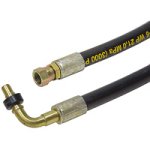
On that hose list did you make up that list? I thought it was unusual that the measurement was just the length of the rubber, and was that the visible rubber. Whenever I have asked the hoseman to build a hose, they take the old hose with fittings and lay it out on a table, and pull out some hose with the fittings laying in the installed position, and then cut the hose, and then crimp.

Andy,

If I asked you for a hose assembly that was 102 in, would you not cut the hose shorter to include the fittings, for a total length of 102 in.
I noticed that some of the fittings cover the ends of the rubber anywhere from 1.5 to 2 in.

On some of the hose assemblies, when you do not have the old hose, and it has a 90 degree bend in the fitting, do you ask the customer if the length is to the middle of the bend or does it include the total bend. My thinking is that the middle of the bend would be the true distance.
 

Attachments

  • p9-6738-AC.jpg
    p9-6738-AC.jpg
    10.8 KB · Views: 140
/ PTO Problems #32  
J_J said:
Andy,

If I asked you for a hose assembly that was 102 in, would you not cut the hose shorter to include the fittings, for a total length of 102 in.
I noticed that some of the fittings cover the ends of the rubber anywhere from 1.5 to 2 in.

On some of the hose assemblies, when you do not have the old hose, and it has a 90 degree bend in the fitting, do you ask the customer if the length is to the middle of the bend or does it include the total bend. My thinking is that the middle of the bend would be the true distance.

Okay, I just happen to know these off the top of my flat head, so I'll give this example.

102" overall length, -8 (1/2") hose, -8 female JIC fittings. Cut-off factor on a Weatherhead crimp fitting for a -8 hose by -8 female JIC is 1.5". So, using 2 crimp fittings, I would cut 99" of hose. Add on the 1.5" of fitting from where the hose ends and the fitting then extends on each end, (1.5" + 1.5"=3") would give the 102"overall length.

There is something on every crimp fitting called a "cut-off factor." This cut-off factor is the measurement from where the hose would end inside the crimp fitting to the end of the fitting. On anything but a straight fitting, the cut-off factor is measured from the center of the fitting opening, no matter what angle the fitting is.

When I make a hose, I measure the overall length. I then subtract the cut-off factor from the o.a.l. Then I cut my hose. I always ask what the hose is off of before I start. On the times when hose length is critical, I place the new assembly next to the old assembly, before crimping of course. I'll make sure the length is correct.

Whenever a hose is listed, it should be in overall length, not the cut or exposed hose length. I hope this is understandable. Any questions, fell free to ask, Andy.
 
/ PTO Problems
  • Thread Starter
#33  
JJ

On the 1850 there are 2 connectors, an upper and lower.. The upper is a long bar with two bolts. The first bolt would be in line with the lower bolt (like the 425 - coming off the back half of the PT) but the this bar goes forward and is bolted say where your feet rest.

It has a Radial Bearing

The bottom section assemble looks just like the 425's. It has a tightenable nut, just the same as the 425.

It also has Ball Bushing and a spacer (along with snap rings to hold it in place).

I do not know how easy replacing these bearing is going to be.

I asked Terry for a parts list for the PT because I have to replace some hoses. I just wanted to be able to pull the replacement through, but I needed lengths. This is what he sent me. Yes, Hand written, And no, i do not know the dealio with the length. But I feel it is just the length of rubber needed to be cut, and then the ends ad to the length (at the top is says rubber Length and PT is very literal)
 
/ PTO Problems #34  
woodlandfarms said:
JJ

On the 1850 there are 2 connectors, an upper and lower.. The upper is a long bar with two bolts. The first bolt would be in line with the lower bolt (like the 425 - coming off the back half of the PT) but the this bar goes forward and is bolted say where your feet rest.

It has a Radial Bearing

The bottom section assemble looks just like the 425's. It has a tightenable nut, just the same as the 425.

It also has Ball Bushing and a spacer (along with snap rings to hold it in place).

I do not know how easy replacing these bearing is going to be.

I asked Terry for a parts list for the PT because I have to replace some hoses. I just wanted to be able to pull the replacement through, but I needed lengths. This is what he sent me. Yes, Hand written, And no, i do not know the dealio with the length. But I feel it is just the length of rubber needed to be cut, and then the ends ad to the length (at the top is says rubber Length and PT is very literal)

Carl, on the hose thing. Did you order your new hoses from that list, or did you take the old hose in for comparison. When you gave them the dimensions, without a hose to compare, did the finish product fit. I remember something about one hose being to short.

In the above post, Andy explained the procedure for cutting and crimping the fittings. His explanation is the way I thought it should work.
 
/ PTO Problems
  • Thread Starter
#35  
I did not have this list when I made up hoses. I just used a string and a tape measurer. Honestly, I am way off... The hoses are a bit short all the way around..

Carl
 
/ PTO Problems
  • Thread Starter
#36  
Well, here is the update....

Unless there is something plugging up my Aluminum block (I feel I have checked it) then my Solenoid is bad.

I have replaced all the hoses (there were rock hard) except for the return lines as I have to drain the tank to do that and they are not under pressure...

So, the solonoid activates, but I don't think it is strong enough to fully activate. That is why I am getting these weird results...

But, I leave for LA tomorrow so this part is going to have to be replaced later....
 
/ PTO Problems #37  
Carl,

A tip that I think Terry suggested was to hook up a shop vaccuum to the oil tank and turn it on. It apparently generates enough suction not to leak much while you change reservoir hoses. I can say that I have tried it.

All the best,

Peter

woodlandfarms said:
Well, here is the update....

Unless there is something plugging up my Aluminum block (I feel I have checked it) then my Solenoid is bad.

I have replaced all the hoses (there were rock hard) except for the return lines as I have to drain the tank to do that and they are not under pressure...

So, the solonoid activates, but I don't think it is strong enough to fully activate. That is why I am getting these weird results...

But, I leave for LA tomorrow so this part is going to have to be replaced later....
 
/ PTO Problems
  • Thread Starter
#38  
WOW. That is a WAY cool idea. I have 3 hoses that are original that have me concerned. All are low pressure but the are hard as a rock (PTO Return from PTO Actuator - PTO Return from Implement - 1" Source hose from tank to filter).
 

Marketplace Items

Brock 60'x26' Flat Bottom Grain Storage Tank (A57148)
Brock 60'x26' Flat...
2025 Safety Basket Forklift Attachment (A59228)
2025 Safety Basket...
2019 Merlo TF 42.7 (A60462)
2019 Merlo TF 42.7...
2013 Ford E-150 Passenger Van (A59230)
2013 Ford E-150...
JCB 2145 (A47477)
JCB 2145 (A47477)
Husqvarna Riding mower (A56857)
Husqvarna Riding...
 
Top