PTO rookie - questions about disassembly and greasing

   / PTO rookie - questions about disassembly and greasing #1  

johnsayen

Silver Member
Joined
Jun 24, 2021
Messages
102
Tractor
None
Hi all,

The snowblower (Cyclone) I bought is from a Canadian company (Pronovost) that mostly speaks French and I do not. The PTO drive shaft they used is Italian (Comer industries T60) although if I'm being honest I'm not sure it would matter with regard to my questions as this is my first rear PTO driven implement.

I'm trying to learn about and be diligent with the required grease maintenance and I have a lot of questions I can't figure out how to find answers to.

I attached five pictures and here are my questions.

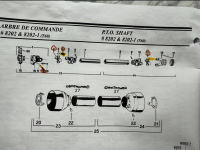
1. For the grease diagram what exactly is that saying? To me it looks like there are several different drive shafts, is it referencing the outer cover somehow?

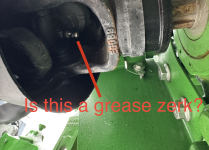
2. On the tractor side of the PTO shaft it looks like there might be a grease fitting on the u-joint but the location requires a 90, it looks slightly oversized so it has me guessing. Do people keep two grease guns around for straights and 90s?

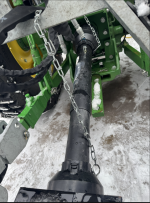
3. Each side of the outer plastic housing looks like it has a grease fitting - is that really what it's for, and why?

4. How do I disassemble this thing, and I am assuming I need to regularly dissasemble to apply the grease to some parts? I included a diagram from the snowblower manual but I'm still very confused.

Thank you
 

Attachments

  • full shaft - disassemble.png
    full shaft - disassemble.png
    2.5 MB · Views: 179
  • grease diagram.png
    grease diagram.png
    373.8 KB · Views: 166
  • plastic housing.png
    plastic housing.png
    2.9 MB · Views: 155
  • pto tractor side.png
    pto tractor side.png
    4.8 MB · Views: 164
  • Screenshot 2025-02-02 at 8.51.40 PM.png
    Screenshot 2025-02-02 at 8.51.40 PM.png
    2.1 MB · Views: 166
   / PTO rookie - questions about disassembly and greasing #2  
1. Basic idea is to grease the splines and their locks on both ends, the crosses on both ends, and then be sure there's some grease between the shield and the shaft assembly. That makes three grease points on each end of the shaft, plus greasing the (usually square) tube slip joint. So, pull the thing off the tractor, pull the two shaft halves apart, grease outside of the "inner" shaft, and slip them back together.

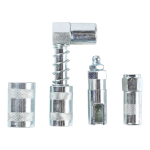
2. The crosses can usually be greased with a straight gun tip, by just knuckling the joint over at 90 degrees. But they do make 90 degree adapters to go on the end of your grease gun, and you should probably have one of these for other purposes, even if not here:

1738565505650.png

3. Yep... you want to be sure that outer guard can spin nice and free on the driveshaft, as that's what'll keep the shaft from sucking you in if it catches your shirt tail, etc.

4. Just pull. It should be a telescoping tube with no stops. Half the time, they fall apart when you don't want them to! :D
 
   / PTO rookie - questions about disassembly and greasing #3  
Good post - Winter Deere. Only thing I would add. Whether you leave the shaft attached to your first PTO implement or completely remove and store it.

Completely cover the shaft with some form towel or sheet. Dust will find that new grease and can make operation( install/removal) difficult.
 
   / PTO rookie - questions about disassembly and greasing
  • Thread Starter
#4  
Thanks to both of you, it sounds like to properly do this greasing I will need to disconnect the drive shaft from both the tractor side and the snowblower gearbox side so that the other guard can slip off and I can separate the drive shafts

I was thinking it might be able to be done by leaving it connected or disconnecting only one side.
 
   / PTO rookie - questions about disassembly and greasing #5  
Just disconnect tractor side and drop the implement off the tractor. I never remove my driveshafts from the implements they’re on, unless I’m doing a repair on them.
 
   / PTO rookie - questions about disassembly and greasing #6  
Pull the shaft out and put it on a bench.
Before you grease it move the shaft in different directions and confirm there is smooth movement of both joints. If the movement hits what I refer to as a clunk, get ready to replace the joint in the future. Wipe off the grease nipples and grease until you see a bit of grease out of the seals.

Check that the two sections of the slide are moving freely, consider adding grease to the slip portion of the slide if there is not smooth motion.

Clean and lubricate both spline shafts with a wire brush at each end of the shaft both inside and outside. just a very light coat of grease. Also see that the retainer is moving freely.

Finally a bit of advice: Be sure when you get an implement that the PTO shaft is the proper length. If for instance you are putting on a rototiller, put the shaft onto the tiller then take the shaft to the tractor (do not connect it). Next (1) shorten the top link to draw the tiller top toward the tractor as far as it can travel. (2) raise the three point as far as it can raise. (3) confirm that the PTO shaft now has good clearance to connect to the tractor. (4) double check clearance at multiple points in the lift. If the shaft is too long and you go to raise it fully, something WILL break as the shaft bottoms out (hopefully the tiller and not the rear of the tractor...). Likely you will not be raising the tiller to the full height when tilling but size the shaft for EVERY possibility.
 
   / PTO rookie - questions about disassembly and greasing #7  
Good information on PTO shaft maintenance and sizing. Just to add to the proper sizing issue, DO NOT assume the shaft on a new implement (or tractor for that matter) is correct from the manufacturer or selling dealer. The potential damage can be very expensive.
Also, if you store the implement outside (even covered) remove the PTO shaft to indoor storage, as well as a slip clutch if equipped (not likely on a blower).
 
   / PTO rookie - questions about disassembly and greasing #8  
Since I completely strip down my PTO shaft to clean and grease - inside storage is simple. I bang and scuff enough knuckles doing it when off. Leaving it on the implement could involve added body parts.
 
   / PTO rookie - questions about disassembly and greasing #9  
If the sliding shaft is square, be sure you mark the position of each shaft before separating. There is a thing called PTO phasing, where the knuckles need to have the same orientation, otherwise there wile be an acceleration and deceleration with each revolution.
 
   / PTO rookie - questions about disassembly and greasing
  • Thread Starter
#10  
Thanks all. I learned a lot here. Thankfully it’s a cylinder shaft not a square.
 
   / PTO rookie - questions about disassembly and greasing #11  
Thanks all. I learned a lot here. Thankfully it’s a cylinder shaft not a square.
I'm unsure what you mean there. The shafts I have are roughly triangular with rounded lobes, one lobe being bigger/flatter than the other two such that the inner and outer will go together in only one orientation. Is that what you mean with a "cylinder" shaft?
 
   / PTO rookie - questions about disassembly and greasing
  • Thread Starter
#12  
Yeah I used the wrong word sorry about that.
 
   / PTO rookie - questions about disassembly and greasing #13  
The shafts I have are roughly triangular with rounded lobes...
All the same? Do you only have one brand of equipment?

Of those I've owned, I think most have probably been rectangular cross-section, but I've also had round with two rolled splines, triangular, and probably some others I can't remember anymore.

1738627420487.png
 
Last edited:
   / PTO rookie - questions about disassembly and greasing #14  
I have five implements, each with it's own PTO shaft, and they're all the same shape - triangular. One implement came with an Italian shaft, however I think the other four shafts are from bareco.com.au.

PTO shaft profile.jpg


The shaft safety covers/sleeves they supply now have a quick release system to allow the cover tubes to be slid away from the yokes, which makes it much easier to reach and press the spring-loaded pin/s when attaching or removing the PTO shaft from the splined shaft of the tractor and/or implement. This style of safety cover release may well be common all over the world, but it sure beats the older fiddly system I had 20 years ago. :)

Bareco safety cover.jpg
 
   / PTO rookie - questions about disassembly and greasing #15  
I wonder if that has more to do with size of implement, or country of origin? Many of my implements were for smaller tractors, my old Deere 750 and 855.
 
   / PTO rookie - questions about disassembly and greasing #16  
Completely cover the shaft with some form towel or sheet
Just a thought: you probably want to take the towel off before operating.
 
   / PTO rookie - questions about disassembly and greasing #17  
Be leery of using "normal" grease in the sliding sections of the pto shaft, doesn't matter if it's rectangular, lemon shaped or tri lobe, or any other style that has been used for the last 80-100 years. Greased shafts and cold weather do not agree, I have seen well greased shafts that could not be separated by normal effort. Many of the various chain lube or graphite products will do the job and allow the shaft to be scoped in and out with normal force.
 
   / PTO rookie - questions about disassembly and greasing #18  
"Normal" grease is generally NLGI-2. But you can pick up something like Lubrimatic wheel bearing grease at most auto parts stores, which definitely doesn't thicken and harden nearly as much in cold weather, as what comes out of most grease gun tubes.

"Grease" is really just oil suspended in soaps and binders. Of course oil doesn't freeze in the weather most of us will see, south of Fairbanks, but the soaps and binders will.
 
   / PTO rookie - questions about disassembly and greasing
  • Thread Starter
#19  
Thanks I’ve been using a polyeura good for -15F on the blower and a HD lithium complex 3% moly good for -15F on the tractor and loader.
 
   / PTO rookie - questions about disassembly and greasing #20  
If I recall, at least from the Deere brand of each, is that these two greases are actually compatible. Two of the few you can mix with impunity.


Marketplace Items

BOMAG TRENCH COMPACTOR (A60429)
BOMAG TRENCH...
2019 KUBOTA SVL75-2 SKID STEER (A60429)
2019 KUBOTA...
2013 International WorkStar 7400 4x4 Altec AM650 50ft Material Handling Insulated Bucket Truck (A59230)
2013 International...
2016 Ford F-150 4x4 Crew Cab Pickup Truck (A56858)
2016 Ford F-150...
2019 CATERPILLAR 336 EXCAVATOR (A60429)
2019 CATERPILLAR...
2006 Nissan Frontier Ext. Cab Pickup Truck (A59230)
2006 Nissan...
 
Top