PTO speed question

/ PTO speed question #1  

smfcpacfp

Veteran Member
Joined
Nov 21, 2007
Messages
1,314
Location
Sands Township, Marquette Co, Michigan
Tractor
Kubota B3030HSDC
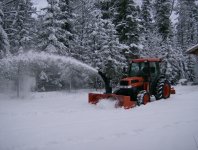
Ok guys be patient because I have only owned my B3030 for about 3 weeks and operated it five times snow blowing, but there is something that isn't crystal clear in the operating manual.

When using a PTO set the hand throttle lever control to the "PTO" setting on the tachometer. To control the tractor running speed, chose the appropriate L M or H gear and use varying pressure on the speed control pedal. When not operating the PTO, I would guess that you don't need to run the engine speed at that that high of an RPM, even if you are driving the tractor. Is this correct?
 
/ PTO speed question #2  
That is correct. I don't even run mine up to the PTO speed when using implements now because I only have about 12 hours on my B3030, I try to keep my RPM's varied from 1,400 to 2,100 or so. There are lots of opinions on break-in but I am trying to go easy for the first 50.
 
/ PTO speed question #3  
As a sweeping generalization;
PTO speed is 540 (or 1,000 - maybe some other special set speed) at the indicated rev for maximum power (force times speed).
Only SOME PTO implements/attachments are really speed sensitive, e.g. generators. Things like tillers and some sprayers may have a maximum PTO speed, but lower speeds are unlikely to harm them. They may be less efficient at say 450 or 400, but won't just quit and turn belly up.

You didn't ask and it may not apply to your particular tractor, but in many cases it is practical to run 540 RPM implements off the 1,000 RPM gear with the engine running at 54% (or so) of the recommended engine RPM.
 
/ PTO speed question #4  
There will be plenty of times when you will be running a PTO impliment, say.... even your snowblower, when you may find it more enjoyable to run it at less than "PTO speed". You may find it blows snow just fine at 3 - 400 rpms less , and is quieter in the cab at that RPM. Or, if you are running a brush chipper on just smaller limbs, you may find that the chipper operates just fine @ 1800rpm. Like anything else, once you've got more hours under you belt........ you'll make adjustments in your operating habits that work better for you.
 
/ PTO speed question
  • Thread Starter
#5  
Thanks for the useful information, guys. I have been running with the snowblower at less than the PTO speed. It is definitely quieter, and we haven't more than 9" of low moisture content snow at any one time, and it just seemed so effortless for the tractor.
 
/ PTO speed question #6  
Another question - isn't it harder on the tractor and more likely to bog the engine down when running an attachment at less than 540 PTO RPM? For instance a tiller, brush hog, chipper all could run just fine at 400 - 450 PTO RPM right up until that one branch or root gets caught up and then you are lugging and bogging the engine. Also at those speeds you are way more likely to lug the engine to the point of shut-down because you are not running at peak power. And all this can happen very quickly and I would assume that this is not good for the tractor? Right? I guess it would come down to the risk factor. Are you willing to take the risk of possibly damaging the tractor to save a few RPM that the diesel engine was designed to run at to begin with. I am not saying that it will do damage the first or even second time, but we all say that bogging and lugging the engine is not good at all and I would think that by running an implement with less RPM than designed to that you are putting the tractor at risk. Thoughts??
 
/ PTO speed question #7  
I do understand that a snowblower on the other hand is way less likely to bind up or bog down unexpenctantly. I was speaking more for tillers, brush hogs, chippers, etc.....
 
/ PTO speed question #8  
I certainly understand your point, but in reality, this could happen at any power setting if you hit an unexpected object with a tiller or brush hog, and the result would be the same. I run enough power so the implement operation does not impact the engine RPM's. As an example, when tilling, lowering the tiller to the lowest point does not cause the engine to bog down when being operated. Certainly, I could hit a root or rock which could cause bogging, but the implements usually have a slip clutch or shear pin to prevent damaging the tractor in the event you hit a solid object. Since I don't run anything that is speed sensitive like a generator, I'm not all that concerned with actual PTO speed. Also, knowing the ground you are working is clear of things like stumps and discarded wire or fencing is always a good idea. Stan

Adam23 said:
Another question - isn't it harder on the tractor and more likely to bog the engine down when running an attachment at less than 540 PTO RPM? For instance a tiller, brush hog, chipper all could run just fine at 400 - 450 PTO RPM right up until that one branch or root gets caught up and then you are lugging and bogging the engine. Also at those speeds you are way more likely to lug the engine to the point of shut-down because you are not running at peak power. And all this can happen very quickly and I would assume that this is not good for the tractor? Right? I guess it would come down to the risk factor. Are you willing to take the risk of possibly damaging the tractor to save a few RPM that the diesel engine was designed to run at to begin with. I am not saying that it will do damage the first or even second time, but we all say that bogging and lugging the engine is not good at all and I would think that by running an implement with less RPM than designed to that you are putting the tractor at risk. Thoughts??
 
/ PTO speed question #9  
It won't hurt the engine to bog. It can only produce a certain amount of torque regardless of the RPM. The torque is limited by the amount of fuel introduced by the injectors. Once the RPM starts to drop even slightly, the governor opens the fuel flow to max where it stays until the engine stops. The greater chance for damage is a sudden stop from a high RPM. The sudden stop such as jamming a rock in a rotating device that doesn't slip or shear a pin will produce a shock load. I use generally use the slowest engine speed that gets the job done. If the grass is short and drought stricken, I mow at 2,500 RPM. If high and thick, 3,300. If you drop the revs back even a little, you'll see the fuel consumption drop drastically.
 
/ PTO speed question #10  
I have a GL4630gstc and have just hit 50 hours. With front mount blower i have been running engine at 1800 to 2000 and blower works fine. Also used these speeds for 3pt log splitter. My father inlaw is old school and says don't rev engine if not required.
 

Attachments

  • gl4630.JPG
    gl4630.JPG
    240.8 KB · Views: 247
/ PTO speed question #11  
While I don't disagree with any of the advice given for operating PTO implements, I believe your actual question was what RPM to run the engine when not using the PTO. I have a B3030 and I generally operate anywhere from idle (about 1100 RPM) to 2100 RPM. Most of the time it is about 1400-1600. The B3030 has so much power for its' size that high RPMs are rarely needed for most jobs. I typically drive around my yard in H range at a little above idle. I plow snow off my 300' driveway with a 6' RB in H at 1600 RPM. When I use the loader for light work I drop down to M. The only time I use L is if I am using the loader to dig dirt or to plow with my 2 bottom Ferguson. I can easily use L to get a full scoop of topsoil off of a pile and then shift to H to idle across the yard to where I want to dump it. I mow lawn at the low side of the orange PTO speed indicator on the tach. I mow in M which is ideal. At full HST pedal in M you are moving right along. If the ground is rough or the grass is wet and tall I will not run at full pedal. As you get more hours on your B3030 you will see what a good tractor it is. I like to use mine at the lowest RPM necessary to get the job done. On the other hand, you could do everything at WOT and the only thing that would suffer would be fuel consumption. The engine is designed to run its' whole life at WOT and last a long, long time. Change the oil regularly, keep the air filter clean and feed it good fuel and it will give you faithful service for many years. Good luck.
 
/ PTO speed question #12  
dutchman56 said:
I have a GL4630gstc and have just hit 50 hours. With front mount blower i have been running engine at 1800 to 2000 and blower works fine. Also used these speeds for 3pt log splitter. My father inlaw is old school and says don't rev engine if not required.

I don't own a tractor (yet) so I'll be the first to admit I don't know what I'm talking about but I was under the impression it is important to keep the rpms up when you have an HST trans for cooling purposes. I know that's what it says on my little hst lawn tractor (even when the engine is not under a load) and I've read on various threads on tbn one of the advantages of a gear trans is you can lower the rpms down and putt-putt down the farm lanes. I'm sure your old school father in law probably had a gear trans. Do you think there's any validity to keeping the rpm up for keeping a hst cool? Does the manual say anything about it? I'm sure 1800-2000 would be considered sufficient rpms though.

Beautiful snow mover you have there!
 

Marketplace Items

VICON ROTOFLOW SPREADER (A63291)
VICON ROTOFLOW...
New/Unused Wolverine 78in Quick Attach Smooth Bucket (A65583)
New/Unused...
INOP/NON-RUNNING 1957 B61 Mack (A65563)
INOP/NON-RUNNING...
Kubota Industrial Turbo Diesel Engine - Tag Missing - Pump Takeout - Approx. 80-85 HP Class (A63689)
Kubota Industrial...
2014 JAYCO JAYFEATHER TRAVEL TRAILER (A65643)
2014 JAYCO...
IRANCH IRGC40 ELECTRIC SCOOTER (A64280)
IRANCH IRGC40...
 
Top