Ballast Question About Tractor Weights

   / Question About Tractor Weights #1  

cooljoe00

Member
Joined
Apr 3, 2016
Messages
32
Location
Nichols, sc
Tractor
Kioti NX6010HST Cab
Okay I been reading through the forums I read a lot about when to use weights and where to put them; but nothing about how much. I was looking to see if there was a general rule like if I am only Font loader lifting thing under 500lbs used 10%(50lbs) rear ballast. Or if I am mowing/grading use X(lbs) front weights. Also I was wondering is it bad to only fill(rim-guard) the rear tires if the tractor is 4wd(AWD) seems like it would be? One other thing if I did fill all tires how bad on fuel would it be if I was just mowing for extended periods of time? Oh and does filling all the tires change how much front/rear ballast is need for these thing?
 
   / Question About Tractor Weights #2  
Okay I been reading through the forums I read a lot about when to use weights and where to put them; but nothing about how much. I was looking to see if there was a general rule like if I am only Font loader lifting thing under 500lbs used 10%(50lbs) rear ballast. Or if I am mowing/grading use X(lbs) front weights. Also I was wondering is it bad to only fill(rim-guard) the rear tires if the tractor is 4wd(AWD) seems like it would be? One other thing if I did fill all tires how bad on fuel would it be if I was just mowing for extended periods of time? Oh and does filling all the tires change how much front/rear ballast is need for these thing?[/QUOTE

Check your owners manual for rear tire ,and 3 point ballast to us use your loader safely.
Nobody is going to give you the specs you want,.to .much to liability;)

Go by the book...be safe, keep everyone out of trouble.:thumbsup:
 
   / Question About Tractor Weights #3  
Most owners manuals will recommend not filling front tires. The FEL will transfer weight from the solid rear axle to the tippy front axle, even an empty FEL. A load will transfer more. The whole point of rear ballast is to transfer that weight back to the rear axle. That will only happen if the weight is behind the rear axle. Loaded tires help with traction and stability, but do not cause that weight transfer backwards.
 
   / Question About Tractor Weights #4  
Will you be operating on slopes fairly often?

I mow with a Land Pride medium duty, 60" RCF2060 Rotary Cutter. Occasionally I drop off the bucket from the FEL when mowing. I never feel the need for additional front end weight when mowing.

My ground is flat. My small tractor is fairly heavy. My small tractor has 4-WD. My tires are filled only with air. For FEL work I use three point ballast only. This works for ME.

If you will be mowing COMMERCIALLY, punctured tires are part of the game. You do not want loaded rear tires and a puncture together.

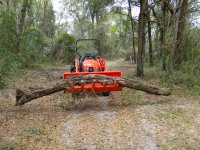
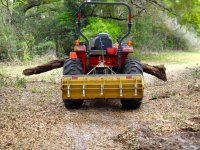
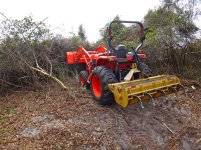
Soggy Water Oak in the photos was around 1,600 pounds. Rollover Box Blade is 630 pounds but CANTILEVERED FAR BACK making greater EFFECTIVE counterbalance. (Maybe 1,000 pounds EFFECTIVE counterbalance?)

Buy enough tractor.
 

Attachments

  • DSC00177.jpg
    DSC00177.jpg
    1.2 MB · Views: 349
  • DSC00178.jpg
    DSC00178.jpg
    1.1 MB · Views: 299
  • DSC00176.jpg
    DSC00176.jpg
    1.2 MB · Views: 358
Last edited:
   / Question About Tractor Weights #5  
Will you be operating on slopes fairly often?

My ground is flat. My small tractor is fairly heavy. I use three point ballast only. My tires are filled only with air. This works for ME.

I mow with a Land Pride medium duty RCF2060 Rotary Cutter. Sometimes I drop the bucket off the FEL when mowing. I never feel the need for additional front end weight when mowing.

And that would work for 90% of all other scenarios too.
 
   / Question About Tractor Weights #6  
Look at your owners manual. Mine gives many good suggestions. First - they recommend not filling the front tires. Second - there is a maximum amount that the 3-point can lift - don't go beyond that. Third - adding ballast(liquid) to the rear tires, only, will not affect the 4WD system negatively. Fourth - the owners manual may recommend, as a starting point, the amount of weight to put on the 3-point.

I'm sure any weight added to the rear tires will decrease your fuel economy marginally. However, the increase in safety - if you need the weight - will more than offset any added fuel used.
 
   / Question About Tractor Weights #7  
Keep in mind the more ballast you have on the rear the more weight your front axle will take.

Say if you can't handle a full bucket so you add ballast to the rear. Now you are putting the extra weight of the load plus the equal weight from the ballast on your front axle. This can add up quick.

I deal with these scenarios on a daily basis and I bet you can guess what it is by my screen name!
 
   / Question About Tractor Weights #8  
Most owners manuals will recommend not filling front tires. ...... That will only happen if the weight is behind the rear axle. Loaded tires help with traction and stability, but do not cause that weight transfer backwards.

Not sure where you came up with this, but it ain't so....I believe any additional weight behind the lateral center of gravity (ie. fulcrum point) will aid in additional ballast....including your butt sitting on top of the rear axel. Fact: weighted rear tires WILL help.
 
   / Question About Tractor Weights #9  
Not sure where you came up with this, but it ain't so....I believe any additional weight behind the lateral center of gravity (ie. fulcrum point) will aid in additional ballast....including your butt sitting on top of the rear axel. Fact: weighted rear tires WILL help.
Weighted rear tires will keep the tires on the ground when lifting heavy loads BUT without some load on the 3 PH, the loaded rear tires would enable more stress to be placed on the front axle when lifting a heavy load.
You said that weight needs to be behind the fulcrum point which is true. Loaded tires are on the fulcrum point which is the rear axle. Weight has to be behind the rear axle for it to start reducing the load on the front wheels. The further the load is extended behind the tractor the more effect is has. A 1000# ballast box is not as effective as a 1000# bush hog which extends 6 feet or more behind the tractor. A ballast box is great for working tight places though and it does reduce the load on the front axle by the amount of weight that the ballast box carries.
 
   / Question About Tractor Weights #10  
Not sure where you came up with this, but it ain't so....I believe any additional weight behind the lateral center of gravity (ie. fulcrum point) will aid in additional ballast....including your butt sitting on top of the rear axel. Fact: weighted rear tires WILL help.

You conveniently omitted my previous statement that the primary goal was transfer weight backwards. And as Gary points out below, loaded tires will not accomplish that.

Weighted rear tires will keep the tires on the ground when lifting heavy loads BUT without some load on the 3 PH, the loaded rear tires would enable more stress to be placed on the front axle when lifting a heavy load.
You said that weight needs to be behind the fulcrum point which is true. Loaded tires are on the fulcrum point which is the rear axle. Weight has to be behind the rear axle for it to start reducing the load on the front wheels. The further the load is extended behind the tractor the more effect is has. A 1000# ballast box is not as effective as a 1000# bush hog which extends 6 feet or more behind the tractor. A ballast box is great for working tight places though and it does reduce the load on the front axle by the amount of weight that the ballast box carries.
 
   / Question About Tractor Weights #11  
Ray, I'm sorry, loaded rear tires have alway moved the transfer weight "backwards"...and you don't ever have to fill the fronts...the traction is what you seek, as well as stability. Again, my tractor with the FEL only weighs about 5 tons or so with the FEL AND loaded rears...I don't need anything behind me to keep the rear end on the ground. Your experience may be different. Again, sorry I tried to help. BobG in VA
 
   / Question About Tractor Weights #12  
Ray, I'm sorry, loaded rear tires have alway moved the transfer weight "backwards"...and you don't ever have to fill the fronts...the traction is what you seek, as well as stability. Again, my tractor with the FEL only weighs about 5 tons or so with the FEL AND loaded rears...I don't need anything behind me to keep the rear end on the ground. Your experience may be different. Again, sorry I tried to help. BobG in VA

The point is that loading rear tires does not *MOVE* any weight backwards. In order to move weight backwards, the result would be LESS weight on the front axle. Loading rear tires does not remove any weight from the front axle, only adding weight behind the rear axle will cause the weight to move to the rear axle. Doesn't matter how big your tractor is, the principle doesn't change.

Keeping the rear wheels on the ground is definitely important. Filled tires will contribute to doing that, and I use them. I was addressing a particular issue though. If your rear tires are heavy enough to keep them on the ground, you have a rare tractor indeed, or relatively light loads (compared to the tractor's weight). Most guys on these forums seem to use both loaded tires and 3ph ballast. Both have advantages and application.

No blood, no foul. My apologies as well. Context is everything.
 
   / Question About Tractor Weights
  • Thread Starter
#13  
Thank you for the input I finally found a thread that had more information in it. I had posed this question because I haven't bought a tractor yet and was wondering how much weights should I buy to run the attachment I was going to get. I didn't know it was in the owners book, I was trying to find out everything I could before buying. http://www.tractorbynet.com/forums/owning-operating/356084-help-adding-weight.html This was the thread I found that had some discussion on this topic if anyone finds this thread.
 
   / Question About Tractor Weights #14  
I live in a hilly mountains of western NC. My last tractor (MF1529) with the backhoe installed would at times pull the front tires off the ground when taking off on a grade(did just above idle and worse higher the rps was). So I loaded the front tires (rear was also loaded), and flipped them for max width. I only did 50/50 mix of dexcol. But after loading the front tires, it stopped lifting the front tires. At times could tell was lite, but at least didn't lift them into the air.
 
   / Question About Tractor Weights #15  
Thank you for the input I finally found a thread that had more information in it. I had posed this question because I haven't bought a tractor yet and was wondering how much weights should I buy to run the attachment I was going to get. I didn't know it was in the owners book, I was trying to find out everything I could before buying. http://www.tractorbynet.com/forums/owning-operating/356084-help-adding-weight.html This was the thread I found that had some discussion on this topic if anyone finds this thread.
Since you are in SC you will be able to use plain water for ballast. This will let you experiment and give you full freedom and convenience since you no longer have to manage the fluid - just fill from garden hose/drain on ground. A fill valve from TSC will make filling convenient. Rim guard is expensive, requires special equipment to manage, and youre stuck with it.

,,,, Here in VA, I use water in the 16.9 X 30 tubeless AGs on the Mahindra 7520. I fill the tires to somewhere in the 90% range - near 100 Gal/tire. The tractor seems to ride better than if they were empty. We are about as far north as plain water can be feasible.
 

Tractor & Equipment Auctions

2023 Bobcat E60 (A53317)
2023 Bobcat E60...
Club Car Utility Cart (A55851)
Club Car Utility...
2001 FORD F-350 XL SUPER DUTY FLATBED TRUCK (A60430)
2001 FORD F-350 XL...
Toyota 8BPU15 3,000 LB Electric Forklift (A59228)
Toyota 8BPU15...
UNUSED RAYTREE RMPP680 HYD POST POUNDER (A60432)
UNUSED RAYTREE...
CHANDLER 500 BBL FRAC TANK (A58214)
CHANDLER 500 BBL...
 
Top