Question to the firewood gurus

/ Question to the firewood gurus #1  

Bavarian

Platinum Member
Joined
Nov 8, 2015
Messages
671
Location
Winnipeg
Tractor
Massey Ferguson 1759
For about 15 years, I own a 25 ton Speeco wood splitter. From day one, it seemed weak, at least not what I would expect. It did always get the job done but with the constant feeling that it's lacking power.

I couldn't find any technical specs, but let me crush some numbers. Something doesn't add up.
It has a 4" cylinder on it. I did not take it apart to measure, but that's the closest I could guess.
On a YouTube video, a user stated a hydraulic pressure of 3000 Psi. I doubt that number on the two stage pump.

But let's stick with these two numbers.

The cylinder provides an area of 12.56 square inches, at a pressure of 3000 psi, it's pushing at 37.680 lbs.

What does the 25 ton rating relate to?

25 metric tons would equal 55.000 lbs.

Using imperial short tons, it would still be 50.000 lbs.

These numbers are nowhere close to each other. Where do the manufacturers get their numbers?
Am I missing something?
 
/ Question to the firewood gurus #2  
The 22 ton splitters had a 4" cylinder while the 25 ton splitters had a 4.5" cylinder. Do you only have a 22 ton or a 25 ton with a small cylinder on it?

Using your math, a 4.5" cyl would provide 47689 lbs of push.
 
/ Question to the firewood gurus
  • Thread Starter
#3  
The 22 ton splitters had a 4" cylinder while the 25 ton splitters had a 4.5" cylinder. Do you only have a 22 ton or a 25 ton with a small cylinder on it?

Using your math, a 4.5" cyl would provide 47689 lbs of push.
4.5" M A Y B E overall outside diameter on a hot day with low air pressure.
But even then, I'd end up with 42.390.
 
/ Question to the firewood gurus
  • Thread Starter
#4  
The 22 ton splitters had a 4" cylinder while the 25 ton splitters had a 4.5" cylinder. Do you only have a 22 ton or a 25 ton with a small cylinder on it?

Using your math, a 4.5" cyl would provide 47689 lbs of push.
It says 25 tons on the side.
 
/ Question to the firewood gurus #5  
My 25 ton Speeco has a 4.5" cylinder. Measure on the rod end to get the inside diameter of the outer tube (cylinder bore). I just checked mine...4.5"
 
Last edited:
/ Question to the firewood gurus #6  
Could the cylinder be metric? 115 mm =4.528 in diameter

If I did the math correctly that is 48,3** lbs at 3000 PSI so 24 tons.

Depending on who made the pump it might go a little higher than 3,000 PSI but suspect it is purely sales since how many people actually check what the force is?
 
/ Question to the firewood gurus #7  
Could the cylinder be metric? 115 mm =4.528 in diameter

If I did the math correctly that is 48,3** lbs at 3000 PSI so 24 tons.

Depending on who made the pump it might go a little higher than 3,000 PSI but suspect it is purely sales since how many people actually check what the force is?
Speeco lists cylinder repair kits in INCH sizes. They have 4", 4.5", 5", kits.
 
/ Question to the firewood gurus #8  
Could the cylinder be metric? 115 mm =4.528 in diameter

If I did the math correctly that is 48,3** lbs at 3000 PSI so 24 tons.

Depending on who made the pump it might go a little higher than 3,000 PSI but suspect it is purely sales since how many people actually check what the force is?
There's no need to check force. Just check pressure at cylinder inlet. Max force is achieved when pump kicks into low gear, which is probably close to 2 GPM on that 11 GPM pump. At 2 GPM, flow rate is low enough that system pressure drop is nearly zero (all 1/2" or larger lines), so it's safe for manufacturer to claim pump bypass pressure as uniform system pressure, under that condition.

22 tons would require 3500 psi on a 4" cylinder, which is indeed above the default/factory bypass pressure on many of these pumps, which usually come pre-set at 3000 psi (19 ton). But there's nothing preventing a given splitter manufacturer from turning the adjuster screw on the bypass check valve up to 3500 PSI, as many have done.

There are several members here who have a pressure gauge on their splitter, it'd be interesting to see what type of max pressure they see on a typical day of splitting. I'm sure everyone has peaked their system out into full bypass on occasion, not that interesting. But what force does it actually take to split 99.5% or 99.8% of all your firewood? That'd be a useful number for many.
 
Last edited:
/ Question to the firewood gurus
  • Thread Starter
#9  
My 25 ton Speeco has a 4.5" cylinder. Measure on the rod end to get the inside diameter of the outer tube (cylinder bore). I just checked mine...4.5"
I got to have a closer look tomorrow.
 
/ Question to the firewood gurus #10  
I got to have a closer look tomorrow.
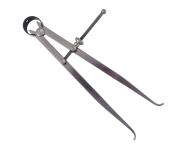
You can usually measure cylinder bore pretty easily at rod end, as the cylinder bore casing extends past the gland a bit. Old-school internal diameter calipers and a ruler or tape measure are the way:

1743633158211.png

If that doesn't work, measure OD by wrapping a seamstress tape around the cylinder, dividing by pi = 3.14159, and then subtracting 2x wall thickness.
 
/ Question to the firewood gurus #11  
I have a 22 ton Huskee which is a rebranded Speeco. When I first got it 12 years ago I put a pressure gauge on it out of curiosity. It has a 4" cylinder and the max pressure is indeed 3500 psi. That yields 22 ton as advertised. I interesting thing is that for probably 80% of the wood I split the pressure doesn't go above 1500 psi - so less than 10 ton.

SplitterPressureGauge.JPG


22_3_30.JPG


gg
 
/ Question to the firewood gurus #12  
I have a 22 ton Huskee which is a rebranded Speeco. When I first got it 12 years ago I put a pressure gauge on it out of curiosity. It has a 4" cylinder and the max pressure is indeed 3500 psi. That yields 22 ton as advertised. I interesting thing is that for probably 80% of the wood I split the pressure doesn't go above 1500 psi - so less than 10 ton.

View attachment 3216293


View attachment 3216294

gg
I have the same splitter. Or more accurately, "had"... it's been heavily modified.

I have my cycle time down around 7 seconds for a full 48" of stroke (24" down + 24" back). That means for the usual 6" to 8" of down-stroke required to split most rounds, I'm around 1 second on the down stroke. I hit the return detent, and try to stop it about a second later, to prevent an unnecessary full-return as I'm lifting the splits off the beam. Very fast operation, for plowing thru up to 14 cords per year, here.

I did add a fluide temperature gauge, as moving fluid at that rate causes some heat, but never got around to adding a pressure gauge. Your 1500 psi number is close to what I expected, though.
 
/ Question to the firewood gurus #13  
Very seldom do I need max push from my 25 ton Speeco. Maybe once a year?
 
/ Question to the firewood gurus #14  
Interesting... Never thought of putting gauge before relief valve, always thought it should be after..... New way of thinking every day..... And Yes I realize the pressure in system can not go above relief valve setting if its function properly....

And yes I split a lot of hard dry oak on a 30 year old DUERR splitter and very really does pump drop into high pressure low volume mode....

splitterpressuregauge-jpg.3216293
 
/ Question to the firewood gurus
  • Thread Starter
#15  
Today I took my caliper with me. Set it at 4.5". In my opinion, that's not a 4.5" cylinder
20250403_094353.jpg
 
/ Question to the firewood gurus #17  
I'm thinking that it is a 4.5" cylinder as it looks like the calipers match the ID of casing. It sure isn't a 4" cylinder. If the OP is having a problem building enough push, maybe there is a problem with the relief valve, cyl seals, valve body, etc??
 
/ Question to the firewood gurus #18  
Mr. Winterdeere, what changes were made to shorten the splitter cycle time?
 
/ Question to the firewood gurus #19  
Mr. Winterdeere, what changes were made to shorten the splitter cycle time?
He either reduced the size of his push cylinder or more than likely increased pump gallonage coupled with a larger engine.
 
/ Question to the firewood gurus #20  
Larger pump, which necessitated larger lines, fittings, valve, and engine. I'm presently max'd out at roughly 19 GPM, driven by an 11 hp Intek. Any larger, and I'd have to cut and weld in a larger suction bung in the reservoir tank, and I'm already really pushing the temperature limit due to the small tank size on this chassis.

I'm still running a 4" cylinder for 22-ton force. I've tried 3.5" machines before (19 ton), but occasionally stall them in a gnarly round, whereas 22 tons has never failed me. As I said earlier, I think it's the sweet spot, if you're aiming for max speed.

I've toyed with the idea of starting over on a new platform, probably one of the 35-ton machines, to get a larger tank and tank fitting size. Some of them already come with pumps as large as 23 GPM, which when mated with a 4" cylinder, would reall rip. But then you run into availability issues with finding a 4" cylinder having 3/4" ports. You're not going to move 23+ GPM thru the 1/2" ports found on most 4" cylinders, without a lot of loss and heat, and unnecessary loading / fuel usage, etc.
 

Marketplace Items

(2) UNUSED 31" X 8 MM EXCAVATOR TRACKS W/ PINS (A60432)
(2) UNUSED 31" X 8...
UNUSED IRANCH 23" GRID SHAPED MINI EXCAVATOR BKT (A60432)
UNUSED IRANCH 23"...
UNUSED FUTURE LUXURY EQUIPMENT SEAT (A60432)
UNUSED FUTURE...
2014 SKYTRAK 10054 TELEHANDLER (A58214)
2014 SKYTRAK 10054...
CABINET OF HOSE ENDS (A58214)
CABINET OF HOSE...
2844 (A58376)
2844 (A58376)
 
Top