Rear wheel width setting vs. Bucket Width

/ Rear wheel width setting vs. Bucket Width #21  
I agree with you on most of this, but wonder about this last point. When you are on a significant side hill I'd think that once the uphill rear comes off the ground enough for the front axle to hit the stop you have likely already lost it. Does anyone know of any actual facts on this?

Terry
Hey, that's my point!:laughing: Isnt this why they took 3 wheeled ATV's off the market. If you are traversing a down hill slope, the wider your rear tires are set the easier it is for the tractor to tip forward on the down hill side. Not trying to start a fight just trying to figure it out..
 
/ Rear wheel width setting vs. Bucket Width #22  
I agree with you on most of this, but wonder about this last point. When you are on a significant side hill I'd think that once the uphill rear comes off the ground enough for the front axle to hit the stop you have likely already lost it. Does anyone know of any actual facts on this?

Terry

I think the actual facts are: "It depends."
"The point of no return comes when the center of gravity of the tractor and load in the bucket goes over the line of rotation which is the line from the outside edge of the rear tire and the outside edge of the front tire on the low side. " is true.
I think there could be situations when the c.o.g. is forward (because of a FEL load) where the front axle 'stops" stop it from going over.
Imagine a situation where the the uphill rear tire (only) drives over a rock or stump at the same time the downhill rear (only) falls into a woodchuck hole on a side hill with a very full FEL load.
 
/ Rear wheel width setting vs. Bucket Width #23  
...of course this is when you've gone way beyond the pucker zone, and are into change your pants territory.
 
/ Rear wheel width setting vs. Bucket Width #24  
I think the actual facts are: "It depends."
....
...Imagine a situation where the the uphill rear tire (only) drives over a rock or stump at the same time the downhill rear (only) falls into a woodchuck hole on a side hill with a very full FEL load.
What your scenario does is increase the angle of the slope the tractor is resting on. If the difference is enough to put the COG past the line of rotation a roll over will occur. If your full load in the loader is held high this point will be reached sooner then if the load was held close to the ground.
Three wheelers got banned because they tip over easily when turned sharp at speed. The same physics apply to tractors and quite a few rollovers happen when turning fast from a road into a drive. Another reason they don't make many tricycle front ends anymore.
 
/ Rear wheel width setting vs. Bucket Width #25  
I was trying to imagine a scenario where cog is "outside" the vertical line of the downhill rear tire, but not front tire, and the "stops" save you.
 
/ Rear wheel width setting vs. Bucket Width #26  
Sure it counts but when you get too wide in the rear you start to create a tricycle. Your front axle is free floating as im sure you are aware. There is a false sense of security by going to far, or so says my simple math book.

Missouri Department of Transportation sometimes contracts mowing along the Interstate Hiway that I travel frequently. The contractors normally have their tractors set as wide as possible.

The only reason I don't have my tractor set wider is because I was taught to keep the inside track of front/back equal for AG use.

As for the tricycle theory. A wide front tractor, mechanically, is a tricycle until the front axle oscillates to the stopper either direction. Then and only then does the wide front increase stability.

A minimal amount of stability can be gained by widening the front tire track width. But mostly what's gained is it minimizes the effect of either front tire falling into a hole because the triangle created between the oscillation point and the contact patch of each tire flattens out.

But again, once the axle oscillates to the stopper, then all equations change and the width of the front track is effecting the stability of the tractor.

This leverage can work against you too. If on a sidehill and the upper front tire rides up on an obstacle far enough to cause the axle to oscillate to the stopper it will have increased leverage to try to tip the tractor over.
 
/ Rear wheel width setting vs. Bucket Width #27  
Thanks, Lots of very smart people hang out here. I aint one of them.
 
/ Rear wheel width setting vs. Bucket Width #28  
Thanks, Lots of very smart people hang out here. I aint one of them.

Ain't no stupid people here. Everyone contributes. :)

I have learned a LOT about rollover conditions from 4wheeling with Jeeps/Buggies. I've been in a dozen or more side flops where I ended up on my side. I've been in three rollovers where I ended up on my top and once back on my wheels. I've been in one tip over backwards falling off an 80' high bluff. I've gained a pretty good feel for looming danger.

I've also honed those skills on my tractor. I started with a B2910 Kubota. I thought it was relatively stable but was affected a lot by uneven terrain.

I then got an L4400 Kubota. I thought it was a lot more stable and less affected by changing conditions. I felt pretty comfortable on it and used it frequently in steep timber terrain.

Then I got my M9540. It is many times more stable than the other two tractors were. I think that's mostly because of it's bigger footprint. It is less affected by changing terrain. The front axle oscillates a long ways. Rarely do I have one tire off the ground because of uneven terrain.

I believe the most important thing to remember is when you have a load on the FEL, all balance of the tractor changes. That's when decisions made concerning slope enters the danger zone!!!! I use a Grapple a lot. It's very common for me to have one rear off the ground. I've grown accustomed to that and am vividly aware of what all four tires are doing.
 
/ Rear wheel width setting vs. Bucket Width #29  
I was trying to imagine a scenario where cog is "outside" the vertical line of the downhill rear tire, but not front tire, and the "stops" save you.

No that's impossible. The line of rotation is from outside edge of rear tire to outside edge of front tire. If the COG is outside that line, stops or not ,she’s going over. If the COG is still inside the line your not going to go over again on the stops or not. What dropping a front tire into a hole on the low side all the way to the stops does is move the COG forward and to the low side by changing the plane the tractor is resting on.
It's the plane the tractor is resting on that matters not the shape of the ground between the wheels. Of course all the ground gets its turn as you drive over it with first the front axel then the rear so stay out of the chuck holes.
 
/ Rear wheel width setting vs. Bucket Width #31  
No that's impossible. The line of rotation is from outside edge of rear tire to outside edge of front tire. If the COG is outside that line, stops or not ,she’s going over.
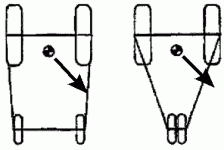
Yes, this is true. What I was trying to convey was a scenario where the cog is towards the front and inside this "front tire to back" (plan view) line, but looking at the cog location from the rear "elevation" view it appears to be outside a vertical line drawn up from the outside of the rear tire (only). That is the horizontal distance between the rear tires is narrower (cause they're tipped) than the wider front. i.e. on the image, imagine the front wheels are the back and vise-versa (cause only the back is tipping) and the cog is effectively located right up next to one of the front tires (in plan view), it would "appear" from a rear "elevation view" to be outside the rear tires. (We are way into the theoretically "could happen" zone here!)

02wv003d.gif

ovrscd: "This leverage can work against you too. If on a sidehill and the upper front tire rides up on an obstacle far enough to cause the axle to oscillate to the stopper it will have increased leverage to try to tip the tractor over." - Good point!
 
/ Rear wheel width setting vs. Bucket Width #32  
Fact is, when you dig into a pile you want the fronts well narrower than the bucket so they don't hamper digging in. Set the fronts for convenience and the rears for stability. My $.02
And don't forget as someone said that the rears may not fit through where the bucket might.
Jim
 
/ Rear wheel width setting vs. Bucket Width #33  
The line of rotation is from outside edge of rear tire to outside edge of front tire.
Actually it's not until the front axle hits the stop. Until then the line of rotation is from the outside edge of the downhill rear tire to the pivot point of the front axle. That's where the rotation happens until the front axle hits the stop. If that weren't the case the uphill front tire would lift before the stop is hit, and of course it doesn't. Once the stop is hit the line of rotation is as you describe.

So, the uphill rear can lift off the ground while both fronts stay put because the line of rotation runs through the pivot point of the front axle. Once the stop is hit, the line of rotation shifts downhill to the downhill front tire, making the tractor more stable, in theory. But the rotation has already shifted the center of gravity down hill somewhat (assuming a load in a low bucket in the FEL isn't counteracting), and is rotating with some momentum. So the shifted CG may now be outside the line of rotation even after it shifts from the pivot point to the downhill front tire, and even if it's not the momentum already gained may carry it over.

Terry
 
/ Rear wheel width setting vs. Bucket Width #34  
Actually it's not until the front axle hits the stop. Until then the line of rotation is from the outside edge of the downhill rear tire to the pivot point of the front axle. That's where the rotation happens until the front axle hits the stop. If that weren't the case the uphill front tire would lift before the stop is hit, and of course it doesn't. Once the stop is hit the line of rotation is as you describe.

So, the uphill rear can lift off the ground while both fronts stay put because the line of rotation runs through the pivot point of the front axle. Once the stop is hit, the line of rotation shifts downhill to the downhill front tire, making the tractor more stable, in theory. But the rotation has already shifted the center of gravity down hill somewhat (assuming a load in a low bucket in the FEL isn't counteracting), and is rotating with some momentum. So the shifted CG may now be outside the line of rotation even after it shifts from the pivot point to the downhill front tire, and even if it's not the momentum already gained may carry it over.

Terry

Well stated. That's been my point thru this discussion. A wide front tractor is no different than a tricycle until the front axle oscillates to the "stop". Then the formula changes and it's more stable.

The diagram posted above is inaccurate because of this.
 
/ Rear wheel width setting vs. Bucket Width #36  
Fact is, when you dig into a pile you want the fronts well narrower than the bucket so they don't hamper digging in. Set the fronts for convenience and the rears for stability. My $.02
And don't forget as someone said that the rears may not fit through where the bucket might.
Jim
I'm not following you here. Would not the bucket get full long before the fronts got to the pile? As to the rears fitting into the path made by the bucket: I ran a four foot wide bucket for years on a seven foot wide rear tread tractor. No problem at all taking a bucket on the left then a bucket on the right and working an eight foot wide face.
 
/ Rear wheel width setting vs. Bucket Width #37  
Please don't kill yourself trying to prove me wrong on this.

What?? I didn't know I was on a mission to prove anything??? Thought we were discussing theories??
 
/ Rear wheel width setting vs. Bucket Width #38  
What?? I didn't know I was on a mission to prove anything??? Thought we were discussing theories??

OK I'll try again. The wide front end is Always better, all the time. It averages two points on the ground that are several feet apart so one wheel falling into a hole has only half the effect of a narrow front end dropping into the same hole. Even before it hits the stops the line of rotation runs to the low side tire not the pivot pin. When making a turn the wide front tire is in line with the turning force where it can resist that force in compression instead of being behind it. Think of it as a lever trying to right the tractor as it tips to the side. The narrow front end has a four inch lever arm while the wide front end has perhaps 36 inches That’s a nine to one advantage. And the inside tire has that same lever arm being pushed down on it by the weight of the tire and rim.
 
/ Rear wheel width setting vs. Bucket Width #39  
OK I'll try again. The wide front end is Always better, all the time. It averages two points on the ground that are several feet apart so one wheel falling into a hole has only half the effect of a narrow front end dropping into the same hole. Even before it hits the stops the line of rotation runs to the low side tire not the pivot pin. When making a turn the wide front tire is in line with the turning force where it can resist that force in compression instead of being behind it. Think of it as a lever trying to right the tractor as it tips to the side. The narrow front end has a four inch lever arm while the wide front end has perhaps 36 inches That’s a nine to one advantage. And the inside tire has that same lever arm being pushed down on it by the weight of the tire and rim.

I hear ya. But your theory is just not mathematically correct. On a wide front tractor, until the front axle oscillates to the stops, the balance of the tractor isn't affected by how wide the front tires are set. That only happens when the axle hits the stops.

As for a wide front handling uneven terrain smoother, yes it does, for the reasons you talked about.

With a wide front on a sideslope, when the tractor tips to the point of contacting the oscillation stops, then the width of the front tires comes into play. And will most certainly add stability to the tractor.

Unless, like has been discussed before, the upper side tire rides up on a hump, or the lower side tire falls into a hole big enough to hit the stopper, then the wide front applies the leverage you are talking about and actually contributes to the tractor tipping sideways, downhill.

To prove this theory, load your FEL with as big a load as your tractor will handle on flat ground. Then while on flat ground, drive one front tire off into a ditch deeper than the front axle can oscillate to overcome. As soon as the tire going into the ditch loses contact with the gound the balance of the tractor changes dramatically, and in most cases the opposite rear tire will lift off the ground until the front tire returns to solid footing or the tractor tips over, whichever happens first!!! At this time the lever you talked about comes into play and contributes to the rollover of the tractor.

But don't mistake what I'm saying as being in favor of a tricycle tractor. I'm not. They are inherently dangerous. Not because they will start to tip sideways quicker, but because they have no safety net (wide front) to catch them once they start tipping. :eek: :)
 
/ Rear wheel width setting vs. Bucket Width #40  
Well I tried. :banghead: Consider if you will your wide front tractor parked sideways on a large tilt bed. Nice even plane under all four tires. Now tilt the bed until the tractor is just about to roll. The front axle is still on the same plane as the rear tires and nowhere near the stops. But the tractor is ready to roll because the center of gravity has reached a position in the vertical plane that is determined by the line from the lower rear tire and the lower front tire. If the tractor had a narrow front end it already would have rolled as that plane would be closer to the COG to begin with.
 

Marketplace Items

2024 Kubota M7-174D (Deluxe) 4WD Tractor - 244 Hours (A63118)
2024 Kubota...
2018 CATERPILLAR TL1055D TELESCOPIC FORKLIFT (A62129)
2018 CATERPILLAR...
2022 Belshe WB14 18ft  12000lb Trailer (A64047)
2022 Belshe WB14...
2010 Kenworth T3 Class 7 Flatbed, 4x2, w Tuck-Under Liftgate (A63118)
2010 Kenworth T3...
6500 GAL PLASTIC STORAGE TANK (A63745)
6500 GAL PLASTIC...
2015 FREIGHTLINER CASCADIA 6x4 T/A DAY CAB TRUCK TRACTOR (A59906)
2015 FREIGHTLINER...
 
Top