Repacking/rebuilding a cylinder

/ Repacking/rebuilding a cylinder
  • Thread Starter
#41  
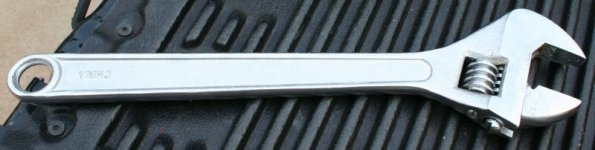
I got the wrench and it worked like a charm. I would guess it took somewhere between 100-150 lbs to get them loose. I didn't use a cheater and I didn't put all my weight on it.

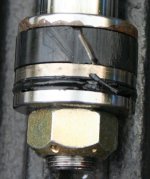
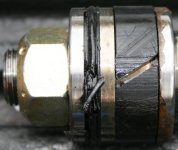
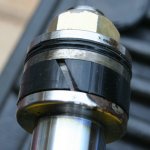
I have the cylinders apart and I'll probably put them back together tomorrow or Saturday. I have attached some pics of the broken seals. It's easy to see what the problem was. I think the small frayed seal in cylinder 2 was what was causing the initial slow leak down and the split larger seals in both cylinders are what happened this past weekend when the bucket would stay up at all.

One question I have is when I removed the caps, it looked like there was either some pipe thread sealer or some sort of Loctite on the threads. I don't have a picture of the cap threads, but the white stuff on the seals in one of the pictures is what I'm talking about. Does anyone know what this is? Do I need to put thread sealer or Loctite on the cap threads when I put it back together?
 

Attachments

  • The magic wrench.jpg
    The magic wrench.jpg
    65.1 KB · Views: 265
  • Cylinder 1a.jpg
    Cylinder 1a.jpg
    135 KB · Views: 289
  • Cylinder 1b.jpg
    Cylinder 1b.jpg
    136.1 KB · Views: 285
  • Cylinder 2a.jpg
    Cylinder 2a.jpg
    166.4 KB · Views: 264
  • Cylinder 2b.jpg
    Cylinder 2b.jpg
    142.5 KB · Views: 264
/ Repacking/rebuilding a cylinder #42  
chanceu said:
I need a 2 1/8" wrench. I've only looked a couple places, but all the open ended 2 1/8" wrenches I've found were around $150.

Try Harbor Freight Tools - from their web site -

* Wrench material: hardened steel
* Pieces: 4
* Size:
SIZE LENGTH WEIGHT
2-1/8'' 24-1/2'' 6 lbs.
2-1/4'' 25'' 6-3/4 lbs.
2-3/8'' 25-1/2'' 8-1/2lbs.
2-1/2'' 26-1/2'' 9-1/2lbs.
* Shipping weight: 35 lbs.


ITEM 1965-0VGA

$62.99
 
/ Repacking/rebuilding a cylinder #43  
chanceu said:
One question I have is when I removed the caps, it looked like there was either some pipe thread sealer or some sort of Loctite on the threads. I don't have a picture of the cap threads, but the white stuff on the seals in one of the pictures is what I'm talking about. Does anyone know what this is? Do I need to put thread sealer or Loctite on the cap threads when I put it back together?

It is probably thread sealant, like THIS, I think I would put some on the threads when I reassembled the cylinders.
 
/ Repacking/rebuilding a cylinder #44  
MJPetersen said:
The last(!) thing - you should be able to pull the rod/piston from the cylinder by hand (slowly). If you can't - be careful when you reach for a compressed air gun to "assist". Don't ask about that :rolleyes:


Kevin, I cannot help but ask how far across the shop the rod and piston shot when you gave it a bit of assist air.:D I really laughed when I read that. Think potato gun with hydraulic cylinder.

I got to thinking of the 50 ton Grove hydraulic cranes that we had to replace the extension boom cylinder seals in. I forget now what the diameter of the largest piston(a telscoping hydraulic cylindar and rod) was (I am thinking 6-8 inches.) We had one stick and then come out rather, huh, forcefully. No real damage to the shop wall though. :eek:

We had to rig a dingle berry brush on a long rod with wooden carrier bearings to hone the thing. We had to replace the packing because they could not take the -50 and colder temps in Prudoe Bay without leaking and that is a no-no in precise work like bridge building when you have men working around the load.

Mike

Well, the full scoop on what happened wasn't that exciting. The cylinders on the backhoe are just under 3" in diameter, and I was aware that 80psi (which is what the reg was set to) would produce a rocket if not done carefully. I was careful - the blower/duster gun on the airhose was a "nice" fit in the JIC fitting on the cylinder. Nice, controlled extension. Beautiful to behold. Top of piston visible, keep going, nice, gentle. Got to the end of the liner in the cylinder and stopped. Naturally, I took the gun out of the fitting :eek: OILBATH!

Hydraulic oil ain't fun stuff to have pressure sprayed on your face. Not a mistake I'll repeat. Not ever. Caused some amusement for the rest of the family, BUT NOT NICE!!

/Kevin
 
/ Repacking/rebuilding a cylinder #45  
chanceu said:
I got the wrench and it worked like a charm. I would guess it took somewhere between 100-150 lbs to get them loose. I didn't use a cheater and I didn't put all my weight on it.

I have the cylinders apart and I'll probably put them back together tomorrow or Saturday. I have attached some pics of the broken seals. It's easy to see what the problem was. I think the small frayed seal in cylinder 2 was what was causing the initial slow leak down and the split larger seals in both cylinders are what happened this past weekend when the bucket would stay up at all.

One question I have is when I removed the caps, it looked like there was either some pipe thread sealer or some sort of Loctite on the threads. I don't have a picture of the cap threads, but the white stuff on the seals in one of the pictures is what I'm talking about. Does anyone know what this is? Do I need to put thread sealer or Loctite on the cap threads when I put it back together?
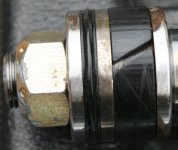
Glad you got it done. Looking at the pics, the seal scuffing is pretty extreme - have you checked for nicks and bumps in the cylinder? The chrome is also spalling and kind-of looks consistent with hitting the cylinder walls. The other possible cause of the destruction could be re-assembly - if there is a sharp ridge at the top of the cylinder. My bigger cylinders had a "liner" which had a very sharp top edge (sharp enough to shave a finger nail). I relieved the lip with a bit of wet-n-dry (and flushed it clear, upside down, with WD-40 after).

One last thing - you can clamp the nut in a vice and put a bar through the clevis end of the rod to unscrew. I found that easier, but my nuts had been welded on and needed some grinding first :mad:

I didn't use any sealant on the threads - the O-ring in the cap does the sealing. Sealer wouldn't hurt, but threadlocker will make you need a bigger bar next time :)

Cheers
/Kevin
 
/ Repacking/rebuilding a cylinder #46  
chanceu
I noticed some rust on top side of piston check the bore of your cyl for damage for any pits in there. Pits will chew up piston seal (which is what you show in picture) maybe some water got in to cyl from bad rod seal (the one in the cap) and caused damage there?

usually there is an o-ring on cap before threads to seal the cap to cylinder I usually put a LITTLE nevercease on threads.

tommu56
 
/ Repacking/rebuilding a cylinder
  • Thread Starter
#47  
I'm pretty sure the scuff marks on the flat rings happened when I pulled them past the threads in the cylinders. I didn't take any precautions to not damage the seals because I am replacing them all. I did peek in the cylinders and didn't see any damage, but I am going to look closer before I put them back together.

I noticed the rust and wondered how something rusted in a bath of oil especially since I haven't operated it in the rain and it is stored inside. My guess is it's from the dealer as I'm sure it sat outiside for weeks if not months before I purchased it.

As I said, I'm going to take a closer look in the cylinders before I put everything back together. I'm also going to hit the rust with a scuff pad just to make sure it isn't causing any damage. I really don't think there is any problems in the cylinders because I know I was doing something I shouldn't have been doing when the initial slow leak down started and I was doing something else I shouldn't have been doing this past weekend when the seals gave way for good.

The first time, I hit a rock going forward with the bucket curled down. There wasn't supposed to be any rocks that big, but lesson learned. This past weekend, I was back dragging with bucket curled down. I know it was wrong, but I also knew I was replacing the seals so I wasn't concerned if I broke an already broken seal.
 
/ Repacking/rebuilding a cylinder #48  
chanceu said:
I'm pretty sure the scuff marks on the flat rings happened when I pulled them past the threads in the cylinders. I didn't take any precautions to not damage the seals because I am replacing them all. I did peek in the cylinders and didn't see any damage, but I am going to look closer before I put them back together.

I noticed the rust and wondered how something rusted in a bath of oil especially since I haven't operated it in the rain and it is stored inside. My guess is it's from the dealer as I'm sure it sat outiside for weeks if not months before I purchased it.

As I said, I'm going to take a closer look in the cylinders before I put everything back together. I'm also going to hit the rust with a scuff pad just to make sure it isn't causing any damage. I really don't think there is any problems in the cylinders because I know I was doing something I shouldn't have been doing when the initial slow leak down started and I was doing something else I shouldn't have been doing this past weekend when the seals gave way for good.

The first time, I hit a rock going forward with the bucket curled down. There wasn't supposed to be any rocks that big, but lesson learned. This past weekend, I was back dragging with bucket curled down. I know it was wrong, but I also knew I was replacing the seals so I wasn't concerned if I broke an already broken seal.

Ok I am confused. I know I have said this before in this post. Why are you so certain you did something wrong that caused this. I know people who do the same thing you describe in land that is very very very rocky. They dont have problems with buckets leaking down on new tractors. I have 50 hours on my montana over half of which is doing exactly what you are describing. I back with my bucket curled down and the front tires lifted off of the ground. If I hit a place where all 4 wheels start spinning I take some pressure off of the bucket. I have not had a problem with mine yet. I know people with other tractors that have been doing that for years with no problems.
 
/ Repacking/rebuilding a cylinder #49  
Hmmm, I looked at the pictures. The thing that is cut at a 45 degree angle is a wear ring that keeps the metal piston from rubbing on the inside of the cylinder. It is split so that it can expand as it wears. All of the sealing is done by the thin stuff down by the nut. Be nice to that when you are putting it together ....

jb
 
/ Repacking/rebuilding a cylinder
  • Thread Starter
#50  
gemini5362 said:
Ok I am confused. I know I have said this before in this post. Why are you so certain you did something wrong that caused this. I know people who do the same thing you describe in land that is very very very rocky. They dont have problems with buckets leaking down on new tractors. I have 50 hours on my montana over half of which is doing exactly what you are describing. I back with my bucket curled down and the front tires lifted off of the ground. If I hit a place where all 4 wheels start spinning I take some pressure off of the bucket. I have not had a problem with mine yet. I know people with other tractors that have been doing that for years with no problems.

For me, it isn't an issue of simply pushing/dragging with the bucket curled down and slowly stopping because I had too big of a bite. In my case, I had the bucket curled down, moving forward at about half a walking pace, and I hit rock that didn't move that almost stopped the tractor. The bucket edge then scraped over the rock and the bucket sprang back the other direction. I'm pretty sure that these small cylinders on small farm loaders aren't built to withstand that sort of shock. After that, the bucket started slowly leaking down.

Of course, I couldn't see inside the cylinder so I can't say for sure that this shock was the direct cause of the problem. It may have been the straw the broke the camels back so to speak. I don't really see anything in the cylinder, but it may be that something in the cylinder is wearing the seals over time which then allows a significant shock to go ahead and break through. Or it may have been any number of other things, but both times I've had this issue with my bucket leaking down, I can point to a single event after which the problem started.

I do have to put some stock in the fact that my owners manual specifically says not to back drag with the bucket curled down. I assume that also applies to pushing forward. I have read several other posts in which people have said their owners manuals for other manufacturers loaders say the same thing.

john_bud said:
Hmmm, I looked at the pictures. The thing that is cut at a 45 degree angle is a wear ring that keeps the metal piston from rubbing on the inside of the cylinder. It is split so that it can expand as it wears. All of the sealing is done by the thin stuff down by the nut. Be nice to that when you are putting it together ....

That may be. I thought is was to much of a coincidence that the splits in both rings were almost identical.
 
/ Repacking/rebuilding a cylinder
  • Thread Starter
#51  
The operation was a complete success. The cylinders did need a little work which surprised me given how long I've had it and that I keep it inside. I used a fine brake cylinder honer to clean the inside of the cylinders and a scuff pad to clean the pistons.

I put the cylinders back on the loader this evening and ran it for a while to get all the air out. When I parked it, I raised the bucket off the ground about an inch and left it. The last time I checked, about an hour after I turned it off, everything was still where I left it.

All in all it wasn't too bad. I have $25 in tools, $27 in seal kits, and several hours of work invested. It's a little more money (assuming the warranty covered it), but a lot less time than it would've taken me to load the tractor, haul it to the dealer, wait two weeks, then pick it up and haul it back. The good news is, I believe now that I've done it once, the next time it happens, I can probably handle the whole operation in less than a couple hours.

BTW john_bud...the rings you said were supposed to be split, the new ones were split too. I didn't notice when I first looked in the package. The only difference was the new rings were split straight across and not at a 45 like the old ones.
 
/ Repacking/rebuilding a cylinder #52  
Glad you got it done and that it's holding.

$52 to rebuild 2 cylinders isn't bad. Had one done and it was $350+... (ouch).

The real good thing is that you now know it was done right and the detail work with the hone done to clean it up. That may not have happened at the dealership.

On the rings - the 45 degree ones are thought to be higher quality. They can't wear a slot in the cylinder like straight split rings can. In 25-30 years you may have a problem (lol!)

jb
 
/ Repacking/rebuilding a cylinder #53  
Congratulations chanceu, you must be chuffed. Not a lot of $$'s to fix the job properly.

And as John_Bud said, you now have the tools and the expertise. I agree about the 45 degree cut packers too. Mine are all that way too.

Assuming you need to do the job over again sometime in the future, how many hours do you reckon it'd take to repack 2 cylinders? Just out of curiousity!

/Kevin
 
/ Repacking/rebuilding a cylinder
  • Thread Starter
#54  
john_bud said:
On the rings - the 45 degree ones are thought to be higher quality. They can't wear a slot in the cylinder like straight split rings can.

I really didn't think about the difference in wear between a straight slot versus a diagonal slot. I wondered about the difference, but they came from New Holland so I figured they knew best. BTW, I was wrong about the price, the seal kits were $16.91 each so my total was just under $60. For that amount and considering this is the second time I've damaged the bucket cylinder seals, I'm going to go ahead and get two more kits so I have them in stock.

KJM said:
Assuming you need to do the job over again sometime in the future, how many hours do you reckon it'd take to repack 2 cylinders? Just out of curiousity!

This time it took 4-6 hours over a week and a half. Some of that time was figuring out how to take off/put on the loader for the first time. The bucket wouldn't stay up at all and I needed to mow. If it happens again, I figure I can do it in two hours or less now that I have the tools and probably wouldn't remove the loader.

Passing on something I learned between removing the first cylinder and the second cylinder is a way to do it mostly mess free. I know some can't do this because of the size of the cylinders, but my cylinders are small enough to easily handle. I removed both hoses and let them drain while I removed the top pin from the cylinder. I attached one end of a small piece of hydraulic hose I had (luckily it had the right fitting) to the bottom cylinder port and put the other end in the drain pan. I then extended the cylinder all the way which pushed all the oil in to the drain pan. After that, I pushed the cylinder back down and replaced the top pin so I could loosen the cap. When I removed the cylinder and the cap, there was only a tablespoon full of oil left in the cylinder.
 

Marketplace Items

KUBOTA ZG23F ZERO TURN LAWN MOWER (A60430)
KUBOTA ZG23F ZERO...
Freightliner Columbia (A61306)
Freightliner...
2022 FORD TRANSIT 250 CARGO VAN (A59905)
2022 FORD TRANSIT...
2006 KAWASAKI BAYOU 250 ATV (A60430)
2006 KAWASAKI...
HYD QUICK ATTACH STUMP GRINDER (A52706)
HYD QUICK ATTACH...
(38) 8" - 11'L X 20" - 34" FLOOR TRUSSES (A60432)
(38) 8" - 11'L X...
 
Top