Replacing another Wheel Motor.

   / Replacing another Wheel Motor. #1  

Barryh

Veteran Member
Joined
Jul 5, 2005
Messages
1,588
Location
Harpers Ferry WV - Mountains of Shannondale
Tractor
Former owner of a P T -180 / Kubota BX-1500 .. A Craftsman Yard Tractor / John Deere 140 H-1 / Cub Cadet 108. And now ( Little Red ) a Power Trac 1425
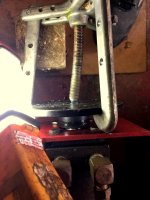
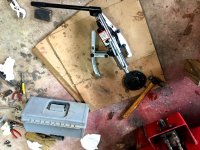
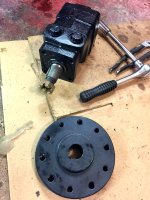
Well was time to replace another Wheel motor on the old girl =1425. The old one was leaking hydraulic fluid just a matter of time before I had a seal blow out. Probably in the middle of a snow storm with my luck. Anyway Getting the hubs off was a lot fun as usual. You can see with my first wheel puller the shaft bent and it still didn't budge the frozen wheel hub even after applying heat...

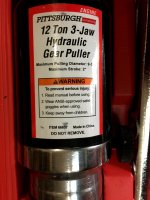
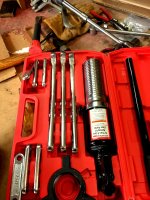
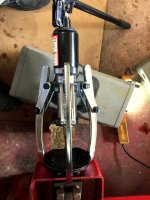
This time I decided to pull out the Big Boy. A 12 ton hydraulic puller.. It bent the old hub in three places before it shot off across the floor like a Rocket... The new one is much thicker .. I always stand to the side and wear shop goggles when doing anything like this. I know if it would have hit my leg it might break a bone or at least put a big indent in the shin ...

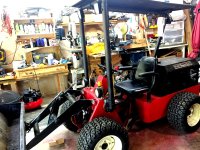
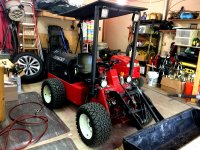
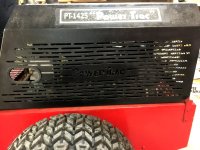
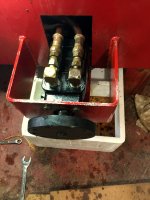
Now to replace the wheel motor and get messy with hydraulic fluid everywhere .. Had some coffee now back to the shop .. New motor installed .. Next take off my all metal gas tank replace the petcock put on new lines and clean out any debris that may have accumulated over the years still loving this old machine the Kohler runs like a top..
 

Attachments

  • IMG_7301.JPG
    IMG_7301.JPG
    189.4 KB · Views: 316
  • IMG_7316.JPG
    IMG_7316.JPG
    175.4 KB · Views: 319
  • IMG_7315.JPG
    IMG_7315.JPG
    243.8 KB · Views: 301
  • IMG_7317.JPG
    IMG_7317.JPG
    225.1 KB · Views: 295
  • IMG_7320.JPG
    IMG_7320.JPG
    252.3 KB · Views: 316
  • IMG_6736.JPG
    IMG_6736.JPG
    272.4 KB · Views: 319
  • IMG_6739.JPG
    IMG_6739.JPG
    282.2 KB · Views: 297
  • IMG_6734.JPG
    IMG_6734.JPG
    221.6 KB · Views: 306
  • IMG_7321.JPG
    IMG_7321.JPG
    230 KB · Views: 300
  • IMG_7322.JPG
    IMG_7322.JPG
    206.4 KB · Views: 298
Last edited:
   / Replacing another Wheel Motor. #2  
Nice going. Did you use PB Blaster or the like on the hub? I have had it work wonders.
 
   / Replacing another Wheel Motor.
  • Thread Starter
#3  
Thanks Bob yes I did.. As you know every little bit helps .. 👍
 
Last edited:
   / Replacing another Wheel Motor.
  • Thread Starter
#4  
Turning the wheel while up on blocks.. I noticed a slight grinding on the opposite side rear wheel motor, which I plan to replace next ., Anyone know if one of these wheel motors can have a good seal but a bad bearing ?
 
Last edited:
   / Replacing another Wheel Motor. #5  
Sadly, yes.

The bad news about a bad bearing in the drive system is that the particles get circulated around the wheel motor hydraulic circuit without filtration.

All the best,

Peter
 
   / Replacing another Wheel Motor. #6  
I think that about 4 gallons a minute is makeup oil which is filtered.
 
   / Replacing another Wheel Motor. #7  
Dear Bob,

That's an interesting number; can I ask where you got it from?

My understanding was that the charge pump kept the low pressure side of the system charged, and that most of the charge pump flow was dumped back to the reservoir, rather than through the pump circuit. I had read that a typical specification for the charge pump was on the order of 10% of total flow, but that most of that was passed through the pump, rather than bleed from the drive circuit. c.f. Danfoss pump design document, where they have some interesting plots on how much the temperature drops with a fluid bypass line from the pump that would divert up to 10% of the total flow. The specification in the document is that the variable volume pump would bleed about 5ml/min from the charge pump. (Yes, ml, i.e. about 4 grams).

Just curious. I still don't know what all of the hoses do on my tractor.

All the best,

Peter

I think that about 4 gallons a minute is makeup oil which is filtered.
 
   / Replacing another Wheel Motor.
  • Thread Starter
#8  
Bob / Pony .. Can either of you elaborate. Is the oil that is circulated in the drive system filtered to some degree. Or do I need to find a way to flush out the contaminated oil after I change out the other wheel motor with the bad bearing . Thanks for your input.. Appreciate it 👍
 
   / Replacing another Wheel Motor. #9  
I will try to find it. Later
 
   / Replacing another Wheel Motor. #10  
The way I understand it is any hydraulic oil that enters the tram circuit is filtered as it leaves the tank, then goes to the charge pump in the tram pump. Anything that leave the tram circuit returns to the tank. So if you're driving along forward, the tram pump is pushing fluid forward, through all of your wheel motors and back to the tram pump. The 400 series wheel motors don't have case drains (that I know of), so all fluid goes through all wheel motors and back around through the tram pump. Anything that leaks past the seals inside the tram pump is where it goes back to the tank from the tram circuit.

So, if a wheel motor tosses chunks of metal internally, they're gonna circulate around inside the motor, back and forth in the wheel circuit(s), and perhaps make their way to the next motor or the pump. To get filtered out, they'd have to pass through the tram pump, into the tank and manage to get picked up in the sucktion for the filter to get back into the tram pump.

As far as I know, the main and aux PTO pump circuits are never filtered.
 
   / Replacing another Wheel Motor. #11  
I could not find the flow rate. It is just something in my memory. Looking at the wheel motor circuit I see that some flow from the variable volume pump goes to the oil cooler. The outlet of the oil cooler then goes to the tank. The charge pump then must pump from the tank into the wheel motor circuit through the hydraulic oil filter to make up what is lost from the wheel circuit through the hydraulic oil cooler. I don稚 know how much flow goes through the oil cooler, but it must be more than a trickle given the size of the hoses and oil cooler tubing. It appears that the charge pump is an integral part of the VVP.

Of course I agree that particles in the wheel circuit could damage the VVP. But they will be filtered out eventually.
 
   / Replacing another Wheel Motor. #12  
That's where I'll disagree... I don't think metal parts from the wheel motors will be filtered out eventually. I think they'll be sloshed back and forth between the next wheel motor and VVP, lodge in the wheel motor case, or the VVP case, and, at best, sink to a corner in the tank if they make it that far.

Of course, fine shavings and such will have a better chance of making it to the tank and eventually the filter. But I'll guess that the main PTO pump will have a better chance of pulling shavings out of the tank and recirculating them than the charge pump would have of getting the shavings through the filter.

So, fine shavings maybe. Large pieces from a failied bearing, probably won't ever make it to the filter. But again, I could be completely incorrect. :) Just guessing.
 
   / Replacing another Wheel Motor. #13  
Since all oil eventually returns to the oil tank (although it is hard to see since flow through the valve bank is on two separate drawings) and the hydraulic oil filter draws from that tank, then all oil is eventually filtered. I hope I have explained this clearly and that I am correct. I have made some assumptions since oil flow through valves and pumps is not shown. However the steering/PTO pump and PTO pump do pull from the oil tank.
 
   / Replacing another Wheel Motor. #14  
I think the heaviest particles may settle to the bottom of the tank. At this point I am guessing. I am not an expert on hydraulics, just an electrical engineer. I certainly understand your points. Any hydraulic experts here? Somebody call Terry at Power Trac.
 
   / Replacing another Wheel Motor.
  • Thread Starter
#15  
The way I understand it is any hydraulic oil that enters the tram circuit is filtered as it leaves the tank, then goes to the charge pump in the tram pump. Anything that leave the tram circuit returns to the tank. So if you're driving along forward, the tram pump is pushing fluid forward, through all of your wheel motors and back to the tram pump. The 400 series wheel motors don't have case drains (that I know of), so all fluid goes through all wheel motors and back around through the tram pump. Anything that leaks past the seals inside the tram pump is where it goes back to the tank from the tram circuit.

So, if a wheel motor tosses chunks of metal internally, they're gonna circulate around inside the motor, back and forth in the wheel circuit(s), and perhaps make their way to the next motor or the pump. To get filtered out, they'd have to pass through the tram pump, into the tank and manage to get picked up in the sucktion for the filter to get back into the tram pump.

As far as I know, the main and aux PTO pump circuits are never filtered.

Moss, My old motors do have case drains.. I have upgraded and replaced two of the old motors for the newer style along with the newer improved hubs.. One right front.. And now the left rear. but still have two of the older style motors in circulation with case drains. Including the one with the bad bearing, I had to cap off the case drain hose's on the newer motors.. How does that change the equation if any ? Thanks to all for reply's so far... Hopefully I have no unseen pump damage seems to running fine at this point.. Really never thought about it before. I'm now starting to get a better understanding of how the system works ..
 
   / Replacing another Wheel Motor. #16  
Bob- I think that you are correct. Some fraction of the oil in the wheel motor circuit flows out of the circuit via the cooler to the tank. The charge pump is responsible for charging the return (suction) side of the variable volume pump.

If you have a look at the first link that I posted above, it has a nice discussion of possible ways to plumb a charge pump. From the drawings, you can get a sense of the diversity of solutions; there are hydraulic systems where the charge pump is a separate pump. That's where the Danfoss calculations come in, second link in my prior post, to compute the necessary charge pump size.

The bit where I am confused is how much of the PT charge pump flow is added to the hydraulic drive system, i.e. how much of hydraulic drive system is diverted to the tank/min, and how much, if any, of the charge pump flow is returned to the tank via a pressure relief or variable volume pump lubrication blow by. That's why I was interested in where you got the 4gpm number, and what it represented. (total flow of the pump, flow into/out of the drive circuit, or just maximum flow)

That was just me being curious. My PT and this forum has taught me pretty much everything I know about hydraulics.

The oil is eventually all filtered through the suction filter on the charge oil pump. In the 425s, the hydraulic tank is 10gal. That means that 40% is filtered every minute, or in about 10 minutes 99% of the oil has been filtered. (to 10 microns) unfiltered oil remaining =(1-.4)**n, where n is the number of minutes (approximately)

Barry-
The case drains on some motors are there to simplify the design of the motor. By intentionally passing oil from the high pressure side through the bearings and by the seals, it is a way to a) cool the motor, b) sweep away dirt penetrating the seal, and c) have mechanically simpler, and lower cost, seals. I don't know that one way is intrinsically better than the other; there are tradeoffs. The volume draining though the case drains should be minimal, in the grand scheme of things. When I worked in food processing, I used to see lots of machines in that had a water flush/drain on the shaft before the motor. It kept food particles from contaminating the bearings, cleaned the seals, and kept oil and grease out of the food. Same idea.

All the best,

Peter
 
   / Replacing another Wheel Motor. #17  
If the hydraulic tank was a long, thin, tube, all of the fluid would be forced through the filter eventually. However, the hydraulic tank is not a tube. It's a cube. With corners, baffles, etc... Fluid flowing into the tank will create uneven currents. Some of the fluid will get filtered more often and some will get filtered less often.

Look at it like the water behind a bridge abutment in a river. Throw your bobber in there, and it doesn't move. The water is calm. The sediments all gather under that spot. That's why the fish are there, to eat the food that falls out of the current there. Then a flood comes along, the current increases, and the sediments might get stirred up. Similar to if we jar our machines around.

And if we're running our PTO, which I'm guessing sucks a LOT more fluid than the tram pump, just by the size of the hoses, most of the fluid will be going into and out of the PTO circuit directly from and to the hydraulic tank. Most of the fluid won't be getting filtered that day.
 
   / Replacing another Wheel Motor. #18  
I think I'd have more faith in magnets in the tank to grab metal particles. Some day, I may do that. But probably not until I'm forced to do a hydraulic oil change.
 
   / Replacing another Wheel Motor. #20  
Look through the hydraulic fluid cap sometime with the engine running. It is really well mixed, or at least mine is.

All the best,

Peter
 

Tractor & Equipment Auctions

2022 New Holland C327 Compact Track Loader (A61306)
2022 New Holland...
Toro hr:2213.5 (A56859)
Toro hr:2213.5...
2024 CATERPILLAR 305 CR EXCAVATOR (A60429)
2024 CATERPILLAR...
UNUSED 1RGC40 HIGH END MINI GOLF CART (A60432)
UNUSED 1RGC40 HIGH...
2015 Ram 1500 Crew Cab Pickup Truck (A59230)
2015 Ram 1500 Crew...
2001 INTERNATIONAL 4900 WATER TRUCK (A58214)
2001 INTERNATIONAL...
 
Top